The Mystery of the Dyatlov Pass Incident Revisited
On the night of February 1, 1959, nine experienced Soviet hikers were camping on the eastern slope of Kholat Syakhl in the northern Urals. During the following weeks, searchers discovered their tent cut open from the inside and the bodies of the hikers scattered down the mountain and in a forested area below, some dressed inadequately for the weather and several suffering severe injuries. The Dyatlov Pass mystery was born from that combination of facts: a disciplined group had apparently abandoned shelter in extreme cold, moved away from their tent, and never returned.
The expedition had been organized by students and graduates of the Ural Polytechnic Institute, and Igor Dyatlov, a 23-year-old engineering student and experienced skier, led the group. There had originally been ten participants, but Yuri Yudin left the expedition before the fatal climb because of illness, leaving nine people to continue toward the Otorten region. The planned journey was difficult but not intended as a suicide mission, and nothing in the surviving record suggests that the hikers expected an extraordinary catastrophe when they established their final camp.
For decades, the tragedy generated an extraordinary range of explanations, from avalanche and extreme weather to military testing, infrasound, criminal attack, unknown animals, secret weapons, and even extraterrestrial intervention. Much of the fascination came from details that seemed mutually incompatible: the hikers were experienced, the tent appeared to have been abandoned abruptly, several victims were badly injured, and some bodies were found far from the campsite. Modern research has narrowed the plausible explanations substantially, but it has not turned every unanswered question into a proven fact.
Nine Experienced Hikers Entered the Northern Urals
The expedition belonged to the culture of Soviet mountaineering and scientific recreation, in which technically skilled young people undertook demanding winter routes in remote regions. The group was not made up of untrained tourists, and several members had extensive experience with skiing, navigation, and winter travel, while Zolotaryov was considerably older than the students and brought additional expedition experience. Their competence is important because many later retellings make the hikers appear almost incapable of making a mistake, when in reality experience reduces risk without eliminating it.
The group photographed itself during the trip, and one of the final known photographs shows members working to prepare a campsite on the snowy slope. The image has become iconic because it captures the expedition shortly before its final night, but it also provides a practical clue: the hikers had cut into the snow on the slope to create a level area for the tent. That apparently mundane decision became central to a scientific explanation proposed more than sixty years later.
The landscape itself was another part of the problem. Kholat Syakhl, whose name is commonly translated from Mansi as “Dead Mountain,” lies in a remote, exposed section of the northern Urals where winter weather can change quickly and strong winds can create dangerous snow conditions. The hikers were operating in an environment in which visibility, temperature, snow structure, and terrain could change independently of one another, creating risks that were not always obvious from the surface.
The Tent Became the First Great Clue

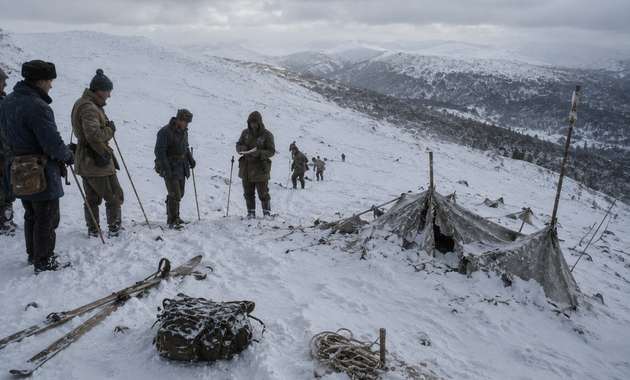
Search teams did not find the group immediately because there was uncertainty about the route and the expected return time. When investigators eventually reached the area, the tent was found on the slope, partially collapsed and covered by snow, with the interior suggesting that the hikers had left quickly rather than packing their belongings and organizing a conventional retreat. The 1959 case materials recorded that the tent had been cut from within and that the traces leading away from the campsite were made by the hikers themselves.
This detail became one of the central mysteries because leaving a tent at night in extreme cold is normally a terrible survival decision. Modern investigators have emphasized that the important question is not simply why anyone would leave a tent, but what perceived threat could have made remaining inside seem even more dangerous. If something had seriously compromised the shelter, the decision could have been rational even if the consequences of leaving were fatal.
The original investigation did not establish that another group had attacked the hikers. Searchers found no reliable evidence of a struggle involving outsiders at the tent, and later summaries of the case file record that investigators found no indication of other people in the immediate area. The Soviet investigation ultimately concluded that the deaths had been caused by an unspecified “compelling natural force,” a deliberately broad conclusion that closed the criminal case without identifying a precise mechanism.
The phrase mattered because it simultaneously excluded the most obvious criminal explanation and preserved the mystery. Investigators had enough evidence to say the deaths were not explained by an ordinary attack, yet not enough confidence to specify the natural event that had driven the hikers from their tent. That gap between a broad conclusion and an absent mechanism allowed later generations to fill the space with increasingly dramatic theories.
What Happened to the Hikers After They Left?
The bodies were found in stages rather than all at once, producing a complicated physical map of the final hours. Four victims with the most severe injuries were found later in a ravine-like area beneath several meters of snow, while others were located closer to the forest and the remains of a fire. The pattern indicates that the group did not simply die in one place, but moved away from the tent and then separated into smaller groups as the night progressed.
The first group appears to have reached the forest and built a fire beneath a cedar tree. Two members died there, while others seem to have attempted to return toward the tent or establish a more sheltered position in the snow, leaving behind an increasingly fragmented trail of survival decisions. The eventual deaths were therefore probably not the result of one instantaneous event killing everyone at the same moment, but of a chain of events in which injury, cold, exhaustion, poor visibility, and deteriorating conditions compounded one another.
Hypothermia was recorded as the principal cause of death for several members, while three deaths were associated with major traumatic injuries. Some victims suffered serious chest trauma or skull injuries, and these wounds became one of the strongest arguments against simplistic explanations such as ordinary exposure alone. The injuries were real and substantial, but their presence does not automatically establish how they were inflicted, which is why the forensic evidence has remained central to every serious reassessment of the case.
The state of the bodies also contributed to the mythology. Two victims were found with missing eyes and another with a missing tongue, details that have repeatedly been presented as evidence of deliberate mutilation, although decomposition, water, snow, and scavenging can alter bodies after death and such findings do not by themselves prove that another person caused them. Researchers studying the incident therefore have to distinguish between observations made during the autopsies and interpretations later attached to those observations.
Why the Original Investigation Remained Unconvincing
The 1959 investigators worked with limited technology, incomplete meteorological data, a remote crime scene that had been exposed to weather, and a rapidly changing snow environment. They also had to interpret injuries without the modern tools available to forensic and snow-science researchers today. Their conclusion that a natural force caused the deaths was therefore understandable as a cautious administrative ending, but it was not a complete scientific explanation of the sequence of events.
Several details seemed difficult to reconcile with an ordinary avalanche. The tent was located on a slope whose average angle appeared relatively shallow, the searchers found no obvious avalanche debris weeks later, and the severe injuries did not resemble the injuries many people associate with avalanche victims. Those objections were powerful enough that avalanche theories remained controversial for decades, even though the basic idea of snow instability had never completely disappeared.
The lack of a clear physical signature was particularly persuasive to critics. Avalanches usually leave recognizable deposits, fractures, or altered snow patterns, and the rescuers who reached the site weeks after the deaths did not report an unmistakable avalanche path directly above the tent. Without such evidence, the simplest avalanche model appeared to demand that investigators ignore one of the most obvious physical clues they would normally expect to find.
That criticism is important because it shows why the avalanche explanation should not be treated as an obvious answer that everyone simply overlooked. A conventional avalanche theory did not fit all the evidence, and any modern version must explain not only the injuries but also the delayed timing, the shallow apparent slope, the missing debris, the cut made for the tent, and the hikers’ subsequent movement. The scientific value of the newer work lies precisely in trying to explain those contradictions rather than pretending they do not exist.
The Russian Government Eventually Returned to the Case
Interest in the tragedy never disappeared, but the case received renewed official attention in the 2010s. The Investigative Committee of the Russian Federation reviewed the case and concluded in 2019 that an avalanche was the most probable explanation, while the Russian Prosecutor General’s Office subsequently conducted its own review and announced in July 2020 that the group had been driven from the tent by an avalanche caused by sharply worsening weather.
The Prosecutor General’s account went further than the old phrase about a “compelling natural force.” According to the announcement, the hikers left the tent because of an avalanche and then struggled to find their shelter again in extremely poor visibility, eventually dying from cold and injuries caused by snow pressure. The investigators also argued that the terrain itself could expose the group to avalanche danger and that the visibility at the time made it difficult to relocate the tent after the hikers moved downslope.
The announcement did not settle the matter for everyone. Families and advocates for the victims disputed aspects of the investigation, and contemporaneous reporting noted that some relatives considered the review incomplete or too narrow because it focused primarily on natural explanations. The official position therefore became stronger than it had been in 1959, but it did not eliminate disagreement among researchers, relatives, or independent investigators.
That distinction is essential when discussing the word “solved.” In July 2020, a Russian prosecution authority announced a final natural-cause explanation, but a scientific hypothesis about how the snow could have behaved is not the same thing as a forensic reconstruction proving every detail beyond reasonable doubt. The modern evidence makes an avalanche or snow-slab event much more plausible than many popular theories, but the historical record still contains uncertainties that justify describing the case as unresolved in some respects.
The Delayed Slab-Avalanche Theory
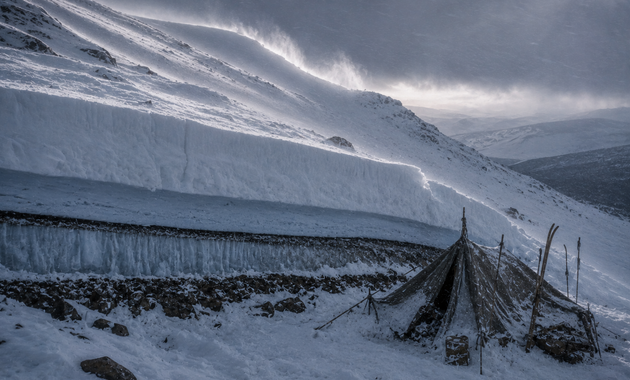
The most influential modern scientific explanation came from avalanche researcher Johan Gaume and geotechnical engineer Alexander Puzrin, whose 2021 paper in Communications Earth & Environment proposed a delayed slab-avalanche mechanism. Their argument was designed specifically to address the classic objections, particularly the relatively shallow average slope and the lack of obvious avalanche evidence when rescuers arrived weeks later.
Their model begins with a crucial detail from the hikers’ own campsite preparation: they cut into the snow slope to create a platform for the tent. The researchers argue that the surface visible to later investigators did not necessarily represent the slope of the buried weak layer beneath the snow, because irregular terrain and subsequent snowfall could smooth the visible surface. Their calculations indicated that a buried weak layer could have been steeper than the average visible slope and therefore more susceptible to failure than the scene initially suggested.
The second part of the mechanism involves wind. Strong katabatic winds moving over the exposed mountain could transport snow and deposit it above the tent, gradually increasing the load on the buried weak layer rather than triggering a collapse immediately after the hikers cut into the slope. In the researchers’ model, the combination of the original cut, local topography, a weak layer, and continuing wind-driven accumulation could delay failure for roughly 7.5 to 13.5 hours, matching the broad forensic estimate for the likely time of death.
That delay is important because it answers one of the strongest objections to the avalanche theory. If the hikers cut the slope several hours before the collapse, there is no reason to expect the avalanche to happen instantly, especially if the snow initially remained cohesive and additional wind-loaded snow accumulated afterward. The theory therefore turns what once looked like a contradiction into a possible sequence: the camp was established safely enough at first, the snowpack changed through the night, and a delayed slab release eventually became dangerous.
The model also addresses the injuries. Gaume and Puzrin simulated a relatively small slab impacting people trapped inside the tent and concluded that the force could produce severe but non-fatal thoracic injuries, with the tent floor and compacted snow effectively restricting the bodies and concentrating the impact. Their paper does not claim that the avalanche explains every injury or every subsequent event, but it demonstrates that a relatively small snow slab can produce trauma much more serious than the public image of a soft avalanche might suggest.
Evidence Found After the Scientific Model
The avalanche model attracted immediate criticism because it relied on reconstructed snow conditions rather than a surviving photograph of the actual snowpack on the night of February 1–2, 1959. Critics questioned whether enough snow was present, whether the wind was strong enough to transport it, whether the slope contained the necessary irregularities, and whether avalanches really occurred in that specific part of the mountain. Those objections were serious enough that the researchers conducted additional fieldwork rather than treating the first model as the end of the investigation.
Follow-up work produced evidence relevant to several of those objections. Researchers reported that Russian scientists’ measurements supported assumptions about snow depth and wind, while a 2021 drone survey produced a high-resolution terrain model showing continuous local slope sections steeper than the broad average suggested by older measurements. The team also noted that the region was classified in a Russian natural-hazards handbook as an avalanche-risk zone, although the available map was too coarse to establish the exact risk at the tent location by itself.
Most strikingly, field expeditions in 2021 and 2022 documented slab avalanches on an eastern slope less than three kilometers from the original tent area. The 2022 observations occurred under some weather conditions similar to those described for the night of the tragedy, including strong winds, low temperatures, and substantial wind-transported snow, and the researchers reported that fresh avalanche traces could disappear rapidly under continuing wind and snowfall.
That evidence does not prove that an identical avalanche happened at the Dyatlov campsite in 1959. The researchers explicitly acknowledged differences between the modern observed avalanches and their reconstruction of the 1959 event, including slope geometry and possible triggering mechanisms. What the field observations do is remove one common objection: the region is not a place where slab avalanches are physically impossible or unknown.
What the Avalanche Theory Still Cannot Explain
A scientifically plausible mechanism is not automatically a complete historical reconstruction. The 2021 paper itself says that its model does not address every controversial element of the case, including the reports of radioactivity on clothing, the precise behavior of the hikers after leaving the tent, the locations and conditions of all the bodies, and other disputed details. Its purpose was narrower: to show that a delayed slab release could physically occur under a realistic combination of snow, terrain, and wind conditions.
This limitation is sometimes lost in simplified retellings. The paper did not establish that an avalanche was observed directly by anyone on the night, nor could it reconstruct the exact snowpack from 1959 with perfect certainty, and it did not demonstrate that every unusual detail followed automatically from the avalanche. The authors themselves described the incident as still a mystery even after presenting their mechanism, which is a stronger statement about the limits of the evidence than many popular summaries suggest.
There is also an important distinction between cause and sequence. Even if a snow-slab event forced the hikers from their tent and caused some of the traumatic injuries, hypothermia and exhaustion could still have become the dominant causes of death after the group moved into the forest. The tragedy may therefore be best understood as a cascade in which one environmental event triggered a series of later survival failures rather than as a single phenomenon that directly killed all nine people.
The later location of the bodies supports that kind of cascading interpretation better than a one-event explanation. People appear to have moved into the trees, started a fire, attempted to create shelter, and in some cases tried to return toward the tent, while the weather continued to deteriorate. A major initial disturbance followed by cold, darkness, injury, disorientation, and exhaustion explains why the final evidence is distributed across several locations instead of being concentrated at one point.
Theories That Have Not Survived the Evidence
The Dyatlov case became famous partly because its unexplained features invited extraordinary theories. Suggestions involving Yeti attacks, deliberate murder by local Mansi people, secret military weapons, nuclear testing, espionage, extraterrestrial activity, or mysterious lights have circulated widely, but serious evidence supporting those claims is weak compared with the physical evidence for severe weather, cold exposure, and snow instability. The original investigation itself found no evidence of an external group killing the hikers, and later scientific work has concentrated increasingly on natural mechanisms.
The Mansi attack theory is particularly important historically because it reflects an early attempt to explain an unfamiliar tragedy by blaming local Indigenous people. Investigators questioned Mansi residents, but the physical evidence did not support a violent confrontation, and no credible pattern of multiple attackers emerged from the scene. Modern accounts should therefore treat that theory as part of the history of the investigation, not as an equally supported explanation of the deaths.
The military-testing theories persist largely because the Soviet Union was secretive and because witness reports of unusual lights were incorporated into later versions of the story. Yet secrecy itself is not evidence that a secret weapon caused the deaths, and the existence of unexplained lights does not establish a connection between those lights and the campsite. Without a demonstrable physical link, these theories remain speculative narratives rather than evidence-based reconstructions.
The same principle applies to the many stories built around radioactivity. Some clothing was reported to contain elevated radioactive traces, but that finding has never established that a nuclear event caused the deaths, and the avalanche researchers explicitly treated radioactivity as one of the issues outside the scope of their model. A responsible account should therefore mention the evidence without transforming it into proof of a hidden military incident.
Why the Case Became a Cultural Mystery
The tragedy became more than a historical investigation because its physical evidence contained unusually powerful narrative elements. A tent cut from inside, abandoned footwear, bodies spread across a snowy mountainside, severe injuries, extreme cold, and the absence of surviving witnesses created a story that seems almost designed for speculation. Each unexplained detail became the foundation for another theory, and the theories accumulated faster than the evidence could eliminate them.
The secrecy of the Soviet state added another layer. The original investigation was not publicly explained in the transparent manner expected of a modern forensic inquiry, and the phrase “compelling natural force” was vague enough to invite suspicion, especially as later generations learned more about Soviet censorship and military secrecy. Yet the existence of secrecy around the case does not demonstrate a cover-up, and the historical record must distinguish between what was concealed by the state and what simply was never known.
The story also belongs to the larger tradition of wilderness mysteries. HiddenFrontiers’ article on the lost Franklin Expedition examines another expedition in which experienced travelers disappeared in a hostile environment and later investigators had to reconstruct events from incomplete physical evidence. The difference is that Franklin’s Arctic mystery unfolded over years and involved ships, written notes, Inuit testimony, and later archaeology, while Dyatlov’s tragedy compressed the uncertainty into a single winter night and left a far smaller documentary trail.
The maritime mystery of the Mary Celeste and its missing crew offers another comparison. In both cases, the central fascination comes from a discrepancy between what investigators expect competent travelers to do and what the evidence shows actually happened, although the Franklin and Mary Celeste stories involve very different environments and historical circumstances. Dyatlov’s case is particularly compelling because the environment itself appears to have become part of the trigger rather than merely the backdrop.
The Soviet context also makes the story superficially resemble other Cold War mysteries, such as the Kyshtym disaster and the village that disappeared from Soviet maps, but the evidence points in different directions. Kyshtym concerns documented state secrecy surrounding a technological disaster, whereas Dyatlov provides no comparable evidence that a hidden military catastrophe caused the deaths. The comparison is useful precisely because it demonstrates why Soviet secrecy should be treated as historical context rather than automatically as an explanation.
What We Actually Know
Several elements of the case are firmly established. Nine members of the expedition died in early February 1959, the tent was found cut from inside, the group had left the campsite on foot, and the bodies were eventually discovered at several locations below the tent. The 1959 investigation found no convincing evidence of an attack by outsiders and concluded that a natural force was responsible, while later official review identified avalanche and severe weather as the most probable explanation.
It is also established that hypothermia played a major role in the deaths and that several victims had serious blunt-force trauma. The evidence does not require a supernatural or criminal explanation to account for the basic pattern, because a combination of environmental exposure and traumatic injury is already supported by the medical record. The unresolved question concerns the mechanism that initiated the disaster and the precise sequence of events after the hikers abandoned their tent.
The delayed slab-avalanche model is the most developed modern natural explanation because it attempts to join several previously contradictory observations into one physical sequence. It explains how a slope that looked relatively shallow could contain a steeper buried weak layer, how the hikers’ cut could alter snow stability, how wind could load the snow hours later, and how a comparatively small slab could cause injuries without leaving a gigantic avalanche path. Follow-up field observations near the site have strengthened the claim that the local terrain and weather can produce slab instability, although they cannot prove the 1959 event happened exactly as modeled.
What Still Remains Uncertain
The most important uncertainty is the exact trigger. The scientific model shows that a delayed slab release is mechanically plausible, but historical conditions cannot be reproduced perfectly because the precise snowpack structure, wind transport, temperature profile, and microscopic properties of the snow on February 1, 1959 are not preserved. The model therefore establishes plausibility rather than forensic certainty.
The hikers’ decisions after leaving the tent are also not fully reconstructable. The official Russian account proposed that poor visibility prevented them from finding the tent again after moving toward the forest, while later scientific discussions describe a sequence in which the group sought shelter and separated as survival became increasingly difficult. Without a surviving witness, every reconstruction of the final hours necessarily combines hard evidence with inference.
Questions about the missing eyes, missing tongue, clothing, radiation traces, and unusual reports of lights remain part of the case’s mythology, but not all of them are equally mysterious once postmortem alteration and environmental exposure are considered. Some details may have ordinary explanations that are simply difficult to prove after so much time, while others may remain permanently ambiguous because the evidence was altered by weather, decomposition, animals, snow movement, and human handling. The responsible position is therefore not to force every anomaly into one grand theory.
This is also why the word “solved” is too blunt. The 2020 Russian review established an official natural-cause conclusion, and modern avalanche science has supplied a credible mechanism that was unavailable to the 1959 investigators, but neither development reconstructs every minute of the night. The strongest position supported by the evidence is that a natural snow and weather event, probably involving slab instability, offers the best current explanation for the initial crisis, while the entire sequence remains incompletely documented.
Why the Dyatlov Pass Mystery Still Endures
The case remains compelling because it sits at the uncomfortable boundary between a solvable physical problem and an incomplete historical record. Science can model snow instability, calculate forces, reconstruct terrain, estimate weather conditions, and compare injury patterns, but it cannot recover a conversation that was never recorded or determine with absolute certainty what nine frightened people thought in the minutes after leaving their tent. The limits of evidence are therefore part of the story rather than signs that science has failed.
The modern research also changes what the mystery means. Instead of asking whether the hikers were killed by something extraordinary, investigators can ask how an apparently safe campsite might become dangerous through an interaction between terrain, human modification of snow, wind deposition, and delayed instability. That question is less sensational than a conspiracy theory, but it is scientifically richer because it can be tested against field observations and known properties of snow.
The tragedy also demonstrates why historical mysteries should not be judged by how many details remain unexplained. A mystery can survive even after its most dramatic questions have been narrowed, because new evidence often replaces one large unknown with several smaller ones. In Dyatlov’s case, the disappearance of nine people once seemed almost incomprehensible, while modern research now offers a plausible environmental chain of events but still cannot establish every decision, injury, and movement with complete certainty.
The most credible explanation today is therefore neither “nothing is known” nor “everything has been solved.” A delayed slab avalanche driven by local terrain and wind is a physically credible explanation and is consistent with the Russian authorities’ later natural-cause conclusion, while the forensic and historical evidence still leaves parts of the sequence uncertain. The mystery endures because the evidence has become strong enough to exclude many extraordinary stories, but not complete enough to eliminate every ordinary question about one of the most haunting wilderness tragedies of the twentieth century.
SOURCES & REFERENCES
Johan Gaume and Alexander M. Puzrin — “Mechanisms of slab avalanche release and impact in the Dyatlov Pass incident in 1959,” Communications Earth & Environment, 2021.
The principal modern scientific study of the delayed slab-avalanche mechanism, including snow physics, terrain, wind loading, timing, and injury modeling.
Nature article
Johan Gaume and Alexander M. Puzrin — “Post-publication careers: follow-up expeditions reveal avalanches at Dyatlov Pass,” Communications Earth & Environment, 2022.
Used for the 2021–2022 field observations, drone terrain mapping, wind and snow evidence, and documented nearby slab avalanches.
Follow-up Nature study
Interfax — “General Prosecutor’s Office finally determines cause of death of Dyatlov group,” July 11, 2020.
Used for the Russian Prosecutor General’s conclusion that an avalanche and severe weather initiated the emergency and that the hikers subsequently died from cold and injuries.
Interfax report
Dyatlov Pass 1959 Criminal Case Archive.
Used for the existence of the 1959 criminal investigation, the campsite inspection, and preserved case-file materials concerning the tent and bodies.
Dyatlov Pass case archive
ETH Zurich — Podcast transcript with Johan Gaume and Alexander Puzrin, 2021.
Used as a supplementary source explaining the development of the modern avalanche hypothesis and the researchers’ interpretation of the physical problem.
ETH Zurich transcript
Piers Paul Read / historical summaries of the 1959 investigation and forensic record.
Used only as contextual secondary evidence; the article relies primarily on the surviving case archive, official reporting, and modern scientific literature rather than later sensational retellings.
Russian Prosecutor General’s Office review reporting, 2019–2020.
Used to distinguish the later official conclusion from the intentionally broad wording of the original 1959 investigation. The contemporary reporting records that the prosecution examined avalanche, snow-slab, and hurricane scenarios before announcing its final natural-cause conclusion.
FAQ
What exactly happened at Dyatlov Pass?
Nine hikers died in the northern Urals during the night of February 1–2, 1959 after leaving their tent under extreme winter conditions. The hikers moved downslope toward the forest, where some built a fire and others later attempted to create shelter or return toward the campsite, but all eventually died from hypothermia and severe injuries. The exact event that forced them out of the tent remains the central historical question, although a delayed snow-slab avalanche is now one of the strongest evidence-based explanations.
Was the tent really cut open from the inside?
The 1959 investigation documented the tent as cut and damaged from within, and the evidence showed that the hikers left the campsite on foot. This has often been portrayed as proof that they fled in panic, but the physical evidence does not reveal precisely what they believed was happening. A sudden threat to the tent, including a snow-slab impact or fear of an imminent collapse, could potentially explain the decision without requiring an attacker or supernatural event.
Did an avalanche actually kill the Dyatlov group?
An avalanche or slab-avalanche event is now the leading natural explanation and was also the cause announced by the Russian Prosecutor General’s Office in 2020. Modern research has proposed a delayed slab mechanism involving the cut made for the tent, a buried weak layer, irregular terrain, and wind-driven snow accumulation, while later fieldwork documented nearby slab avalanches under partly comparable winter conditions. The evidence makes the mechanism plausible, but it does not provide a direct eyewitness confirmation that exactly this event occurred at the tent in 1959.
Why did the avalanche theory seem unlikely for so long?
The original objections were substantial because the visible slope appeared relatively shallow, rescuers found no obvious avalanche debris weeks later, and the injuries did not fit a simplistic image of avalanche fatalities. The 2021 research addressed these problems by proposing that the buried weak layer could have been steeper than the later visible terrain and that wind-driven snow could have created a delayed failure whose traces disappeared rapidly. Follow-up expeditions also documented small slab avalanches nearby that became difficult to detect within a short period because of continued wind and snow transport.
Was the Dyatlov group attacked by the Mansi people?
There is no convincing evidence that the Mansi attacked the hikers. The original investigation considered the possibility of other people being involved but did not find evidence of such an attack, and the physical injuries were not interpreted as evidence of a conventional human assault. The theory became part of the mythology of the case, but it is not supported by the strongest surviving evidence.
What about Soviet military testing or mysterious lights?
Reports of unusual lights and later speculation about Soviet weapons testing contributed heavily to the legend, but no reliable evidence has demonstrated that a military experiment caused the deaths. The existence of Soviet secrecy elsewhere is not evidence that the Dyatlov group was killed by a secret weapons program, and the modern scientific literature has instead focused on environmental mechanisms that can be tested against physical evidence. Radioactive traces reported on some clothing remain part of the case record, but they have not been shown to establish a causal connection to the deaths.
Did the hikers die immediately after leaving the tent?
No. The evidence suggests a sequence lasting long enough for the group to reach the forest, build a fire, separate into smaller groups, and attempt additional survival measures. The Russian Prosecutor General’s reconstruction and modern scientific studies both place significant time between the initial emergency and the deaths, although the exact chronology cannot be recovered with complete certainty.
Is the Dyatlov Pass mystery solved?
It depends on what “solved” means. The strongest modern interpretation is that a natural snow-and-weather event, most plausibly a delayed slab avalanche, forced the hikers from their tent, after which cold, injury, disorientation, and exhaustion killed them, and this broadly matches the Russian authorities’ later conclusion. What remains unresolved is the precise sequence of the night and whether every unusual detail can be explained by that mechanism, so the case is better described as substantially narrowed rather than completely reconstructed.