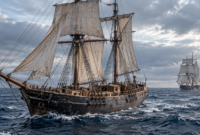
Mary Celeste Mystery: What Happened to the Missing Crew?
On December 4, 1872, sailors aboard the British brigantine Dei Gratia spotted another vessel drifting across the Atlantic, roughly 400 miles east of the Azores. Something was wrong. The ship, later identified as the American brigantine Mary Celeste, was under partial sail and apparently making way, yet nobody answered the calls from the Dei Gratia. When a boarding party climbed aboard, they found a vessel that was still capable of sailing, still carrying its cargo, and almost entirely intact. The ten people who had left New York aboard her were gone.
The Mary Celeste mystery has survived for more than 150 years because the physical evidence seems to contradict itself. The ship had been abandoned, but there was no clear wreck. Its cargo remained aboard, but its lifeboat was missing. The crew’s personal belongings were largely still in their quarters, yet the captain’s navigational instruments and important papers were gone. There was water in the bilge and damage to parts of the rigging, but the ship was not found sinking or catastrophically damaged. Most importantly, there was no surviving account from anyone who witnessed the abandonment.
That absence has allowed almost every conceivable explanation to take root, from mutiny and piracy to insurance fraud, alcohol fumes, a waterspout and even sea monsters. Yet the surviving historical record is much more restrained than the legends suggest. The mystery begins not with a supernatural disappearance, but with a practical question: why would an experienced captain leave a functioning ship in the middle of the Atlantic?
The Voyage Begins in New York


The vessel had not originally been named Mary Celeste. Built in Nova Scotia in 1861, she was launched as the Amazon before eventually becoming an American-registered ship under her better-known name. By 1872 she was an established merchant vessel rather than some experimental craft making its first uncertain voyage.
Her final voyage began in New York on November 7, 1872, bound for Genoa, Italy. Captain Benjamin Spooner Briggs was in command, and he was accompanied by his wife, Sarah, their two-year-old daughter Sophia, and seven crewmen. Among the crew were first mate Albert Richardson, second mate Andrew Gilling, steward William Head, and seamen Gottleib Gouldschaal, Arian Martens, Boz Lorenzen and Volkert Lorenzen. The ship carried approximately 1,700 barrels of industrial alcohol.
This was not simply a commercial voyage for Briggs. His wife and young daughter were aboard, making the passage a family undertaking as well as a business trip. Briggs was also an experienced mariner, and contemporary accounts presented him as a respectable captain with a strong reputation. Nothing about the crew list suggests a group obviously destined for mutiny or chaos.
The voyage initially proceeded normally enough. The Mary Celeste crossed the western Atlantic and reached the vicinity of the Azores. By November 25, the ship’s log recorded a position near Santa Maria Island. That entry would eventually become one of the most important pieces of evidence in the entire case because it represented the last known position recorded by the captain or crew before the ship was found abandoned.
From there, however, the documentary trail becomes disturbingly thin.
The Last Known Position
The final surviving log entry was made on the morning of November 25. The ship was north of Santa Maria Island in the Azores, roughly hundreds of miles from the position where the Dei Gratia would find her nine days later. The geographical gap matters because it establishes that the abandonment almost certainly occurred somewhere between the Azores and the later discovery point.
The Mary Celeste did not simply disappear after the last log entry. She continued sailing.
That is one of the strangest features of the case. Whatever happened to Briggs, his family and the crew, the vessel itself remained afloat and moved onward through the Atlantic. The Dei Gratia would later find her roughly 400 miles east of the Azores, meaning the unmanned ship had apparently remained in motion for days. Later accounts emphasized that she was under partial sail and capable of continuing her course without anyone at the helm. The nineteenth-century press quickly transformed that fact into the image of a “ghost ship,” but the reality was more mundane and more unsettling: the ship had become a drifting vessel after its occupants left it.
There is a crucial distinction here. We do not know precisely when the crew abandoned the Mary Celeste. We only know that the last recorded log entry was on November 25 and that the Dei Gratia encountered the empty ship on December 4 by modern civil dating. The nine-day interval provides a narrow but still substantial window in which the decisive event must have occurred.
The Strange Discovery by the Dei Gratia
The Dei Gratia was under the command of Captain David Morehouse. After his crew noticed that the other vessel was behaving strangely, he sent men across to investigate.
What they found was remarkable precisely because it was not a wreck.
The Mary Celeste was deserted, but it was still largely seaworthy. Its cargo had not been stolen. Food and water remained aboard. The crew’s personal effects had not been systematically removed. The ship’s lifeboat, however, was gone, and there were signs that the vessel had been left in an orderly enough manner for people to take some essential equipment with them.
The boarding party also found the ship’s sails partially set and evidence of damage to the rigging. One of the pumps had been dismantled, while the bilge contained several feet of water. A sounding rod had also been left on deck, suggesting that someone had been checking the amount of water accumulating below. Those details are important because they point toward a possible concern about the ship’s condition rather than an obviously violent takeover.
The disappearance also appeared remarkably selective. Important navigational instruments and some paperwork were missing, while ordinary belongings remained behind. The ship’s cabin and living quarters were not stripped. That does not tell us why everyone left, but it complicates theories that depend on robbery or systematic violence.
As the Dei Gratia crew brought the abandoned vessel toward Gibraltar, the mystery immediately became a legal matter as well as a maritime one. The Mary Celeste was not simply an abandoned curiosity; whoever had rescued and delivered her was entitled to seek salvage. A formal inquiry was therefore inevitable.
The Gibraltar Investigation
The Mary Celeste reached Gibraltar in December 1872, and a salvage court began investigating the circumstances surrounding her abandonment. The proceedings continued for weeks, with testimony and examinations focused on the condition of the vessel and the possibility of foul play.
The investigation became tangled in suspicion. Frederick Solly-Flood, the Gibraltar attorney general, strongly suspected that something criminal had happened and considered the possibility that the captain and his family had been murdered. Some reports also circulated about supposed bloodstains and damage to the ship.
But the physical evidence did not convincingly support a massacre.
Later examination of the alleged bloodstains failed to establish that they were human blood, while inspection of the hull did not produce convincing evidence of a violent struggle. An archival report reproduced by the Library of Congress records that Admiral R. W. Shufeldt examined damage around the bow and rejected the idea that it represented deliberate violence.
The Gibraltar inquiry therefore did not solve the mystery. What it did accomplish was almost as important: it weakened some of the most dramatic explanations.
There was no demonstrated pirate attack, no confirmed massacre, and no clear evidence of an insurance fraud carried out through the disappearance of the crew. British authorities ultimately rejected the stronger claims of foul play, although the inquiry could not establish an alternative explanation for why the people aboard the ship had abandoned it.
In other words, the official investigation did not produce a solution.
It produced a problem.
The ship’s condition suggested that something had frightened or compelled the occupants to leave, but the evidence did not reveal what that something was.
What We Know About the Ship’s Condition
The most revealing evidence may be the collection of small, seemingly disconnected details aboard the Mary Celeste.
The ship had a missing lifeboat. Its sails and rigging showed some disorder. There was water in the bilge. A pump had been partly dismantled. Some navigation equipment and papers were missing. Yet food, water and much of the cargo remained. The vessel itself had not been reduced to a wreck.
That combination makes a deliberate, planned abandonment difficult to reconcile with a pirate attack. A pirate crew seeking valuable cargo would have had little reason to leave approximately 1,700 barrels of alcohol untouched while removing the people aboard. Likewise, the absence of clear violence makes a bloody mutiny difficult to sustain.
The Dei Gratia‘s crew also did not find a ship that looked as though a catastrophic explosion had ripped through it. The hull and cargo remained substantially intact.
There was, nevertheless, one particularly intriguing feature of the cargo: it consisted almost entirely of industrial alcohol, and later unloading records found that nine of the 1,701 barrels were empty. Historical researchers have connected those empty barrels with differences in barrel construction, noting that the empty barrels were made of red oak, which is more porous than white oak and could have allowed alcohol to seep out.
That observation eventually became central to one of the most plausible modern theories.
The Alcohol Vapor Theory

One explanation proposes that the crew did not believe the ship was sinking. Instead, they may have believed it was about to explode.
Alcohol vapors can be extremely dangerous in an enclosed space. If enough vapor accumulated in the hold, an ignition could produce a sudden pressure event without destroying the entire vessel. The Mary Celeste was carrying a particularly large quantity of industrial alcohol, which made such a hazard more plausible than it would have been aboard an ordinary merchant ship.
The theory received renewed attention during a modern investigation led by documentary producer Anne MacGregor. Chemist Andrea Sella of University College London constructed a model of the ship’s hold and demonstrated that an alcohol-vapor ignition could create a powerful pressure wave without leaving the kind of extensive fire damage people might expect from a conventional explosion.
That does not prove that such an event occurred aboard the Mary Celeste.
There are problems with the theory. The boarding party did not report a strong smell of alcohol vapor when they entered the ship, and the condition of the cargo did not indicate that a massive explosion had occurred. The main hatch was also found in a condition that complicates the idea of a huge buildup of dangerous fumes.
Still, the theory does not require a catastrophic explosion.
A more cautious version proposes that leaking alcohol, strange sounds, pressure in the hold, or the smell of vapor may have convinced Briggs that the ship was in danger. He could then have ordered everyone into the lifeboat as a temporary precaution while the vessel was inspected or the situation stabilized.
The fatal event would have come afterward.
Once the occupants were in a small boat near a moving sailing vessel, even a short separation could have become permanent.
That scenario fits several important facts without requiring murder, piracy or supernatural forces. It explains why a competent captain might order an apparently irrational evacuation while leaving a valuable cargo behind.
But it remains a reconstruction, not a documented account of what Briggs actually did.
Other Theories: Mutiny, Piracy and Fraud
The early years of the investigation produced theories that were far more dramatic.
Mutiny was one possibility. Perhaps the captain and family had been killed and the crew had fled. The problem is that investigators found no convincing evidence of widespread violence, and contemporary officials struggled to substantiate such a story. The later examinations of supposed blood evidence weakened the argument considerably.
Piracy presents an even greater difficulty. A pirate attack makes little sense if the attackers intended to seize valuable cargo and then left nearly all of it aboard. There is simply no strong evidence of robbery.
Insurance fraud has also appeared in versions of the story, but again the surviving evidence does not establish such a scheme. The cargo remained aboard, and the disappearance of ten people created an enormous risk rather than an obvious financial advantage for everyone involved.
One should also separate these historical theories from later fictional inventions. The case became a gift to writers, and Arthur Conan Doyle’s 1884 story “J. Habakuk Jephson’s Statement” helped transform the real event into a much more sensational legend. Doyle changed important details and invented characters, but later readers sometimes absorbed elements of fiction into the historical memory of the case.
That process matters because the Mary Celeste we know today is partly a historical event and partly a mythology built around it.
Waterspouts, Earthquakes and Other Possibilities
Other explanations have focused on natural phenomena.
A waterspout, sudden storm, rogue wave or unusual pressure event could have damaged the ship or frightened the crew. The problem is that there is no surviving witness who describes such an event, and no single natural explanation accounts neatly for every clue.
There is also the possibility that the crew’s decision was rational from their perspective but based on information that later disappeared.
A captain at sea does not need a ship to be visibly sinking before deciding it is unsafe.
A sudden increase in water in the hold, uncertainty about the pumps, concerns about cargo, damaged rigging, or an apparent structural problem could have created a temporary emergency. If the crew moved into the lifeboat expecting to remain close to the ship, they might not have anticipated how quickly circumstances could change.
This is one reason the disappearance remains so difficult to reconstruct.
The historical record preserves the result of the decision but not the conversation that led to it.
We know the people left.
We do not know what they thought they were doing when they left.
The Missing Lifeboat Is the Central Clue
Among all the evidence, the missing boat may be the single most significant clue.
There is no credible scenario in which the crew simply vanished into thin air. They appear to have used the ship’s boat to leave the Mary Celeste. That fact narrows the problem considerably.
The question becomes: why would experienced sailors leave a seaworthy merchant ship for a small boat in the middle of the Atlantic?
The answer may have something to do with temporary evacuation rather than permanent abandonment.
The crew may have believed the Mary Celeste was about to sink, catch fire or explode. They may have intended to stay close enough to return. Some of the missing navigational equipment could have gone with them because Briggs needed it to monitor their position. The vessel could then have drifted or accelerated away before the boat’s occupants could regain control.
That last step is hypothetical, but it explains why the ship could later be found with its sails set while the people were nowhere in sight.
The ocean does not need a dramatic event to separate a small boat from a larger sailing vessel.
A line can part. Wind can change. Visibility can disappear. A current can carry two vessels in different directions.
Once that happened, survival in an open lifeboat would have been extremely difficult.
What We Know and What Remains Uncertain
What We Know
The Mary Celeste left New York on November 7, 1872, bound for Genoa with Captain Benjamin Briggs, his wife, their young daughter and seven crewmen aboard. The vessel carried around 1,700 barrels of industrial alcohol.
Its final recorded log position was near Santa Maria in the Azores on November 25. Nine days later, the Dei Gratia discovered the ship abandoned in the Atlantic. Its lifeboat was missing, but much of the cargo and the crew’s possessions remained.
A Gibraltar investigation examined the vessel and allegations of foul play, but no definitive cause for the disappearance was established.
What Remains Uncertain
No one knows the exact time the crew abandoned ship.
No surviving eyewitness account describes the event.
No remains of Briggs, his family or the seven crewmen were recovered.
No evidence conclusively identifies the place where their lifeboat was lost.
And there is no surviving document explaining what emergency, if any, caused Briggs to order the abandonment.
That last point may be the most important of all.
The Mary Celeste gives historians an unusually rich set of physical clues, but almost no explanation from the people who experienced the event.
The Mary Celeste Mystery and the Problem With Historical Legends
The enduring Mary Celeste mystery is sometimes described as the greatest ghost-ship story ever recorded. But calling it a ghost story can obscure what actually makes the case extraordinary.
There was nothing supernatural about the ship continuing to sail after its crew had left.
There was nothing inherently impossible about a lifeboat becoming separated from a larger vessel.
There was nothing unusual about nineteenth-century sailors confronting hazards that modern ships can monitor and respond to with far greater precision.
What is unusual is the combination of circumstances.
Ten people disappeared.
A valuable ship survived.
The cargo remained.
The lifeboat vanished.
And the event occurred far from land, leaving no witnesses behind.
The ocean effectively erased the most important piece of evidence: the people who knew what happened.
This is also why the case has attracted so much fictional embellishment. Writers and newspapers found it easier to tell a story with pirates, murderers or monsters than to admit that the surviving record did not contain an answer.
The historical truth is less satisfying but more compelling.
Something frightened or compelled the people aboard the Mary Celeste to leave. They apparently believed they had a reason to do so. Their decision may have been rational in the circumstances, yet it ended disastrously. The ship survived long enough to be found. The people did not.
A Mystery Without a Final Scene
When the Dei Gratia brought the abandoned Mary Celeste into Gibraltar, the ship became evidence in a case nobody could solve. Investigators could inspect timber, sails, cargo, water levels, belongings and documents. They could question sailors. They could test suspicious marks.
What they could not examine was the moment when ten people climbed into the missing boat and disappeared from the historical record.
That missing moment is why the case continues to resist a definitive solution.
The alcohol-vapor theory remains one of the more plausible explanations because it offers a realistic reason for a captain to abandon a ship that was not actually doomed. A pump or flooding concern could have contributed. Weather may have played a role. A combination of several ordinary problems may have created an extraordinary decision.
But none of those possibilities can be elevated into fact.
The responsible historical conclusion is therefore not that the Mary Celeste has finally been “solved.” It has not.
The evidence allows us to eliminate some explanations and develop more credible ones. It lets us see that the famous ghost-ship image is misleading, and that the disappearance was probably the result of a human decision made under uncertain and frightening circumstances.
But the final fate of Benjamin Briggs, Sarah Briggs, Sophia Briggs and the seven men who sailed with them remains unknown.
That is the part of the story the Atlantic never gave back.
And unlike a ghost story, the Mary Celeste mystery needs no supernatural ending. The most unsettling possibility is that ten ordinary people made one desperate decision at sea, and the ocean was large enough to make sure nobody ever returned to explain it.
An earlier HiddenFrontiers feature on the Roanoke Colony mystery offers another example of how incomplete evidence can turn a historical disappearance into a centuries-old mystery.
For a broader look at how maritime mysteries acquire dramatic legends, the historical record surrounding the Mary Celeste is also a useful reminder that later storytelling can be very different from the original evidence. The contemporary press already treated the abandoned vessel as extraordinary, while later writers added increasingly sensational details.
SOURCES & REFERENCES
Royal Museums Greenwich — Andrew Choong Han Lin, “The mystery of the Mary Celeste.”
This is the primary modern museum source used for the voyage chronology, crew, cargo, discovery, investigation and major theories. Royal Museums Greenwich — The mystery of the Mary Celeste
Smithsonian Magazine — Jess Blumberg, “Abandoned Ship: The Mary Celeste.” 2007.
Used for the historical reconstruction, condition of the vessel, cargo, investigation and modern examination of the alcohol-vapor theory. Smithsonian Magazine — Abandoned Ship: The Mary Celeste
Smithsonian Magazine — Eli Wizevich, “An Abandoned Merchant Ship Was Discovered Floating in the Atlantic in 1872.” 2024.
Used to cross-check the discovery date, voyage details, folklore and historical treatment of the case. Smithsonian Magazine — Mary Celeste historical overview
The Guardian — “Mary Celeste: mysterious occurrence at sea – archive, 1873.”
A contemporary newspaper archive used to verify how the abandoned ship and ongoing investigation were reported at the time. The Guardian archive — Mary Celeste, 1873
Library of Congress — digitized historical newspaper material concerning the Mary Celeste.
Used as an archival cross-check for the inquiry, alleged blood evidence and examination of the ship. Library of Congress newspaper archive material
Dalhousie University Archives — Irving Deale Collection.
The collection catalogue documents surviving copies of historical Mary Celeste-related records, including the Gibraltar letter, Dr. Patron’s report, Lloyd’s material and shipping records. Dalhousie University Archives — Irving Deale Collection