Great Molasses Flood: Why Did Boston’s Tank Burst?
Just after noon on January 15, 1919, the North End of Boston was enjoying an unusually mild winter day. Workers were outside, children were making their way home from school, and activity around Commercial Street was settling into the midday routine. Then came a deep rumble from a giant steel storage tank near the waterfront. Within moments, the structure ruptured and an estimated 2.3 million gallons of molasses surged into the neighborhood. The Great Molasses Flood would kill 21 people, injure about 150 more, destroy buildings, damage transportation infrastructure and become one of the strangest disasters in American history.
The image is almost absurd until the human cost comes into focus. Molasses sounds harmless, even comic, because its ordinary movement is associated with slowness. But thousands of tons of the dense liquid were stored inside an enormous tank elevated above part of a crowded urban district. When the tank failed, gravity turned that stored mass into a destructive flow. The flood struck with enough force to move debris, crush buildings and trap people beneath a substance that became increasingly difficult to escape as it cooled.
Yet the most important question surrounding the disaster is not why Boston happened to be in the path of a freak wave of syrup. It is why a tank capable of holding such an enormous quantity of molasses was allowed to operate despite evidence that it leaked and weaknesses that, according to later engineering analysis, made catastrophic failure much more likely.
The answer emerged only after years of investigation and litigation. The Great Molasses Flood was eventually understood not as an inexplicable accident, but as a failure of design, construction, oversight and corporate responsibility.
A Tank Built for a Changing Industrial Economy


The tank stood in Boston’s North End, close to the waterfront and the elevated railway. It belonged to the Purity Distilling Company, which used molasses as a raw material for producing alcohol. During the First World War, industrial alcohol had strategic importance because alcohol could be used in manufacturing and other industrial processes, while the broader demand for alcohol-related products was tied to wartime production. The tank, built in 1915, was about 50 feet high and capable of holding approximately 2.3 million gallons.
The location was commercially convenient but physically unforgiving. The North End was densely populated, with workers, families, businesses and transportation infrastructure packed into a relatively small area. The tank stood close enough to streets and buildings that a structural failure would not remain a private industrial problem. It would become a neighborhood catastrophe.
The company also had a reason to keep the tank operating at enormous scale. Molasses arrived by ship at the waterfront and could be stored before being transferred elsewhere for industrial use. The arrangement was efficient, but it concentrated a huge quantity of heavy liquid in one place. The tank was essentially storing a vast reservoir of potential energy above a working neighborhood.
That risk was not necessarily obvious to everyone at the time. Large steel tanks were becoming an increasingly common feature of industrial America, and engineering standards were not what they are today. But the later history of the tank makes clear that it had warning signs long before January 1919.
Residents had noticed leaks. The vessel’s steel shell sometimes allowed molasses to escape through seams and riveted joints. According to accounts of the period and later investigations, the company responded partly by painting the tank a darker color so that the leaking molasses would be less conspicuous.
That detail became one of the most revealing pieces of the disaster’s history. A tank does not need to explode for a warning to matter. A leak can be evidence that a larger structure is under stress.
In the case of Boston’s tank, those warnings did not lead to a complete reevaluation of the structure.
January 15, 1919: The Wave
The weather that morning was unusually warm for Boston in January, with temperatures climbing above 40 degrees Fahrenheit after a much colder period. The change in temperature would later become important to scientific interpretations of how the flood behaved, but at first the day seemed ordinary. Workers around Commercial Street were moving through their routines while the elevated railway carried trains above the neighborhood.
Shortly after midday, the tank failed.
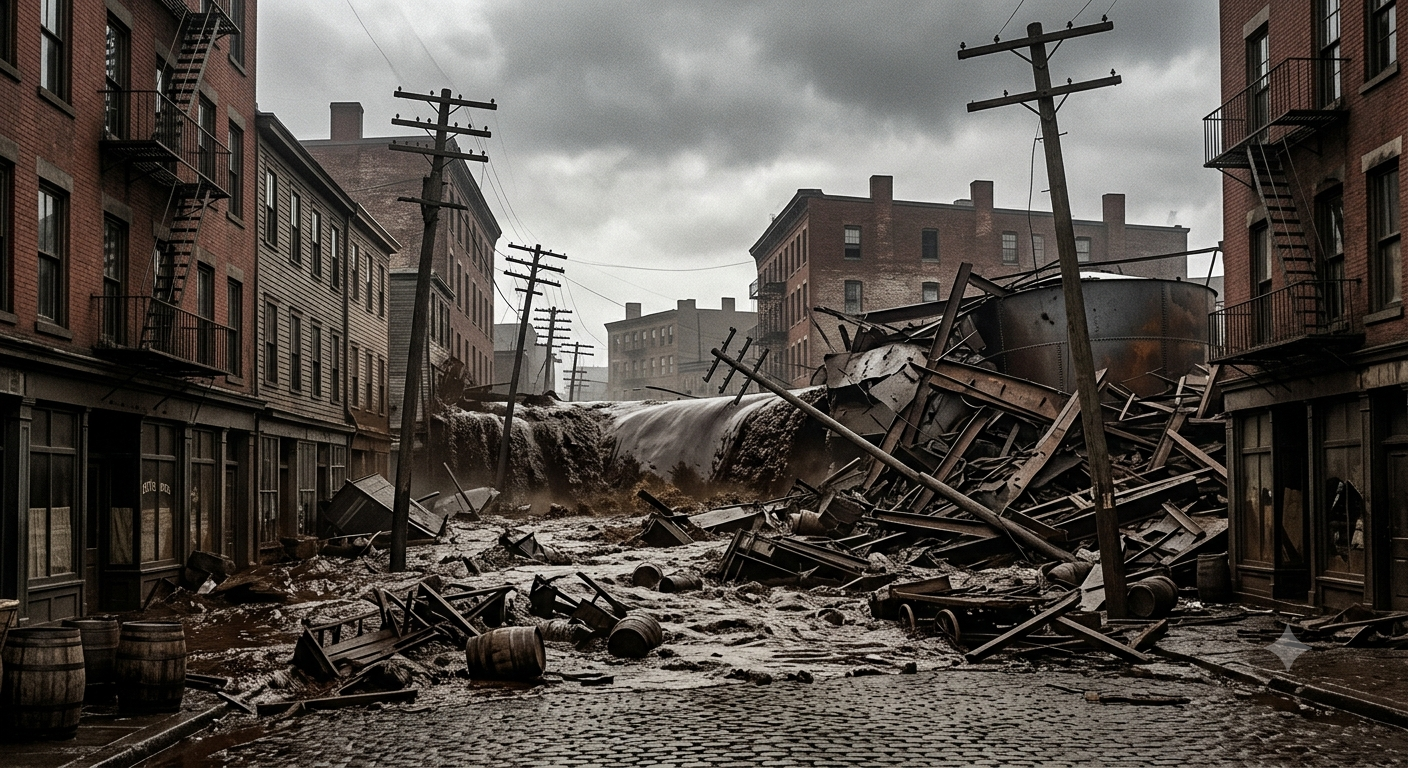
The exact sound has been described in different contemporary accounts, but survivors recalled a violent roar and a tremendous release of material. The tank’s steel walls came apart and millions of gallons of molasses were suddenly moving downhill through the streets. Later estimates put the leading wave at roughly 15 feet high and around 35 miles per hour, although exact measurements were impossible because nobody was standing there with instruments when the tank ruptured.
For people close to the tank, there was almost no meaningful warning.
The flood struck the nearby Boston Elevated Railway structure, damaged buildings and swept debris across Commercial Street. A firehouse was badly damaged, and the force of the moving material carried wreckage into surrounding streets. The wave was not uniform as it spread. It slowed, cooled and thickened, but the initial surge had already delivered extraordinary destructive energy.
The victims included workers, residents and children.
Among those killed was Bridget Clougherty, whose nearby home was destroyed. Firefighter George Layhe died after the firehouse was heavily damaged. The final death toll reached 21, while approximately 150 people were injured. Horses were also killed, a grim reminder that the flood was powerful enough to overwhelm both human beings and animals in its path.
The first moments were only the beginning.
After the initial surge, the neighborhood became an enormous rescue site filled with wreckage, sticky debris and partially submerged streets. The same physical property that made molasses useful as an industrial material now made rescue unusually difficult.
Why Molasses Could Behave Like a Crushing Wave
The popular phrase “slow as molasses” makes the disaster difficult to visualize. Molasses is highly viscous, so why did millions of gallons move with such apparent violence?
The answer lies partly in the amount of material involved.
A tank containing roughly 2.3 million gallons represented an enormous mass. When the container failed, gravity acted on that mass and converted stored potential energy into motion. The resulting flow did not behave like a gentle spill from a kitchen jar. The first surge carried enough momentum to demolish structures before viscosity could significantly slow it. Scientific analyses have concluded that reports of a fast-moving initial wave are physically plausible.
Modern research also helps explain why the situation became even more dangerous after the first wave.
Boston was experiencing winter conditions, and the molasses cooled as it spread. As temperature dropped, its viscosity increased significantly, making the substance much harder to move through. People trapped under debris were therefore confronting two different hazards: the initial force of the flood and the progressively thickening material that surrounded them afterward.
This matters when reconstructing the deaths.
Some victims were struck by the initial wave or crushed by buildings and debris. Others survived the first impact but became trapped in the thickening molasses. Rescue workers could not simply wade in as they might through ordinary floodwater. Every movement required effort, and debris hidden beneath the surface created additional hazards.
The disaster therefore had an unusual two-stage character. First came the sudden mechanical force of a massive tank failure. Then came the slow, exhausting problem of survival and rescue in an increasingly viscous environment.
The Rescue Became a Battle Against Time

First responders arrived quickly. Firefighters, police officers, sailors and other volunteers began searching for survivors almost immediately. More than 100 sailors from the nearby USS Nantucket joined the rescue effort, while the Red Cross and other groups helped provide assistance.
But speed alone could not solve the problem.
The streets were covered in molasses and debris, and rescue vehicles struggled to move. People searching for victims had to work around collapsed structures and heavy wreckage while avoiding becoming trapped themselves. The flood had also damaged transportation infrastructure, making access to some areas more difficult.
The death toll increased as rescuers searched.
Some victims were difficult to identify, and at least two bodies were recovered several days after the rupture. The disaster site had become both an emergency scene and a difficult recovery operation. What had been an ordinary part of Boston’s working waterfront was suddenly transformed into an industrial landscape of twisted steel, broken timber and hardened molasses.
The cleanup took much longer than the initial flood.
Fireboats used salt water to wash the molasses from streets, while workers spread sand over affected areas to make surfaces more manageable. The material was carried beyond the immediate disaster zone on boots, vehicles and equipment, spreading the mess through other parts of Boston. Reports that the smell of molasses lingered in the neighborhood for years afterward became part of local memory.
Yet while workers were clearing the streets, investigators were turning their attention toward a more difficult problem.
Why had the tank failed in the first place?
The First Suspect Was Sabotage
In the immediate aftermath, sabotage was considered seriously.
The United States had only recently emerged from the First World War. Boston’s industrial environment was shaped by wartime production, political tensions and fears of anarchist violence. The possibility that someone had deliberately damaged or bombed the tank did not seem entirely implausible to investigators and company officials.
The tank’s owner, the United States Industrial Alcohol Company, eventually emphasized the theory that anarchists might have caused the disaster. If sabotage could be established, the company could argue that it had not been responsible for the deaths and destruction.
Another possibility involved fermentation.
Because molasses can ferment, investigators considered whether gases produced inside the tank could have built up enough pressure to trigger the rupture. The theory had a superficially attractive quality: it offered a way for the tank to fail from the inside without obvious external interference.
But neither sabotage nor fermentation ultimately provided the strongest explanation.
The legal process would force the company’s tank, construction methods and operating practices into much greater scrutiny.
The Court Case That Changed the Story
In the years following the flood, a large number of lawsuits were filed against United States Industrial Alcohol. The legal proceedings became extraordinarily extensive, eventually lasting several years and involving thousands of witnesses. The central case, Dorr v. United States Industrial Alcohol Company, examined whether the company had been negligent in constructing and operating the tank.
The dispute was not simply about what had happened on January 15. It was about responsibility.
If the tank had failed because of an unforeseeable event, the company could argue that the disaster was essentially unavoidable. If, on the other hand, the structure had been dangerously designed or inadequately supervised, then the company had a responsibility to the people living and working nearby.
The investigation found substantial evidence of structural weakness. By 1925, a court-appointed auditor concluded that negligence by the tank’s owner was responsible for the collapse. Boston’s official historical account identifies that ruling as a significant turning point in the case and in the broader history of construction oversight.
The court’s conclusion effectively killed the most dramatic early explanation.
There was no need for a hidden bomber or mysterious sabotage.
The tank had been allowed to operate with fundamental weaknesses.
The company was ultimately held liable, and settlements were paid to victims and families. Contemporary and later accounts place the total damages in the hundreds of thousands of dollars.
The legal significance extended well beyond the individual payouts.
What Was Wrong With the Tank?
Modern engineering analysis has made the physical explanation clearer.
A 2014 structural engineering study by Ronald Mayville concluded that the steel used in the tank was substantially thinner than would have been appropriate for a structure of its size under modern calculations, and the steel’s material properties were less favorable than those of later steels. The riveted construction was also vulnerable around the rivet holes, which became points where stress could concentrate.
That does not mean engineers in 1915 could simply have applied twenty-first-century calculations and predicted the disaster. Standards, materials and engineering practices were different. It does mean that, viewed with modern knowledge, the tank contained several characteristics that made failure more likely.
The tank had also shown leaks almost from the beginning.
That is significant because a leak is more than an inconvenience in a giant storage structure. It can be a signal that the vessel is experiencing stress, that joints are failing, or that construction quality is inadequate.
According to the Boston Public Library, the tank’s structural weakness became the basis for the eventual liability finding. The library also notes that the tragedy contributed to stricter construction codes and greater expectations for professional engineering review in Massachusetts and elsewhere.
The most striking lesson is therefore not that the tank failed unexpectedly.
It is that evidence of its weakness existed before the day of the flood.
The Science of the Wave
The court case explained why the tank failed, but it did not fully explain why the resulting wave was so destructive.
That question attracted new scientific attention nearly a century later.
A team associated with Harvard examined the disaster using historical records, weather information and experiments involving cold corn syrup as a proxy for molasses. Their work suggested that the reported speed of the initial flow was physically plausible and that temperature played an important role in what happened after the tank ruptured.
The critical distinction was between the first surge and the later spread.
Immediately after the rupture, the huge mass of molasses was driven by gravity and inertia. Its viscosity did not prevent an extremely rapid initial movement. Once the material spread and cooled, its viscosity increased, making it dramatically harder to move through and much more difficult for trapped people to escape.
This provides a better explanation of the disaster than the popular mental image of “slow molasses suddenly becoming fast.”
The molasses did not cease to be viscous.
The quantity of it, the height of the tank, the geometry of the neighborhood and the energy released by the rupture allowed the initial flow to behave violently despite that viscosity. Temperature then helped turn the aftermath into a prolonged rescue nightmare.
The physics did not replace the historical investigation. It completed it.
The Human Cost in Boston’s North End
Statistics can describe the scale of the Great Molasses Flood, but they cannot fully capture what happened in the North End that afternoon.
The neighborhood was densely populated and home to many working-class families, including a large Italian immigrant community. The disaster struck people who had little reason to expect an industrial catastrophe from an ordinary-looking storage facility. Children were among those caught in the wave, while workers nearby were struck as they went about their jobs.
The loss of 21 lives was only part of the damage. Around 150 people were injured. Buildings were destroyed or badly damaged, a firehouse was heavily hit, railway infrastructure was affected, and the economic costs extended far beyond the tank itself.
The social consequences mattered, too.
The flood became a local memory that blended physical evidence with stories handed down through families. The smell of molasses reportedly remained associated with the area long after the cleanup ended. The site itself changed as Boston’s waterfront and transportation infrastructure evolved, leaving relatively little visible evidence of the catastrophe for later generations.
That fading landscape may explain why the event can feel almost unbelievable today.
The North End does not resemble the industrial waterfront of 1919.
The tank is gone.
The elevated railway is gone.
Most of the physical environment has changed.
What remains is the historical record, the photographs, the litigation and the lesson embedded in the disaster.
From Molasses to Modern Safety Rules
The long legal battle that followed the flood became important because it established that industrial corporations could not simply dismiss catastrophic structural failure as an unavoidable accident.
Boston’s official historical account connects the case to the development of stronger expectations surrounding professional engineering, building inspection and documented design work. The exact influence of the disaster on individual regulations has been discussed by historians, but there is broad agreement that the case became a landmark in the evolution of engineering accountability.
That legacy is easy to overlook because modern building codes and engineering reviews feel routine.
Before a large structure is built, engineers calculate loads, designers document their work, inspectors check construction, and authorities can require evidence that a project meets established standards. Those systems did not appear because of one disaster alone, but the Boston case became one of the historical examples demonstrating why professional oversight mattered.
The irony is that the tank itself was not an inexplicable technical failure.
People understood that it leaked.
The disaster showed what can happen when warning signs are normalized instead of investigated.
What We Know
The documented outline of the disaster is remarkably clear.
On January 15, 1919, a large steel tank containing approximately 2.3 million gallons of molasses ruptured in Boston’s North End. The flood killed 21 people and injured roughly 150. It damaged buildings, transportation infrastructure and nearby property. Rescue workers spent days dealing with the aftermath.
The tank belonged to an industrial company that used molasses in the production of alcohol. The structure had leaked previously, and concerns about its construction and condition became central to the subsequent investigation and lawsuit.
A court-appointed auditor eventually found the company responsible for the collapse. The legal conclusion was that the disaster resulted from structural weakness and negligence rather than a proven bomb attack.
Modern scientific work has further explained how the resulting flood could move so rapidly and why cooling made the material increasingly difficult to escape from.
What Remains Uncertain
Not every detail can be known with equal confidence.
The precise sequence by which individual sections of the tank failed is reconstructed from photographs, engineering analysis, testimony and later studies rather than from a modern instrumented record of the rupture. Estimates of the wave’s maximum speed and height are therefore estimates rather than direct measurements.
There has also been debate about the exact contribution of fermentation, temperature changes and other physical processes immediately before the rupture. Fermentation was considered in the historical investigation, while later engineering research has placed greater emphasis on structural deficiencies.
That distinction is important.
The Great Molasses Flood does not need an exotic explanation. The historical evidence strongly supports structural failure and negligence, while modern engineering and fluid-dynamics research explains much of how the catastrophe unfolded. But science and history are still reconstructing individual details of an event that occurred more than a century ago.
Why the Great Molasses Flood Still Matters
It is tempting to remember the disaster because of its absurd premise: a city street flooded by molasses. That is how the story is often introduced, and the strangeness undoubtedly explains why it remains memorable.
But the unusual substance is almost a distraction.
The deeper story is about a dangerous industrial structure placed beside a dense neighborhood, warning signs that were not treated as sufficient reasons to stop, and an eventual catastrophe in which ordinary people paid the price for weaknesses they did not control.
In that respect, Boston’s molasses disaster belongs in the same historical category as other preventable industrial tragedies.
The Mary Celeste mystery is remembered because crucial evidence disappeared with the people who knew what happened. Boston’s flood presents the opposite problem: the evidence remains, but the event was so extraordinary that it has sometimes been treated as a curiosity rather than as a serious case study in engineering failure.
The difference matters.
The North End did not suffer because molasses became magically dangerous. It suffered because millions of gallons of a heavy industrial material were stored in a structure that was not strong enough to contain them.
The liquid was strange.
The failure was not.
A Disaster That Changed What “Safe” Was Supposed to Mean
The most revealing thing about the Great Molasses Flood is how little mystery remains when the evidence is followed carefully.
There is no credible need for a conspiracy. No unexplained natural phenomenon is required. There is no indication that the disaster was simply an unavoidable freak accident.
A tank had weaknesses. It leaked. It was subjected to enormous loads. The surrounding community had no meaningful way to protect itself if the structure failed. When it did, the consequences were immediate and lethal.
The flood lasted only minutes, but its consequences continued for years through rescue work, lawsuits, compensation claims, engineering analysis and changes in how industrial construction was understood.
More than a century later, that may be the most important reason to remember the event.
The strange part of the story is that a wave of molasses could move fast enough to kill people. The darker part is that the conditions allowing it to happen were created by human decisions.
In January 1919, Boston learned that a structure could look enormous, modern and useful while still being dangerously inadequate. The lesson was paid for in 21 lives.
The molasses eventually disappeared from the streets.
The principle it revealed did not: when warning signs are treated as minor inconveniences, a failure that seems impossible can become inevitable.
SOURCES & REFERENCES
City of Boston, Archives and Records Management — “100 years ago today: Molasses crashes through Boston’s North End.” Updated October 30, 2025.
City of Boston historical account
Boston Public Library — “Boston’s Great Molasses Flood.” 2019.
Boston Public Library historical overview
Smithsonian Magazine — Edwards Park, “Without Warning, Molasses Surged Over Boston 100 Years Ago.” Originally published November 1983; republished online in 2019.
Smithsonian Magazine historical account
Smithsonian Magazine — Jason Daley, “The Sticky Science Behind the Deadly Boston Molasses Disaster.” November 28, 2016.
Smithsonian Magazine science analysis
American Physical Society — “This Month in Physics History: January 15, 1919: Physics and the Boston Molasses Flood.” January 1, 2017.
American Physical Society historical and scientific account
Library of Congress — “Boston, Mass. Boston molasses explosion.” Photograph from the American National Red Cross collection.
Library of Congress photograph record
Library of Congress — “Spectacular Failures: Investigating Stability and Change Through Engineering Disasters.” April 7, 2026.
Library of Congress primary-source and engineering-disaster resource
Scientific American — Ferris Jabr, “The Science of the Great Molasses Flood.” August 1, 2013.
Scientific American fluid-dynamics analysis
Washington Post — “Boston’s Great Molasses Flood killed 21 people 100 years ago.” January 13, 2019.
Washington Post historical investigation