The Lost Franklin Expedition and the Arctic Mystery That Endures
In April 1848, the surviving members of Sir John Franklin’s expedition abandoned their ships in the Canadian Arctic and began walking south across King William Island. A message left at Victory Point recorded the deaths of 24 officers and men, including Franklin himself, and stated that the remaining 105 men were setting out toward the Back River. None of those 105 survived. The ships were eventually found more than 150 years later, yet the Franklin expedition mystery still endures because the final months of the expedition remain only partially reconstructed from scattered notes, skeletal remains, Inuit testimony and objects left behind on the ice.
The expedition had begun with every advantage the British Navy could provide. HMS Erebus and HMS Terror were experienced polar vessels, Franklin was an established explorer, and the expedition carried provisions and equipment intended to sustain the men for several years. They sailed in 1845 to complete one of the great unfinished geographical ambitions of the nineteenth century: finding and charting a navigable Northwest Passage through the Canadian Arctic.
Instead, the expedition became one of the most consequential failures in the history of polar exploration. The ships were trapped in sea ice, Franklin died, the surviving officers abandoned the vessels, and the men disappeared across a landscape that few Europeans understood. What followed was an enormous search effort that lasted for decades, changed British and Canadian Arctic exploration, and eventually demonstrated that the most reliable clues had often been preserved in Inuit knowledge rather than in European records alone.
A Well-Equipped Expedition Entered an Unforgiving Arctic
Franklin’s final expedition departed Greenhithe, England, on May 19, 1845 with 134 officers and crew. During the early voyage, five men left the expedition in Greenland, reducing the party that continued into the Canadian Arctic to 129. Parks Canada describes the expedition as exceptionally well prepared by contemporary European standards, with ships equipped with advanced technology and supplies intended to last for three years, potentially longer if carefully managed.
The two ships had already proven themselves in polar waters. Erebus and Terror had both served in earlier Antarctic expeditions, and their crews had experience with ice navigation and extreme conditions. For the final voyage, they were fitted with steam propulsion and heating systems in addition to sails, reflecting the British belief that technological preparation could reduce some of the risks that had defeated earlier expeditions. The wreck of Erebus has since confirmed the presence of its steam machinery, heating apparatus and coal bunkers, allowing archaeologists to see some of that preparation directly.
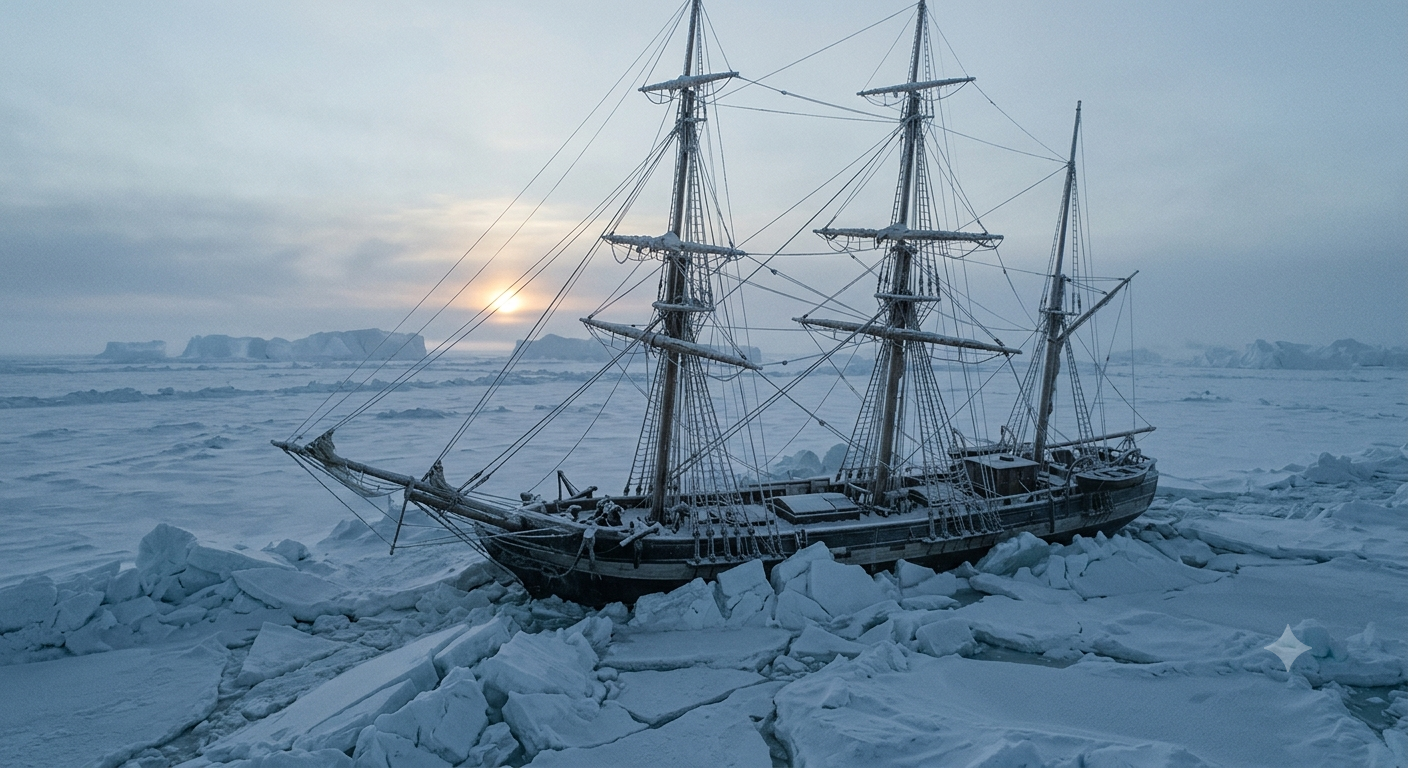
The expedition spent its first winter at Beechey Island in 1845–46, where three men died and were buried. The graves became one of the earliest physical clues recovered by later searchers, and their remains were eventually examined by archaeologists and medical researchers. The expedition then moved southward and became trapped in ice off the northwest coast of King William Island in September 1846, where the ships would remain for another year and a half.
The distinction between preparation and reality became critical once the ships stopped moving. Supplies designed for a voyage were being consumed while the Arctic denied the crew the ability to continue their route. The men were no longer simply navigating through difficult waters; they were becoming inhabitants of a temporary frozen world whose conditions were beyond their control. The expedition’s confidence in its equipment could not compensate for the fundamental problem that the ice had effectively taken command of the voyage.
The First Winter Was a Warning
The three deaths at Beechey Island have attracted enormous attention because the bodies were preserved unusually well by the Arctic environment. John Torrington, John Hartnell and William Braine were buried in frozen ground, and later researchers examined their remains for signs of disease, nutritional stress and possible exposure to contaminants. The evidence suggests that the men were already experiencing serious health problems before the expedition reached its final crisis, although the precise medical causes remain debated.
Lead exposure became one of the most famous explanations for the expedition’s collapse after elevated lead concentrations were found in some Franklin remains. Researchers originally argued that lead poisoning might have contributed significantly to the expedition’s failure, potentially through contaminated food or other sources, but later skeletal microstructure research produced a more cautious conclusion and found insufficient evidence that unusually high lead exposure played a pivotal role for all of the crew.
Scurvy has also been proposed as an important factor, but the evidence is similarly complicated. Researchers have identified medical and nutritional problems consistent with severe hardship, while the skeletal record does not provide a simple diagnosis that explains the deaths of the entire expedition. Tuberculosis has also been identified in some remains, demonstrating that the men entered the Arctic carrying ordinary nineteenth-century diseases into an environment where treatment options were limited and recovery conditions were poor.
The important point is that there may never have been one single medical explanation. The expedition probably suffered from interacting problems involving disease, inadequate nutrition, exhaustion, cold, declining mobility, isolation and the progressive loss of experienced personnel. The Arctic did not need one spectacular cause of death to destroy the expedition; a combination of smaller failures could be fatal when escape was measured in hundreds of miles over sea ice and tundra.
The Message That Changed the Story

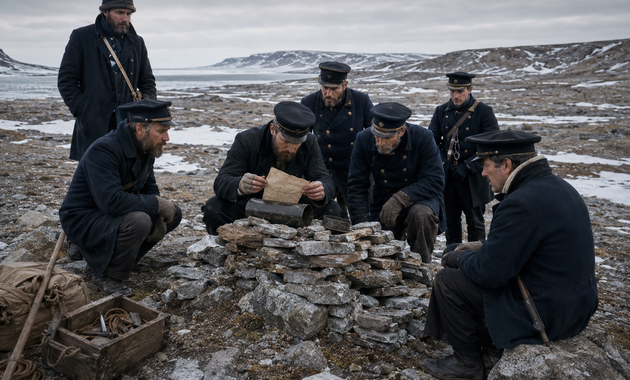
The most important surviving document from the expedition was found in a cairn at Victory Point on King William Island. Captain Francis Crozier and Commander James Fitzjames had written messages on the same sheet of paper at different moments, creating an accidental record of how dramatically the expedition’s situation had changed. The first message, written in May 1847, reported that the expedition had wintered at Beechey Island and that the ships had been trapped in ice since September 1846, ending with the reassuring phrase “all well.”
The second message was added in April 1848 and could hardly have been more different. It stated that Franklin had died on June 11, 1847 and that 24 officers and men had died in total, while the remaining 105 survivors had abandoned the ships on April 22, 1848. The men intended to travel south toward the Great Fish River, now generally called the Back River, apparently hoping to reach the mainland and ultimately obtain assistance from a Hudson’s Bay Company post.
That document transformed the later search. For the first time, investigators knew that the ships had not simply vanished at sea and that a large group of survivors had left them deliberately. It also established a final documented point on the expedition’s timeline, after which the evidence became increasingly scattered across the landscape of King William Island and the mainland. The story shifted from a missing expedition to a desperate overland retreat.
The note also contained an unsettling contradiction. If the expedition was capable of reporting “all well” in May 1847, why was it in such catastrophic condition less than a year later? The answer may lie in how quickly Arctic conditions, illness and dwindling resources could transform a trapped expedition, but no surviving document provides a detailed account of the months between those two messages. That gap remains one of the core uncertainties in the Franklin expedition mystery.
The 105-Man March South
When the men left the ships, they did not simply walk away carrying light packs. They attempted to drag heavy boats and supplies southward using sledges, an enormous logistical burden that would have made travel through Arctic terrain painfully slow. Later searchers found evidence of this retreat, including a large sledge carrying a ship’s boat, along with clothing, books and other equipment abandoned along the route.
The decision itself has long been debated. Remaining with the ships offered shelter and access to whatever supplies remained, but the vessels had already been trapped for almost two years, and the officers apparently judged that remaining in place offered little prospect of rescue or movement. Leaving created another set of risks, since the men now had to cross difficult terrain with exhausted bodies, reduced food supplies and no reliable guarantee that they would find help.
The archaeological evidence shows that the retreat became increasingly fragmented. Bodies were found in different locations, some carefully buried and others left where the men had died, while objects were dispersed across the route. Inuit witnesses later described encountering groups of exhausted European men, and those accounts became vital because the British searchers arrived too late to observe the retreat themselves.
Every mile southward was therefore a calculation between survival and burden. Heavy equipment that might have been useful in a settlement or ship was almost useless if the men could not physically drag it. The objects found by later searchers reveal the tension between what the expedition had believed it might need and what exhausted men could actually carry across the Arctic.
Inuit Knowledge Was Part of the Evidence, Not an Afterthought
For decades, European searchers struggled to reconstruct the expedition’s fate while Inuit witnesses already possessed information about what had happened. Inuit communities had lived around King William Island and the surrounding Arctic landscape for generations, knew local travel routes, ice conditions and wildlife behavior, and had encountered Franklin’s men and their abandoned equipment. Parks Canada now explicitly recognizes Inuit Qaujimajatuqangit, or Inuit traditional knowledge, as a central component in understanding the expedition and locating the wrecks.
In the nineteenth century, however, Inuit testimony was not always treated with the seriousness it deserved. John Rae, who travelled through the region in the 1850s, gathered detailed information from Inuit about bodies, abandoned equipment and the condition of Franklin’s men, including reports that some of the dead appeared to have been cannibalized. Rae’s conclusions provoked intense controversy in Britain, where the idea that Royal Navy officers could have resorted to cannibalism was deeply offensive to Victorian notions of imperial heroism.
Later evidence has confirmed important parts of those accounts. Archaeologists found cut marks on human bones consistent with butchery, and more recent examination identified signs known as “pot polish,” suggesting that some bones were heated and scraped to extract remaining nutrients. The evidence does not mean that every member of the expedition participated in cannibalism, but it demonstrates that at least some of the survivors endured extreme starvation before they died.
This is one of the most important lessons of the expedition’s history. Inuit knowledge was not a colorful supplement to European archaeology; it contained information that helped explain the fate of the expedition and ultimately helped guide modern searches for the ships themselves. Parks Canada states that the combination of Inuit knowledge, oral histories and modern technology directly contributed to the discoveries of both wrecks.
The Ships Were Missing for More Than 150 Years
The disappearance of Erebus and Terror became one of the great obsessions of nineteenth-century exploration. Search parties repeatedly entered the Arctic, and their findings gradually transformed the map of the region while also producing new clues about Franklin’s route. Among the most important was the discovery of the Victory Point note by Leopold McClintock’s search expedition in 1859, together with skeletons, graves, books, clothing and other objects from the retreat.
Yet the ships themselves remained elusive. Searchers had several clues about where they might have been abandoned or later wrecked, but the Arctic was vast, the coastline was difficult to survey and the state of nineteenth-century navigation made underwater searching effectively impossible. The absence of the ships created an enduring mystery because they were the largest pieces of physical evidence that could potentially explain how the expedition ended.
Modern searchers finally had tools that their predecessors could not have imagined. Side-scan sonar, multibeam surveying, aircraft, remotely operated equipment and detailed geographic databases could be combined with Inuit place knowledge and oral testimony to narrow the search areas. Parks Canada began a renewed long-term search in 2008, treating the effort as a sustained archaeological investigation rather than a single expedition based on one theory.
The breakthrough came in September 2014. Searchers found a small number of physical clues near Wilmot and Crampton Bay, including a metal davit pintle and a wooden hawse plug, and the search team shifted its attention to a nearby area. On September 2, the sonar screen revealed the wreck of HMS Erebus resting on the seabed in remarkably coherent condition.
Terror Was Found Two Years Later
Finding Erebus solved only half the maritime mystery. The location and fate of HMS Terror remained unknown, and investigators still had to determine why the two ships had ended up where they were found. That second search produced its own remarkable moment in September 2016, when the research vessel Martin Bergmann unexpectedly passed over a wreck after receiving a tip from Inuk Samy Kogvik from Gjoa Haven. Parks Canada subsequently verified that the wreck was HMS Terror.
Terror was found in Terror Bay, west of Gjoa Haven on the King William Island coast, sitting in approximately 24 metres of water. Its relatively sheltered position contributed to an unusually well-preserved wreck, and later examinations revealed that much of the vessel remained intact, offering archaeologists an opportunity to study cabins, decks and equipment in ways that nineteenth-century searchers could never have imagined.
The discovery also emphasized the importance of Inuit knowledge again. The search was not simply a triumph of sonar technology; Parks Canada states that Inuit oral history helped guide researchers toward both wreck sites, while the 2016 Terror discovery followed a local Inuit tip that changed the search team’s immediate plans. The modern story of Franklin is therefore not one in which technology finally solved an old European mystery by itself, but one in which different knowledge systems proved most effective when used together.
The wrecks are now part of the Wrecks of HMS Erebus and HMS Terror National Historic Site, which is cooperatively managed by Parks Canada and Inuit organizations including the Inuit Heritage Trust and the Nattilik Heritage Society. The site is protected from unauthorized access, and Parks Canada continues to conserve artifacts while incorporating Inuit participation into research, stewardship and interpretation.
What the Wrecks Are Revealing
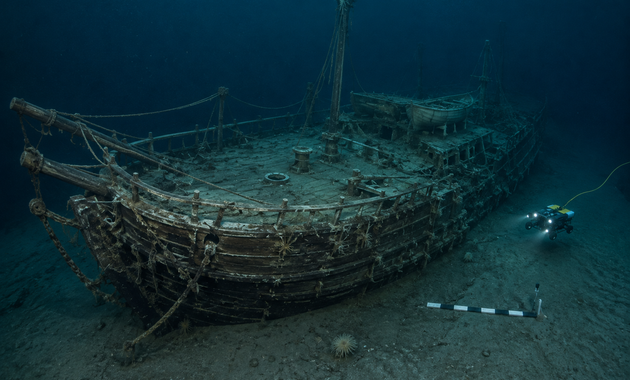
The wrecks have become underwater time capsules, but they do not contain a single final explanation waiting to be opened. Archaeologists have recovered navigation instruments, clothing, medical bottles, firearms, personal objects and pieces of equipment that reveal how the expedition operated during its final years. In 2024 alone, Parks Canada recorded 50 dives at Erebus and recovered items including a soldering iron, gloves, socks, medicinal bottles, pistols, shaving razors, an artificial horizon and a nearly complete sextant.
One particularly revealing feature is the ship’s coal supply. Archaeologists found the coal bunkers empty as far down as they could see, which is not surprising given the long duration of the voyage and the years the ships spent trapped in ice. They also documented a passage cut through a watertight bulkhead, probably to make it easier to move coal from the bunkers to the machinery spaces.
The 2024 work also showed how quickly archaeology is changing the story. Investigators returned to Terror for the first diving visit since 2019, produced extensive photogrammetric imagery and created a detailed three-dimensional model of the wreck, while instruments were deployed to study the environmental conditions affecting both sites. Parks Canada has since moved from intensive annual excavation toward a more regular monitoring program designed with Inuit partners, reflecting a shift from discovery to long-term stewardship.
The objects can also complicate theories. A nearly intact navigation instrument might illuminate how officers worked, a medicine bottle may reveal something about health care, and a piece of clothing may identify a social role or working routine, but none of those objects automatically explains why the expedition collapsed. The evidence is accumulative, and the mystery persists because historians must connect thousands of small clues without assuming that any one artifact is the missing key.
The Human Remains Are Rewriting the Last Days
The bodies left behind by the expedition have produced some of the most painful evidence. Human remains were discovered in scattered locations around King William Island and the Adelaide Peninsula, and modern researchers have used archaeology, osteology, genealogy and DNA analysis to restore names to people whose identities had been lost for more than a century. The work has transformed anonymous bones into individual human stories.
In September 2024, researchers identified Captain James Fitzjames of HMS Erebus through DNA and genealogical analysis. The identification placed a name on one of the men who had helped lead the 105 survivors after the ships were abandoned, and examination of his jaw showed cut marks consistent with the evidence for cannibalism documented at the site. The identification was significant not because it solved the entire mystery but because it connected written records, genealogy and physical remains to one specific officer.
By May 2026, the number of expedition members identified by DNA had risen to six. Researchers identified William Orren, David Young and John Bridgens, all from Erebus, and Harry Peglar, Captain of the Foretop aboard Terror, whose remains were found near the site where nineteenth-century searchers had also discovered his personal documents. The Peglar identification was especially valuable because it resolved a long-standing discrepancy between the name of the man associated with the documents and the clothing found with the remains.
These discoveries do more than put names back onto skeletons. They help reconstruct where different men died, which ship they served on and which parts of the retreat they may have experienced, while also providing descendants with information about what happened to relatives who disappeared in the Arctic. As Parks Canada and the University of Waterloo continue to combine DNA evidence with archaeological context, the expedition is slowly becoming less a story about 129 anonymous victims and more a collection of individual lives.
Did Lead Poisoning Cause the Disaster?
Few Franklin theories have been debated as intensely as lead poisoning. Earlier studies found elevated lead in some remains and suggested that lead from the expedition’s canned food may have impaired the men’s health, potentially contributing to weakness, neurological problems or poor decision-making. The theory became one of the most widely repeated explanations for the expedition’s collapse, but later research has made the picture significantly less certain.
A 2018 study using high-resolution analysis of skeletal microstructure found that the evidence did not support the conclusion that lead played a pivotal role in the loss of Franklin and his crew. The researchers found lead in the remains, but the pattern did not demonstrate the kind of unusually high or decisive exposure that would justify making lead poisoning the central explanation for the disaster. That does not prove that lead had no effect on any individual; it means the evidence does not support using it as the master key to the expedition.
The more persuasive modern approach is therefore multifactorial. Disease, nutritional stress, exhaustion, cold, long-term confinement in ice, dwindling resources and the physical demands of the retreat likely interacted, while the exact contribution of each factor remains difficult to measure. The expedition’s collapse may ultimately be one of those historical disasters in which several ordinary hazards combined until recovery became impossible.
This is a useful correction because a single-cause explanation is emotionally satisfying but historically risky. The Franklin expedition mystery has survived precisely because the evidence rarely points to one neat answer, and replacing one famous theory with another does not improve the historical record. What matters is recognizing which claims are strongly supported, which are plausible and which remain unresolved.
The Cannibalism Evidence Changed the Reputation of the Expedition
John Rae’s nineteenth-century reports of cannibalism produced outrage in Britain because they challenged the heroic image of the Royal Navy. Charles Dickens was among those who attacked the suggestion that Franklin’s men could have engaged in such behavior, and Victorian audiences were far more comfortable imagining the expedition as a noble tragedy than as a desperate struggle in which the survivors might have eaten their dead.
Archaeology eventually made the argument harder to dismiss. Human bones recovered from the retreat route bear cut marks consistent with the removal of flesh, while later research identified polished fractures that may have resulted from boiling and scraping bones to extract marrow. The evidence is grim, but it fits the Inuit testimony that had been dismissed or doubted in parts of nineteenth-century Britain.
It is still important not to turn this evidence into a sensational story. Cannibalism appears to have occurred under extreme starvation, and the evidence does not tell us that every survivor participated or exactly when each act occurred. The more responsible conclusion is that some men reached a state of desperation in which the normal boundaries of survival had collapsed, which is consistent with the broader evidence of starvation and physical decline during the retreat.
The story also changes the way the expedition should be remembered. Rather than treating Franklin’s men solely as explorers defeated by an indifferent Arctic, the evidence shows them as people who endured a prolonged crisis in which every remaining resource mattered. The archaeological record makes the ending more tragic because it removes some of the romantic distance and exposes the physical reality of the retreat.
What the Victory Point Note Still Cannot Tell Us
The note answers several major questions but leaves others frustratingly open. It tells us when the ships were abandoned, that Franklin had died, that 24 men were already dead and that 105 survivors were heading south, but it does not provide a day-by-day account of the final winter. It also does not explain exactly why the officers concluded that leaving the ships was preferable to waiting longer, nor does it identify the precise route each group followed afterward.
The gap becomes even more important because the two ships did not necessarily remain in the same condition or location after abandonment. The later discovery of Terror in a relatively sheltered bay and Erebus farther south demonstrates that the vessels moved after the crews left them, which means the final phase of the expedition involved environmental processes that continued after the written record ended. The ships themselves became drifting evidence.
Archaeology can narrow the possibilities but cannot reconstruct every decision. Objects can show what remained aboard, bones can show where people died, and DNA can identify individuals, but none of those methods can reliably recover every conversation, judgment or mistake made during the final months. The documentary silence is therefore part of the mystery, not a problem archaeology can necessarily solve completely.
This is why the expedition remains relevant even after the wreck discoveries. The ships were once the biggest missing pieces, but finding them revealed how many smaller questions still survive. The mystery has simply moved from “Where are the ships?” toward “What happened, in sequence, to the people who left them?”
The Modern Search Changed the Story
The discovery of Erebus and Terror might once have been expected to close the book on Franklin. Instead, it opened a new archaeological chapter because the ships contained objects that had been untouched for more than 170 years, while the surrounding landscape preserved artifacts and human remains from the desperate retreat. The result is a rare combination of underwater archaeology, terrestrial archaeology, forensic science and oral history.
Just as important is who is conducting that work. The Wrecks of HMS Erebus and HMS Terror National Historic Site is the first national historic site in Nunavut to be jointly managed by Inuit and Parks Canada, and the partnership extends beyond symbolic consultation into research, stewardship, artifact ownership and monitoring. The modern interpretation of Franklin therefore gives Inuit knowledge a central role that earlier generations of European searchers often failed to recognize.
The current archaeological program also shows how the focus has shifted from treasure hunting to preservation. In 2024, researchers documented changes to the wrecks caused by sediment movement and storm effects, while recovering artifacts from specific cabins and working spaces; by 2025, Parks Canada said it was moving toward a regular monitoring program rather than the same intensity of annual excavation. This is the natural evolution of a mystery once dominated by the desire to find the ships, because after discovery the priority becomes preserving what remains and extracting information responsibly.
The wrecks are also not simply public underwater museums. Unauthorized access is prohibited to protect the archaeological sites, while Inuit beneficiaries retain traditional harvesting rights and the management framework incorporates local stewardship. The nearby community of Gjoa Haven has become central to the interpretation of the expedition, illustrating how a story once framed almost entirely through British exploration history is now being understood through the people whose ancestors witnessed the expedition on their own land.
The Franklin Expedition Mystery Today
The Franklin expedition mystery has changed dramatically since 1848. The ships are no longer missing, Franklin’s death date is documented, the route of the survivors is better understood, evidence of starvation and cannibalism has been established, and DNA has now identified six members of the expedition. At the same time, the central historical question remains broader than the location of a wreck: why did a highly prepared expedition deteriorate so completely, and what exactly happened during the final stages of the retreat?
Some theories have become weaker with time. Lead poisoning can no longer be treated as the definitive explanation, the romantic idea that the men simply vanished without a trace has disappeared, and the old assumption that Inuit testimony was secondary to European evidence has been decisively undermined by both archaeology and the wreck discoveries. Other questions have become sharper, particularly those concerning the timing of decisions, the movement of the ships after abandonment, the health of individual crew members and the sequence of deaths along the retreat route.
The most revealing discoveries have often come from seemingly small pieces of evidence. A metal fitting helped move the 2014 search toward Erebus, an Inuit tip helped reveal Terror, a tooth connected James Fitzjames to a family line in Britain, and a collection of personal papers helped resolve the identity of Harry Peglar more than 160 years later. Each discovery reduces a little of the uncertainty without pretending that the entire story can be recovered.
That gradual reconstruction is also why the story deserves to be told differently today. Earlier histories often framed Franklin as a heroic explorer whose men were defeated by an unknowable Arctic, while modern evidence presents a more complicated picture of technological confidence, environmental limits, illness, starvation, Indigenous knowledge and human decision-making. The tragedy did not happen because the Arctic was simply “too harsh” for Europeans; it happened through an interaction between people, technology, ice, geography and choices made under increasingly desperate conditions.
The expedition is also a reminder that historical knowledge can arrive centuries late. When the ships were found in 2014 and 2016, the discoveries felt like the end of a mystery, but they instead created better questions and made older evidence more valuable. The Arctic had kept the ships, the bones and the objects, while Inuit communities had preserved knowledge about the landscape and encounters with the expedition, allowing modern researchers to bring sources together that earlier searchers had too often treated separately.
What remains unknown is therefore not a single secret locked inside a wreck. It is the precise sequence of human decisions and deaths that transformed a stranded but well-equipped expedition into a mass fatality, and that sequence may never be recovered completely. The surviving evidence can tell us where the men went, what some of them carried, how some died and which ships they served on, but it cannot restore every missing voice from the final journey.
That is what makes the Franklin story endure. It began as a search for a route through the Arctic and became a far more difficult search for the truth about what happened to the people who tried to cross it, with every new artifact, bone and oral history adding another fragment to a story that is now much better understood but still not complete. The wrecks have been found, the names of six sailors have been recovered through DNA, and the evidence for the final retreat is clearer than ever, yet the last chapter remains partly unwritten because the Arctic preserved objects more reliably than it preserved explanations.
SOURCES & REFERENCES
Parks Canada — “Franklin’s 1845 expedition.”
Used for the expedition’s departure, crew numbers, Beechey Island wintering, ice entrapment and abandonment of the ships. Parks Canada — Franklin’s 1845 expedition
Parks Canada — “History of the Franklin Expedition.”
Used for the expedition timeline, vessels, search history and Inuit role in reconstructing the story. Parks Canada — History of the Franklin Expedition
Parks Canada — “Searching for Franklin.”
Used for the Victory Point note, McClintock’s discoveries, the 2014 Erebus search and the 2016 Terror discovery. Parks Canada — Searching for Franklin
Parks Canada — “Inuit traditional knowledge.”
Used for Inuit Qaujimajatuqangit, oral history and the role of Inuit knowledge in locating both wrecks. Parks Canada — Inuit traditional knowledge
Parks Canada — “Exploration 2024.”
Used for recent underwater archaeological work, artifact recoveries, site monitoring and the transition toward long-term preservation. Parks Canada — Exploration 2024
Parks Canada — “Artifacts.”
Used for the ongoing artifact-conservation program and the joint management of recovered objects. Parks Canada — Franklin Artifacts
University of Waterloo — “DNA matches identify four more sailors from Franklin expedition,” May 6, 2026.
Used for the latest DNA identifications of William Orren, David Young, John Bridgens and Harry Peglar, bringing the number of identified crew members to six. University of Waterloo — Four more Franklin sailors identified by DNA
Stenton, Fratpietro & Park — “Identification of a senior officer from Sir John Franklin’s Northwest Passage expedition,” Journal of Archaeological Science: Reports, 2024.
Used for the DNA identification of James Fitzjames and the archaeological evidence concerning his remains. Journal of Archaeological Science: Reports — James Fitzjames identification
Swanston & Varney — “Franklin expedition lead exposure: New insights from high resolution confocal x-ray fluorescence imaging of skeletal microstructure,” PLOS ONE, 2018.
Used to present the lead-poisoning debate cautiously and explain why later research did not support lead as the decisive cause of the expedition’s collapse. PLOS ONE — Franklin expedition lead exposure study
FAQ
What happened to the Franklin Expedition?
The expedition became trapped in Arctic ice after wintering at Beechey Island and remained beset near King William Island from September 1846. Sir John Franklin died in June 1847, and in April 1848 the remaining 105 men abandoned their ships and attempted to travel south toward the Back River. None of those 105 survivors reached safety, and all 129 members of the expedition ultimately died.
Were HMS Erebus and HMS Terror ever found?
Yes, both ships were eventually located. Parks Canada discovered HMS Erebus in September 2014 after combining Inuit knowledge with archaeological and sonar searches, while HMS Terror was found in September 2016 in Terror Bay. Their discoveries transformed the mystery because archaeologists could finally examine the ships themselves and recover objects left aboard.
Why is the Franklin Expedition still considered a mystery?
Finding the wrecks solved the question of where the ships ended up, but it did not reveal exactly how the final months unfolded. The surviving evidence still leaves uncertainty about the men’s health, the timing of decisions, the movement of the ships after abandonment and the precise sequence of deaths during the retreat. Modern research has narrowed many possibilities without producing one complete explanation.
Did the Franklin crew resort to cannibalism?
Archaeological evidence strongly indicates that at least some crew members resorted to cannibalism during the final retreat. Human bones show cut marks consistent with removing flesh, and further analysis has identified “pot polish” associated with bones that were heated and scraped for remaining nutrients. The evidence is consistent with Inuit testimony recorded by John Rae in the nineteenth century, although it does not establish that every member of the expedition participated.
Did lead poisoning kill Franklin and his crew?
Lead exposure was once proposed as a major explanation for the expedition’s collapse, particularly because elevated lead levels were found in some remains. Later research using skeletal microstructure did not support the conclusion that unusually high lead exposure played a pivotal role in the overall disaster, so historians now tend to view the deaths through a more complicated combination of disease, nutritional stress, environmental hardship and exhaustion.
How important was Inuit knowledge in solving the Franklin mystery?
It was crucial. Inuit witnesses preserved information about encounters with Franklin’s men, shipwreck locations and abandoned equipment, while Inuit place knowledge helped researchers interpret the Arctic landscape and identify productive search areas. Parks Canada explicitly credits the combination of Inuit Qaujimajatuqangit and modern technology with the discoveries of both Erebus and Terror.
How many Franklin crew members have been identified?
As of May 2026, six members of the expedition had been positively identified through DNA and genealogical analysis. The identified men include engineer John Gregory, Captain James Fitzjames, William Orren, David Young, John Bridgens and Harry Peglar. Continued testing could potentially identify additional remains in the future.
Can people visit the Franklin shipwrecks?
The wreck sites are protected as a national historic site and are not generally open for public visitation. Parks Canada and Inuit partners manage access for conservation, research and stewardship, while Inuit beneficiaries retain traditional harvesting rights in accordance with the management framework. The archaeological work is increasingly focused on long-term monitoring and preservation rather than unrestricted exploration.