The Town Buried Underground That Still Exists Today
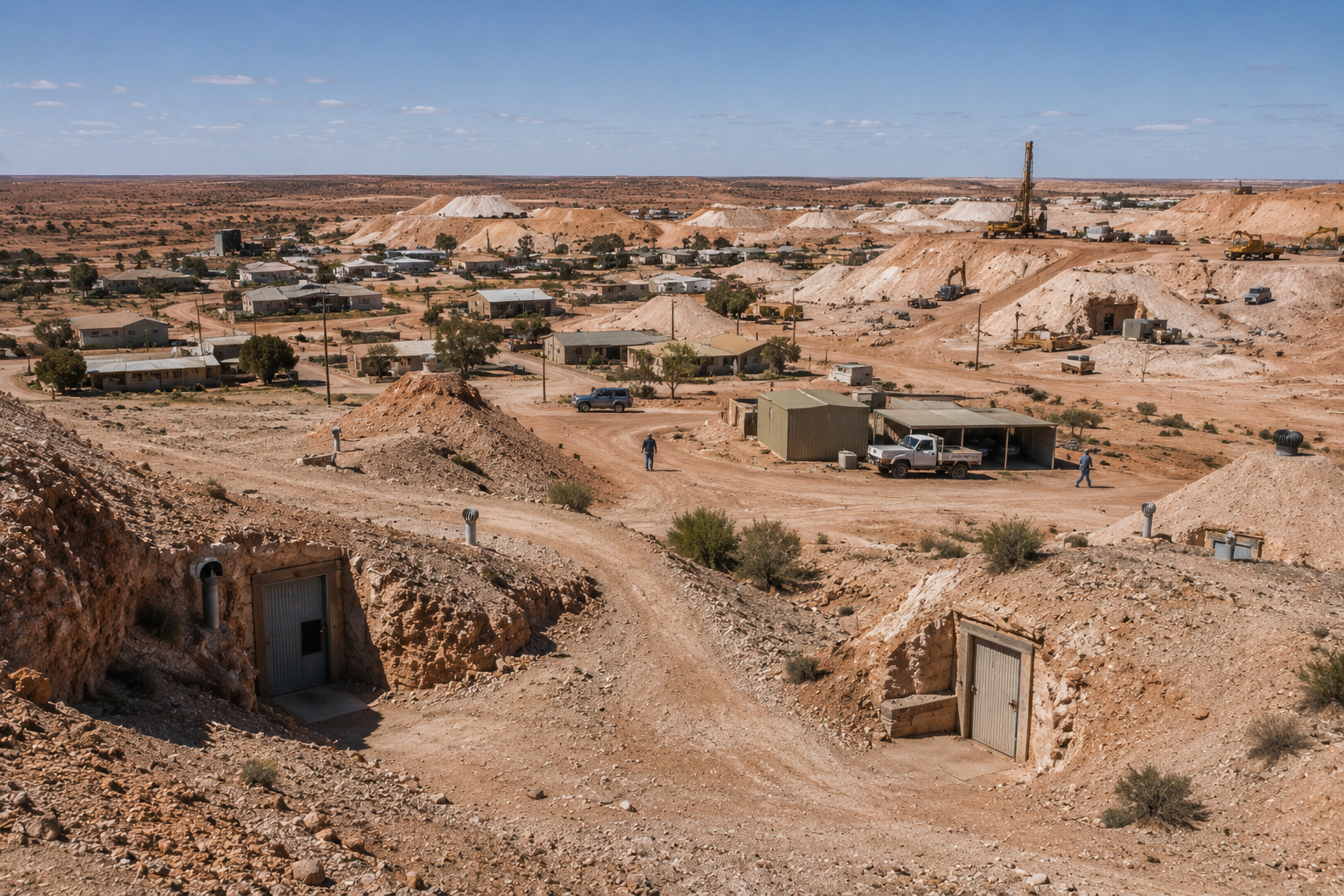
In South Australia’s remote outback, the Coober Pedy underground town does not look unusual from every angle. The settlement has roads, shops, homes, power infrastructure and the familiar low-rise appearance of an Australian country town, but a remarkable part of its life continues beneath the surface. Government information says many early Coober Pedy homes began as holes dug during the search for opal, and the town’s underground dwellings eventually developed into much larger and more comfortable homes, with the South Australian Department for Child Protection stating that about 60 percent of the population lives below ground in dugouts.
The reason is not mysterious once the environment is understood. Coober Pedy sits in an intensely arid part of South Australia where extreme heat, limited water and isolation shaped almost every aspect of early settlement, while the same geological conditions that made the region difficult to inhabit also made it valuable to miners searching for precious opal. The underground home became a solution to two problems at once: miners were already excavating the ground, and the resulting spaces offered a more stable environment than lightweight buildings exposed to the full force of the desert climate.
That combination created one of Australia’s most distinctive settlements. Coober Pedy is often described as an underground town, but it is better understood as a town built in two layers: an above-ground mining settlement shaped by roads, machinery and a harsh desert landscape, and a hidden domestic world of excavated rooms, churches, shops and communal spaces below the surface. Its underground architecture is therefore not an eccentric architectural experiment imposed on the desert; it grew directly from the mining economy and the practical demands of life in one of Australia’s most extreme inhabited environments.
The Opal Discovery That Created Coober Pedy
The story begins in 1915, when precious opal was discovered in what was then known as the Stuart Range Opal Field. The South Australian government records the discovery at Coober Pedy in 1915 and describes the area as the origin of what became the state’s most important precious-opal field, while the District Council of Coober Pedy dates the first discovery to February of that year by members of the New Colorado Prospecting Syndicate.
At first there was little about the place that suggested it would become a permanent settlement. The area was extremely isolated, surface water was scarce and prospectors had initially been searching for gold rather than expecting to establish a major mining community, so the earliest population was irregular and dependent on the fortunes of individual miners. The council’s history records that by around 1920, after favorable rainfall, several hundred miners had arrived and a more recognizable settlement had begun to form, complete with a store, post office and plans for an underground water tank.
The town’s name developed during those early years. The District Council records that the Progress Committee adopted the name Coober Pedy in 1920, explaining it through an Aboriginal expression commonly rendered as meaning something like “white man in a hole,” while the heritage record also documents variations in the interpretation and spelling of the underlying term. The competing translations are a reminder that place names crossing between languages and colonial records can acquire several forms, so the safest historical approach is to recognize the commonly cited meaning while avoiding the claim that there is only one uncontested translation.
The mining field grew because the opal itself was exceptional. South Australia’s Department for Energy and Mining explains that precious opal at Coober Pedy formed within weathered Cretaceous sediments, where silica-rich groundwater eventually produced opal over geological timescales, and the area went on to become the world’s largest producer of precious opal. What seems like a peculiar town-building strategy is therefore directly connected to the geology beneath it: the same ground provided both the mineral wealth that attracted people and the material they excavated to create their homes.
Why Did People Start Living Underground?
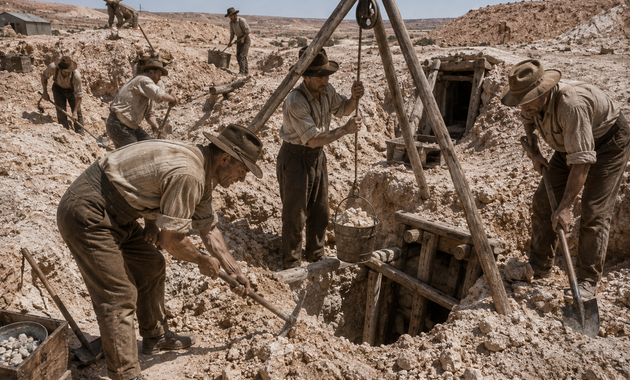
The first underground dwellings were closely tied to mining. Early miners often created excavations in the same ground where they were searching for opal, and some of those openings could be expanded into crude living spaces rather than discarded once the immediate mining work was finished. South Australian government information explicitly describes the early dugouts as holes dug during opal mining and notes that the earliest examples were small because manual excavation was physically demanding.
Climate made the idea even more attractive. Coober Pedy’s desert environment can produce punishing daytime temperatures, while the absence of substantial vegetation offers little natural shade, so a structure protected by a thick layer of earth can provide a far more stable interior environment than a thin-walled building exposed directly to the sun. The South Australian History Hub identifies underground housing at Coober Pedy as a distinctive response to desert conditions, while contemporary state information describes the evolution from primitive dugouts to deliberately planned underground homes.
There is also a practical economic explanation. Building a conventional house required materials that were not always easy or cheap to obtain in a remote mining settlement, whereas excavating into the local ground could transform mining labor into part of the construction process. A dugout still required structural judgment, ventilation, drainage, wiring and finishing, but the basic strategy made use of something Coober Pedy had in abundance: earth and rock.
The result was not an underground architecture that appeared fully formed. Early rooms could be crude, cramped and directly associated with mining, but later residents improved them by expanding chambers, installing electricity and plumbing, adding finished walls and creating multiple rooms. Over time, the dugout stopped being simply an improvised shelter and became a recognizable type of Coober Pedy housing.
What Is a Dugout?

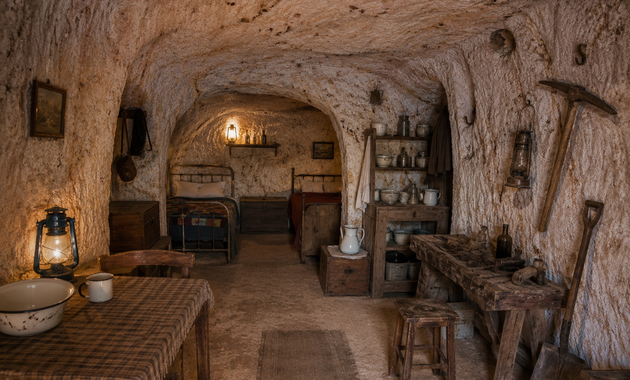
A Coober Pedy dugout is essentially a dwelling excavated into the ground, although the exact form varies considerably. Some are relatively modest spaces cut directly into hillsides or underground workings, while others contain bedrooms, living rooms, kitchens and other domestic spaces arranged behind an ordinary-looking entrance. The important distinction is that the living space is protected by the surrounding earth rather than standing entirely above it.
The heritage record shows just how significant the early form of this architecture has become. South Australia’s Heritage Places Database lists a three-roomed dugout on Hutchison Street as a State Heritage Place, describing it as one of the earliest surviving fully underground dwellings in the state and an important example of a construction technique associated with the early days of Coober Pedy’s opal industry. The listing also emphasizes that the technique is now unusual and is no longer commonly practiced in the same manual form.
The underground rooms are not simply caves in the popular sense. A successful dwelling requires controlled openings, structural stability, lighting, ventilation and access, and modern dugouts can be considerably more sophisticated than the small mining shelters of the early twentieth century. South Australian government material notes that some early underground homes have developed into luxurious modern residences, demonstrating how the original mining adaptation has evolved into a permanent architectural tradition.
That evolution is important because it explains why the town should not be imagined as a collection of primitive holes. Some historic dugouts preserve the roughness of the early mining era, while newer homes can contain comfortable interiors that would be difficult to distinguish from conventional houses once the visitor is inside. The architecture changes dramatically when the wall is no longer required to reveal whether it was excavated yesterday or decades ago.
The Town Grew Around Mining
Coober Pedy’s growth was uneven because the opal industry itself was unpredictable. The council’s history records that the population expanded during the early 1920s but that the field later experienced periods of decline, with only a small number of miners remaining during the 1940s before renewed discoveries helped revive activity in the following decade. This boom-and-bust pattern shaped the town’s physical character, because mining settlements tend to expand rapidly when a valuable deposit is found and contract when returns become uncertain.
Mechanization also changed what it meant to mine at Coober Pedy. South Australia’s Department for Energy and Mining explains that early extraction relied on picks, shovels and hand-operated winches before miners increasingly adopted machinery, including bulldozers to expose shallow opal levels and specialized equipment for deeper workings. Modern workings can involve bucket drills, tunneling machines, boggers and blowers that remove the excavated material from underground.
The landscape around the town consequently became inseparable from the mining process. The surface is marked by excavations, mullock heaps, tracks and disturbed ground, while beneath it are networks of tunnels and chambers representing different generations of mining. The state’s heritage assessment describes the modern opal fields as heavily shaped by drilling, excavation and mechanized mining, creating a landscape that can look almost lunar even though it is the product of industrial and individual mining activity rather than an extraterrestrial environment.
This makes Coober Pedy unusual among mining towns. In many settlements, the mine exists at the edge of the town and homes are built separately from the industrial workings, whereas in Coober Pedy the relationship between excavation and habitation became unusually intimate. The ground being removed in search of opal could also become the ground protecting a bedroom, lounge room or church, blurring the boundary between mine and building in a way that remains characteristic of the settlement.
People Built an Underground Community, Not Just Underground Houses
As the population grew, underground construction spread beyond private residences. Coober Pedy developed underground churches, shops, museums and other spaces, giving the settlement something closer to a subterranean civic life than a collection of isolated houses. South Australia’s Heritage Trail identifies several historic underground sites, including the oldest underground church in the town and early dugouts associated with pioneering residents.
The Old Timers Mine provides an especially useful glimpse of this evolution because its underground workings contain historic dugouts fitted out to represent different periods of Coober Pedy life, including the 1920s and 1970s. The South Australian History Network describes the site as a way to understand the town’s mining industry and underground culture, while preserving examples of the spaces in which people actually lived and worked.
Religious buildings are perhaps the most striking demonstration that underground living became socially normal rather than merely an emergency adaptation. An underground church required its builders to solve the same practical problems as residential dugouts, but on a communal scale, creating a space where people gathered for a purpose unrelated to mining. The existence of such buildings shows that residents had moved beyond simply surviving underground and had begun reproducing the institutions of an ordinary town beneath the surface.
The result is a peculiar inversion of a conventional settlement. In most Australian towns, the building is the obvious object and the landscape forms its surroundings, whereas in Coober Pedy the earth itself becomes part of the architecture. A visitor can enter what appears from outside to be an inconspicuous opening and discover rooms, corridors and communal spaces that are largely invisible from the road.
Why the Underground Is Better Suited to the Desert
The attraction of underground living goes beyond novelty. Earth surrounding an underground room can moderate temperature fluctuations, protecting interiors from the most severe daytime heat and the rapid changes that occur at the surface, which helps explain why dugout housing became an effective response to Coober Pedy’s environment. South Australian government sources explicitly connect the underground housing tradition with the desert conditions of the town.
This does not mean every underground space is automatically comfortable or safe. Poorly designed excavations can suffer from ventilation problems, moisture issues, unstable ceilings or inadequate access, and modern standards impose requirements that early miners would not have encountered. The survival of historic dugouts is therefore partly remarkable because it demonstrates construction techniques developed through experience in a difficult environment, rather than because any hole in the ground can function as a house.
The architectural advantage becomes easier to understand when compared with the alternatives available to early residents. A lightweight above-ground shelter could be built more quickly, but it would be exposed to direct solar heat and the severe temperature swings of the desert, while an underground chamber required considerable labor at the beginning but then benefited from the surrounding mass of earth. For miners already engaged in excavation, the trade-off could make practical sense.
The modern town still carries the evidence of that decision. Underground hotels, homes and other spaces have become part of the visitor experience, but their existence is rooted in ordinary problems that faced miners a century ago: heat, water, isolation, construction costs and the search for opal. Tourism did not invent underground Coober Pedy; it discovered how visually compelling a survival strategy could become.
The Water Problem Was Just as Important as the Heat
Heat is the most famous explanation for Coober Pedy’s underground homes, but water was equally important to the history of the settlement. The District Council records the early lack of surface water as one reason the settlement struggled to grow, and an underground water tank became an important piece of early infrastructure in 1922. The heritage trail still identifies the old water tank and water reserve as key parts of the town’s history.
This scarcity influenced everything from settlement size to mining activity. A place could contain valuable opal and still be difficult to inhabit if people could not reliably obtain drinking water, and early prospectors therefore depended on stored supplies and later infrastructure rather than an abundant local river or permanent freshwater source. The town’s development cannot be understood without recognizing that its underground lifestyle evolved within a broader struggle to make a very dry landscape habitable.
The challenge also helps explain why Coober Pedy remained isolated for so long. Transporting people, supplies, machinery and water through remote South Australia imposed costs that were very different from those faced by mining settlements near established agricultural districts or ports. Improvements in transportation helped, and the completion of the Trans-Australian Railway in 1917 improved access to the broader region, but Coober Pedy remained a remote outback community whose infrastructure had to be built around harsh environmental limits.
Today the water problem is mostly hidden from visitors because modern infrastructure has changed the practical conditions of daily life. The extraordinary underground architecture remains visible, but the fact that a permanent town could survive in such an arid location required decades of engineering, water management and adaptation alongside the more famous opal-mining story.
The Town Is Still a Mining Community
It would be misleading to describe Coober Pedy as an underground tourist attraction that merely remembers its mining past. Opal remains central to its identity and economy, and South Australia’s Department for Energy and Mining continues to list Coober Pedy as a proclaimed precious-stones field, with the town positioned within a large opal-producing region. Current regulation is governed by the Opal Mining Act 1995 and associated regulations, demonstrating that mining remains an active and regulated industry rather than simply a heritage display.
The methods have changed enormously since the earliest prospectors. Modern miners can use heavy machinery, drilling systems, tunneling equipment and specialized methods for removing mullock, while the basic geological challenge remains the same: locate the opal level and extract material without destroying the valuable stones. The state’s geological information describes opal occurring in seams and levels within weathered Cretaceous material, helping explain why excavation remains fundamental to the local economy.
Mining also continues to shape the appearance of the landscape. The surface is marked by mounds, tracks and excavated ground, making the area unlike most Australian desert towns, and the distribution of mine workings extends across many separate fields rather than one compact industrial pit. South Australia’s heritage assessment notes that Coober Pedy today comprises more than 50 opal fields spread across the region, demonstrating the scale of the mining landscape beyond the central township.
That continued mining helps explain why the town has resisted becoming a museum piece. Its underground architecture survives not simply because authorities decided to preserve an unusual past, but because the economic activity that created the landscape still exists. The town therefore offers something unusual for historians: a place where a century-old adaptation to mining and climate remains part of contemporary life rather than being separated neatly into “then” and “now.”
The Underground Town Became a Heritage Attraction
Tourism eventually turned Coober Pedy’s unusual architecture into one of South Australia’s most recognizable visitor experiences. The official South Australia tourism organization now promotes the settlement as an underground town with houses, hotels and shops beneath the desert, while historic attractions allow visitors to see early dugouts and mining spaces preserved for interpretation.
Heritage preservation is particularly valuable because many of the original structures were never intended to become historical exhibits. A working miner’s dwelling was simply a home, and a rough excavation was originally a practical answer to the immediate demands of settlement, so later preservation allows visitors to see forms of architecture that would otherwise be easy to lose as residents renovate or replace older spaces. The State Heritage Register’s listing of the three-roomed dugout reflects the rarity of these early examples and their importance to understanding the town’s development.
The heritage trail extends that historical experience beyond individual attractions. It identifies early graves, the old water tank, the original opal-field areas, historic dugouts, churches and other places that connect the present town to its mining beginnings, creating a network through which the underground landscape can be understood as a historical settlement rather than a collection of curiosities.
There is an important difference between seeing an underground building and understanding why it exists. A visitor entering a cool dugout on a hot afternoon experiences its immediate physical advantage, but the historical story becomes clearer when that room is connected to opal mining, water scarcity, remote transport, manual excavation and the decisions early residents made about how much effort to spend creating a tolerable life in the desert.
Coober Pedy and Other Remote Settlements
Coober Pedy belongs to a broader history of people adapting settlement patterns to environments that appear hostile to permanent habitation. The same basic question appears in very different places: how do people make a difficult environment livable without completely transforming it into something that resembles a more familiar landscape? Coober Pedy answered partly by moving the walls of the home into the earth rather than attempting to make the desert behave like an ordinary suburb.
That strategy gives the town an interesting connection with the broader subject of remote settlement. HiddenFrontiers’ article on why people live in the world’s most isolated villages examines communities that have adapted to severe geographic isolation through different combinations of architecture, economy and social organization, while Coober Pedy demonstrates an adaptation driven especially strongly by mining and climate.
It also differs from abandoned settlements created by catastrophe. A place such as Pripyat, the Soviet ghost town reclaimed by nature became empty because a technological disaster forced its population away, whereas Coober Pedy remains inhabited precisely because residents have developed ways to make the environment workable. In one case, the settlement was abandoned because the landscape became unsafe; in the other, architecture became a tool for negotiating the landscape’s difficulties.
This contrast helps prevent the common mistake of describing Coober Pedy as a ghost town beneath the desert. The town is not a ruin waiting to be rediscovered, and its underground spaces are not remnants of a civilization that disappeared. They are part of a living community whose unusual form developed from economic necessity and environmental adaptation and continues to serve residents and visitors today.
What Life Underground Is Really Like
The underground environment changes the experience of ordinary domestic life. Rooms excavated into the earth can remain relatively stable even when the surface is intensely hot, and the absence of direct sunlight creates a quiet interior atmosphere that is dramatically different from the bright, exposed Australian landscape outside. The architectural result can feel strange to visitors, but to residents the important qualities are practical ones: temperature moderation, privacy and the effective use of space already created through excavation.
The interiors can also be surprisingly ordinary. Modern dugouts may contain finished walls, electrical lighting, bathrooms, kitchens, bedrooms and comfortable furnishings, making the underground setting less dramatic once someone has settled inside. The novelty belongs mainly to the relationship between the interior and the surface above it, because the rooms function much like conventional homes while being physically embedded in the ground.
Historic dugouts tell a different story. Their rooms are generally smaller and more directly connected to the labor of mining, and some preserved examples reveal how little space early residents needed or could afford when excavation itself was exhausting work. The survival of these early homes provides a tangible record of the transition from mining shelter to deliberate underground architecture.
The underground environment also changes people’s relationship with the surface. Instead of treating the ground merely as something beneath a building, residents depend on the surrounding earth as part of the building’s performance, while the town’s visible landscape remains dominated by mining tracks, open desert and piles of excavated material. Coober Pedy therefore makes the boundary between natural environment and architecture unusually difficult to separate.
What Is Unique About Coober Pedy?
The unusual feature of Coober Pedy is not simply that some homes are underground. Underground construction exists elsewhere, including older dwellings, tunnels and modern earth-sheltered buildings, but in Coober Pedy the practice became closely intertwined with an entire mining settlement and developed into a recognizable community tradition. The State Heritage Register identifies the early dugout as a rare construction technique associated specifically with the town’s opal-mining history, while modern tourism presents a much broader network of underground buildings.
The town’s significance therefore comes from the combination of geology, climate and human adaptation. Opal created the economic reason to excavate, the desert created the environmental reason to remain underground, and decades of settlement turned those practical decisions into an architectural and cultural identity. Remove any one of those factors and Coober Pedy would look very different.
The survival of the tradition into the present is equally important. Some historic dugouts have been protected as heritage places, while new underground residences and visitor spaces continue to demonstrate that the idea remains useful, so Coober Pedy is neither an untouched relic nor a modern imitation of an old mining camp. It is a living settlement whose most distinctive feature developed organically from the circumstances of its first residents.
What We Know
Coober Pedy’s precious opal was discovered in 1915, and the settlement developed around the resulting opal field in the decades that followed. The state government identifies Coober Pedy as one of the world’s major precious-opal producing areas, while the District Council records the rapid growth of miners and basic civic infrastructure during the early 1920s.
Early underground dwellings developed partly from mining excavations, and the practice became attractive because the surrounding earth helped moderate the harsh desert environment. South Australian government information says that the early dugouts evolved from basic mining holes into increasingly sophisticated underground homes, while heritage records preserve some of the earliest surviving examples.
Coober Pedy remains an active mining community today, and the opal field continues to be regulated under South Australia’s modern mining laws. Tourism has expanded the town’s profile, but underground homes, churches and other spaces remain closely connected to the living history of the settlement rather than existing solely as museum displays.
What the “Underground Town” Description Gets Wrong
Calling Coober Pedy an underground town is useful because it captures the feature that attracts the most attention, but it can also create the false impression that the entire community exists below ground. The settlement has a conventional surface infrastructure as well, while underground spaces are distributed through the town and mining areas in different forms. The official South Australian tourism description itself presents Coober Pedy as a modern town whose underground houses, hotels and shops coexist with an extensive above-ground landscape.
The idea that everyone lives underground is also too simple. Current South Australian government information reports that around 60 percent of the population lives below the surface, which means a substantial minority still lives in conventional above-ground accommodation, while individual underground properties vary considerably in design and history. The proportion should therefore be treated as a current descriptive figure rather than as a permanent characteristic that has remained unchanged since the mining town was founded.
The “buried town” image can also obscure the Aboriginal history of the region. The District Council notes that Aboriginal people had moved through the area for thousands of years before the opal settlement appeared, with access to water influencing their presence in the landscape, so the history of Coober Pedy does not begin with European prospectors simply arriving on an empty desert.
That broader context matters because Coober Pedy’s story is not just about eccentric architecture. It is about how a twentieth-century mining community was built within a much older Australian landscape, using local geology to solve practical problems while developing a culture that eventually became recognizable around the world.
Why the Town Still Matters
Coober Pedy is sometimes presented as a curiosity: a place where people live underground because the surface is too hot, with opal mines scattered around a strange landscape of white spoil heaps and excavated ground. The facts are more interesting than that simplified image because the underground architecture reflects a century of adaptation, experimentation and economic change, from hand-dug mining shelters to modern residences and heritage sites.
The town also demonstrates that unusual architecture does not always begin with an architect. In Coober Pedy, the first designs were effectively produced by miners responding to the problems immediately in front of them: where to find opal, how to survive the heat and how to make a remote settlement workable with limited materials. Over generations, those practical solutions became a building tradition that now appears intentional even though it emerged from necessity.
Its continued existence makes the story particularly unusual. Many historic mining settlements became ghost towns once deposits declined, while Coober Pedy adapted through technological change, renewed opal production, improved infrastructure and tourism, allowing the underground tradition to remain part of everyday life. The town has changed considerably since 1915, but the fundamental relationship between digging, climate and habitation survives.
That is why Coober Pedy is more than a strange place to visit. It is an example of architecture shaped almost directly by geology, economics and climate, and it shows how people can turn the apparent disadvantages of an environment into resources. The desert made surface life difficult, the opal made excavation worthwhile, and the ground between the two became the foundation for a community that still exists today.
The Coober Pedy underground town therefore was never truly “buried” in the sense of a settlement lost beneath an unexpected disaster. Its hidden rooms were dug deliberately, first because miners were already cutting into the earth and later because generations of residents discovered that the underground environment could make life more comfortable, while heritage preservation has ensured that some of those early spaces remain available for study.
The most remarkable part is that the original logic still works. Visitors may come for the novelty of walking beneath the desert, but the town’s underground spaces began as practical responses to mining and climate and remain connected to a living community whose economy, architecture and identity have all grown from the same ground. Coober Pedy survives not because people escaped the desert, but because they learned how to live inside it.
SOURCES & REFERENCES
District Council of Coober Pedy — “History: Opal Capital of the World.”
Used for the settlement’s history, 1915 discovery, early population growth, water infrastructure, place-name history and Aboriginal context.
https://www.cooberpedy.sa.gov.au/explore-coober-pedy/history
South Australian Department for Energy and Mining — “Opal.”
Used for opal geology, the 1915 discovery, mining methods and the development of the Coober Pedy opal field.
https://www.energymining.sa.gov.au/industry/minerals-and-mining/mineral-commodities/opal
South Australian Department for Energy and Mining — “Opal Fields in South Australia.”
Used for current status and scale of the Coober Pedy precious-stones field.
https://www.energymining.sa.gov.au/industry/minerals-and-mining/mining/opal-mining/opal-fields-in-south-australia
South Australian Department for Energy and Mining — “Regulating Opal Mining.”
Used for current regulation under the Opal Mining Act and associated regulations.
https://energymining.sa.gov.au/industry/minerals-and-mining/mining/opal-mining/regulating-opal-mining
SA Heritage Places Database — “Three-roomed dugout, Lot 13 Hutchison Street, Coober Pedy.”
Used for the heritage significance and construction history of an early fully underground dwelling.
https://maps.sa.gov.au/heritagesearch/HeritageItem.aspx?p_heritageno=16291
South Australian History Hub — “Housing.”
Used for the relationship between Coober Pedy underground housing and adaptation to desert conditions.
https://sahistoryhub.history.sa.gov.au/subjects/housing/
South Australia Government — Coober Pedy regional profile.
Used for current information on underground housing and the proportion of residents reported as living below ground.
https://www.childprotection.sa.gov.au/work-with-us/working-in-regional-south-australia/coober-pedy
South Australian History Network — “Old Timers Mine, Coober Pedy.”
Used for historic dugouts, mining heritage and preserved examples of underground living.
https://explore.history.sa.gov.au/organisation/old-timers-mine-coober-pedy/
Coober Pedy Heritage Trail — Visitor Guide.
Used for early underground sites, the 1922 water tank, churches and historic dugouts.
https://www.cooberpedy.com/wp-content/uploads/2024/08/2024-VGuide-Final-Web.pdf
FAQ
Why do people live underground in Coober Pedy?
People began living underground partly because early miners were already excavating the ground while searching for opal, making it practical to expand some excavations into shelters and homes. Underground spaces also provide useful protection from the extreme desert climate, and modern South Australian government information continues to describe dugouts as a major part of local housing.
When was Coober Pedy founded?
The opal discovery that triggered the settlement dates to 1915, while the town developed during the following years as more miners arrived and basic services were established. The District Council records that the name Coober Pedy was adopted in 1920, with water infrastructure and a growing mining community following during the early 1920s.
Are Coober Pedy’s underground homes actually caves?
Not in the ordinary sense. Dugouts are excavated living spaces created within the local ground, often originating from mining workings, and many have been expanded and fitted with conventional domestic rooms and services. Heritage-listed examples demonstrate that the earliest manually excavated dwellings were deliberately adapted for habitation rather than being natural caves.
Is the entire town underground?
No. Coober Pedy has normal above-ground roads, buildings and infrastructure as well as underground residences and commercial spaces. The South Australian government currently reports that approximately 60 percent of the population lives in dugouts, so underground housing is widespread but does not describe every resident or every building.
Why is Coober Pedy associated with opal?
Precious opal was discovered there in 1915, and the region developed into a major opal-producing field. South Australia’s Department for Energy and Mining describes Coober Pedy as the site of the state’s world-renowned opal field and explains that miners have used increasingly mechanized methods to reach and extract the opal-bearing levels.
Does Coober Pedy still have active opal mining?
Yes. Coober Pedy remains within a proclaimed precious-stones field, and opal mining is still regulated under South Australian legislation. Modern operations can involve heavy machinery, drilling and tunneling technology, making the contemporary mining landscape very different from the hand-dug workings of the early twentieth century.
Can visitors see underground homes and buildings?
Yes. Historic dugouts, underground churches and mining sites form part of Coober Pedy’s heritage and tourism infrastructure, and the town’s heritage trail identifies several underground locations connected with its early history. The Old Timers Mine also preserves underground spaces fitted out to illustrate different periods of local life.
Why is Coober Pedy considered historically important?
Its significance comes from the unusual combination of mining, climate and architecture. The settlement demonstrates how residents transformed mining excavations into homes and communal spaces and developed an underground building tradition that remains part of a living Australian community more than a century after the first opal discovery.
FEATURED IMAGE
Prompt:
Filename:
coober-pedy-underground-town-australia.webp
ALT Text:
Coober Pedy underground town in South Australia surrounded by opal mine workings
Image Title:
Coober Pedy Beneath the Desert
Image Caption:
An interpretive view of Coober Pedy, where opal mining and underground housing became defining features of the South Australian outback town.
Image Description:
Photorealistic AI reconstruction showing the relationship between Coober Pedy’s surface mining landscape and its famous underground dwellings. The image is an interpretive visualization, not an original photograph.
SUPPORTING IMAGE 1
Prompt:
Filename:
historic-coober-pedy-dugout-home.webp
ALT Text:
Historic Coober Pedy dugout home carved into the desert
Image Title:
Inside an Early Coober Pedy Dugout
Image Caption:
A reconstruction of the modest underground dwellings developed by early Coober Pedy miners.
Image Description:
Photorealistic AI reconstruction of an early Coober Pedy underground home, showing how mining excavation evolved into domestic space. The scene is interpretive and is not an original historical photograph.
Placement:
After the section “”
SUPPORTING IMAGE 2
Prompt:
Filename:
coober-pedy-opal-miners-1920s.webp
ALT Text:
Opal miners excavating the Coober Pedy field in the 1920s
Image Title:
The Miners Who Built the Town
Image Caption:
An interpretive reconstruction of early Coober Pedy miners manually excavating the opal field.
Image Description:
Photorealistic AI reconstruction showing early twentieth-century opal mining techniques that helped shape Coober Pedy’s underground architecture. The scene represents the period generally rather than a specific documented individual or photograph.
Placement:
After the section “.”