Why Did Ancient Romans Fear Certain Forests?
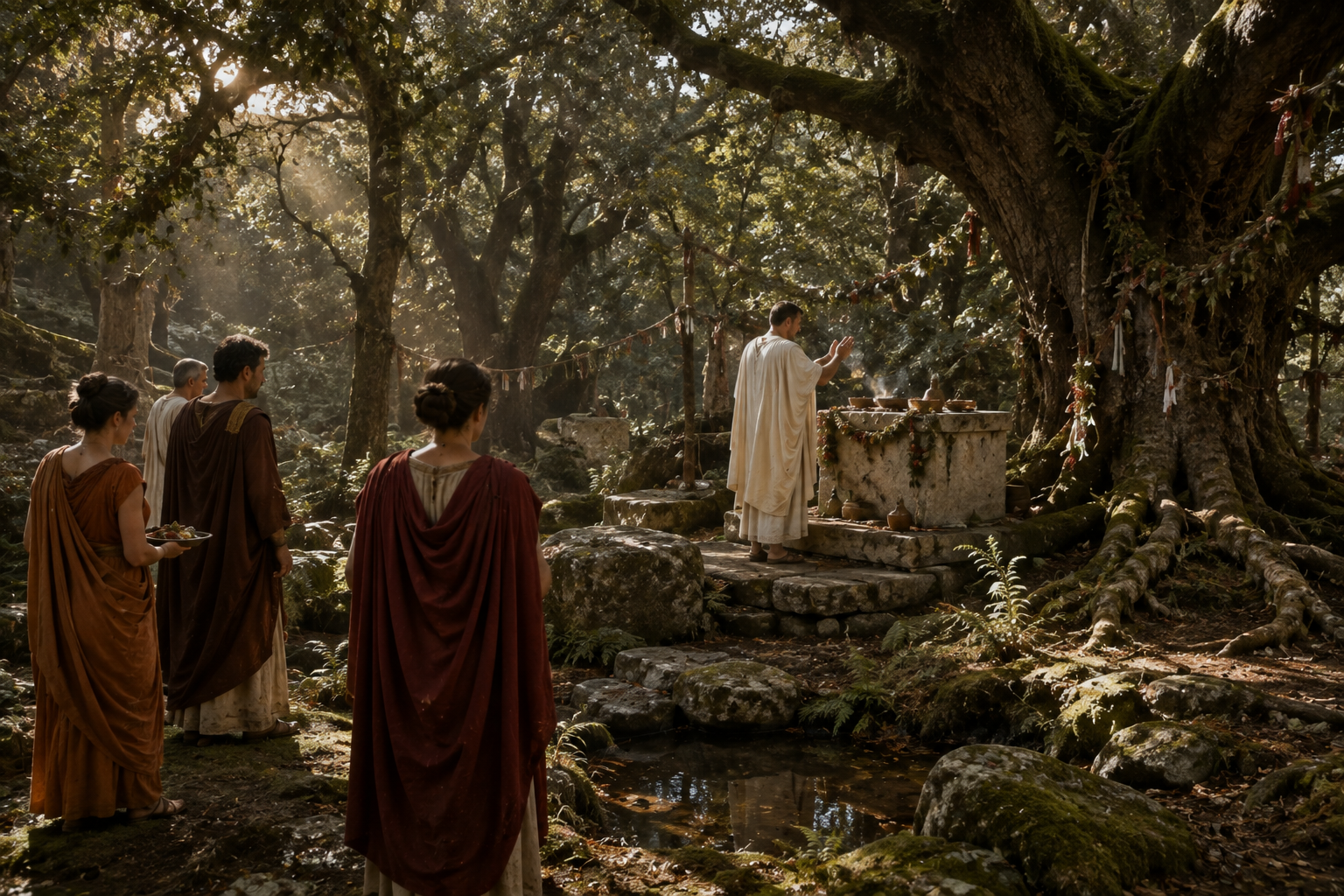
Around 160 BCE, the Roman farmer Marcus Porcius Cato preserved a remarkably specific ritual for anyone who wanted to thin a sacred grove. Before cutting the trees, the landowner was instructed to sacrifice a pig and address the deity of the grove, asking forgiveness and protection for himself, his household, and his children. If the ground was to be cleared for cultivation, Cato prescribed another expiatory sacrifice before the work began, showing that cutting trees could be treated as a religious act requiring permission rather than as ordinary farm labor.
These instructions provide a better starting point for understanding Roman sacred forests than the familiar image of frightened Romans refusing to enter the woods. The Romans did use forests for timber, hunting, agriculture, travel, and military operations, and they certainly did not regard every wooded landscape as forbidden. Yet some groves were places where ordinary rules changed because the landscape itself was understood to be connected with divine power, ancestral tradition, spirits, ritual obligations, or dangers that were difficult to control.
The important distinction is therefore between the forest as a physical environment and the forest as a sacred landscape. A stand of trees could be ordinary woodland one day and a protected lucus in another context, with rituals, restrictions, stories, and divine associations transforming how people behaved there. Roman writers also connected dark woods with wild animals, mysterious sounds, supernatural beings, and the boundaries of civilized space, which helps explain why some forests could inspire both reverence and genuine unease.
The Roman Forest Was More Than Trees
Latin had several words for wooded places, and the distinctions were not always perfectly consistent in ancient usage. Silva could refer broadly to woodland or forest, while nemus often evoked a grove or wooded place, particularly in religious contexts, and lucus became strongly associated with sacred groves. Modern scholars caution that ancient authors did not always use these terms with the consistency modern classifications might suggest, so the vocabulary should be treated as evidence of overlapping ideas rather than as a rigid Roman system of forest categories.
The lucus was important because it was not simply an empty patch of nature. A sacred grove could contain an altar, shrine, temple, spring, monument, or other features that connected the trees with ritual practice, while legal rules could explicitly prohibit unauthorized cutting or removal of material. The archaeological and epigraphic evidence therefore shows that some Roman communities treated sacred woodland as protected property belonging, in religious terms, to a deity or sacred institution.
That protection could be remarkably concrete. The so-called Lex Luci Spoletina, preserved in an inscription from ancient Spoletium, prohibited people from violating the grove, removing its wood, or cutting trees except under specified ritual circumstances, while violations could require an expiatory sacrifice and a monetary fine. The law is especially valuable because it demonstrates that reverence for sacred woodland was not merely a poetic idea; in at least some communities, it had legal consequences.
A Roman who entered such a place therefore entered a landscape governed by another kind of authority. The danger was not necessarily that the trees themselves were physically hostile, but that the space was believed to belong to powers that humans were expected to respect. Breaking the rules could mean offending a deity, contaminating a sacred place, or inviting consequences that were understood through the language of Roman religion.
Why Darkness Made the Woods Feel Sacred
Roman literature repeatedly associates ancient woods with darkness, isolation, age, and an unsettling sense of presence. In his Natural History, Pliny the Elder says that trees were once the temples of the gods and explains that Romans could revere sacred groves and the silence within them as profoundly as statues made of gold and ivory. He also associates different trees with particular divinities and describes Silvani, Fauns, and woodland goddesses as beings assigned to the forests.
Seneca makes the same psychological connection in a more personal way. In Letter 41, he imagines a traveler entering a dense grove of ancient trees whose branches block the sky, emphasizing the height, isolation, and deep shade of the place before suggesting that such qualities could convince a person that a divinity was present. The passage is philosophical rather than a straightforward ethnographic description, but it is important evidence for how a cultivated Roman writer could use the physical experience of an ancient woodland to evoke the presence of the divine.
The darkness mattered because Roman sacred space was not always separated from nature by monumental architecture. A temple built from stone clearly announced itself as a human construction, but a grove could seem powerful precisely because its most striking features were natural: old trees, shadows, springs, rocks, animals, and silence. The landscape itself became part of the religious experience, so the absence of buildings did not imply the absence of sacred authority.
There was another psychological element as well. Woods hid things, and what was hidden could be dangerous, sacred, or both, especially in a society where unfamiliar sounds and isolated landscapes could be interpreted through stories about Fauns, Nymphs, spirits, or other beings. Lucretius later argued that human fear of the gods had helped give sacred status to groves, lakes, temples, and images, revealing that even an openly philosophical Roman could recognize how strongly landscapes contributed to religious imagination.
Silvanus, Fauns, Nymphs and the Other Inhabitants of the Woods
Roman forests were populated conceptually as well as physically. Pliny explicitly names Silvani, Fauns, and various female divinities as beings associated with woodland, while Latin poetry repeatedly places supernatural figures in groves, mountains, springs, and remote countryside. These associations helped turn the forest from a purely economic resource into a place where humans might encounter forces that belonged to a different order of existence.
Silvanus was particularly suited to this environment because his name itself is connected to woodland. He belonged to the world outside the formal urban center, and his presence reflects an important Roman distinction between the cultivated, ordered environment of farms and settlements and landscapes that remained less controlled. The boundary was never absolute, because Romans farmed and harvested timber, but the cultural distinction between managed land and wild space remained significant.
Fauns and Nymphs added another layer because Roman literary traditions often imagined natural places as inhabited by beings whose behavior did not follow ordinary human rules. Echoes in valleys, strange noises in forests, and unexpected encounters with animals could be interpreted through these stories, while poets could use the same material metaphorically to explore fear, desire, disorder, and the limits of civilization. Lucretius even explains how isolated sounds and echoes could generate stories about Fauns, Pan, and Nymphs among people living near the countryside.
This does not mean every Roman who heard a branch crack immediately believed a Faun was hiding nearby. Roman religion was diverse, practical, and full of intellectual disagreement, and skeptical writers could question supernatural interpretations while still participating in traditional rituals. The more defensible conclusion is that the cultural vocabulary of spirits and woodland gods provided Romans with a way to understand why certain natural environments felt unusually powerful or unsettling.
Roman Sacred Forests Were Protected by Ritual and Law

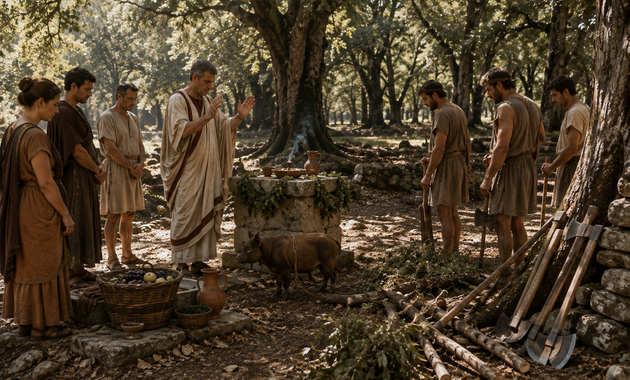
The religious significance of woodland became especially clear when humans needed to alter it. Cato’s agricultural instructions reveal that cutting trees was not automatically forbidden, but that work in a sacred grove required ritual recognition of the deity whose space was being disturbed. The sacrifice functioned as an act of expiation, acknowledging that practical human activity had crossed into a realm where religious obligations had to be observed.
The inscription known as the Lex Luci Spoletina takes this principle further by defining prohibited behavior. It regulates the removal of wood and cutting of trees within a sacred grove and establishes penalties for violations, demonstrating that sacred woodland could possess a protected status recognized by civic authority. The existence of such regulations also suggests that the rules were necessary because people had practical reasons to enter, cut, collect, or exploit the material resources of wooded land.
This is an important corrective to the idea that Romans simply worshipped nature in a vague sense. Their relationship with sacred groves was institutional as well as emotional, involving priests, sacrifices, festivals, legal restrictions, property concepts, and local authorities. Sacred woodland could therefore be simultaneously a natural environment, a religious site, an economic resource, and a legally protected place.
The Roman festival of Lucaria offers another example. The Oxford Classical Dictionary identifies Lucaria as a festival celebrated on July 19 and 21 in a grove associated with the Tiber and the Via Salaria, traditionally connected to Roman survival during the Gallic sack. The festival demonstrates that sacred groves could be woven into the Roman civic calendar rather than existing as isolated superstitious refuges outside mainstream religion.
Diana’s Forest at Lake Nemi
One of the most famous sacred wooded places in Roman Italy was the sanctuary of Diana Nemorensis at Lake Nemi. The sanctuary developed in a wooded crater landscape outside Rome, and archaeological evidence indicates a long history of worship that began well before the Roman Empire, eventually becoming a major monumental complex with temples, terraces, priestly quarters, baths, and other structures.
The setting mattered. Diana was strongly associated with wild places, hunting, animals, childbirth, and the landscape beyond the tightly regulated center of the city, while the sacred grove at Nemi retained an important relationship with the surrounding woodland and lake. Archaeologists and historians therefore study the sanctuary not simply as a temple but as a sacred landscape in which trees, water, architecture, ritual and mythology formed a connected environment.
The famous rex Nemorensis, the “king of the grove,” adds another element of fear to the story, because ancient traditions described the priesthood as an office that could be seized through violent succession. Later sources describe an armed priest who remained ready to defend his position against a challenger, creating one of antiquity’s most unsettling combinations of religion, woodland and political power. Modern scholarship is careful about reconstructing the earliest history of the cult, but the tradition itself demonstrates how the grove could become a stage for narratives about danger and sacred authority.
The sanctuary eventually became monumental, and that transformation tells us something important about Roman religion. Sacred landscapes did not necessarily remain primitive or untouched; an ancient grove could acquire temples, terraces, fountains, theaters, baths, votive spaces, and increasingly elaborate architectural forms while retaining its identity as a sacred wooded place. Nature and architecture were therefore not opposites in Roman religion, because architecture could be used to frame, organize, and intensify a landscape that was already considered sacred.
When a Forest Became a Place of Divine Punishment
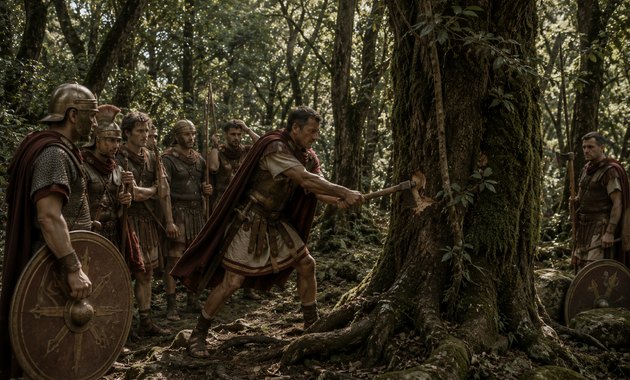
Roman literature repeatedly used the destruction of sacred woodland as a warning about what happened when humans ignored divine boundaries. Ovid’s story of Erysichthon is one of the clearest examples: the king orders the destruction of a sacred grove belonging to Ceres, and even the enormous sacred oak at its center is protected by wreaths, votive offerings, and the presence of Dryads. When the woodcutters hesitate, Erysichthon takes the axe himself, making the violation an act of deliberate impiety rather than an accidental trespass.
The myth is not straightforward historical evidence for what ordinary Roman farmers literally believed would happen if they cut a tree. Ovid was writing poetry, and myths deliberately dramatize religious principles through extraordinary events, but the story nevertheless reflects a cultural understanding in which sacred trees could represent a boundary that humans violated at their peril. The punishment of Erysichthon transforms environmental destruction into a moral offense, making the forest a place where divine justice can become visible.
A similar tension appears in Lucan’s account of Caesar’s men cutting a sacred grove near Massilia during the civil war. Lucan describes the soldiers as reluctant to strike the trees because the grove’s darkness and sacred reputation make them fear divine retaliation, until Caesar himself takes an axe and cuts a great tree, declaring that the responsibility for the act belongs to him. The episode is literary and deliberately dramatic, but it shows how Roman audiences could recognize the idea that entering or destroying a sacred grove meant confronting forces that ordinary people might hesitate to challenge.
Lucan’s scene also introduces a political dimension. Caesar’s willingness to violate the grove distinguishes the authority of the military leader from the caution of ordinary soldiers, allowing the poet to explore impiety, power, and the consequences of civil war through the destruction of a sacred landscape. The forest therefore becomes a test of competing forms of authority, with religious tradition represented by the frightened soldiers and political power represented by Caesar’s axe.
Forests Were Dangerous for Practical Reasons Too
Not every Roman fear of woodland came from religion. Forests were home to wild animals, difficult terrain, hidden enemies, and the logistical problems that came with moving armies through dense vegetation, making them genuinely dangerous places even without supernatural beliefs. A Cambridge study of Roman environmental history notes that Roman writers frequently described forests with words associated with wildness, horror, darkness, and concealment, while Roman armies faced particular strategic challenges in wooded regions such as Gaul, Germany, and Britain.
Military experience reinforced this perception. Dense woodland limited visibility and made it easier for enemies to hide, while narrow paths and unfamiliar terrain could disrupt Roman formations and supply lines, meaning that a forest could erase some of the advantages of disciplined military organization. The disaster of Varus’s army in the Teutoburg region in AD 9 became an enduring reminder of how vulnerable Roman forces could become when the landscape favored their opponents.
The danger was therefore partly environmental and partly cultural. A Roman entering an unfamiliar forest could reasonably expect wild animals, difficult navigation, unstable paths, weather, ambush, and isolation, while stories about gods and spirits added another layer of uncertainty to a landscape already difficult to control. The supernatural did not have to replace practical fear; the two forms of anxiety could reinforce each other.
This helps explain why the Roman imagination often contrasted forests with civilized spaces. Roads, farms, towns, walls, temples, and military camps represented environments that Roman institutions could measure and regulate, whereas deep woodland represented an area where visibility, movement, ownership, and human authority became less certain. The forest was not necessarily outside civilization altogether, but it marked a boundary where civilization’s control became less reliable.
The Romans Did Not Hate Forests
It would be misleading to conclude that Romans simply feared trees or wanted to eliminate forests. Roman society depended heavily on timber for ships, construction, tools, fuel, agriculture, and countless other purposes, while literary sources also praised beautiful landscapes, shaded groves, springs, gardens, and rural retreats. The same culture that could portray a dark wood as terrifying could also deliberately create wooded walks and plant large numbers of trees in the city.
The apparent contradiction disappears once sacredness and usefulness are separated. A Roman could cut ordinary timber for practical purposes while treating a particular grove as inviolable, just as a modern society can allow logging in one area while protecting another landscape as a cemetery, monument, reserve, or religious site. Sacredness was attached to particular places, trees, deities, traditions, and boundaries rather than to every forest in the Roman world.
Roman religion also included a strong tradition of negotiating with divine powers rather than simply avoiding them. Sacrifice, prayer, ritual formulas, festivals, and expiation provided ways for people to enter spaces, perform necessary work, and repair relationships after accidental or deliberate violations. Cato’s instructions are revealing precisely because they show a farmer doing something practical while acknowledging that practical work could have religious consequences.
This is why the better question is not “Why were Romans afraid of forests?” but “Why did certain Roman landscapes demand a different kind of behavior?” The answer involves sacred ownership, divine presence, inherited ritual rules, physical danger, wild animals, military vulnerability, and the cultural memory of places where human authority seemed incomplete. The forest became frightening when it was understood as inhabited, protected, or beyond ordinary control, and that distinction could change the meaning of the same trees from one location to another.
What Sacred Forests Reveal About Roman Religion
Roman sacred groves are useful because they show how Roman religion worked through physical space. The gods were not confined to temples in cities; divine presence could also be associated with trees, springs, lakes, caves, hills, boundaries, and other natural features, creating what modern scholars describe as sacred landscapes. The resulting religious geography was layered, with monumental architecture sometimes growing around places that had already been considered sacred for generations.
The forest also offered a different experience from the political center of Rome. In the city, religion could be displayed through temples, processions, magistrates, priestly colleges, inscriptions, and public festivals, while a grove could communicate sacredness through silence, age, darkness, and the apparent absence of human construction. Pliny’s description of sacred groves being worthy of reverence alongside gold and ivory statues captures the cultural significance of a form of religious space that did not need monumental architecture to feel powerful.
This relationship between landscape and belief also helps explain why Roman literature returns so frequently to woods. A forest was an ideal setting for encounters between humans and gods, hunters and animals, soldiers and enemies, heroes and monsters, or ordinary travelers and the unknown, because it represented a physical environment where normal assumptions could be suspended. The woods were therefore not merely scenery in Roman poetry; they were a narrative device for exploring danger, transformation, religious transgression, and the limits of human control.
The history of Roman sacred forests also reminds us that ancient people did not divide nature and religion in the same way modern societies often do. A grove could be simultaneously habitat, resource, shrine, legal boundary, mythological setting, and political symbol, with none of those identities necessarily canceling the others. That is why the Roman attitude toward forests appears contradictory when reduced to a simple question of fear: reverence, use, danger, beauty, and sacred obligation could all occupy the same landscape.
How Much Did Romans Really Fear the Woods?
The evidence supports a qualified answer rather than a sweeping claim. Some Roman writers clearly describe forests as frightening or mysterious, sacred laws protected particular groves, agricultural rituals required expiation before cutting sacred woodland, and myths and poems repeatedly depict violations of forests as acts that can provoke divine punishment. At the same time, Romans routinely entered forests, harvested timber, hunted animals, traveled through wooded regions, cultivated land, and transformed sacred groves into monumental sanctuaries.
Fear was therefore situational. A dark sacred grove associated with a deity was not equivalent to every patch of woodland, and a dangerous forest on a military frontier posed different problems from a sanctuary at Lake Nemi, even though both could inspire anxiety. The Roman world contained many kinds of wooded places, and the meaning attached to each depended on religion, geography, politics, economics, and local tradition.
The idea becomes clearer when compared with other societies that attach cultural significance to landscapes. HiddenFrontiers’ article on medieval animal trials explores a different historical setting in which humans used religious and legal frameworks to interpret threats from the nonhuman world, while the Roman evidence shows that forests could be treated through similar combinations of ritual, authority, and inherited belief even when no animal or person was being prosecuted.
The comparison is not meant to suggest that Roman religion and medieval Christianity were the same. It shows instead that societies often create formal ways of dealing with parts of nature that seem powerful, dangerous, or difficult to control, whether through sacrifice, law, ritual, storytelling, or religious interpretation. The Roman sacred grove belonged to that broader human tendency, but its particular form was shaped by Roman ideas about gods, place, community, and the boundaries between cultivated life and wilderness.
The Forest at the Edge of Civilization
Ancient Roman forests occupied an unusual place in the imagination because they stood between two worlds. They were economically valuable and physically familiar, yet they could also be remote, shadowed, difficult to navigate, and associated with gods whose presence was believed to demand respect. This combination meant that the woods could represent both a resource civilization needed and a space civilization could never completely master.
That tension is visible in Roman literature from very different periods and genres. Cato approaches the woodland as a farmer who needs to alter it while carefully observing ritual obligations, Pliny looks backward at a world in which trees themselves were temples, Seneca uses the ancient grove as an image of divine presence, and Lucan turns the destruction of a sacred forest into a political and religious drama. Their purposes differ, but they repeatedly return to the same underlying idea: some woods were not empty spaces waiting to be used.
That idea also explains why cutting down a sacred tree could carry a weight far greater than the loss of timber. The act crossed a boundary between practical human needs and a place that had been assigned to a deity, and ritual existed partly to acknowledge that boundary before or after it was crossed. In Roman terms, the problem was not simply that trees were alive; it was that a particular grove had acquired a religious relationship with powers beyond the human community.
The Roman fear of certain forests was therefore not a fear of nature in the modern environmental sense. It was a recognition that some landscapes were charged with meaning, danger, memory, and divine authority, and that entering them required a different set of expectations from entering a farm, street, marketplace, or military camp. Once the forest is understood this way, the ancient stories of sacred trees, mysterious groves, woodland gods, ritual sacrifices, and divine punishment stop looking like unrelated superstitions and become parts of a coherent way of organizing the natural world.
The most revealing evidence may be Cato’s simple instruction to sacrifice before cutting. It shows that the Roman response to a sacred forest was not necessarily to leave it untouched forever, but to recognize that human activity had entered a space where permission, ritual, and responsibility mattered. The woods could feed a community, provide timber, shelter animals, mark a sanctuary, or hide an enemy, yet in certain places the same trees also belonged to a religious world that humans were expected to approach with caution.
That is why ancient Roman forests could be beautiful, useful, sacred, and frightening at the same time, and why the question of whether Romans “feared” them has no simple yes-or-no answer. Their real concern was not the forest as such but the forces, dangers, memories, and obligations that particular forests were believed to contain, and that understanding helps explain why a stand of trees could sometimes function as a temple, a legal boundary, a military hazard, and a place where the gods were thought to be unusually close.
SOURCES & REFERENCES
Marcus Porcius Cato — De Agricultura, §§139–140.
Primary source for Roman ritual procedures before thinning a sacred grove or clearing land. Cato, On Agriculture, §§139–141
Pliny the Elder — Natural History, Book XII, Chapter 2.
Primary source for Roman ideas about trees as ancient temples, sacred groves, divine associations, Silvani, Fauns, and woodland goddesses. Pliny, Natural History XII.2
Seneca the Younger — Moral Letters to Lucilius, Letter 41.
Primary source for the philosophical description of ancient groves as places that could evoke divine presence through their height, darkness, isolation, and silence. Seneca, Letter 41
Oxford Classical Dictionary — C. Robert Phillips, “Lucaria,” 2016.
Used for the Roman festival of Lucaria and its relationship to the sacred grove along the Via Salaria. Oxford Classical Dictionary — Lucaria
Christopher H. Hallett — “The Wood Comes to the City: Ancient Trees, Sacred Groves, and the ‘Greening’ of Early Augustan Rome,” Religion in the Roman Empire, 2021/2022.
Used for the relationship between sacred groves, trees, Augustan religious revival, and urban Rome. Hallett, The Wood Comes to the City
C. M. C. Green — Roman Religion and the Cult of Diana at Aricia. Cambridge University Press.
Used for Diana Nemorensis, the sanctuary at Lake Nemi, sacred-space terminology, and the historical development of the cult. Cambridge — Roman Religion and the Cult of Diana at Aricia
Filippo Coarelli — “Le sanctuaire de Diana Nemorensis: nouvelles découvertes,” Comptes rendus de l’Académie des Inscriptions et Belles-Lettres, 2012.
Used for archaeological and historical context concerning the sanctuary at Nemi. Académie des Inscriptions — Diana Nemorensis
Lucretius — De Rerum Natura, Book V.
Primary source for ancient explanations of the origins of fear of the gods and the associations among groves, lakes, natural landscapes, and supernatural beliefs. Perseus — Lucretius, Book V
Matheus Trevizam — “O bosque na Literatura latina: respeito ou violações ao sagrado,” CODEX, 2023.
Used for the broader literary interpretation of Roman sacred woodland, including Cato, Virgil, Ovid, and Lucan. CODEX — O bosque na Literatura latina
Lex Luci Spoletina — 3rd-century BCE sacred-grove regulations.
Used for the legal protection of sacred woodland and penalties for unauthorized cutting or removal of material. Lex Luci Spoletina — University of Grenoble Roman Law Collection
FAQ
Did ancient Romans really fear forests?
Some Roman writers clearly associated certain forests with fear, darkness, wild animals, mysterious beings, and divine power, but it would be inaccurate to say that Romans universally feared forests. Romans regularly used woodland for timber, agriculture, hunting, travel, and military purposes, while particular groves could be considered sacred and therefore approached with much greater caution.
What was a Roman sacred grove called?
The Latin terms lucus and nemus are commonly associated with sacred wooded places, although ancient writers did not always use the words with strict consistency. A lucus could be a grove associated with a deity and protected through ritual and legal restrictions, while nemus often carried the sense of a grove or wooded sanctuary, particularly in connection with places such as Diana’s sanctuary at Nemi.
Which Roman gods were associated with forests?
Several divine figures had strong woodland associations, including Silvanus, Fauns, Nymphs, and Diana, particularly in the form of Diana Nemorensis at Lake Nemi. Pliny also lists particular trees as associated with specific gods, showing that Roman religious ideas could connect individual species and particular wooded landscapes with divine identities.
Why did Romans sacrifice before cutting trees?
Cato’s agricultural instructions specify an expiatory sacrifice before thinning a sacred grove or clearing land within one, followed by a prayer to the deity associated with the grove. The ritual recognized that practical agricultural work could disturb a sacred place and therefore required the farmer to acknowledge the divine authority attached to the landscape.
Was cutting down a sacred tree actually illegal?
In some places, sacred woodland was protected through explicit rules. The Lex Luci Spoletina, an inscription from ancient Spoletium, restricted violation of the grove and the removal of its wood and prescribed expiation and financial penalties for certain violations, providing unusually clear evidence that sacred woodland could have legal as well as religious protection.
What was special about Diana’s forest at Nemi?
Diana Nemorensis was worshipped at a major sanctuary beside Lake Nemi in the Alban Hills, in a wooded landscape that had sacred significance before the sanctuary became a monumental complex. The site eventually contained temples, terraces, priestly facilities, baths, theaters, fountains, and other structures, but the relationship between the sanctuary and its sacred grove remained fundamental to its identity.
Did Romans believe forests contained spirits?
Roman literature associates wooded places with Silvani, Fauns, Nymphs, and other divine or semi-divine beings, while writers such as Pliny and Seneca describe sacred groves as places capable of evoking a sense of divine presence. That literary evidence does not mean every Roman interpreted every forest supernaturally, but it shows that woodland spirits and divine inhabitants were established elements of Roman religious and literary imagination.
Were all Roman forests considered sacred?
No. Sacred status applied to particular places rather than to every forest, and Romans routinely exploited ordinary woodland for timber, agriculture, hunting, and construction. The important distinction was between ordinary forest and particular groves that had been consecrated, associated with a deity, protected by custom or law, or incorporated into a sanctuary.