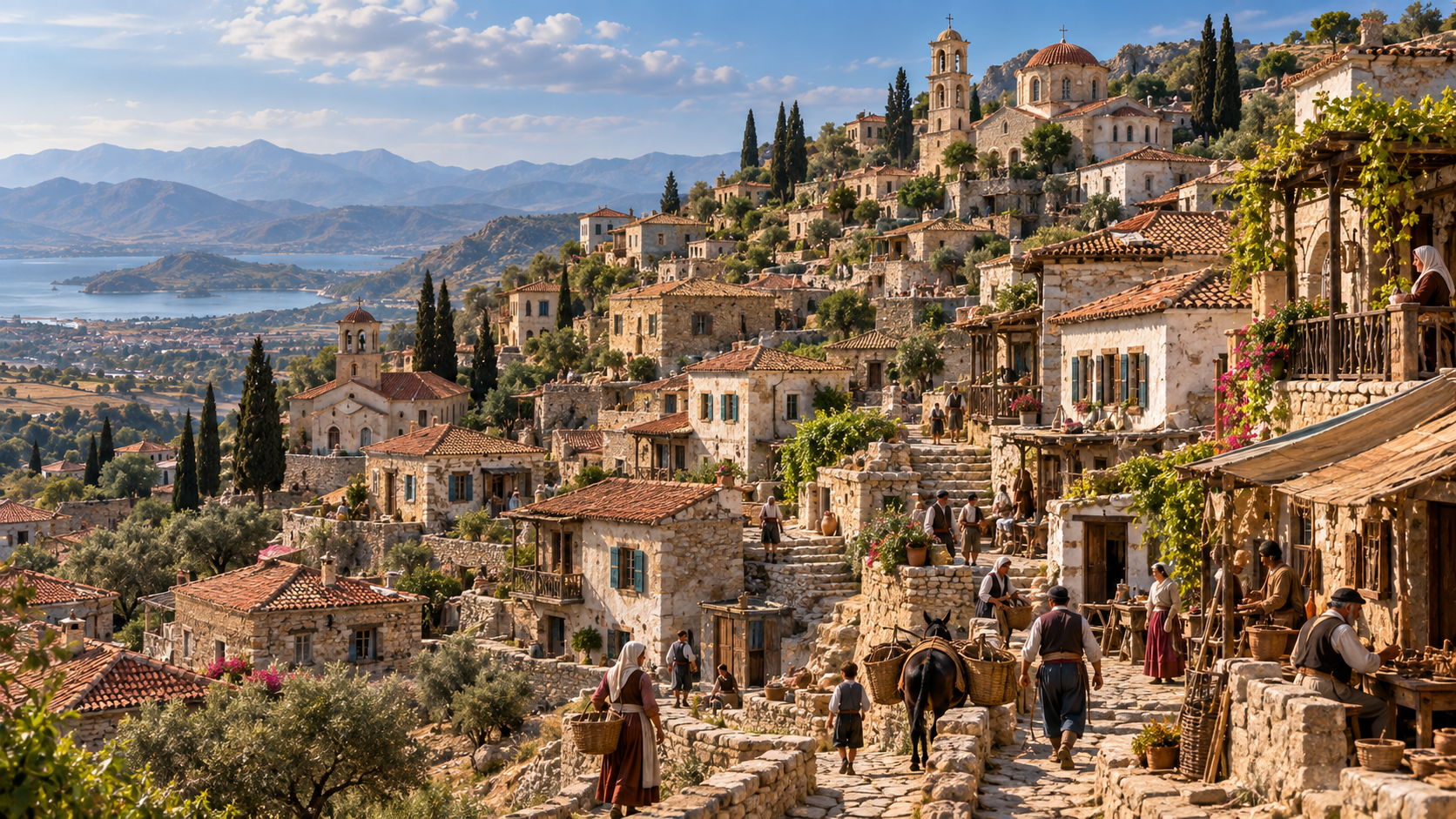
On a rocky hillside in southwestern Turkey, hundreds of roofless stone houses climb toward two old churches, their empty windows opening onto a landscape where thousands of people once lived and worked. The settlement is Kayaköy, known before the twentieth century as Levissi, and its abandoned upper village has remained largely empty for roughly a century. The story behind a village empty for more than a century is not a mystery of disappearance or an unexplained evacuation, but the consequence of war, compulsory population exchange, failed resettlement and the gradual collapse of a community that had once been an important social and commercial center. Kültür Portalı
AI & Editorial Note
Hidden Frontiers uses AI-assisted tools as part of its content-production workflow, including research organization, drafting assistance, and visual development. The factual content of this article is strictly grounded in verified, cited sources, and disputed or uncertain information is identified where appropriate. Visuals accompanying this article are AI-generated historical reconstructions created for illustrative purposes.
Before Kayaköy Became a Ghost Village
The landscape now associated with Kayaköy has a much older history than the ruined houses suggest. The Turkish Culture Portal identifies the wider archaeological site with ancient Karmylassos and notes that the area’s history reaches deep into antiquity, although the surviving hillside buildings visible today were constructed by the Greek community that occupied the settlement during the late Ottoman period. Archaeological remains in the surrounding area include Lycian tombs and other evidence of earlier settlement, meaning the modern ruins stand within a landscape that had already been inhabited and reused for many centuries. Kültür Portalı
The community that produced the buildings seen today was known as Levissi, and its development belongs largely to the later Ottoman period rather than to the ancient world. Academic research describes Kayaköy as a substantial Greek settlement in southwestern Anatolia, positioned on the slope above the Kayaköy plain between the Fethiye and Ölüdeniz areas. Its location was shaped by the terrain, with houses arranged along the hillside so that buildings generally did not block one another’s light and views. DergiPark
By the late Ottoman period, Levissi was far more than a cluster of rural houses. Research based on Ottoman records places its population at approximately 6,500 in 1912, while the settlement contained churches, schools, commercial premises, workshops and other institutions associated with a functioning community. Residents worked in trades including carpentry, shoemaking, metalworking, commerce and maritime activities, while agricultural production and trade connected the village to surrounding settlements and the wider region. DergiPark
A Community Built Into the Hillside

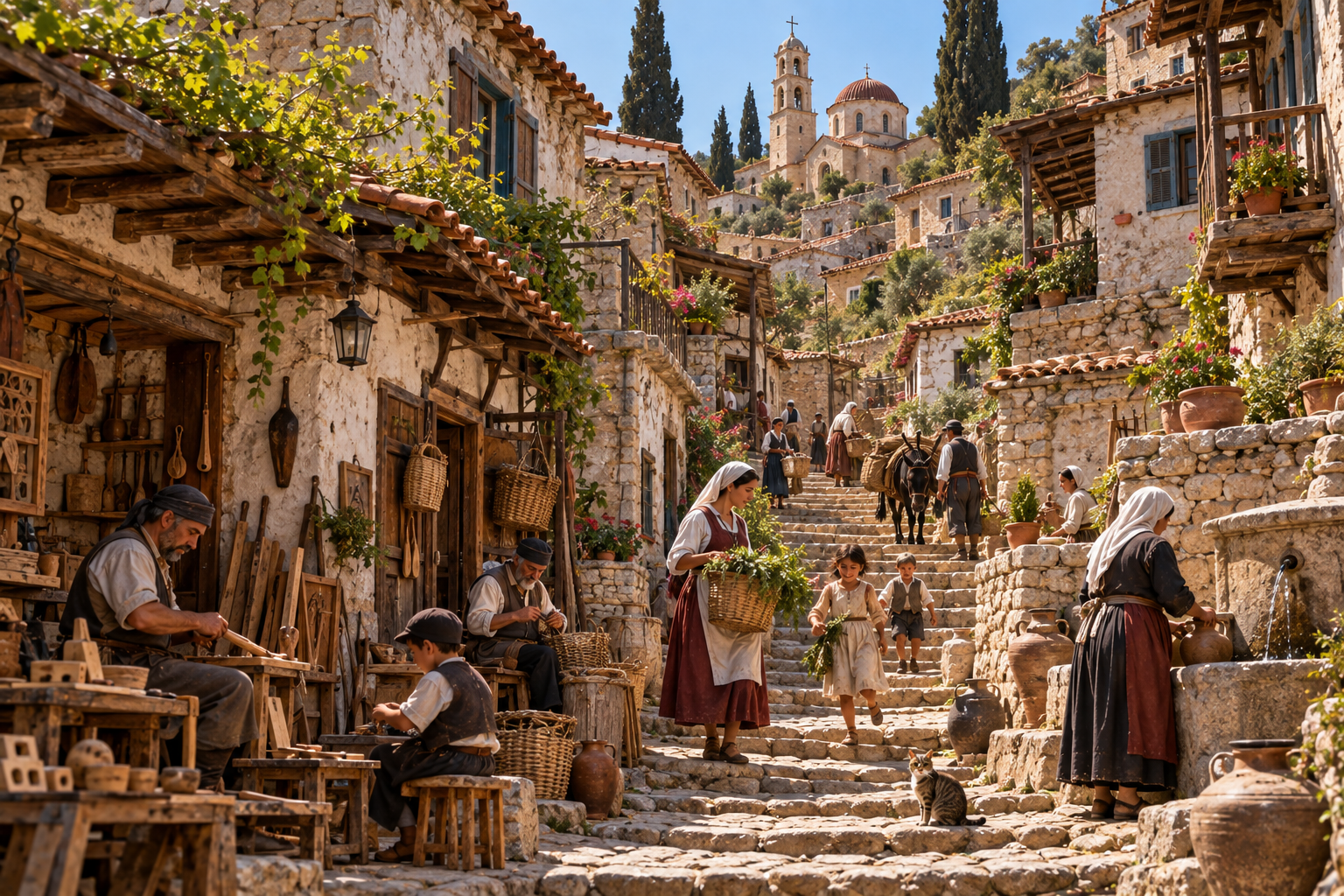
The physical design of Kayaköy helps explain why its ruins remain so recognizable. Houses were generally small stone structures, commonly arranged in close groups on the slope, with streets and stairways adapting to the natural terrain rather than imposing a rigid geometric grid. Many houses incorporated cisterns for collecting rainwater, while the settlement also contained chapels, two major churches, schools and commercial areas. The result was a dense hillside community whose architecture was closely integrated with the rocky landscape. Kültür Portalı
The streets were practical rather than monumental. Stone paving and steps followed the contours of the hillside, while buildings were positioned around the existing terrain and natural rock formations. Archaeological and geographical research records places where exposed rock itself became part of roads, stairs, foundations, garden walls and houses, creating a settlement that appears almost to grow directly out of the mountain. DergiPark
That physical relationship with the landscape also helps explain why Kayaköy can appear strangely intact from a distance. The stone walls were substantial, but many of the vulnerable elements of the houses were wooden. Doors, windows and roof structures eventually disappeared through exposure to the elements, leaving the stone shells behind. What visitors see today is therefore not a town that was suddenly frozen exactly as it looked when its residents departed, but the durable remains of buildings whose roofs and wooden components gradually vanished. Kültür Portalı
Life Before the Population Exchange
Kayaköy’s history before the population exchange was more complicated than the modern label “Greek ghost village” sometimes suggests. Turkish and Greek communities lived in the wider area, with different patterns of settlement and economic activity, and academic research records commercial and social connections between them. The Greek residents of the hillside settlement were particularly active in crafts, trade and services, while Turkish residents in the surrounding lowlands were more heavily involved in agriculture and pastoral activities. DergiPark
The village itself had many of the institutions expected in a prosperous regional center. Research records schools, churches, medical services, pharmacies, a post office, workshops and a customs building, reflecting the settlement’s commercial importance rather than the isolated rural image suggested by its ruins today. Maritime and commercial links with nearby Aegean islands, including Rhodes and other trading centers, further connected the community to a much wider economic world. DergiPark
This distinction is essential to understanding what disappeared. The population exchange did not simply empty a collection of abandoned houses; it broke apart an established community whose economy depended on people, skills, businesses, family networks and regional connections. When those people left, the physical settlement remained, but much of the social system that had made the place function disappeared with them. DergiPark
The War That Changed Everything
The final years of the Ottoman Empire and the Greco-Turkish conflict transformed the political environment in which Kayaköy’s residents lived. After the First World War, conflict between Greek and Turkish forces culminated in the Greco-Turkish War and the eventual settlement that reshaped populations on both sides of the Aegean. Kayaköy’s fate became tied to a much larger political decision that treated population movement as a means of reorganizing relations between Greece and the new Turkish state. Ministry of Foreign Affairs
The legal foundation came with the Convention Concerning the Exchange of Greek and Turkish Populations signed at Lausanne in January 1923. Its first article established a compulsory exchange involving Turkish nationals of the Greek Orthodox religion in Turkish territory and Greek nationals of the Muslim religion in Greek territory, with limited exceptions for particular populations in Constantinople and Western Thrace. The agreement transformed what had previously been individual communities into populations subject to a state-organized relocation process. Ministry of Foreign Affairs
For Levissi, the consequences were immediate and profound. The Greek residents who had built their lives in the village were required to leave for Greece, and the community that had occupied the hillside for generations was effectively dismantled. Academic research on Kayaköy records that the village’s Greek population was sent to Greece during the exchange, while people arriving from Greece were subsequently settled in the area. DergiPark
The Empty Houses Were Not the End of the Story
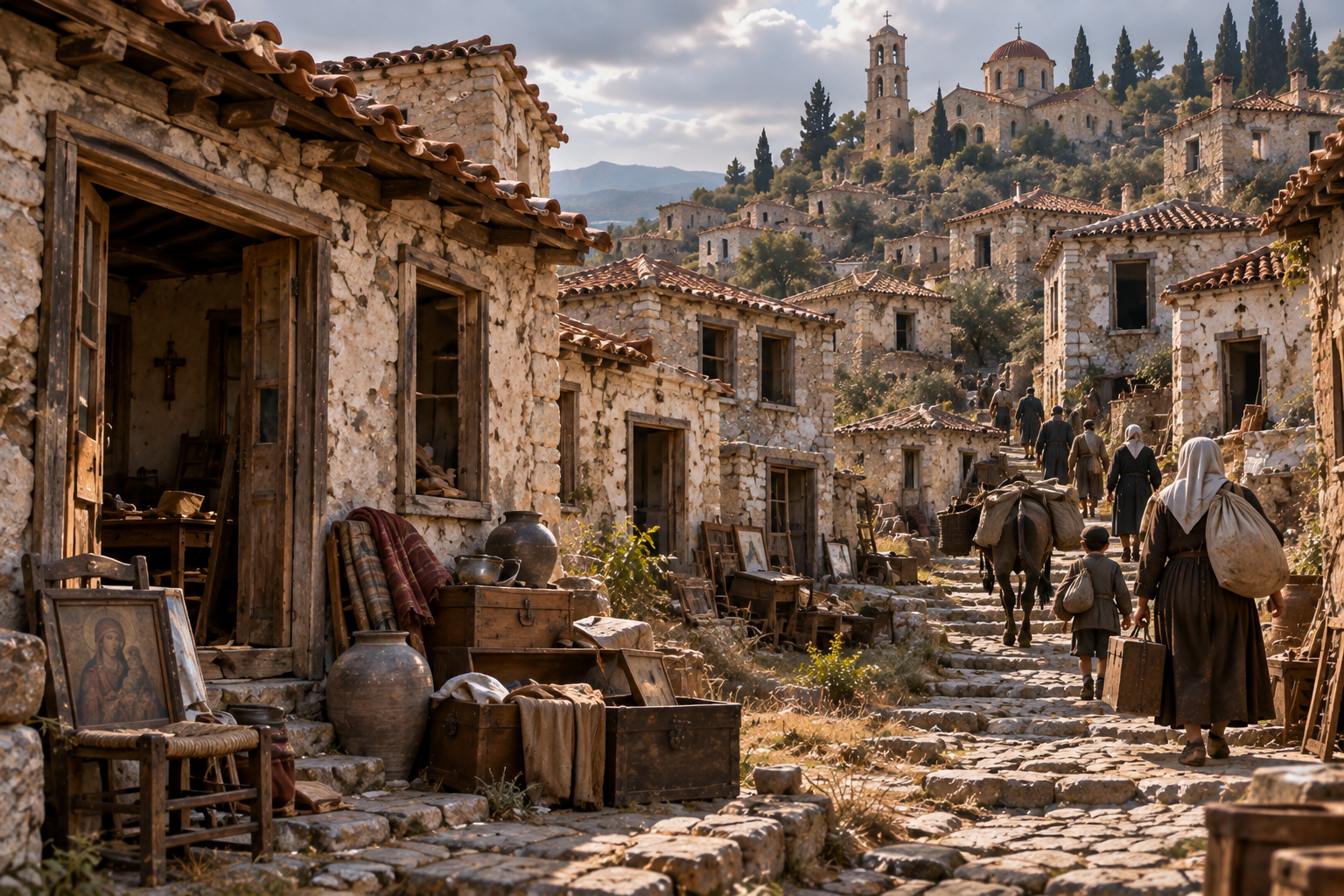
The population exchange did not mean that every house became empty on the same day. Muslim families from Greece were resettled in Kayaköy, but the transition proved difficult, and many of the newcomers did not remain in the old hillside settlement. Research describes problems including water shortages and living conditions that were poorly suited to the new residents, while some families eventually moved elsewhere or established themselves on the plain. DergiPark
The geographical contrast was important. The old Greek community had adapted its economic life to the hillside settlement and surrounding environment over generations, while many of the newcomers came from different agricultural and social settings. Academic research records that only a small number of families remained in the old houses, while many others moved away and some established new settlement patterns on the plain below. The historic hillside was therefore emptied for a second time, but under very different circumstances from the first departure. DergiPark
This is one of the most important details in the story because it complicates the popular image of Kayaköy. The village did not become permanently empty simply because its original inhabitants were expelled and nobody ever attempted to return. There was an effort to repopulate it, but the new community largely did not remain in the old hillside settlement, and the historic houses subsequently lost their everyday function. DergiPark
Why the Village Stayed Empty
Once the social and economic foundations of Levissi disappeared, the old settlement had little reason to recover its former importance. The houses were designed for a particular community, and many of the occupations, businesses and institutions that had sustained the village had vanished with the population exchange. As residents moved toward other settlements and economic centers, the hillside increasingly became a place of abandoned structures rather than a living town. DergiPark
The physical environment reinforced that process. Kayaköy stands on a steep, rocky slope, and its traditional housing pattern was closely adapted to that terrain, while water availability was one of the difficulties recorded for later residents. Academic research also notes that settlement patterns in the surrounding area shifted after the exchange, with new construction increasingly moving toward the flatter plain. The old hillside therefore lost both population and the practical economic role that had once supported it. DergiPark
Nature then became the village’s most persistent occupant. Roof tiles fell, wooden doors and windows deteriorated, vegetation spread through abandoned compounds and rain entered buildings that had once been protected by roofs. Stone walls survived far better than the wooden structures around them, producing the distinctive landscape of roofless houses that now defines Kayaköy. Kültür Portalı
The Churches Left Behind
Among the most recognizable structures in Kayaköy are its two major Greek Orthodox churches. The Turkish Culture Portal identifies two large churches within the abandoned settlement alongside numerous smaller chapels, a school and a former customs building, demonstrating how strongly religious and civic institutions were integrated into the community. Their survival gives visitors some of the clearest physical evidence that the hillside was once a functioning town rather than simply a collection of rural houses. Kültür Portalı
The churches also make the human story of Kayaköy unusually visible. Their scale and position contrast with the small domestic buildings surrounding them, while the network of chapels indicates that religious life was distributed throughout the settlement. Today, the empty churches stand among roofless houses, creating a landscape that can appear almost theatrical, but the underlying explanation is firmly historical rather than supernatural. DergiPark
The surviving architecture has also become important to preservation efforts. Kayaköy is protected as a cultural and archaeological site, and the Turkish Culture Portal records its buildings as part of the area’s heritage. Preservation does not mean that the village has been restored to its former appearance; much of its value lies precisely in the fact that the ruins retain the visible evidence of abandonment and subsequent decay. Kültür Portalı
What the Ruins Can Still Tell Us
Walking through Kayaköy today means moving through a landscape in which the boundaries between public and private life are still physically legible. Small houses sit along narrow streets, while cisterns, churches, chapels and former commercial spaces reveal different parts of the community’s infrastructure. Even where roofs and wooden fittings have disappeared, the surviving stone walls preserve the basic organization of homes and streets. DergiPark
The houses also reveal something about how people adapted to the hillside. Many were relatively compact, often with storage or service areas below and living spaces above, while their positioning allowed light and views to reach neighboring structures. The arrangement was neither accidental nor monumental; it was a practical form of vernacular architecture developed for the local environment. Kültür Portalı
The ruins therefore function almost like a physical archive. They cannot tell us everything about the people who lived there, and they cannot preserve every detail of daily life, but they show the scale of the settlement and the infrastructure required to support it. When combined with historical records, the buildings transform Kayaköy from a picturesque ruin into evidence of a community whose disappearance was caused by a documented political upheaval. DergiPark
A Village Empty for More Than a Century
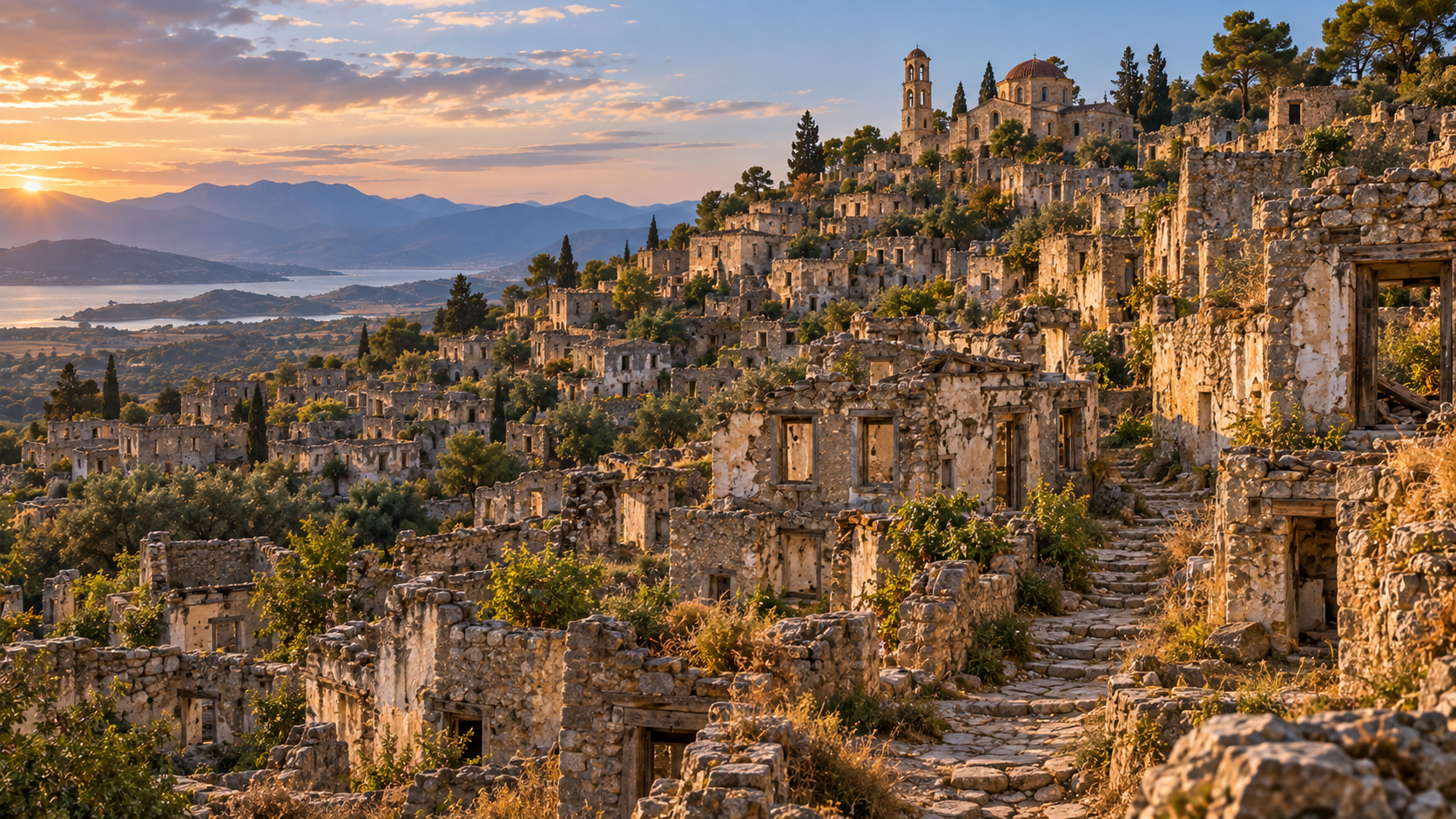
It is tempting to describe Kayaköy as a place that simply “died” in the early twentieth century, but the chronology is more complicated. The Greek population was removed through the compulsory exchange, new residents were brought in, many of those residents later left, and the old hillside settlement was progressively abandoned. The result was a gradual transition from a populated community to a largely deserted historic landscape rather than a single unexplained moment when everyone disappeared. Ministry of Foreign Affairs
That distinction makes the phrase village empty for more than a century useful but incomplete. The historic hillside has indeed remained largely without permanent residential life for about a century, but Kayaköy as a broader locality has not ceased to exist, and people still live in the surrounding area. The “ghost village” refers primarily to the preserved historic settlement of old Levissi rather than every modern building or resident associated with the present-day locality. Kültür Portalı
This is also why the site feels different from much older archaeological ruins. The houses are not the remains of a civilization separated from modern life by thousands of years; they belonged to people who lived there within living memory of later generations. Their streets, schools, churches and workshops were part of a recognizable nineteenth- and early twentieth-century community, making the emptiness feel unusually recent. DergiPark
Memory, Preservation and the Meaning of Kayaköy
Kayaköy’s modern identity has increasingly been shaped by preservation and tourism, but the site remains difficult to separate from the political history that created it. The ruins have become a destination precisely because they retain such a powerful sense of absence, while the surviving buildings provide tangible evidence of a vanished Greek Orthodox community in Anatolia. The Turkish Culture Portal treats the settlement as a cultural heritage site rather than simply an abandoned curiosity. Kültür Portalı
There is also a larger historical question embedded in the ruins. The population exchange was designed by its governments as a compulsory relocation of religious populations, but on the ground it meant that families lost homes, businesses, neighbors and local identities that had developed over generations. Kayaköy makes that enormous historical process visible at human scale because the houses remain in place even though the people who inhabited them are gone. Ministry of Foreign Affairs
That is ultimately what makes the village so haunting. The silence is not the result of an ancient curse, a mysterious disappearance or a forgotten catastrophe whose cause cannot be established. It is the residue of a documented political transformation, preserved in stone on a hillside where the architecture survived long after the community that gave it meaning had been forced to leave. DergiPark
Conclusion
Kayaköy is one of the clearest examples of how a place can survive after its community has disappeared. Once known as Levissi, the hillside settlement supported thousands of residents, with academic research recording a population of about 6,500 in 1912 and documenting its churches, schools, trades, commercial life and close relationship with the surrounding region. The compulsory population exchange of 1923 removed the Greek community, while subsequent resettlement failed to restore the old settlement’s social and economic life. DergiPark
The village that remained was gradually transformed by abandonment and weather. Roofs disappeared, wooden doors and windows decayed, streets deteriorated and vegetation spread among the stone houses, while the two major churches and numerous smaller structures continued to mark the former community. The result is a landscape that looks frozen at first glance, even though its present appearance was produced through decades of decay rather than a single moment of abandonment. Kültür Portalı
More than a century later, Kayaköy remains compelling because the ruins have not erased the story of the people who lived there. Instead, the empty houses make their absence visible, turning architecture into evidence of migration, political upheaval and cultural loss. The village is quiet today, but its stones still preserve the outline of a community that once filled the same streets with work, worship, commerce and ordinary daily life.
FAQ
Why is Kayaköy empty?
The historic hillside settlement of Kayaköy became largely empty after the Greek Orthodox population was removed through the compulsory Greece-Turkey population exchange of 1923. Muslim families from Greece were subsequently resettled in the area, but many did not remain in the old hillside settlement because of difficult living conditions, including water shortages and problems adapting to the environment. The historic houses were therefore progressively abandoned rather than simply deserted in a single unexplained event. Ministry of Foreign Affairs
What was Kayaköy called before it was abandoned?
The settlement was known as Levissi, while the wider archaeological site is associated with the ancient name Karmylassos. The surviving hillside houses, churches and other structures seen today, however, largely belong to the later Ottoman-era Greek community rather than to the ancient settlement. This distinction is important because the archaeological history of the landscape is much older than the ghost village visible today. Kültür Portalı
When did Kayaköy become a ghost village?
The decisive change occurred during and after the 1923 population exchange, when the Greek inhabitants of Levissi were sent to Greece. Replacement residents were brought into the area, but many subsequently moved away, leaving the old hillside settlement without the population necessary to sustain its former economic and social life. Over the following decades, the buildings deteriorated and the historic village acquired the appearance it has today. DergiPark
How many people lived in Kayaköy before it was abandoned?
Academic research on Kayaköy cites Ottoman records giving a population of approximately 6,500 in 1912. The settlement was therefore a substantial regional community rather than a tiny isolated village, with schools, churches, medical services, commercial activity and skilled trades. Some modern tourism sources give much larger population figures, but the 6,500 figure is the one supported by the academic study used here and is therefore preferable for a factual account. DergiPark
Is Kayaköy an ancient city?
Kayaköy’s wider archaeological landscape has ancient roots and is associated with Karmylassos, but the famous abandoned hillside village is not an ancient city in the usual sense. The Turkish Culture Portal states that the visible buildings on the slope were constructed by the Greek population that lived there during the later Ottoman period. Ancient Lycian remains exist in the surrounding archaeological landscape, making the site historically layered rather than a single-period ruin. Kültür Portalı
What buildings are still standing in Kayaköy?
The abandoned settlement contains numerous stone houses together with two major churches, many smaller chapels, school buildings and other former civic or commercial structures. The Turkish Culture Portal also records cisterns associated with the houses, while archaeological and geographical research documents former commercial spaces and a customs building. Many roofs, doors and windows have disappeared, but the stone structures preserve much of the historic street pattern. Kültür Portalı
Did the people of Kayaköy simply leave voluntarily?
The Greek population did not simply decide to abandon the village as part of an ordinary migration. The 1923 Convention Concerning the Exchange of Greek and Turkish Populations established a compulsory exchange of Greek Orthodox populations in Turkey and Muslim populations in Greece, subject to specific exceptions. Kayaköy’s Greek inhabitants were consequently removed within this larger state-organized population transfer, after which a separate resettlement effort failed to restore the old community. Ministry of Foreign Affairs
Can people still live in Kayaköy today?
The historic hillside settlement is preserved as a heritage and archaeological site rather than functioning as the residential community it once was. The wider Kayaköy locality, however, is not literally devoid of people, and modern development exists outside the abandoned historic core. For that reason, describing the old hillside as a “ghost village” is more accurate than claiming that the entire modern locality has been empty for a century. Kültür Portalı
SOURCES & REFERENCES
- Türkiye Ministry of Culture and Tourism — Türkiye Culture Portal, Kayaköy Archaeological Site. Official cultural heritage information covering the site’s location, historical names, architecture, population exchange and surviving structures. Türkiye Culture Portal — Kayaköy
- Republic of Türkiye Ministry of Foreign Affairs — Lausanne Peace Treaty, Convention Concerning the Exchange of Greek and Turkish Populations. Primary documentary source for the compulsory population exchange established in 1923. Republic of Türkiye Ministry of Foreign Affairs — Lausanne Population Exchange Convention
- Bozyiğit, Recep & Tapur, Tahsin — “Güneybatı Anadolu’da Terkedilen Bir Yerleşim Merkezi: Kayaköy (Fethiye),” Marmara Coğrafya Dergisi. Academic geographical study based on documentary research, official data, fieldwork and interviews, including population history, settlement morphology and the post-exchange abandonment process. Marmara Coğrafya Dergisi — Kayaköy Study
- Fethiye District Governorate — Kayaköy. Local-government information concerning the historic settlement, its Greek-era population and the 1923 population exchange. Fethiye District Governorate — Kayaköy
- Korkmaz, Zübeyde & Tekin, Tuğba Batuhan — research on the churches of Fethiye-Kayaköy. Recent academic work examining the decorative programs and architectural heritage of Kayaköy’s two principal churches. DergiPark — Kayaköy Church Research
- Marmara Coğrafya Dergisi — Kayaköy research archive. The full academic study provides detailed documentation of the settlement’s geography, architecture, population development and transformation after the population exchange. Full Academic Study PDF