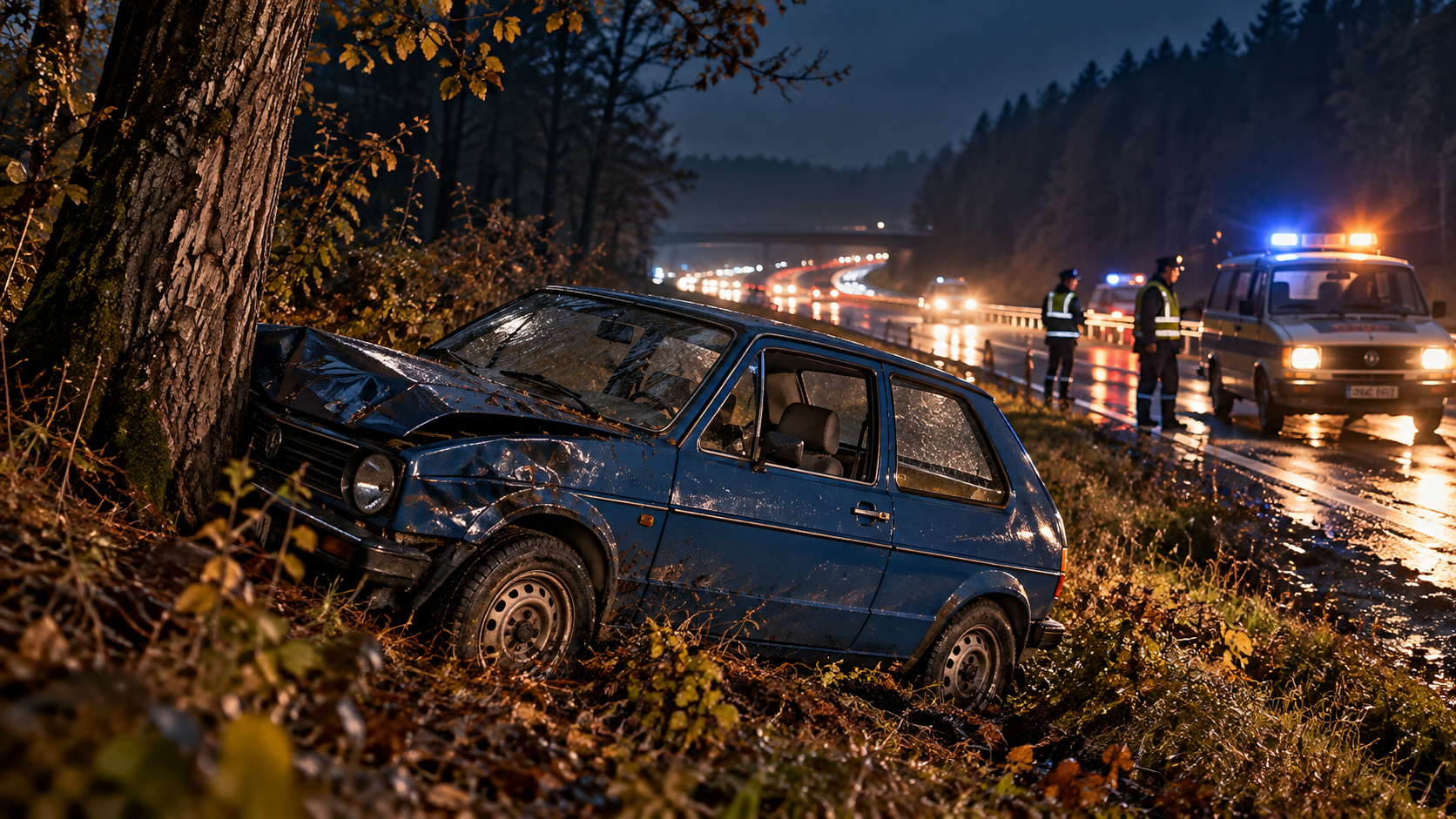
For more than four decades, the YOGTZE case was presented as one of Germany’s strangest unexplained deaths. On the night of October 25, 1984, 34-year-old Günter Stoll left his home in Anzhausen, West Germany, after behaving unusually and telling his wife that he believed someone wanted to harm him. Several hours later, two truck drivers discovered his badly damaged Volkswagen Golf in a roadside embankment on the A45 near Hagen-Süd, with Stoll severely injured and naked in the passenger seat. He died shortly afterward, leaving behind a bizarre sequence of events that investigators initially interpreted as evidence of a violent crime. Presseportal
For years, the case seemed to contain all the elements of an unsolved murder: an apparently unexplained injury, a victim found without clothing, reports of other men supposedly being present, and the mysterious word “YOGTZE,” which Stoll’s wife said he had written shortly before leaving home. The original investigation developed a theory that Stoll had been run over somewhere else and then placed inside his own vehicle before it was taken to the Autobahn. That interpretation helped turn the death into a famous German cold case and eventually brought it to the television program Aktenzeichen XY… ungelöst. Presseportal
But the official story changed dramatically in April 2025. After a renewed investigation, new accident reconstruction, further review of old evidence, and additional forensic assessment, Police Hagen and the Hagen Public Prosecutor’s Office concluded that the evidence no longer supported a homicide. Their conclusion was that Stoll most likely lost control of his vehicle, left the roadway, and crashed into a tree without another vehicle or person being involved. Presseportal
AI & Editorial Note
Hidden Frontiers uses AI-assisted tools as part of its content-production workflow, including research organization, drafting assistance, and visual development. The factual content of this article is strictly grounded in verified, cited sources, and disputed or uncertain information is identified where appropriate. Visuals accompanying this article are AI-generated historical reconstructions created for illustrative purposes.
Who Was Günter Stoll?
Günter Stoll was a 34-year-old food technician from Anzhausen in the Siegen-Wittgenstein region of what was then West Germany. On the evening before his death, he was at home with his wife when his behavior became increasingly concerning, according to the later accounts used by investigators. Police records and later reporting describe him as believing that people were following him or intended to harm him, a detail that became important when investigators eventually reconsidered his final hours. Presseportal

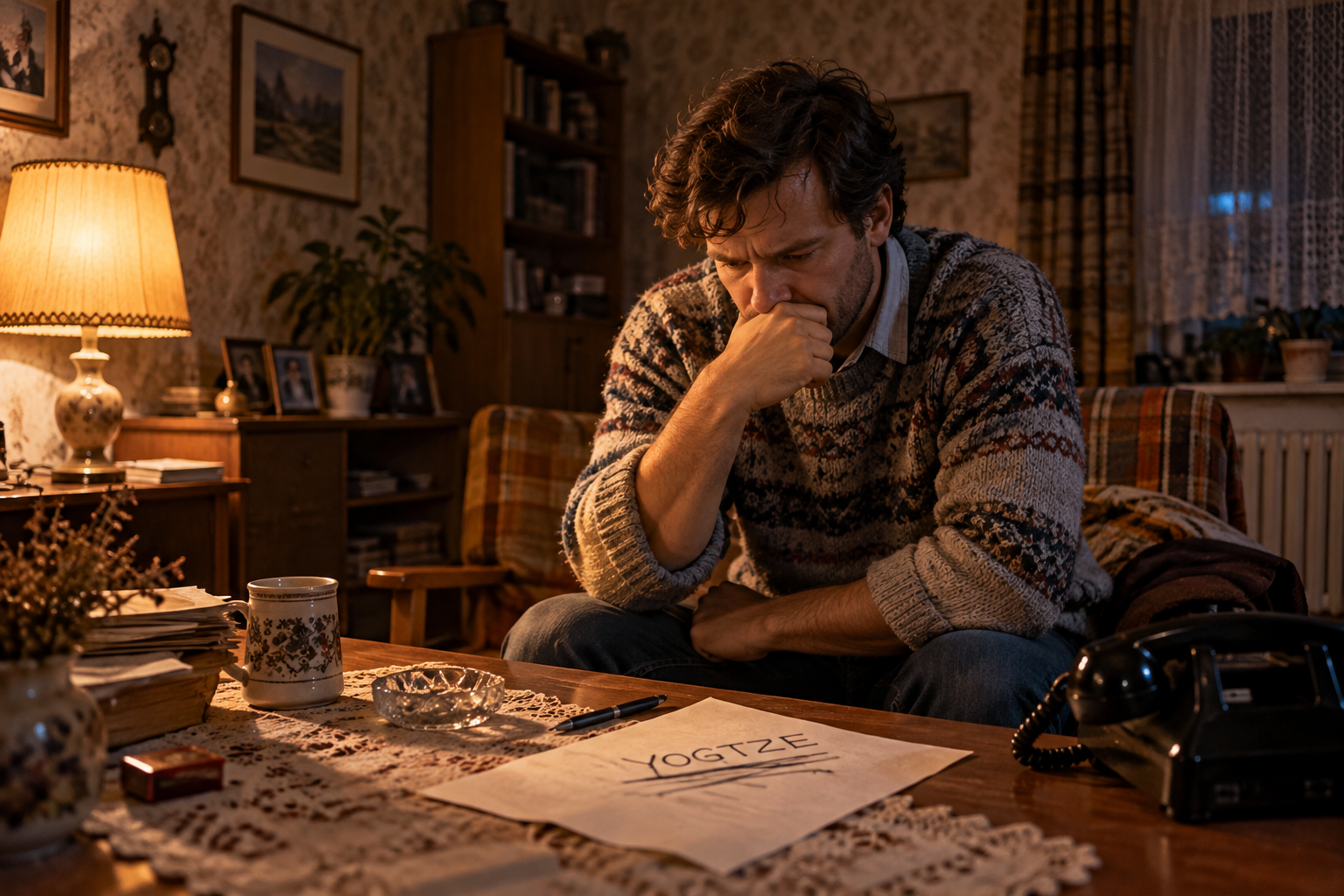
Shortly before leaving the house, Stoll reportedly wrote the sequence “YOGTZE” on a piece of paper and crossed it out. The original paper was never recovered, meaning the public has never been able to examine exactly what he wrote or whether the characters were interpreted correctly. The significance of the supposed note became one of the central mysteries surrounding his death, even though investigators ultimately concluded in 2025 that the word had no relevance to the cause of the accident. Presseportal
The circumstances surrounding Stoll’s behavior have to be treated carefully because much of what is known about his mental state comes from later recollections and investigative reconstruction rather than a contemporaneous medical diagnosis made at the scene. Police Hagen’s 2025 statement nevertheless said that Stoll suffered from depression and was very likely experiencing a psychological crisis shortly before the crash. Investigators considered that condition relevant to the otherwise unusual sequence of events that preceded his death. Presseportal
The Strange Night Before the Crash
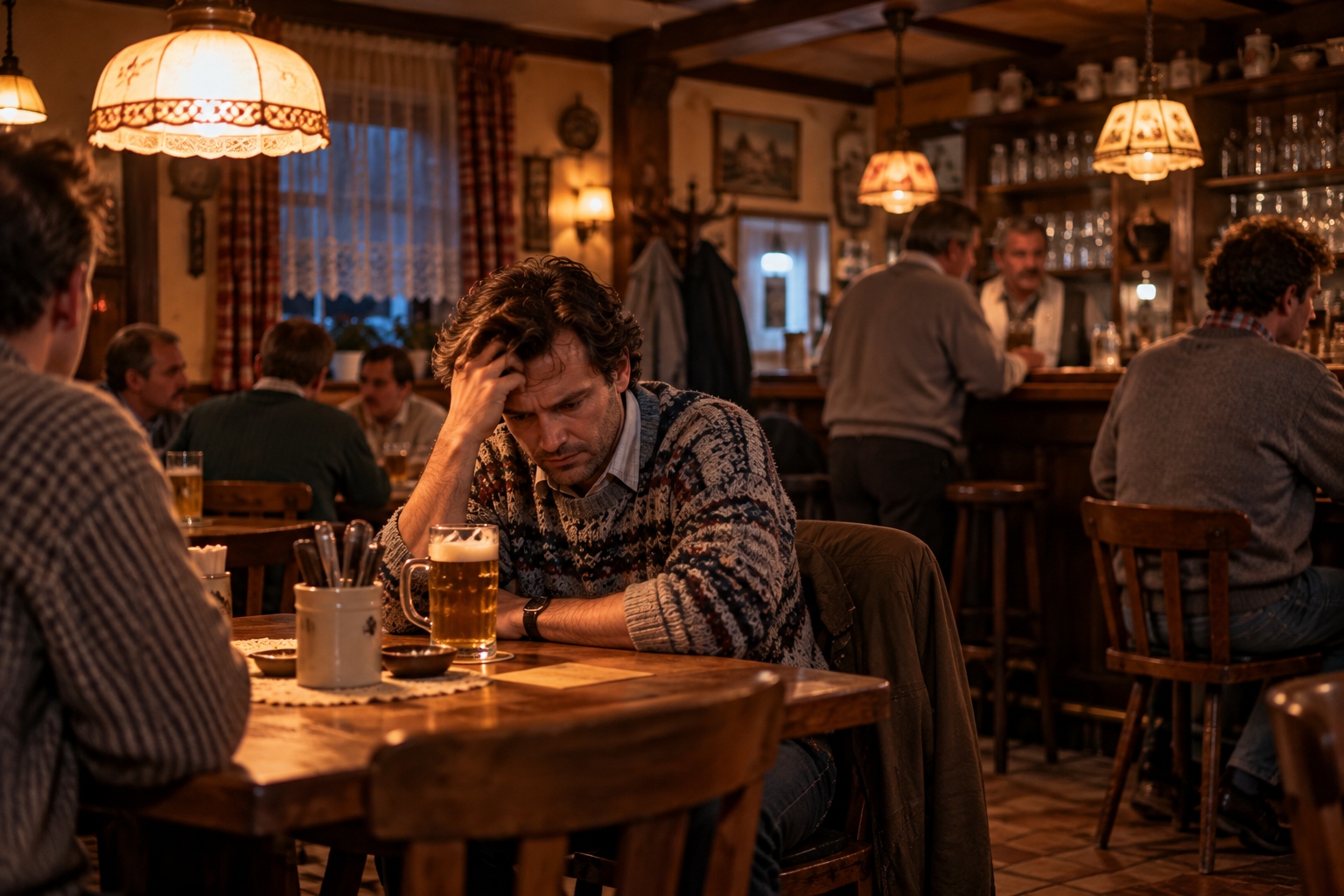
After leaving his home, Stoll went to a familiar pub in Wilnsdorf. According to accounts later used in the investigation, he ordered a beer and then suddenly fell from his seat, injuring his face, although people present did not consider him obviously intoxicated at the time. He subsequently left the establishment in his blue Volkswagen Golf, beginning a period of approximately two hours during which his whereabouts were not fully established. WDR
Around one o’clock in the morning, Stoll appeared at the home of a woman he had known since childhood in Haigerseelbach. He reportedly told her that something terrible was going to happen and attempted to speak with her despite the late hour. She did not allow him inside and advised him to go to his parents or return to his wife, after which Stoll left again. Wikipedia
These events became important because, viewed through the lens of the original murder investigation, they seemed to suggest that Stoll had been frightened by a real threat. Yet the same behavior can also be interpreted differently when considered alongside the conclusions reached decades later. The renewed investigation treated his unusual conduct, rather than assuming an external attacker, as part of a possible psychological crisis that preceded the crash. Presseportal
The Discovery on the A45
At approximately three o’clock in the morning, two truck drivers noticed Stoll’s crashed Volkswagen in an embankment alongside the A45 near the Hagen-Süd interchange. They stopped after seeing what appeared to be a person near the damaged vehicle and contacted emergency services. When they reached the car, they found Stoll severely injured and naked on the passenger side of the vehicle. Presseportal
Stoll was still alive and able to communicate, although his condition was critical. According to the historical account of the case, he said that several men had been in the vehicle and had left, and he indicated that they were not his friends. That statement became one of the most important elements supporting the original theory that another person or group had been involved. WDR
Stoll died from his injuries shortly afterward while being taken to a hospital in Hagen. What investigators saw at the crash scene appeared difficult to reconcile with a straightforward traffic accident, particularly because of the victim’s injuries and the circumstances in which he was found. The unusual scene therefore became the starting point for an investigation that initially concentrated on the possibility of homicide rather than treating the crash itself as the complete explanation. Presseportal
Why the Original Investigation Pointed Toward Murder
The initial interpretation of Stoll’s injuries was central to the direction of the case. Investigators concluded at the time that his fatal injuries were consistent with having been struck by another vehicle somewhere away from the crash site. Under that theory, Stoll had already been injured and was subsequently placed inside his own Volkswagen, which was then driven or otherwise moved to the location where the vehicle was discovered. WDR
That hypothesis immediately created a much larger criminal scenario. If Stoll had been struck elsewhere, someone would have needed to be responsible for the collision, move his injured body, handle the vehicle, and leave him at the Autobahn. The apparent presence of other men, together with Stoll’s statement before his death, seemed to reinforce that interpretation, even though investigators never established the identity of any alleged accomplices or perpetrators. WDR
The case subsequently generated theories involving organized crime and possible connections to the drug scene, including speculation surrounding Stoll’s trips to the Netherlands. None of those avenues produced evidence sufficient to identify a killer or establish a criminal motive. Police Hagen later acknowledged that decades of investigation, including numerous public tips, had failed to establish third-party involvement. Presseportal
The YOGTZE Note Becomes a Mystery
The six-character sequence “YOGTZE” became inseparable from the case because of its strange appearance and its proximity to Stoll’s death. According to his wife, he wrote the characters shortly before leaving home and then crossed them out. The paper itself disappeared, however, and investigators never had the original document available for forensic examination. Presseportal
The absence of the original note left enormous room for interpretation. People proposed that the letters might represent a code, a license plate, a place, a name, or some other hidden message, while the possibility that one character had actually been a number rather than a letter added further uncertainty. Police eventually received numerous tips about the sequence, particularly after the case appeared on television. Presseportal
The most important distinction is between what is known and what was imagined around the note. There is no verified evidence establishing that “YOGTZE” was a message identifying a killer, location, organization, or motive. The 2025 police statement explicitly said that the meaning of the word was not relevant to the sequence of events or the cause of Stoll’s death. Presseportal
The Case Reaches Television
The mystery gained a much wider audience when it was featured in the German television program Aktenzeichen XY… ungelöst in 1985. The program regularly reconstructs unsolved crimes and asks viewers to provide information, making it an important source of public assistance in German criminal investigations. In Stoll’s case, the broadcast generated hundreds of tips, many of which focused on the mysterious word rather than producing a decisive lead toward a perpetrator. Presseportal
Television exposure also helped preserve the original murder interpretation in popular memory. The case was repeatedly discussed as an unexplained killing because the unusual circumstances appeared to demand a criminal explanation. Over time, the phrase “YOGTZE case” became almost synonymous with the idea of an inscrutable coded message and an unknown group of attackers.
That public memory is important when examining the 2025 development because it explains why the official conclusion was so striking. The new investigation did not simply identify a previously overlooked suspect; it challenged the basic assumption that there had been a homicide at all. In doing so, investigators had to reconsider evidence that had been interpreted through the framework of a murder investigation for decades.
The Cold Case Is Reopened
The major reassessment began when Police Hagen investigator Maike Schmidt took another look at the old case in 2024. According to WDR’s account of the investigation, Schmidt reviewed the old files, reorganized evidence and records, and questioned assumptions that had become embedded in the historical case narrative. Her review focused particularly on whether the physical evidence truly required the sequence proposed by the original investigators. WDR
One important issue concerned the reports from the two truck drivers. The original interpretation treated the person they observed near the damaged vehicle as evidence that another individual had been present at the scene and might have fled. When Schmidt examined the original statements more closely, however, she found that the drivers had actually described seeing a person around the vehicle rather than definitively witnessing someone flee into the surrounding area. WDR
That distinction mattered because the presumed second person had become a central part of the murder theory. If the person near the vehicle was Stoll himself rather than an attacker, one of the apparent contradictions in the case disappeared. The renewed investigation therefore asked a much more basic question: what if the scene did not contain evidence of a murderer at all?
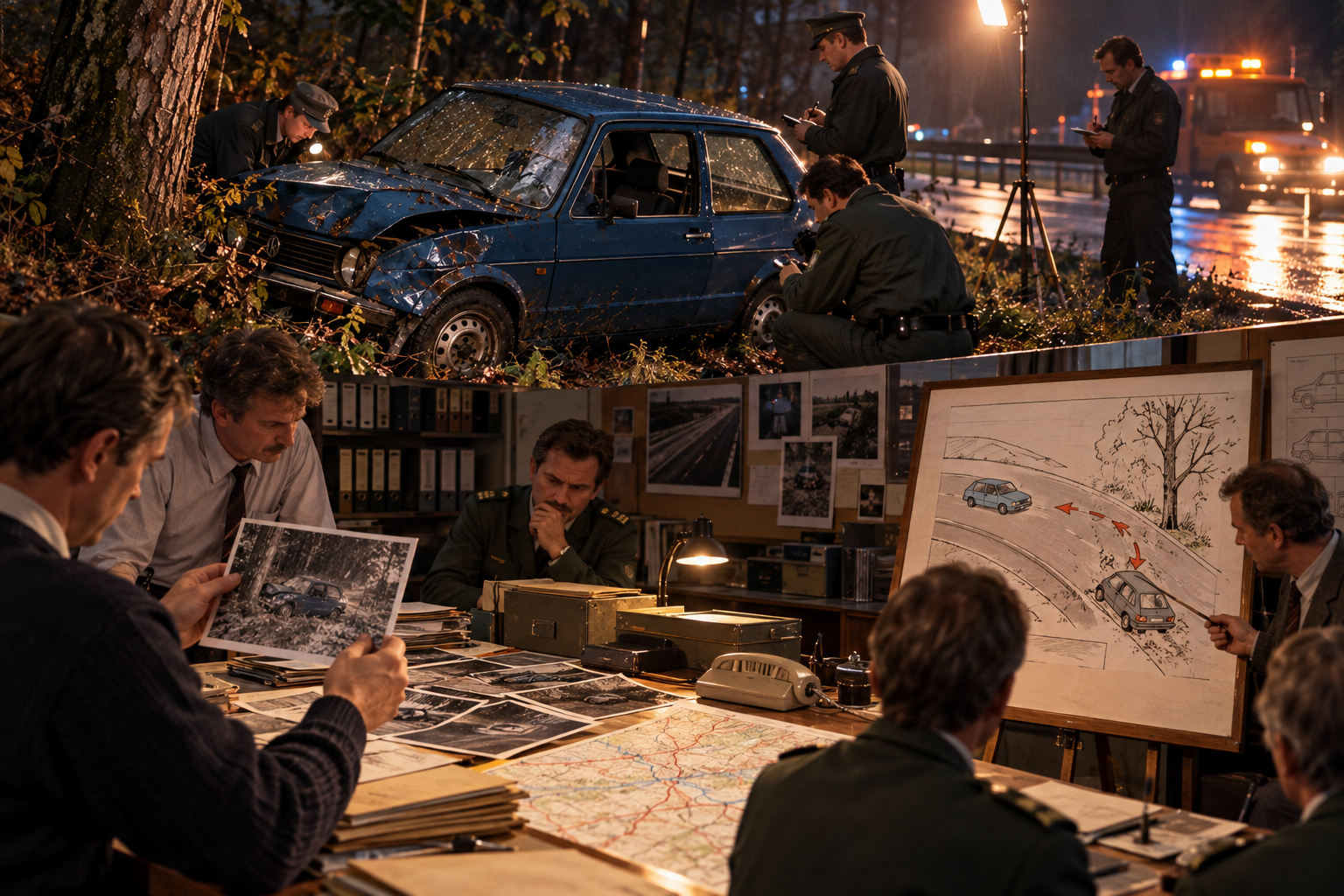
The New Accident Reconstruction
Schmidt commissioned a new accident reconstruction to test whether Stoll’s injuries could have been produced by the crash itself. Modern reconstruction methods allowed investigators to examine factors such as the vehicle’s movement, the collision with the embankment and tree, and the likely movement of an unrestrained occupant during the impact. The resulting analysis provided an alternative explanation for injuries that had previously been interpreted as evidence of a separate assault. WDR
According to the renewed investigation, Stoll was not wearing a seat belt when the Volkswagen left the roadway. Police concluded that the car traveled into the embankment and struck a tree, and that the violent forces generated by the crash could have thrown Stoll from the driver’s position toward the passenger side. This offered an explanation for why a severely injured man was found on the passenger side even though the vehicle itself had apparently been driven by him. Presseportal
The new forensic assessment also challenged the assumption that Stoll had been run over by another vehicle. WDR reported that the renewed analysis concluded his injuries were consistent with the crash rather than a separate run-over incident. The police therefore no longer needed an unknown driver, a group of accomplices, or a second crime scene to explain the physical evidence. WDR
What Happened to the Alleged Other Men?
One of the most memorable details in the YOGTZE case was Stoll’s statement that several men had been in his car and had left. That statement remains part of the historical record, but the 2025 investigation did not treat it as proof that those men actually existed. Stoll was severely injured and in an unusual psychological state when he made the statement, and investigators ultimately found no physical evidence establishing the presence of other people. Presseportal
The official police statement said that neither the trace evidence nor witness accounts ultimately confirmed third-party involvement. WDR additionally reported that investigators found no foreign DNA in the vehicle and concluded that there was no evidence requiring the presence of another person. The result is not that every historical detail has been reconstructed with absolute certainty, but that the evidence no longer supports homicide as the most plausible explanation. Presseportal
This distinction is especially important in a case that has accumulated decades of retellings. A statement made by a dying victim can be deeply significant without necessarily being an accurate description of everything happening around him. The renewed investigation treated Stoll’s words as evidence that needed to be evaluated alongside the physical record rather than as an unquestionable reconstruction of the scene.
Why Was Günter Stoll Naked?
The fact that Stoll was found without clothing became one of the most disturbing and difficult elements of the case. Under the original theory, his nudity could be interpreted as evidence that he had been assaulted or deliberately humiliated before being placed inside his vehicle. That interpretation was consistent with the broader assumption that someone had attacked him elsewhere and transported him to the Autobahn. WDR
The renewed investigation reached a different conclusion. Police Hagen stated that Stoll’s psychological condition very likely explained why he was naked, while WDR reported that investigators considered his depression and apparent psychological crisis important to understanding his behavior that night. This does not provide a detailed reconstruction of precisely when or why he removed his clothing, but it removes the need to attribute the act to an unknown attacker. Presseportal
The uncertainty is worth preserving because the available evidence cannot reconstruct every minute of Stoll’s final hours. What authorities can say with much greater confidence is that there is no longer sufficient evidence for a homicide theory. The official conclusion instead places his unusual behavior within the context of a severe psychological crisis followed by a fatal single-vehicle crash.
The Official Conclusion in Twenty Twenty-Five
On April 3, 2025, Police Hagen and the Hagen Public Prosecutor’s Office issued a joint statement announcing the new assessment. They said that more than forty years of investigation, new analysis, and additional expert work had produced a different factual picture from the one that had dominated the case for decades. The authorities concluded that the available evidence did not establish outside involvement and instead pointed to a self-caused traffic accident. Presseportal
The official reconstruction holds that Stoll’s vehicle left the roadway and traveled into an embankment before colliding with a tree. He was not wearing a seat belt, and the collision could account for his position inside the vehicle and the severe injuries that had previously been interpreted as evidence of an external assault. Police and prosecutors therefore excluded a criminal act and regarded the case as closed. Presseportal
The conclusion was independently reported by major German news organizations, including the Süddeutsche Zeitung and dpa-based coverage in DIE ZEIT. The Süddeutsche Zeitung reported on the renewed reconstruction and the work of investigator Maike Schmidt, while DIE ZEIT reported that prosecutors considered the new expert assessments consistent with a single-vehicle accident. Süddeutsche.de
What Does YOGTZE Mean?
The simplest answer is that nobody knows, and authorities no longer consider the question important to explaining Stoll’s death. The original note was never recovered, the police never had the opportunity to examine it directly, and the sequence was reported by Stoll’s wife rather than preserved as physical evidence. The 2025 police statement therefore treats the word as irrelevant to the cause of death. Presseportal
The enduring fascination with the word illustrates how easily an unexplained detail can become the center of a criminal mystery. Because “YOGTZE” looks like a deliberate code, generations of readers and viewers naturally assumed it must contain information. Yet appearance alone cannot establish meaning, and there is no verified evidence connecting the characters to another person, organization, location, or criminal act.
In the end, the most responsible answer is also the least satisfying one: the meaning remains unknown. The word may have reflected Stoll’s mental state, may have been misremembered, or may have had some private significance that disappeared with him. What investigators concluded in 2025 is that solving the word is unnecessary to explaining how he died.
Why the YOGTZE Case Still Matters
The case remains compelling because it demonstrates how investigative assumptions can shape the interpretation of evidence. Once investigators believed Stoll had been struck elsewhere and transported in his own vehicle, unusual details such as his nudity, injuries, and statements about other men appeared to reinforce that theory. A later reconstruction did not necessarily erase those observations; it changed how they could be understood together.
The case also illustrates the importance of returning to old evidence without automatically accepting the narrative built around it. Decades can introduce repetition, memory distortion, simplified retellings, and assumptions that gradually begin to resemble established facts. In the YOGTZE case, a renewed examination of witness statements and a modern accident reconstruction provided investigators with a basis for challenging a conclusion that had shaped the case for more than forty years. WDR
Most importantly, the story should remain centered on Günter Stoll rather than on the mystery that grew around his death. He was a real person who experienced a disturbing final night and died at only 34 years old. The enduring fascination with the case should not obscure the fact that the official conclusion is now that he was not murdered, but died in a tragic accident during a period of severe psychological distress.
Conclusion
The YOGTZE case began with a sequence of events that seemed almost impossible to explain. A frightened 34-year-old man left his home, wrote a mysterious sequence of letters, behaved erratically in a pub, visited an acquaintance in the middle of the night, and was later discovered severely injured and naked in his wrecked Volkswagen on the A45. His statement about other men and the apparent nature of his injuries led investigators toward a murder theory that remained influential for decades. Presseportal
That interpretation changed in 2025 after Police Hagen revisited the evidence and commissioned new reconstruction work. The authorities concluded that the injuries could be explained by the vehicle crash, that there was no reliable evidence of another person being involved, and that Stoll’s unusual behavior was consistent with a severe psychological crisis. The Hagen Public Prosecutor’s Office and police consequently closed the case as a traffic accident without third-party involvement. Presseportal
The mystery of “YOGTZE” itself remains unsolved, but it is no longer necessary to solve it to understand the official account of Stoll’s death. After more than forty years, the central question has changed from “Who killed Günter Stoll?” to “How did an apparent murder become understood as an accident?” The answer is a reminder that in historical investigations, the most mysterious explanation is not always the most accurate one.
FAQ
What happened to Günter Stoll?
Günter Stoll died in October 1984 after being found severely injured inside his Volkswagen on the A45 near Hagen-Süd. For decades, investigators believed his injuries indicated that he had been struck by another vehicle and then placed inside his own car. In 2025, Police Hagen and the Hagen Public Prosecutor’s Office concluded after renewed investigation and expert reconstruction that he most likely died in a single-vehicle accident without third-party involvement. Presseportal
Was Günter Stoll murdered?
Authorities no longer believe that Günter Stoll was murdered. The original investigation treated the death as a suspected homicide because investigators believed his injuries were caused by another vehicle, but the renewed investigation concluded that the injuries could have resulted from the crash itself. Police Hagen and the Hagen Public Prosecutor’s Office therefore closed the case as a traffic accident without outside involvement. Presseportal
What does YOGTZE mean?
The meaning of “YOGTZE” has never been established. The original note was not preserved, and the sequence was known to investigators through the account of Stoll’s wife rather than through the original document itself. Police Hagen stated in 2025 that the word was not relevant to the events leading to Stoll’s death or to its cause. Presseportal
Why was Günter Stoll found naked?
Stoll’s lack of clothing was initially one of the details that contributed to the belief that another person had attacked him. The renewed investigation instead concluded that his psychological condition likely played a role in his unusual behavior that night, although the evidence cannot reconstruct every moment of how or when he removed his clothing. Police therefore no longer regard his nudity as evidence of homicide. Presseportal
Were other men actually in Stoll’s car?
Stoll reportedly told the truck drivers who found him that several men had been in the vehicle and had left. However, the renewed investigation found no physical evidence establishing the presence of those people, and investigators ultimately concluded that there was no evidence requiring third-party involvement. The official 2025 conclusion therefore does not treat the alleged men as identified suspects or confirmed participants in the crash. Presseportal
Why was the YOGTZE case considered a murder for so long?
The original interpretation of Stoll’s injuries suggested that he had been struck by another vehicle somewhere else and then placed in his own Volkswagen. Combined with his statement about other men, his nudity, and the unusual circumstances of the crash, that theory created a coherent homicide scenario even though no perpetrator was identified. The later reconstruction demonstrated that several of those apparently separate mysteries could instead be explained by a single severe traffic accident. WDR
Is the YOGTZE case solved?
The case is officially considered solved and closed by Police Hagen and the Hagen Public Prosecutor’s Office as of April 2025. Their conclusion is that Günter Stoll died in a self-caused traffic accident rather than through homicide, and that the evidence does not establish third-party involvement. Some individual details, particularly the precise meaning of the YOGTZE sequence and every moment of Stoll’s final hours, remain unknown. Presseportal
SOURCES & REFERENCES
- Police Hagen / Hagen Public Prosecutor’s Office — Official YOGTZE Case Statement — Joint statement dated April 3, 2025, announcing the traffic-accident conclusion and closure of the case.
- Westdeutscher Rundfunk — The YOGTZE Case: One of Germany’s Most Mysterious Deaths — Detailed account of the renewed investigation, accident reconstruction, witness review, and 2025 conclusion.
- Süddeutsche Zeitung — YOGTZE Case Solved: It Was All Very Different — Major investigative report on Maike Schmidt’s reassessment and the modern reconstruction.
- DIE ZEIT / dpa — YOGTZE Cold Case Reclassified as Solved — Contemporary reporting on the police and prosecutor’s conclusion that the death was an accident.
- WDR — YOGTZE Case Investigation and Final Assessment — Background on the original case, the television appeal, and the later reopening.