For almost two decades, couples seeking privacy in the countryside around Florence became the targets of a series of double murders that would eventually be associated with one of Italy’s most notorious unidentified killers. Between 1968 and 1985, eight double homicides were conventionally linked to the so-called Monster of Florence, leaving 16 people dead and generating investigations that crossed police jurisdictions, prosecutors’ offices and multiple generations of investigators. The later convictions of Mario Vanni and Giancarlo Lotti established judicial responsibility for four of those double murders, but they did not produce a definitive legal answer for the entire series or establish the identity of a single person responsible for all of the killings. The Guardian
AI & Editorial Note
Hidden Frontiers uses AI-assisted tools as part of its content-production workflow, including research organization, drafting assistance, and visual development. The factual content of this article is strictly grounded in verified, cited sources, and disputed or uncertain information is identified where appropriate. Visuals accompanying this article are AI-generated historical reconstructions created for illustrative purposes.
The Victims Behind the Monster of Florence Case
The people at the center of the case were not simply anonymous figures in a decades-long investigation. The conventionally linked series begins with Barbara Locci and Antonio Lo Bianco, killed near Signa in August 1968, followed years later by Pasquale Gentilcore and Stefania Pettini, Carmela De Nuccio and Giovanni Foggi, Stefano Baldi and Susanna Cambi, Paolo Mainardi and Antonella Migliorini, Horst Wilhelm Meyer and Jens-Uwe Rüsch, Claudio Stefanacci and Pia Rontini, and finally Jean Michel Kraveichvili and Nadine Mauriot. Sixteen people therefore died across the series, including Italian couples, two German victims and the French couple whose deaths in 1985 became the final killings conventionally attributed to the Monster. The Guardian
The circumstances of the attacks varied, but a recurring pattern eventually became apparent to investigators: couples were attacked while spending private time in isolated locations around Florence and the surrounding countryside. Ballistic evidence became especially important because investigators connected multiple scenes to ammunition fired by the same .22-caliber weapon, generally identified as a Beretta, although the firearm itself was never recovered. This recurring ballistic signature was one of the foundations for treating apparently separate murders as part of a larger series rather than unrelated crimes. la Repubblica
The 1968 killing of Barbara Locci and Antonio Lo Bianco occupies a particularly complicated position in the history of the case. Locci’s husband, Stefano Mele, was convicted in connection with the killings and served a prison sentence, but the murders continued after his imprisonment, creating an immediate problem for investigators who believed the same weapon had later been used. Years afterward, ballistic comparisons and investigative developments connected the 1968 crime to the later series, although modern accounts continue to acknowledge uncertainty surrounding that attribution. Wikipedia
The long interval between the first and later murders also shaped the investigation. After the 1968 killings, no comparable double homicide attributed to the series occurred until 1974, when Pasquale Gentilcore and Stefania Pettini were killed near Borgo San Lorenzo. Additional attacks followed in 1981, 1982, 1983, 1984 and 1985, creating a pattern in which periods of silence were followed by renewed attacks on couples in secluded locations. The pauses made it difficult to determine whether investigators were dealing with one continuous offender, multiple offenders using the same weapon, or crimes whose connections had been overstated by later investigation. The Guardian
How the Monster of Florence Series Emerged
The case became substantially more coherent in the early 1980s, when investigators recognized similarities between recent murders and earlier killings. The discovery of ballistic similarities involving the .22-caliber ammunition helped create the theory that a single firearm had been used across multiple crime scenes. This was a crucial investigative development because it transformed individual murders into what authorities and the media increasingly treated as a single continuing criminal series. la Repubblica
The attack on Paolo Mainardi and Antonella Migliorini in June 1982 was particularly important in this process because investigators were able to compare evidence from that crime with material from earlier cases. Around the same period, evidence associated with the 1968 Mele investigation was reexamined, contributing to the conclusion that the earlier double murder might belong to the same sequence. The connection was not merely based on geography or victim profile; ballistic comparisons became a central component of the theory. Wikipedia
The murders of German tourists Horst Wilhelm Meyer and Jens-Uwe Rüsch in 1983 demonstrated that the attacks were not confined to local Italian couples. The two men were killed while traveling through the Florence area, broadening the range of potential victims and reinforcing the sense that the offender targeted people who were isolated rather than a narrowly defined personal category. Their deaths were subsequently incorporated into the series, and their names remain part of the established historical record of the case. The Guardian
The final attack occurred in September 1985 at Scopeti, where French visitors Jean Michel Kraveichvili and Nadine Mauriot were killed. Their deaths became the last double homicide conventionally attributed to the Monster of Florence, after which no further killings were definitively connected to the series. The investigation into Scopeti later became especially important during the prosecution of Giancarlo Lotti and Mario Vanni because Lotti’s account of the crime was used as part of the evidence supporting the later convictions. The Guardian
The Investigation and the Search for the Gun
One of the most persistent features of the case was the search for the .22-caliber firearm believed to have been used across the series. Investigators repeatedly pursued leads concerning the weapon and its possible ownership, including the so-called Sardinian trail that focused attention on people connected to Barbara Locci and her social circle. Despite extensive investigation, the firearm itself was never recovered, leaving one of the most important physical objects in the case permanently missing. la Repubblica
The investigation expanded dramatically as different theories emerged. Police and prosecutors examined relationships among victims, suspects and people connected to the first murder, while later inquiries considered whether the killings could involve several participants rather than a lone offender. Some investigations pursued organized or ritual explanations, but claims involving secret groups, occult activity or broader conspiracies never became established facts in court. The historical record is therefore best understood as a series of investigative hypotheses rather than a single accepted explanation. The Guardian
The investigation also suffered from institutional complexity. The case involved the Italian State Police and Carabinieri, while different prosecutors and courts became involved as individual murders occurred in different jurisdictions. Later reporting has described competition and disagreement among investigators and prosecutors as an important feature of the case, although those institutional conflicts should not be used as a substitute for evidence about who committed the murders. CBS News
By the time the case entered its most consequential prosecution phase, investigators had accumulated decades of records, witness statements, ballistic evidence and competing theories. The sheer volume of material created its own problem because later investigators were not simply reconstructing a single crime but attempting to interpret a chain of killings separated by years. The question was no longer merely who killed one couple, but whether the evidence truly established a common perpetrator or group across the entire sequence. la Repubblica
Pietro Pacciani and the First Major Trial
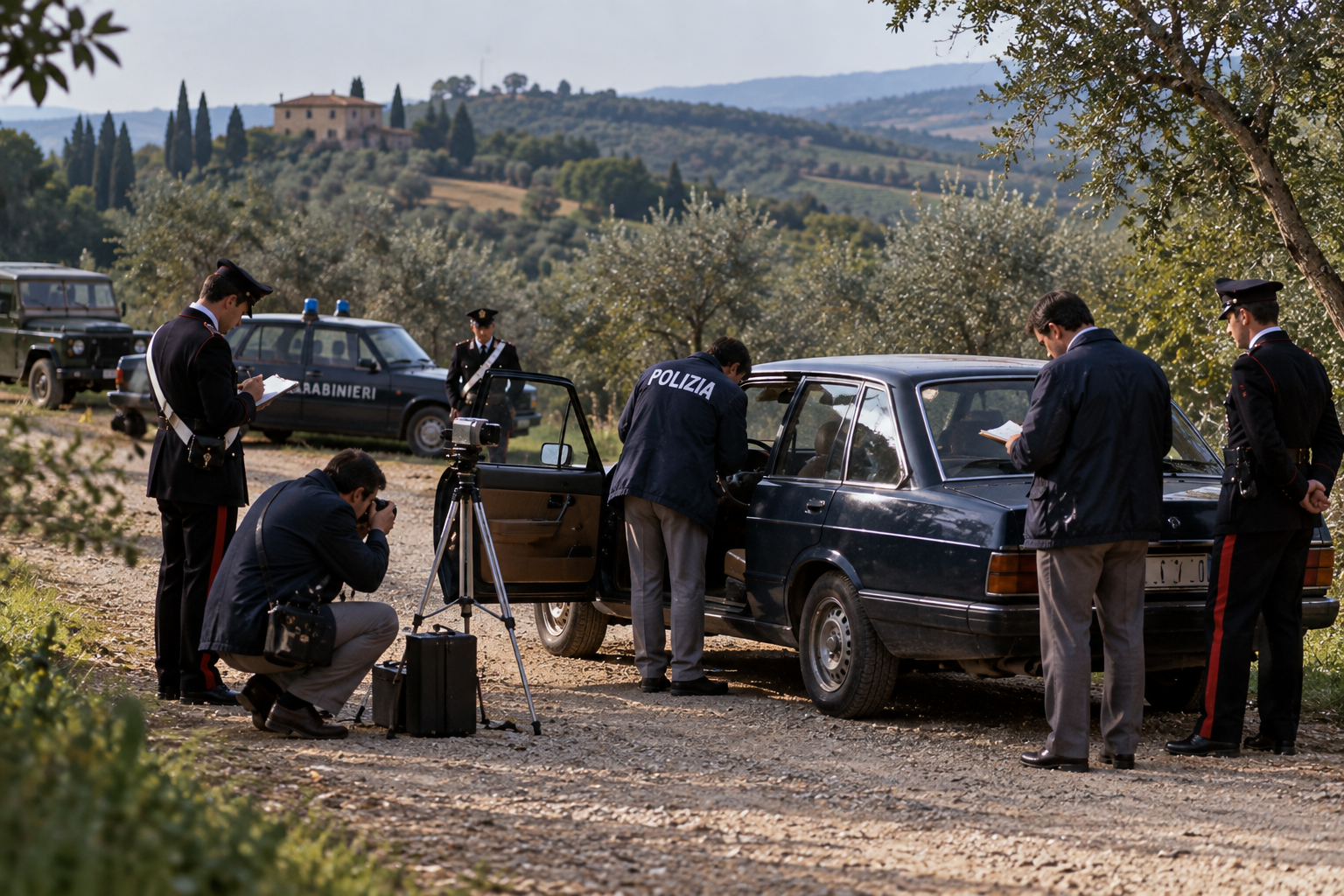
Pietro Pacciani became the central suspect of the most prominent phase of the investigation. A farm worker from Tuscany, Pacciani was investigated and eventually prosecuted on the theory that he had participated in the murders, while prosecutors developed the argument that he was connected to other men who assisted him. His 1994 trial attracted enormous public attention and became one of the most consequential criminal proceedings in modern Italian history. UPI
In November 1994, a Florence court convicted Pacciani and sentenced him to life imprisonment. The conviction concerned seven of the eight double murders attributed to the Monster at that stage, but the verdict did not end the controversy surrounding the case. Pacciani maintained his innocence, and the defense challenged the prosecution’s interpretation of the evidence and the reliability of parts of the investigation. UPI
Pacciani’s conviction was overturned on appeal in 1996. Italy’s Supreme Court subsequently annulled that acquittal and ordered a new appellate proceeding, but Pacciani died in February 1998 before the retrial could take place. As a result, there was never a final judicial determination establishing Pacciani’s criminal responsibility for the full group of murders attributed to the Monster. CBS News
The distinction is important because Pacciani is often described in popular accounts as though his guilt had been definitively established. It had not, because the conviction against him did not survive the appellate process and the retrial ordered after the Supreme Court’s intervention never occurred. His role therefore remains part of the judicial history of the case, but it cannot accurately be presented as a final conviction for the entire series. Mostro di Firenze – Monster of Florence
Mario Vanni and Giancarlo Lotti
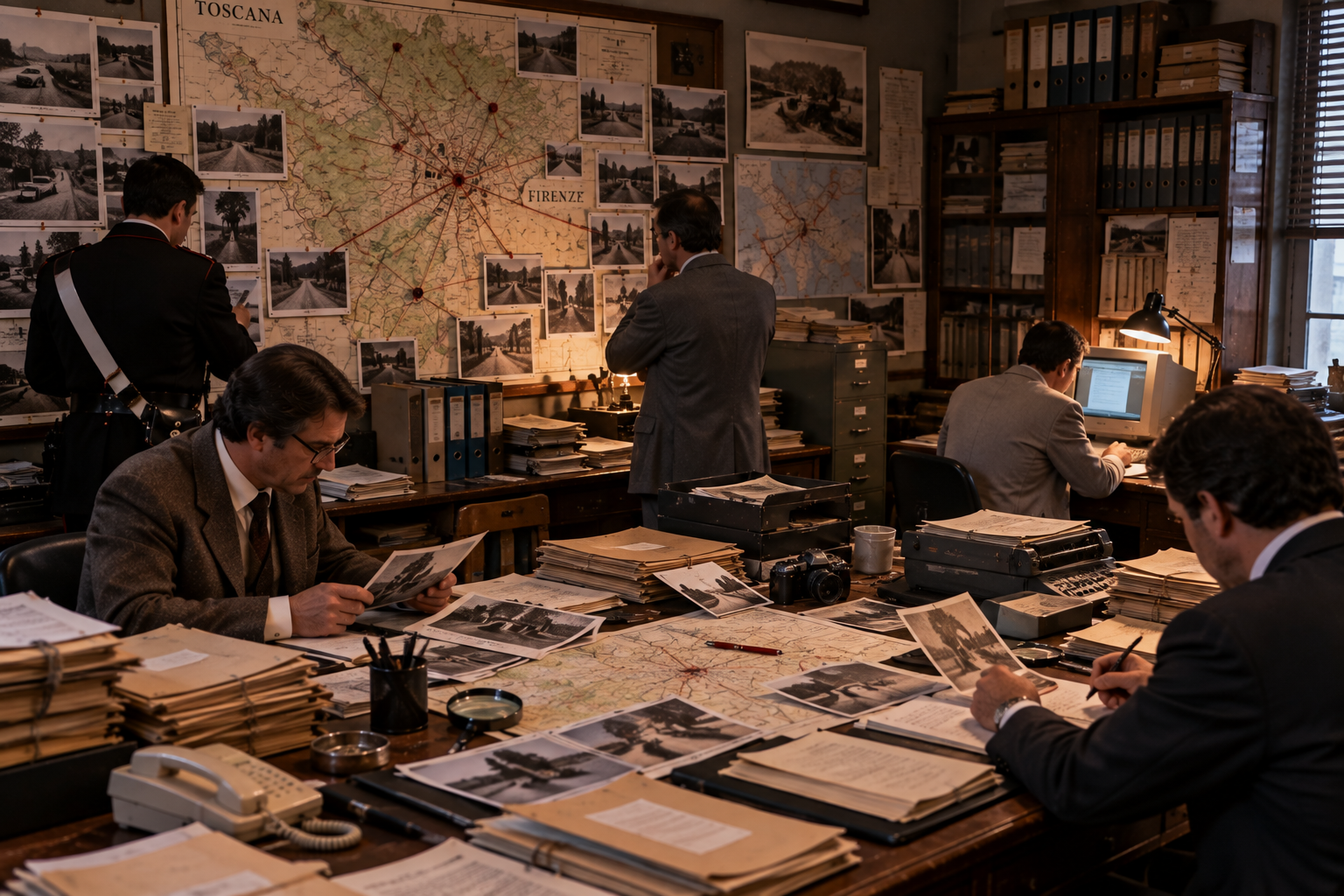
The prosecution’s theory later shifted toward a group of men associated in the media with the phrase “Compagni di merende,” or “snack companions.” Mario Vanni and Giancarlo Lotti became the central defendants in the second major trial, while Pacciani remained an important figure in the prosecution theory despite his death before the proceedings against him could be completed. The prosecution argued that the men acted together in the later murders, an interpretation that ultimately produced final convictions for Vanni and Lotti. la Repubblica
In 1998, the Florence Court of Assizes sentenced Vanni to life imprisonment and Lotti to 30 years. The appellate process subsequently modified Lotti’s sentence to 26 years and limited the final findings concerning Vanni to four of the eight double murders associated with the Monster. In 2000, Italy’s Court of Cassation confirmed the life sentence for Vanni and the 26-year sentence for Lotti, making those convictions final. Mostro di Firenze – Monster of Florence
The convictions are a central part of the legal record and should not be blurred with the unresolved aspects of the wider case. Vanni and Lotti were not merely suspects in the historical record; their convictions became final after review by Italy’s highest court. At the same time, those judgments did not identify a single person as responsible for every one of the eight double murders, leaving a distinction between the crimes covered by final convictions and the larger series popularly known as the Monster of Florence murders. la Repubblica
The evidence presented against Lotti also became controversial because his statements played a major role in the prosecution’s reconstruction of the later killings. Fernando Pucci’s testimony was another important element in the proceedings, particularly concerning the Scopeti crime, but later discussions have continued to question aspects of the testimony and the broader investigative reconstruction. Those later challenges do not erase the final convictions, but they explain why the case continues to generate debate over how much of the wider series was actually resolved in court. la Repubblica
The Evidence That Still Shapes the Case
The .22-caliber ballistic evidence remains one of the most important elements linking the murders. Investigators concluded that the same firearm had been used in multiple attacks, and the recurring Winchester ammunition associated with the weapon became a distinctive feature of the case. Yet the missing firearm meant that investigators never had the opportunity to establish ownership through the weapon itself or conduct the kind of comprehensive modern examination that a recovered gun could have allowed. la Repubblica
Physical evidence from the crime scenes has also been revisited repeatedly as forensic technology improved. In 2024, ANSA reported on an unknown DNA profile identified on a projectile associated with the 1985 Scopeti murders, with a partial overlap reportedly found on projectiles from the 1983 and 1984 killings. The finding was presented as a potential new investigative lead, not as an identification of the killer, and proposals were made to compare the profile with other biological evidence and, potentially, material from victims whose remains might preserve traces of an assailant. ANSA.it
That distinction between a new forensic lead and a solved case is essential. The reported DNA finding did not produce a named perpetrator, and the available reporting does not establish that the profile belongs to the person who fired the weapon rather than someone who handled ammunition or was otherwise associated with it. Until such a profile can be independently attributed and connected to the relevant crime scenes, it remains evidence requiring further interpretation rather than a definitive identification. ANSA.it
Other physical evidence has also been disputed. For example, a cartridge found in Pacciani’s garden became a major point of contention, while later forensic assessments cited by defense representatives questioned whether it had ever been fired through the Beretta associated with the murders. Such disputes illustrate the difficulty of treating every piece of evidence recovered decades after the crimes as equally reliable, particularly when questions exist about provenance, handling and the original chain of custody. la Repubblica

Theories Beyond the Courtroom
The Monster of Florence investigation generated an unusually large number of theories, including the Sardinian trail, alleged secret groups, possible occult motives and theories involving influential local figures. Some of these ideas were investigated by police or prosecutors and therefore belong to the documented history of the case, but an investigative theory is not equivalent to a proven fact. The absence of a final judicial finding supporting many of these theories is precisely why they should be presented as hypotheses rather than explanations. The Guardian
The so-called Sardinian trail became particularly influential because the first murder involved Barbara Locci, who had Sardinian origins, and because several men connected to her relationships came under scrutiny. Investigators examined people including Salvatore and Francesco Vinci, among others, while attempting to understand how the weapon used in 1968 could later have appeared in the subsequent murders. The trail generated substantial investigative activity but did not produce a final judicial identification of the Monster. la Repubblica
Later theories also proposed that professionals or other outsiders had commissioned or facilitated the killings. These ideas gained attention because some investigators believed that the mutilations suggested a motive extending beyond ordinary homicide, but there has been no court finding establishing an occult organization or secret group as the force behind the murders. The historical record contains allegations and investigative documents concerning such theories, but the evidentiary status of those claims remains fundamentally different from the final convictions of Vanni and Lotti. The Guardian
The continued production of theories has also influenced how the victims are remembered. The more elaborate the proposed conspiracy becomes, the easier it is for the individual lives of the victims to disappear behind the mythology of the case. A responsible reconstruction therefore has to return repeatedly to the basic historical fact that 16 people died, while acknowledging that the legal record resolves only part of the larger sequence. The Guardian
The Case in the Modern Era
The Monster of Florence investigation has never entirely disappeared from public and legal discussion. In 2019, the Florence Prosecutor’s Office sought the closure of an investigation involving Giampiero Vigilanti and Francesco Caccamo, describing the evidentiary picture as too weak and uncertain to support further investigative action. That development demonstrated that prosecutors continued to examine alternative suspects decades after the last murder, even though no new prosecution resulted from the inquiry. la Repubblica
New forensic work subsequently renewed attention to the case. The 2024 reporting about an unidentified DNA profile on ammunition prompted calls for additional comparisons and possible exhumations, while other investigators and victim representatives argued that surviving biological evidence should be reassessed using modern techniques. These developments reopened questions about what could still be extracted from the surviving evidence, but they did not establish a new suspect or overturn the final convictions. ANSA.it
The legal status of Mario Vanni also received renewed attention in 2025. His nephew’s lawyers sought a revision of Vanni’s life sentence, relying in part on a new forensic-entomology analysis concerning the timing of the Scopeti murders and arguing that a different date could undermine part of the evidentiary reconstruction used at trial. The Court of Appeal in Genoa rejected the application, and in February 2026 the Court of Cassation rejected the subsequent challenge, leaving Vanni’s final conviction intact. ANSA.it
The 2026 ruling is significant because it demonstrates the difference between a continuing historical mystery and a reopened criminal conviction. The courts did not identify the Monster or declare the broader case solved; they rejected an attempt to obtain a new trial for Vanni based on the proposed entomological evidence. The decision therefore leaves the final convictions of Vanni and Lotti in place while the identity of whoever was responsible for the full sequence of murders remains unresolved. La Nazione
What Remains Unresolved
The central unanswered question is whether one individual, several individuals, or different combinations of perpetrators were responsible for every murder conventionally grouped under the Monster of Florence name. The final judgments against Vanni and Lotti address four of the double murders, while Pacciani died before a new trial could determine the effect of the Supreme Court’s decision to overturn his acquittal. No person has therefore received a final conviction covering all eight double homicides. la Repubblica
The missing murder weapon remains another major gap. Investigators have associated the murders with the same .22-caliber firearm, but the gun itself has never been recovered, preventing a potentially decisive evidentiary chain linking the weapon to a specific owner. The continuing search for ballistic and biological evidence illustrates why the case has remained fertile ground for new investigations even after the principal trials ended. la Repubblica
The earliest murder remains particularly important to this uncertainty. Barbara Locci and Antonio Lo Bianco were killed in 1968, and the later series was eventually connected to their deaths through ballistic and investigative reasoning, but the attribution has never been free of controversy. If the first crime is treated differently from the later murders, the historical question becomes not simply who committed the Monster’s crimes but exactly which crimes should be included in the series in the first place. Wikipedia
The most defensible conclusion is therefore narrower than many popular accounts suggest. The historical record supports a series of eight double homicides conventionally attributed to the Monster of Florence, a recurring .22-caliber firearm, extensive investigations, and final convictions involving Vanni and Lotti for four later double murders. It does not provide a final, universally accepted identification of the person or persons responsible for the entire series, and later forensic developments have not yet changed that fundamental status. la Repubblica
Remembering the Victims
The mythology surrounding the Monster of Florence can easily make the unidentified offender appear to be the main character, but the historical record begins and ends with the people who were killed. Barbara Locci, Antonio Lo Bianco, Pasquale Gentilcore, Stefania Pettini, Carmela De Nuccio, Giovanni Foggi, Stefano Baldi, Susanna Cambi, Paolo Mainardi, Antonella Migliorini, Horst Wilhelm Meyer, Jens-Uwe Rüsch, Claudio Stefanacci, Pia Rontini, Jean Michel Kraveichvili and Nadine Mauriot were sixteen individual people whose lives were ended in attacks that devastated families and communities. Their names should not become secondary simply because the identity of the offender remains unresolved. The Guardian
Several of the victims were young people whose families expected ordinary futures for them, including relationships, marriages, employment and travel. Some were local couples, while others were visitors passing through Tuscany, and their differing backgrounds demonstrate that the series cannot be reduced to one simple social profile. The common element was the vulnerability created when couples sought privacy in isolated locations, not a shared personal relationship with a known offender established by the courts. The Guardian
The final French victims, Nadine Mauriot and Jean Michel Kraveichvili, were visitors to Italy whose deaths in 1985 brought the series to an end. Their case later became central to renewed forensic work because physical evidence from the scene and ammunition remained available for modern analysis. Even decades later, the investigation surrounding their deaths continues to influence attempts to understand whether the full Monster of Florence case can ever be resolved. ANSA.it
Conclusion
The Monster of Florence case is not a single solved criminal story with a disputed footnote. It is a long sequence of murders whose legal history established convictions for particular crimes while leaving the broader identity and structure of the offender or offenders unresolved. Pietro Pacciani was convicted and later acquitted before his death prevented a new trial, while Mario Vanni and Giancarlo Lotti received final convictions for four of the later double murders, but no final judgment has established responsibility for all eight double homicides. Mostro di Firenze – Monster of Florence
The evidence tells a similarly complicated story. The repeated use of a .22-caliber firearm created a powerful link among the murders, yet the gun itself was never recovered, while later DNA and forensic investigations have produced leads without providing a universally accepted identification. The 2026 rejection of the attempt to revise Vanni’s conviction further demonstrates that a challenge to one part of the judicial record is not the same thing as solving the wider mystery. la Repubblica
More than half a century after the first conventionally linked killing, the most responsible way to describe the Monster of Florence is therefore as a partially resolved criminal case surrounded by a larger unresolved historical mystery. The final convictions matter, but so do the limits of those convictions, the disputed attribution of the earliest murder, the missing weapon and the continuing questions surrounding the full series. Above all, the case remains a story about sixteen victims whose lives should be remembered independently of the mythology that has grown around the person or persons who killed them. The Guardian
FAQ
Who was the Monster of Florence? The Monster of Florence was the name given by the Italian press to the unidentified perpetrator or perpetrators associated with a series of double murders around Florence between 1968 and 1985. The conventional series consists of eight double homicides involving 16 victims, although the inclusion of the first 1968 Signa murders has remained subject to historical debate. No individual has been finally established as the single perpetrator of the entire series. The Guardian
How many victims did the Monster of Florence kill? Sixteen people are conventionally counted as victims because eight double homicides were attributed to the Monster of Florence. The series began with Barbara Locci and Antonio Lo Bianco in 1968 and ended with Nadine Mauriot and Jean Michel Kraveichvili in 1985. Because the attribution of the earliest killing has been debated, some historical accounts distinguish the 1968 crime from the seven later double murders when discussing the strongest evidentiary sequence. The Guardian
Who were the Monster of Florence victims? The conventionally identified victims were Barbara Locci and Antonio Lo Bianco, Pasquale Gentilcore and Stefania Pettini, Carmela De Nuccio and Giovanni Foggi, Stefano Baldi and Susanna Cambi, Paolo Mainardi and Antonella Migliorini, Horst Wilhelm Meyer and Jens-Uwe Rüsch, Claudio Stefanacci and Pia Rontini, and Jean Michel Kraveichvili and Nadine Mauriot. They came from different backgrounds, including local Italian couples and foreign visitors. Treating them as a group of individual people rather than simply as entries in a serial-killer case is important to understanding the human impact of the investigation. The Guardian
Was Pietro Pacciani the Monster of Florence? Pacciani was convicted in 1994 and sentenced to life imprisonment, but his conviction was overturned on appeal in 1996. Italy’s Supreme Court later annulled that acquittal and ordered another proceeding, but Pacciani died in 1998 before the retrial could occur, so there was no final conviction establishing his responsibility for the full series. He therefore cannot accurately be described as the legally established killer of all the Monster of Florence murders. UPI
Were Mario Vanni and Giancarlo Lotti convicted? Yes, both men were convicted in connection with the later Monster of Florence murders. Vanni received a life sentence and Lotti received 26 years after the appellate process, with Italy’s Court of Cassation confirming the convictions in 2000. Their final convictions concerned four of the double murders attributed to the Monster, rather than every killing in the wider series. la Repubblica
Was the Monster of Florence’s gun ever found? No, the .22-caliber firearm believed to have been used across the linked murders has never been recovered. Investigators developed ballistic evidence connecting ammunition from multiple crime scenes, making the firearm one of the most important physical elements of the case. Its continued absence has prevented investigators from establishing a complete ownership and forensic history for the weapon. la Repubblica
Has DNA solved the Monster of Florence case? No, DNA has not produced a confirmed identification of the Monster of Florence. In 2024, researchers reported an unknown DNA profile on a projectile associated with the Scopeti murders and reported partial overlap with material from two earlier crime scenes, but the finding was presented as a potential investigative lead rather than proof of the killer’s identity. Further comparisons and possible examination of surviving biological material from victims have been proposed, but those developments have not established a named perpetrator. ANSA.it
Is the Monster of Florence case solved today? The broader case remains unresolved. Final convictions exist for Mario Vanni and Giancarlo Lotti in four of the later double murders, while Pacciani’s conviction did not survive his appeal and he died before a retrial, leaving the complete series without a single final judicial resolution. In February 2026, the Court of Cassation rejected an attempt to revise Vanni’s conviction based on new entomological evidence, but that decision did not identify the person responsible for the entire Monster of Florence series. La Nazione
SOURCES & REFERENCES
- ANSA — Unknown DNA Reopens the Monster of Florence Mystery — Contemporary reporting on the unidentified DNA profile associated with ammunition from multiple crime scenes. ANSA.it
- ANSA — Vanni Revision Request — Reporting on the 2025 attempt to reopen Mario Vanni’s final conviction. ANSA.it
- ANSA — Genoa Court Rejects Vanni Revision — Report on the rejection of the requested revision by the Genoa Court of Appeal. ANSA.it
- RaiPlay — Monster of Florence Investigation and Investigative Errors — Public broadcaster discussion of the unresolved case and modern forensic developments. RaiPlay
- La Nazione — Court of Cassation Rejects Vanni Revision — Reporting on the February 2026 Cassation decision concerning the attempted revision of Vanni’s conviction. La Nazione
- The Guardian — The Monster of Florence Investigation — Historical reporting on the murders, Pacciani proceedings and later investigative theories.