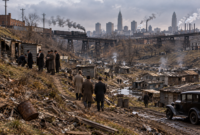
In the autumn of 1888, a series of murders in London’s impoverished East End became one of the most heavily publicized criminal investigations of the Victorian era. Five women — Mary Ann Nichols, Annie Chapman, Elizabeth Stride, Catherine Eddowes and Mary Jane Kelly — are conventionally identified as the victims linked to the unknown killer who became known as Jack the Ripper. Their murders occurred within a relatively small area of Whitechapel over several months, yet despite a major Metropolitan Police investigation, the killer was never identified or charged. London Museum
AI & Editorial Note
Hidden Frontiers uses AI-assisted tools as part of its content-production workflow, including research organization, drafting assistance, and visual development. The factual content of this article is strictly grounded in verified, cited sources, and disputed or uncertain information is identified where appropriate. Visuals accompanying this article are AI-generated historical reconstructions created for illustrative purposes.
Whitechapel Before the Murders
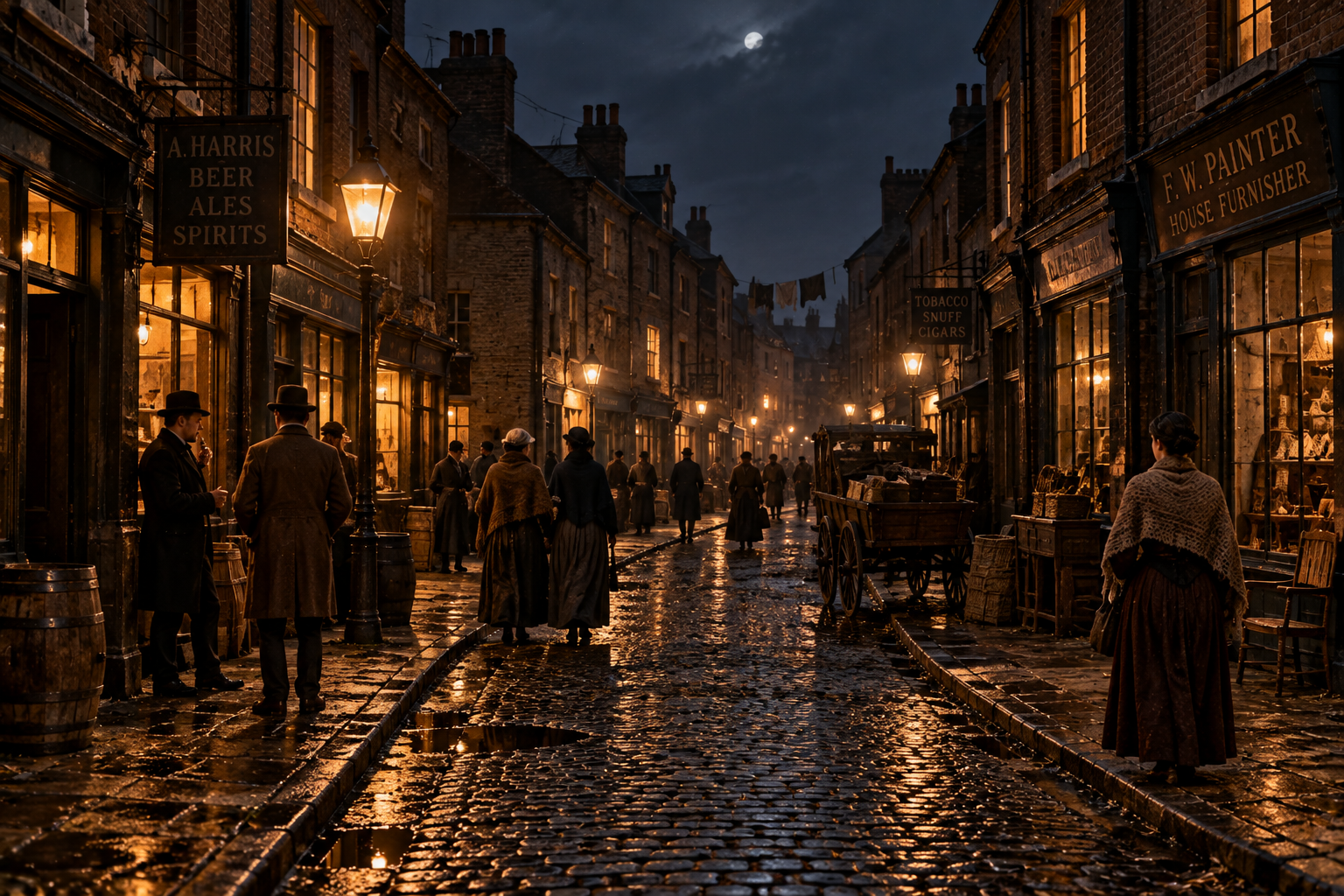
Whitechapel in the late nineteenth century was part of London’s rapidly expanding East End, an area shaped by overcrowding, insecure employment and severe poverty. The London Museum describes the district as one of the poorest parts of the capital, with badly ventilated housing, low-paid work and families sometimes sharing a single room. The neighborhood was also home to a substantial Jewish population, including refugees who had arrived from Eastern Europe, making Whitechapel a densely populated and socially diverse part of Victorian London. London Museum
The circumstances of the women later associated with Jack the Ripper have frequently been reduced to a single stereotype, particularly the claim that all five were prostitutes. Contemporary reporting often described them in those terms, but the surviving historical record is more complicated. The London Museum notes that Mary Jane Kelly is the only one of the five known to have been working in the sex trade at the time of her death, while the other women had supported themselves through various forms of casual or irregular work and lived under difficult economic circumstances. London Museum
That distinction matters because the murders became famous partly through the way newspapers portrayed the women. Their circumstances were frequently used to construct a sensational story about supposedly “fallen” women, while details of their families, employment, relationships and struggles received far less attention. Modern historical research has increasingly attempted to restore those individual lives to the record rather than treating the victims simply as characters in the story of an unidentified killer. London Museum
The Five Women Associated With Jack the Ripper
Mary Ann Nichols, known as Polly, was found murdered in Buck’s Row on August 31, 1888. Her death is generally regarded as the first of the five canonical Jack the Ripper murders, although other Whitechapel killings before and after the canonical series have sometimes been proposed as related cases. The London Museum identifies Nichols alongside Chapman, Stride, Eddowes and Kelly as the five women whose deaths were linked by police and later historical accounts to the same unidentified murderer. London Museum
Annie Chapman was killed on September 8, 1888, and her body was discovered in the backyard of a house in Hanbury Street. Her murder intensified public concern because it occurred only days after Nichols’s death and showed similarities that encouraged investigators to consider the possibility of a single offender. Chapman had worked in several occupations during her life and, like the other victims, had experienced poverty and instability before her death. London Museum
Elizabeth Stride and Catherine Eddowes were killed on the same night, September 30, creating one of the most important turning points in the investigation. Stride was found in Dutfield’s Yard in Whitechapel, while Eddowes was discovered in Mitre Square in the City of London less than an hour later. Their deaths generated intense speculation about whether the same person had killed both women, while the geographic boundary between the Metropolitan Police area and the City of London added another institutional complication to the investigation. London Museum
Mary Jane Kelly was murdered on November 9, 1888, in the room where she lived at Miller’s Court. Her death was the fifth and final murder traditionally included in the canonical sequence, after which the killings attributed to Jack the Ripper stopped. The reason the murders ended remains unknown, and no subsequent event has provided a definitive explanation for whether the killer died, left London, was imprisoned for another offense, or simply stopped. London Museum
The Whitechapel Murders Investigation
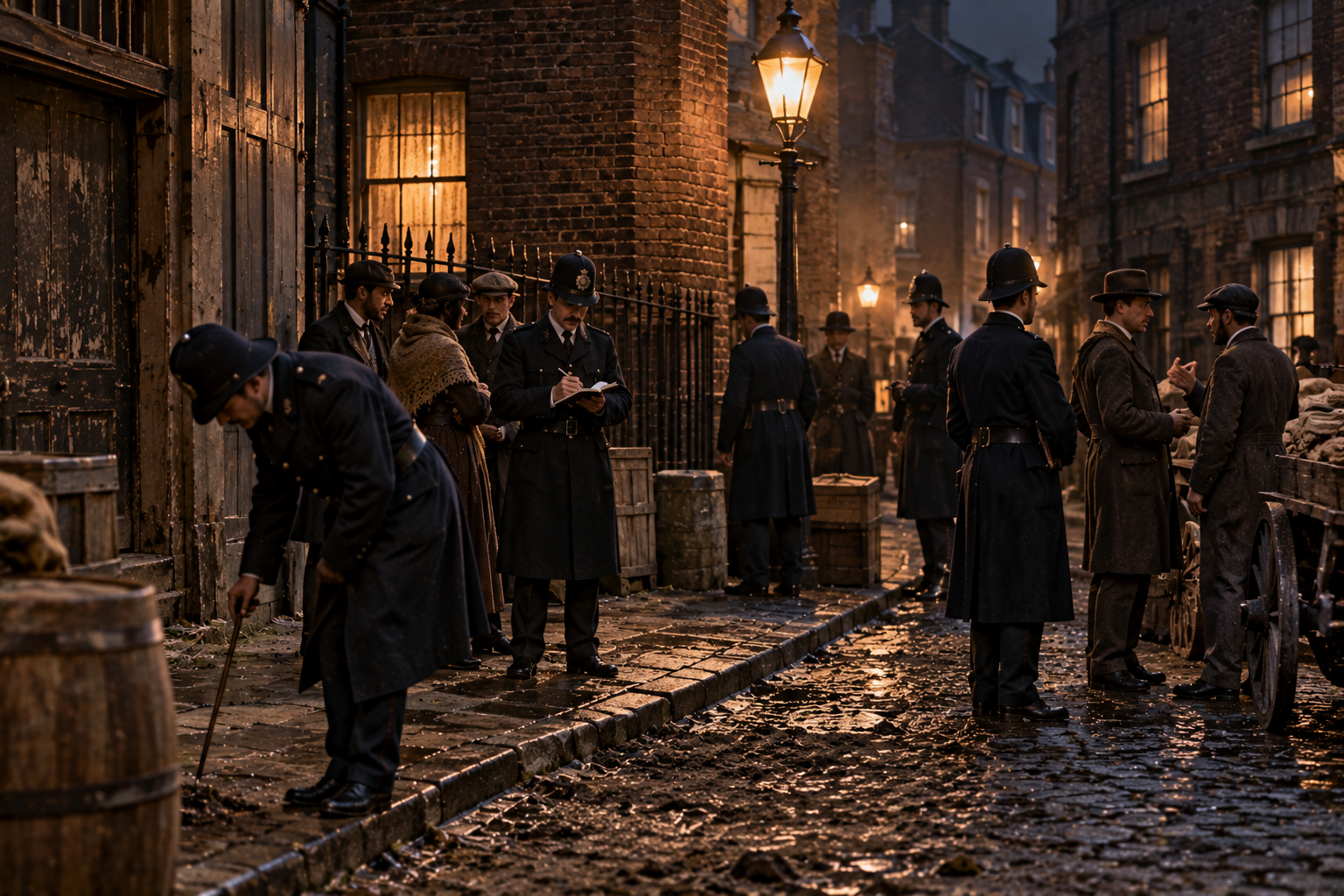
The Metropolitan Police investigation took place during a period when professional policing was still comparatively young. The Metropolitan Police detective department had been established in 1842, less than half a century before the Whitechapel murders, and the force had no access to many of the forensic techniques that investigators would later consider standard. Officers conducted thousands of interviews and investigated numerous suspects, but no one was ultimately charged with the murders attributed to Jack the Ripper. London Museum
The investigation was also complicated by the physical environment of Whitechapel. The district contained crowded lodging houses, narrow streets, busy markets, workshops and numerous people moving through the area at night, making it difficult to reconstruct precisely who had been where at the relevant times. Police had to rely heavily on eyewitness testimony, physical observations, medical examinations and conventional investigative work rather than fingerprints, DNA profiling or modern databases. The Metropolitan Police itself identifies fingerprinting as a much later development, with its Fingerprint Bureau not established until 1901. Met Police
The police were also working under extraordinary public pressure. Newspapers published extensive coverage of each murder, while public anger grew as another woman was killed without an arrest. A contemporary Punch cartoon preserved by the London Museum mocked the Metropolitan Police for its inability to identify the murderer, demonstrating that criticism of the investigation began while the case was still unfolding. London Museum
The involvement of two police jurisdictions further complicated the response. Most of the canonical murders occurred in the Metropolitan Police district, but Catherine Eddowes was killed in Mitre Square within the jurisdiction of the City of London Police. The investigation therefore involved cooperation between different authorities at a time when communications, record keeping and forensic procedures were far less standardized than they are today. London Museum
The Letters and the Name Jack the Ripper
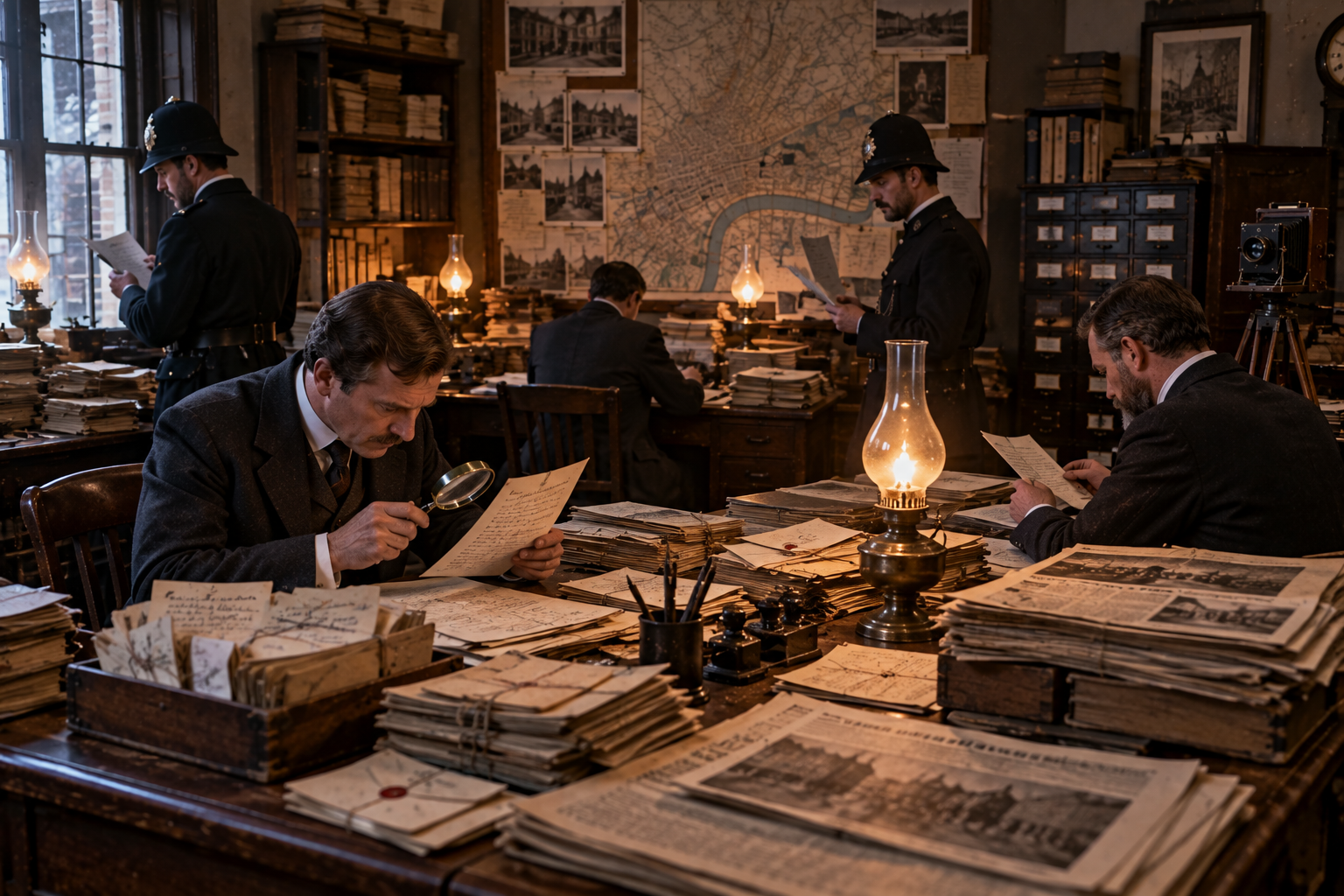
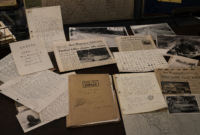
The name Jack the Ripper became inseparable from the case partly because of correspondence sent during the murders. Police and newspapers received hundreds of letters claiming to come from the killer, many of which were obvious hoaxes or attempts to exploit public fascination. The National Archives preserves one such letter from October 1888 and explicitly describes it as a hoax, while noting that it forms part of a much larger collection of alleged communications held in the Metropolitan Police and Home Office records. National Archives
The famous “Dear Boss” letter is particularly important to the history of the name, but its authorship remains uncertain. The letter was signed “Jack the Ripper,” helping establish the name in the public imagination, yet there is no reliable proof that the murderer wrote it. The National Archives warns that there is no strong evidence that the surviving letters were written by the killer, while academic analysis of the correspondence has explored the possibility that journalists were involved in producing some of the earliest influential texts. National Archives
This uncertainty changes how the case should be discussed. “Jack the Ripper” is best understood as the historical name attached to an unidentified killer or presumed killer associated with the canonical Whitechapel murders, rather than as a verified self-identification by the offender. The name became enormously powerful because it provided newspapers and the public with a single character around which an otherwise fragmented investigation could be organized. National Archives
The Evidence and Its Limitations
The similarities among the five murders led investigators and later researchers to consider them connected. All five women were killed in Whitechapel or the immediately surrounding East End, and the murders occurred between late August and early November 1888. The London Museum notes that all five had their throats cut and that four of the bodies were mutilated in ways that suggested a degree of anatomical knowledge, although the surviving evidence does not establish the offender’s profession or identity. London Museum
The physical evidence was nevertheless limited by nineteenth-century investigative technology. Investigators could examine wounds, clothing, footprints, witness accounts and other physical traces, but they lacked modern DNA analysis and systematic fingerprint identification. The absence of these techniques did not make investigation impossible, but it meant that evidence that might now connect a person to multiple crime scenes could not necessarily be recovered or interpreted in the same way in 1888. London Museum
One of the most important problems is that even the basic boundaries of the case are not completely certain. The five canonical victims are widely accepted as the group associated with Jack the Ripper, but other women were murdered in the surrounding period, and historians have debated whether some belonged to the same series. The London Museum specifically cautions that the lack of evidence means the exact number of victims cannot be established with certainty. London Museum
The alleged letters present a second major evidentiary problem. Because hundreds of communications claimed to be from the killer, later researchers have sometimes treated individual letters as if they were direct windows into the offender’s thoughts or methods. The National Archives instead demonstrates why caution is necessary: at least some were deliberate hoaxes, and the existence of a letter signed “Jack the Ripper” does not establish that it came from the murderer. National Archives
The Suspects and the Search for an Identity
No suspect was ever convicted or legally established as Jack the Ripper. Over the decades, investigators, historians and amateur researchers have proposed a large number of names, ranging from men investigated during the original police inquiry to individuals identified many years later. The sheer number of theories has become one of the defining features of the case, but a frequently repeated name should not be mistaken for evidence that the person committed the murders. London Museum
One important official document came from Melville Macnaghten, who later became an assistant commissioner at Scotland Yard. A surviving Metropolitan Police document dated February 23, 1894, identifies three suspects in connection with the Ripper murders, demonstrating that police thinking continued to be recorded years after the killings had stopped. The existence of the document is historically significant, but it does not constitute a conviction or establish that any of the named men was the killer. National Archives Images
Later generations produced even more elaborate theories. Some candidates have been proposed because of their occupations, locations, relationships or alleged anatomical knowledge, while others became famous because a later author or researcher argued that previously overlooked evidence pointed toward them. History’s review of the case notes that more than one hundred suspects have been named over time, a figure that illustrates the enormous distance between speculation and proof. HISTORY
Modern claims based on supposed DNA evidence have not resolved the question either. A frequently cited example involves a silk shawl allegedly associated with Catherine Eddowes and later tested for mitochondrial DNA, but the provenance of the item has been seriously questioned, meaning that even a genetic result cannot automatically establish that the material came from the original crime scene. Smithsonian reporting concluded that such testing did not provide a reliable identification of Jack the Ripper. Smithsonian Magazine
Why Jack the Ripper Was Never Caught
The failure to identify the killer resulted from a combination of circumstances rather than a single investigative mistake. Police were dealing with an unfamiliar pattern of murders in a crowded urban district, while forensic science was still developing and communications between witnesses and investigators were imperfect. The public and press also generated enormous amounts of information, much of which had to be evaluated without the analytical tools available to modern investigators. London Museum
The murders also depended heavily on timing. The killer appears to have operated in streets and spaces where darkness, crowds and poverty could provide opportunities to approach vulnerable women without immediately attracting attention. Once a body was discovered, investigators could document what remained, but they could not reconstruct every movement that had occurred before the discovery. The absence of a definitive eyewitness identification therefore remained a fundamental weakness in the case. London Museum
Another difficulty was the absence of a confirmed motive or personal connection linking the victims to a particular individual. Although theories have repeatedly suggested that the killer possessed anatomical knowledge or selected women according to particular circumstances, the evidence does not provide a verified biography of the offender. Without a confirmed identity, investigators could not test those theories against a suspect’s employment, relationships, movements or personal history in the way a modern cold-case investigation might. London Museum
The Legacy of the Whitechapel Murders
The murders quickly became more than a criminal investigation. Newspapers transformed the killings into an international story, helped by modern communications technology such as the transatlantic telegraph cable, while illustrations and sensational reporting created an enduring image of Victorian London as a city of fog, shadows and hidden predators. The London Museum emphasizes that the story gradually became a mixture of documented history and legend, with later retellings often giving greater attention to the killer than to the women he allegedly murdered. London Museum
The antisemitism surrounding the case is another important part of its history. Whitechapel was home to many Jewish refugees from Eastern Europe, and suspicion directed toward the Jewish community was rooted in prejudice rather than evidence that the killer was Jewish. The London Museum documents how these assumptions developed within an already tense environment shaped by poverty, immigration and competition for housing and employment. London Museum
The enduring fascination with Jack the Ripper has also influenced how true crime is consumed. The killer’s nickname, the unidentified suspect and the absence of a definitive conclusion provide a narrative structure that invites endless speculation, while the victims can easily become secondary characters in a story about the person who killed them. Modern historical work has attempted to reverse that imbalance by examining the five women as individuals whose lives existed before the murders and cannot be reduced to the circumstances of their deaths. London Museum
What the Historical Record Can Actually Establish
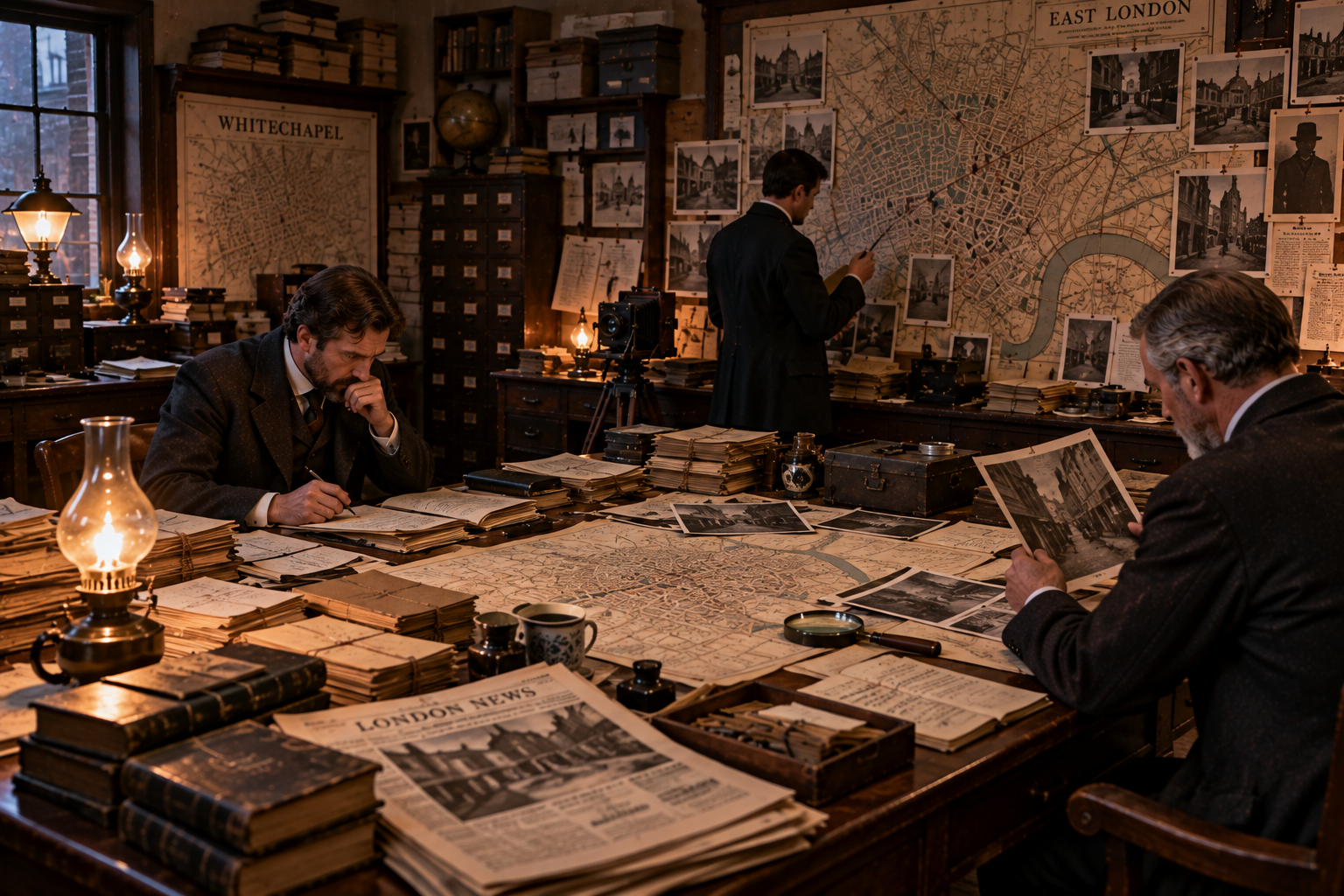
The strongest historical conclusion is also the simplest: five women were murdered in London’s East End in 1888, their deaths were linked by investigators and later historians to an unidentified offender, and that offender was never conclusively identified. The Metropolitan Police conducted an extensive investigation, thousands of interviews were undertaken, suspects were examined and numerous communications were received, but no prosecution established the identity of the killer. The surviving archives provide substantial evidence about the investigation while leaving the central question unanswered. London Museum
The case should also be understood as a historical record with boundaries rather than an invitation to turn every theory into fact. The five canonical victims are the most defensible group associated with the Jack the Ripper name, but even that classification reflects historical interpretation rather than a court finding. Claims involving particular suspects, alleged letters, modern DNA tests or additional victims must therefore be evaluated according to the quality and provenance of the evidence behind them. London Museum
More than a century later, Jack the Ripper remains unidentified. The case survives because the murders were documented extensively enough to leave a substantial archival record, but not extensively enough to provide the definitive evidence needed for a conviction. For the five women whose deaths created the case, the most responsible historical approach is to remember them as people who lived difficult but individual lives, rather than allowing the mythology surrounding their killer to become the whole story. London Museum
Conclusion
The Jack the Ripper case is often presented as an enduring puzzle about a mysterious killer, but the historical record tells a more complicated story. Mary Ann Nichols, Annie Chapman, Elizabeth Stride, Catherine Eddowes and Mary Jane Kelly were real women living in a difficult social environment, and their deaths triggered an enormous police investigation that unfolded before modern forensic science existed. Their killer was never identified, while the subsequent century of speculation has produced far more proposed answers than the surviving evidence can support. London Museum
The most reliable evidence comes from contemporary police and government records, historical collections and careful scholarship rather than from sensational claims of a definitive solution. The National Archives preserves original material showing both the scale of the investigation and the problem created by fraudulent communications, while the London Museum provides important context about the victims and the society in which they lived. Taken together, those records show why the case remains unresolved and why certainty about any individual suspect would go beyond the evidence. National Archives
Jack the Ripper therefore remains an unsolved historical murder case, not a mystery that has been conclusively solved by a modern theory. The absence of a confirmed identity is part of the historical record, but so are the names and lives of the five women whose deaths became associated with that name. More than the mythology of the unknown killer, those surviving records offer an opportunity to understand the victims, the realities of Victorian Whitechapel and the limitations faced by the investigators who tried to find the person responsible. London Museum
FAQ
Who was Jack the Ripper?
Jack the Ripper was the name given to an unidentified killer associated with five murders in and around Whitechapel in London’s East End during 1888. The name became famous after a letter signed “Jack the Ripper” was sent to a London news agency, although there is no strong evidence that the murderer actually wrote the letter. The killer’s real identity has never been conclusively established, and no person was convicted for the five canonical murders. National Archives
Who were Jack the Ripper’s victims?
The five women conventionally identified as Jack the Ripper’s victims were Mary Ann Nichols, Annie Chapman, Elizabeth Stride, Catherine Eddowes and Mary Jane Kelly. Their murders occurred between August and November 1888, with Stride and Eddowes killed on the same night. Historical sources emphasize that these women had individual lives, occupations and relationships, and that the commonly repeated claim that all five were prostitutes is inaccurate. London Museum
Were all of Jack the Ripper’s victims prostitutes?
No, the surviving historical evidence does not support describing all five women as prostitutes. The London Museum states that Mary Jane Kelly is the only one of the five known to have been working in the sex trade at the time of her murder, while the other women earned money through various forms of work or casual employment. Contemporary newspapers often used the prostitute label more broadly, but later historians have shown that this simplified description obscures important parts of the women’s lives. London Museum
How many people did Jack the Ripper kill?
Five murders are conventionally attributed to Jack the Ripper, forming what is commonly called the canonical five. However, other murders of women in the surrounding period have sometimes been proposed as possible Ripper crimes, and the evidence is insufficient to establish the exact number with certainty. The London Museum therefore distinguishes the five commonly linked victims from the broader group of murders that have been speculatively associated with the case. London Museum
Why was Jack the Ripper never caught?
The investigation faced major limitations because Victorian police did not have modern DNA analysis or systematic fingerprint identification, while the crowded streets of Whitechapel made eyewitness identification difficult. Police conducted thousands of interviews and investigated suspects, but no one was charged with the murders. The huge number of letters, rumors and competing claims also created additional investigative noise, including communications that were later recognized as hoaxes. London Museum
Were the Jack the Ripper letters genuine?
Some letters were genuine historical documents in the sense that they were actually sent to police or news organizations, but that does not mean they were written by the murderer. The National Archives identifies one surviving letter as a hoax and explains that hundreds of alleged Ripper communications entered police files. There is no strong evidence establishing that any surviving letter was definitely written by the killer, and scholarly research has raised the possibility that some influential early letters were produced by journalists or other hoaxers. National Archives
Has Jack the Ripper’s identity ever been proven?
No. Numerous suspects have been proposed, including people investigated during the original inquiry and individuals identified by later researchers, but no suspect has been legally or historically established as the murderer beyond reasonable doubt. Modern claims involving DNA or newly interpreted historical evidence have also failed to produce a universally accepted identification, partly because the provenance and reliability of some supposed evidence remain disputed. National Archives Images
What is the strongest evidence in the Jack the Ripper case?
The strongest evidence consists of the contemporary records documenting the murders, police investigations, medical examinations, witness accounts and surviving archival material. These sources establish that the five women were murdered and that investigators considered their deaths sufficiently similar to connect them to one offender, but they do not provide a definitive name. The surviving evidence is therefore much stronger for reconstructing what happened to the victims and how police responded than for identifying the person responsible. London Museum
SOURCES & REFERENCES
- London Museum — Jack the Ripper — Detailed historical overview of the five canonical victims, Whitechapel, the investigation, social context and continuing uncertainty. London Museum
- The National Archives — Hoax Letter Signed by “Jack the Ripper” — Original archival material and context concerning the alleged Ripper correspondence and police investigation. National Archives
- The National Archives — Macnaghten Report — Surviving Metropolitan Police record dated February 1894 identifying three suspects considered in the investigation. National Archives Images
- Metropolitan Police — Timeline of Met History — Official institutional timeline documenting the 1888 Jack the Ripper murders and later development of Metropolitan Police forensic capabilities. Met Police
- Smithsonian Magazine — No, We Still Cannot Confirm the Identity of Jack the Ripper — Examination of the disputed DNA claim involving the alleged Catherine Eddowes shawl. Smithsonian Magazine
- Smithsonian Magazine — New Book Chronicles the Lives of Jack the Ripper’s Victims — Historical context emphasizing the individual lives of the five women rather than reducing them to the mythology surrounding their killer.