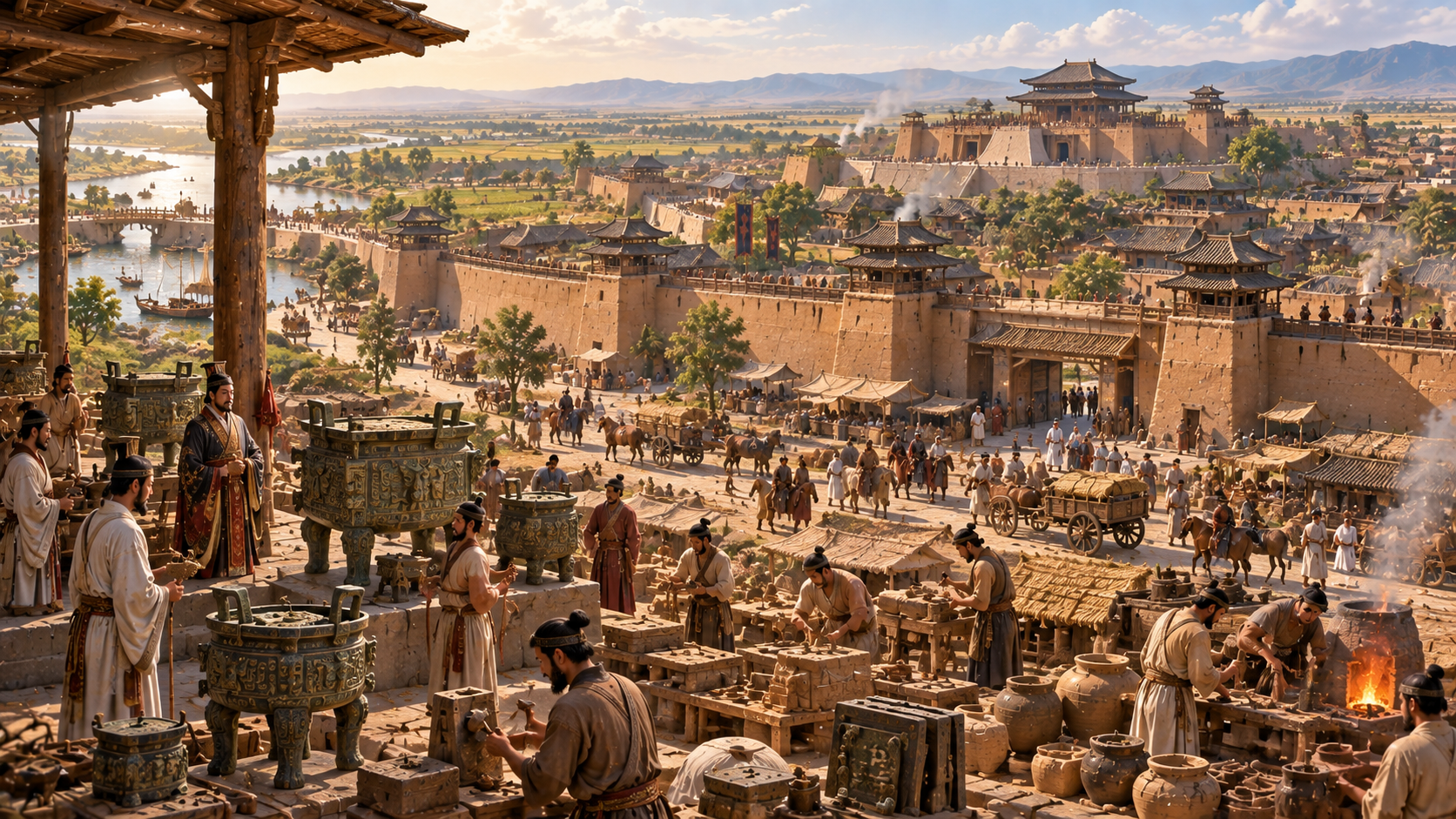
Ancient China was not created in a single moment, nor did it develop from one isolated settlement into a permanent unified state. It emerged through thousands of years of regional cultures, agricultural communities, cities, ritual traditions, political experiments, warfare, technological change, and cultural exchange, eventually producing powerful states and dynasties along the Yellow River and across much of eastern Asia. From Neolithic societies and the Bronze Age Shang to the Zhou kingdoms, the unification of the Qin, and the expansive Han Empire, early Chinese civilization developed institutions and ideas that would shape Chinese history for centuries. Its surviving bronze vessels, tombs, inscriptions, philosophical texts, administrative records, and archaeological sites provide an unusually rich record of how a complex civilization took shape.
AI & Editorial Note
Hidden Frontiers uses AI-assisted tools as part of its content-production workflow, including research organization, drafting assistance, and visual development. The factual content of this article is strictly grounded in verified, cited sources, and disputed or uncertain information is identified where appropriate. Visuals accompanying this article are AI-generated historical reconstructions created for illustrative purposes.
The Geographic Foundations of Ancient China
The earliest civilizations of China developed across a remarkably varied landscape rather than within one uniform ecological zone. The Yellow River basin became especially important for early state formation, while the Yangtze basin and other regions supported their own agricultural communities and distinctive cultural traditions. Mountains, deserts, grasslands, forests, rivers, and coastal environments created different opportunities and constraints, helping produce a mosaic of regional societies long before political unification.
Agriculture provided the economic foundation for increasingly complex communities. Millet was especially important in northern China, while rice cultivation became central in parts of the south, and archaeological evidence demonstrates that agricultural development occurred in multiple regions rather than following one simple path from north to south. Settlements gradually became more permanent and organized, with pottery, tools, storage facilities, ritual objects, defensive structures, and increasingly elaborate burial practices revealing substantial differences in wealth and social organization.
The phrase “Ancient China” can therefore be misleading if it suggests that all early communities shared one culture from the beginning. Neolithic societies developed distinctive artistic and technological traditions, while maintaining varying degrees of communication and exchange. The eventual emergence of states in the Yellow River region did not erase these differences; instead, political expansion repeatedly brought diverse communities into larger networks of interaction.
Neolithic China and the Road to Civilization
Long before the first historically documented dynasties, China was home to numerous Neolithic cultures. Yangshao communities in the Yellow River region became known for painted pottery and settled agricultural life, while cultures such as Dawenkou, Longshan, Hemudu, and Liangzhu developed distinctive traditions farther east and south. Archaeological evidence from these societies reveals increasingly sophisticated pottery, jade working, settlement organization, ritual practices, agriculture, and craft specialization.
The Longshan tradition is particularly important for understanding the transition toward more complex societies. Archaeological sites associated with Longshan communities contain evidence of large settlements, rammed-earth walls, social differentiation, specialized crafts, and increasingly elaborate burial practices. These developments do not prove that a single centralized kingdom already existed, but they show that the social and technological foundations required for later states were developing before the traditionally recorded dynasties.
The origins of the Xia dynasty require particular caution. Traditional Chinese historical texts describe the Xia as the first dynasty, preceding the Shang, but archaeological cultures such as Erlitou have not produced universally accepted evidence that allows historians to identify them straightforwardly with the Xia described in later texts. Erlitou is nevertheless extremely important because its archaeological remains demonstrate the emergence of a large, politically complex society in the Yellow River region during the early second millennium BCE. The distinction between archaeological evidence and later historical tradition is essential when reconstructing this formative period.
The Shang Dynasty and Bronze Age China
The Shang dynasty, conventionally dated to approximately 1600–1046 BCE, is the earliest Chinese dynasty for which there is substantial archaeological and written evidence. Shang political power was centered in northern China, and its rulers controlled territories through a combination of royal authority, kinship relationships, military force, ritual institutions, and networks of subordinate communities. The final Shang capital at Anyang, traditionally identified with Yin, has produced some of the most important archaeological discoveries associated with early Chinese civilization.
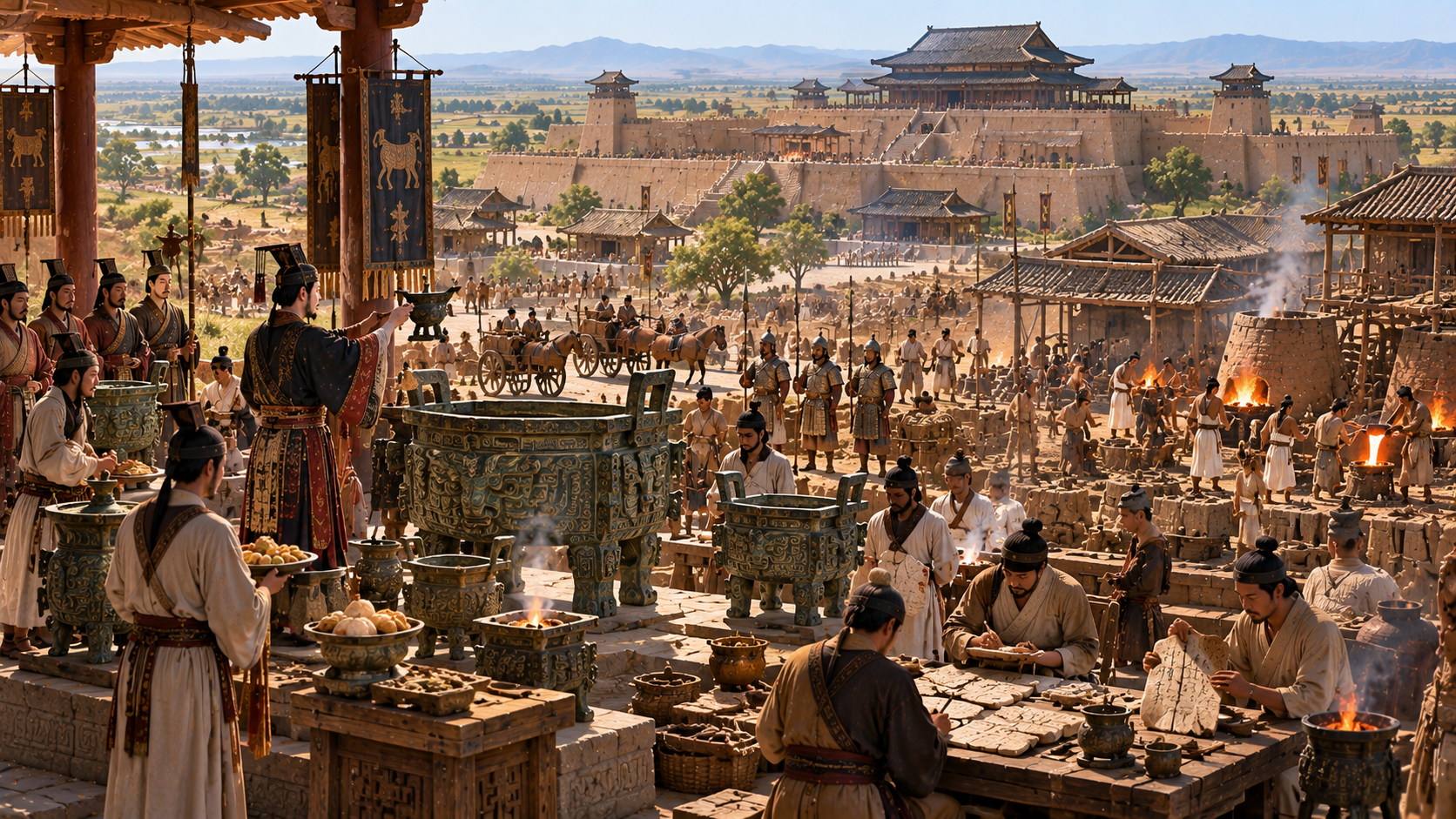
Bronze technology became one of the defining features of Shang elite culture. Large ritual vessels were cast using sophisticated piece-mold techniques, allowing artisans to create elaborate forms and intricate animal and geometric decoration. Bronze objects were not simply luxury goods because they played central roles in ceremonies involving food, wine, ancestors, political authority, and communication with the supernatural world. The technical skill required to produce these vessels also reveals the existence of highly organized systems of mining, transportation, labor, craftsmanship, and elite patronage.
Shang society was deeply hierarchical. Kings occupied the center of political and ritual authority, while aristocratic families, military leaders, priests or ritual specialists, craftspeople, agricultural workers, and other laborers occupied different positions within the social order. Tombs at major Shang sites contain evidence of striking differences in wealth and status, while some elite burials also contain chariots, weapons, bronze vessels, jade objects, and human or animal sacrifices.
Oracle Bones and the Birth of Chinese Writing
One of the most important Shang discoveries is the corpus of oracle-bone inscriptions found particularly at Anyang. These inscriptions were written on animal bones and turtle shells used in divination, with questions concerning matters such as warfare, hunting, harvests, weather, illness, childbirth, and sacrifices. The inscriptions provide direct evidence of a mature writing system during the late Shang period and represent the earliest substantial body of Chinese writing currently known.
The writing on oracle bones is particularly valuable because it connects archaeological objects with identifiable political and religious practices. A typical divination procedure involved preparing an animal bone or turtle shell, applying heat to create cracks, and interpreting those cracks in relation to a question presented to the ancestral or divine world. The resulting inscription could record the question, sometimes the prediction, and later information concerning what actually happened.
Modern Chinese writing is not simply identical to Shang script, but there is a long historical relationship between the early writing tradition represented by oracle-bone inscriptions and later Chinese scripts. The continuity is especially significant because written Chinese became one of the most important institutions through which historical memory, administration, literature, philosophy, and political culture were transmitted. At the same time, the survival of early writing should not obscure the fact that literacy was highly specialized and concentrated among particular groups.
The Zhou Dynasty and the Mandate of Heaven
The Zhou conquered the Shang around the middle of the eleventh century BCE and established a new political order. The Zhou rulers justified their overthrow of the Shang partly through the concept later known as the Mandate of Heaven, according to which legitimate political authority depended upon moral and cosmic approval rather than an unbreakable hereditary right. A ruler who governed badly could theoretically lose the Mandate, allowing a new ruling house to claim legitimate authority.
The Zhou political system developed differently from the later centralized empires of Qin and Han. During the Western Zhou period, the Zhou royal house exercised authority over a network of regional states connected by kinship, political relationships, ritual obligations, and military ties. Over time, however, royal authority weakened and powerful regional states became increasingly autonomous, especially after the Zhou court moved its capital eastward in the eighth century BCE.
The Zhou period lasted for centuries and is therefore better understood as a broad historical framework than as a single stable political system. The Eastern Zhou period saw the rise of increasingly powerful states, frequent warfare, political reform, technological change, and major intellectual developments. The weakening of Zhou authority did not mean cultural collapse; instead, competition among states created an environment in which political thinkers, military strategists, administrators, and philosophers debated how society should be governed.
The Spring and Autumn and Warring States Worlds
The Spring and Autumn period and the subsequent Warring States period transformed ancient Chinese political life. Dozens of states gradually consolidated into fewer and more powerful kingdoms, each seeking military, economic, and administrative advantages over its rivals. Warfare became larger and more organized, while rulers introduced reforms designed to increase agricultural production, taxation, military service, population control, and state authority.
Iron tools and weapons became increasingly important during the Eastern Zhou period, although bronze remained highly significant for ritual and military purposes. Crossbows, cavalry, fortified cities, large infantry armies, and increasingly sophisticated administrative systems changed the nature of warfare. States could mobilize populations on a scale that earlier city-centered political systems had not achieved, contributing to the emergence of territorial states capable of absorbing or defeating smaller rivals.
This period also produced one of the great intellectual transformations in Chinese history. Thinkers associated with Confucian, Daoist, Mohist, Legalist, and other traditions debated ethics, education, political authority, social order, human nature, ritual, law, warfare, and the relationship between individuals and the state. Later historians often grouped these traditions into distinct “schools,” but the boundaries between them were more fluid in early China than simple modern labels sometimes suggest.
Confucius and Classical Chinese Thought
Confucius, traditionally dated to 551–479 BCE, lived during the later Zhou world when political fragmentation and social instability encouraged intense debate about good government and proper conduct. He emphasized moral cultivation, learning, ritual, relationships, and the responsibilities associated with different social roles. His teachings were not preserved in a single book written personally by him; instead, traditions associated with Confucius were transmitted, edited, interpreted, and expanded over generations.
The Analects became the most famous collection associated with Confucius, although its formation was complex and its textual history remains important to scholarship. Confucian thought placed considerable emphasis on education and the cultivation of virtuous behavior, arguing that political order depended not only on laws and punishments but also on the moral character of rulers and officials. These ideas would become deeply influential during later Chinese history, particularly after the Han period.
Confucius was not the only important thinker of the era. Laozi became associated with Daoist traditions emphasizing the Dao, naturalness, and a distinctive approach to political and personal life, although the historical identity and chronology of Laozi remain debated. Legalist thinkers emphasized institutions, laws, administrative control, and the practical power of the state, while Mohist thinkers developed arguments concerning impartial concern, practical benefit, and opposition to costly warfare. The intellectual world of early China was therefore remarkably diverse.
Qin and the Unification of China
The state of Qin emerged from the western Zhou political order and gradually developed into the strongest of the competing Warring States kingdoms. Reformers strengthened Qin agriculture, taxation, administration, and military organization, enabling the state to mobilize resources more effectively than many rivals. By the late third century BCE, Qin armies had defeated the other major competing states.
Ying Zheng became king of Qin as a young ruler and completed the conquest of the remaining rival kingdoms. In 221 BCE, after defeating the final major opposition, he adopted the title Qin Shi Huang, commonly translated as the First Emperor of Qin. This marked the creation of the first unified imperial state to control much of what later became the historical core of China.
The Qin government pursued extensive standardization and centralization. Weights and measures were standardized, administrative divisions were reorganized, roads and canals supported imperial communication, and the writing system was regularized across the newly unified territories. The Qin also imposed heavy labor and taxation demands, creating enormous infrastructure projects while generating resentment that contributed to the dynasty’s rapid collapse after the emperor’s death.

The Great Wall and Qin Frontier Policy
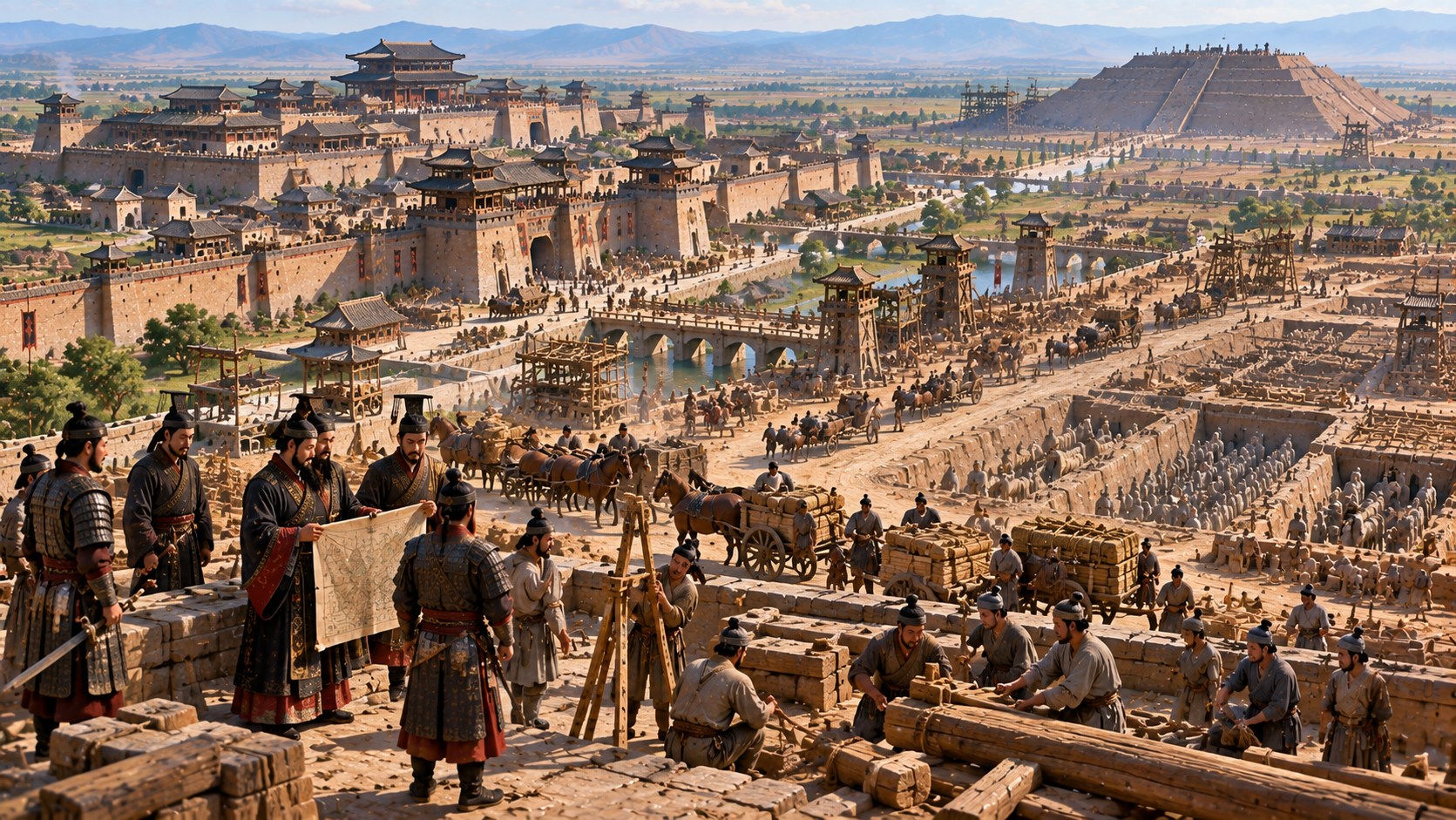
The Great Wall was not originally one continuous structure built entirely by Qin Shi Huang. Earlier states had constructed separate defensive walls during the Warring States period, and the Qin government connected or rebuilt portions of these existing defenses as part of its northern frontier policy. Subsequent dynasties, especially the Han and much later the Ming, built, rebuilt, extended, or modified different sections, meaning the structure visible today represents many centuries of construction.
Qin frontier policy was shaped partly by conflict with peoples beyond the agricultural states of northern China. The northern frontier was a zone of interaction, trade, warfare, migration, and cultural exchange rather than a simple dividing line between two completely separate worlds. The Great Wall system therefore had military, administrative, communication, and territorial-control functions that changed according to historical circumstances.
The popular image of the Great Wall as a single Qin-era monument is consequently misleading. Archaeological remains demonstrate a long and complex history of walls, trenches, watchtowers, passes, and other defensive installations. Some of the earliest surviving sections were built from rammed earth rather than the stone and brick construction associated with many famous later sections.
The Terracotta Army and Qin Imperial Power
The mausoleum complex of Qin Shi Huang near modern Xi’an provides extraordinary evidence of the ambitions of the first Qin emperor. The famous Terracotta Army consists of thousands of life-size figures representing soldiers, horses, and other elements of an enormous funerary complex. Their scale and organization reflect the military and administrative power that the Qin state had accumulated by the end of the Warring States period.
The figures were produced in workshops using a combination of standardized and individualized components. Soldiers differ in hairstyle, facial features, clothing, armor, and equipment, although modern scholarship continues to investigate how much of this variation represents actual military organization and how much resulted from workshop production. The original figures were also painted, meaning the familiar earth-colored appearance of the excavated army does not accurately reproduce how the sculptures originally looked.
The mausoleum complex illustrates an important characteristic of Qin political culture: the imperial state was imagined as extending beyond the emperor’s death. The enormous investment in tomb construction, soldiers, officials, servants, animals, weapons, and architectural spaces suggests that the imperial court attempted to reproduce or protect aspects of earthly power in the afterlife. The project also demonstrates the enormous labor and administrative resources available to the Qin government.
The Fall of Qin and the Rise of Han
The Qin dynasty lasted only a short time after the death of Qin Shi Huang. Rebellions, political conflict, harsh demands, and struggles among rival leaders destabilized the empire, and the Qin court eventually lost control. After a period of civil war, Liu Bang emerged victorious and founded the Han dynasty.
The Han retained many of the Qin’s administrative innovations while moderating some of its harshest policies. The empire was divided into centrally controlled commanderies and other territories, while imperial officials, taxation, military service, agriculture, and law provided the institutional foundation for long-term rule. The result was a more durable imperial system that would govern large parts of China for roughly four centuries, interrupted by the short-lived Xin regime of Wang Mang.
The Han period is therefore crucial for understanding the formation of a durable imperial political tradition. Later Chinese dynasties frequently looked back to the Han as a model of effective government, territorial expansion, scholarship, and cultural identity. The term “Han” also became associated with one of the largest cultural and linguistic identities in later Chinese history, although the population of the Han Empire itself was diverse and included many regional communities.
Han Society, Economy, and Everyday Life
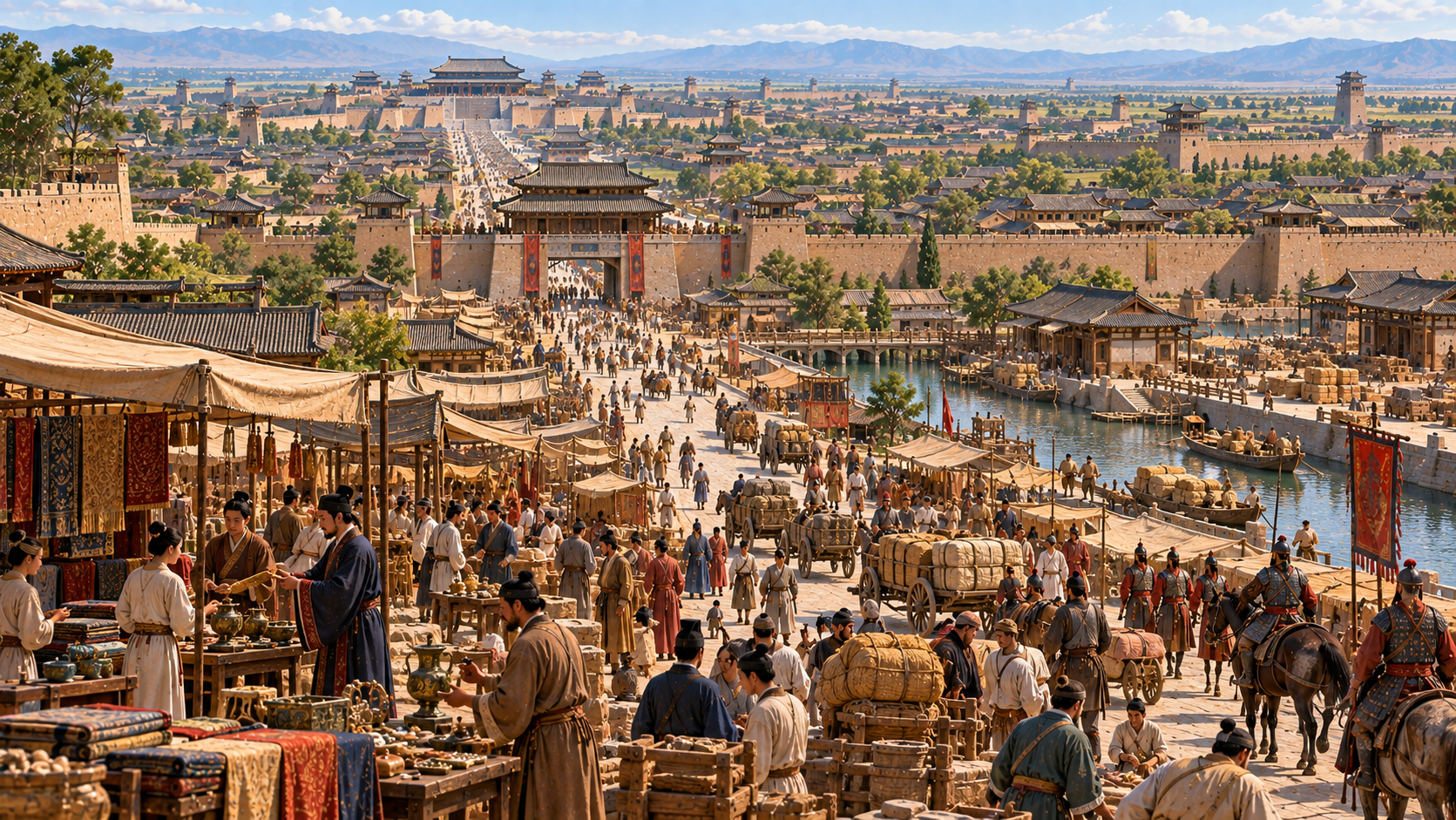
The Han Empire depended heavily on agriculture. Farmers cultivated grains, raised animals, managed irrigation and water resources, and supplied the state through taxes and other obligations. At the same time, craftsmen produced ceramics, bronze objects, textiles, lacquerware, weapons, tools, and luxury goods, while merchants operated within networks that connected local markets to long-distance trade.
Urban centers became important administrative and commercial hubs. Chang’an, the capital of the Western Han, developed into a monumental city containing palaces, residential districts, markets, and government institutions. Other cities served as regional administrative centers, military bases, production centers, and points of connection between agricultural communities and long-distance trade networks.
Han tombs provide valuable evidence about elite life and beliefs concerning death. Tomb objects include models of houses, servants, animals, agricultural facilities, vehicles, musical instruments, weapons, lamps, ceramics, lacquerware, and luxury goods. These objects suggest that some people imagined the afterlife as an extension of earthly existence, while also revealing the social hierarchy, domestic environment, technologies, and material culture of the living world.
Religion, Ancestors, and the Cosmic Order
Religious practices in ancient China developed through multiple traditions rather than one unified belief system. Ancestor worship was especially important during the Shang and Zhou periods, with rulers and elite families conducting rituals intended to maintain relationships with deceased ancestors and divine powers. Heaven, ancestors, nature, local spirits, and other supernatural forces appeared within different religious and philosophical traditions, and their importance changed across time.
Ritual was also deeply connected with political authority. Shang kings used divination and sacrifice as part of royal decision-making, while Zhou political thought connected legitimate rule with Heaven’s approval. Later Confucian traditions placed great emphasis on ritual as a means of cultivating proper behavior and maintaining relationships between individuals, families, and political institutions.
During the Han period, religious life became even more diverse. Court rituals, ancestral ceremonies, local cults, cosmological theories, immortality practices, and emerging Daoist traditions all existed within a complex religious environment. Buddhism began entering China through networks of contact during the later Han period, although its major institutional development belongs primarily to subsequent centuries.
Technology, Craft, and Innovation
Ancient Chinese civilization produced important technological developments, although individual inventions should not be separated from the social systems that allowed them to spread. Bronze casting reached extraordinary technical sophistication during the Shang and Zhou periods, while iron technology became increasingly important during the later Zhou and imperial periods. Agriculture, textile production, transport, water management, metallurgy, ceramics, and construction all underwent significant development.
Paper is often included among the famous inventions of ancient China, but the history is more complicated than the popular story suggests. Early paper-like materials existed before the Han, while traditionally credited improvements associated with Cai Lun belong to the Eastern Han period. The important historical point is that Chinese papermaking developed over time and eventually became a transformative medium for writing, administration, literature, and education.
Silk production was another major part of ancient Chinese economic and cultural history. Silk textiles became important prestige goods and eventually traveled along long-distance networks linking China with Central Asia and regions farther west. The resulting exchanges involved far more than silk itself, with goods, technologies, artistic motifs, religions, ideas, and people moving through a series of interconnected routes rather than along one single road.
The Han Empire and the Silk Roads
The Han Empire expanded westward and established increasingly extensive relationships with peoples and states across Central Asia. Emperor Wu’s reign saw major military and diplomatic initiatives, including the famous missions of Zhang Qian to the Western Regions. These contacts contributed to the development of long-distance networks later associated with the Silk Roads.
The Silk Roads were not a single road stretching continuously from China to Rome. They were networks of land and maritime routes connecting different communities, markets, political powers, and ecological zones. Han China participated in these networks through diplomacy, military expansion, trade, migration, and exchange, helping connect the Chinese heartland with Central Asia and beyond.
The Chang’an-Tianshan corridor illustrates the complexity of these networks. Cities, forts, passes, post stations, settlements, religious sites, and water-management systems supported movement across difficult terrain. The resulting exchanges brought Chinese communities into contact with Central Asian societies and helped create a wider Eurasian world of commercial and cultural interaction.
Government and the Imperial Bureaucracy
The emergence of centralized government was one of the most important developments of early Chinese history. Shang and Zhou rulers relied heavily on aristocratic relationships and ritual authority, while Qin and Han rulers increasingly governed through territorial administration, appointed officials, taxation systems, military institutions, and written regulations. This did not eliminate local power, but it gave the central government far greater capacity to coordinate large territories.
The Qin state demonstrated how administrative standardization could support rapid political expansion. The Han inherited much of this infrastructure but combined centralized institutions with hereditary and local elites, regional kingdoms, and a growing class of officials. Over time, education and mastery of classical texts became increasingly important pathways into government service, although the fully developed civil-service examination system belongs to later Chinese history.
The political ideal of the scholar-official would become one of the defining features of imperial China, but it should not be projected backward in its later form. During the Han, the relationship between philosophical learning, state service, family background, recommendation, and political office was still developing. The period nevertheless established intellectual and administrative traditions that later dynasties would expand considerably.
The End of the Han Dynasty
The Han Empire experienced periods of extraordinary prosperity and expansion, but it also faced major structural pressures. Court factionalism, conflicts among powerful families, military commanders, taxation problems, peasant unrest, and regional competition weakened central authority. The Yellow Turban rebellion in the late second century CE became one of several crises that exposed the growing difficulty of maintaining imperial control.
The Han dynasty formally ended in 220 CE, after decades of political fragmentation and military competition. Powerful regional commanders increasingly controlled their own territories, while the imperial court became dependent upon competing military and political factions. China subsequently entered a long period of political division, even though the cultural and institutional traditions developed under the Qin and Han remained deeply influential.
The end of the Han therefore did not represent the end of Chinese civilization. Written traditions, administrative practices, philosophical texts, religious institutions, artistic styles, family structures, and ideas about political legitimacy continued to evolve under new regimes. Later dynasties repeatedly inherited, modified, and reinterpreted the political and cultural foundations established during the early imperial period.
The Legacy of Ancient China
The legacy of Ancient China is unusually broad because many institutions developed during the early dynastic and imperial periods remained influential long after individual dynasties disappeared. Writing, classical learning, ritual traditions, centralized administration, family ethics, political theory, technological knowledge, and artistic practices were repeatedly preserved and transformed by later generations. The Qin and Han in particular established political and cultural frameworks that became reference points for subsequent imperial states.
Ancient China also demonstrates the importance of regional diversity. Early Chinese civilization was never simply the product of one river valley or one ethnic community, and the eventual imperial state incorporated populations from many different environments and cultural backgrounds. Contact with nomadic peoples of the northern frontier, societies of Central Asia, communities of southern China, and neighboring regions contributed to the development of the civilization rather than merely challenging it from outside.
Perhaps the most important historical lesson is that Chinese civilization developed through continuity and change at the same time. Neolithic communities created agricultural and craft traditions that supported more complex societies, Shang rulers built a powerful Bronze Age state, Zhou thinkers developed influential political and ethical ideas, Qin rulers created an unprecedented centralized empire, and Han institutions transformed that imperial model into a durable political tradition. Each period inherited something from the past while also reshaping it for new circumstances.
Conclusion
Ancient China was the product of a long and complicated process that began with diverse Neolithic communities and eventually produced sophisticated Bronze Age states, competing Zhou kingdoms, the Qin imperial unification, and the vast Han Empire. Its history cannot be reduced to a list of dynasties because political change was accompanied by transformations in agriculture, technology, writing, religion, philosophy, warfare, commerce, and social organization. Archaeological discoveries and early texts together reveal a civilization whose development was both deeply rooted in regional traditions and shaped by continual interaction among different peoples.
The Shang oracle bones, Zhou bronze inscriptions, Qin administrative reforms, Terracotta Army, Han cities, tombs, and Silk Road networks each illuminate different aspects of this history. They show how rulers sought legitimacy, how states organized resources, how craftspeople achieved remarkable technical skill, how philosophers debated human behavior and government, and how ordinary people lived within increasingly complex political systems. Ancient China was therefore not a finished civilization that appeared fully formed in the distant past, but a constantly changing world whose institutions and cultural traditions provided foundations for much of later Chinese history.
Quick Historical Timeline
| Period | Approximate Date | Major Development |
|---|---|---|
| Neolithic cultures | c. seventh–third millennium BCE | Agriculture, settled communities, pottery, jade, regional cultures |
| Erlitou period | early second millennium BCE | Large settlements and complex political organization emerge |
| Shang dynasty | c. 1600–1046 BCE | Bronze-age state, oracle-bone writing, royal ancestor rituals |
| Western Zhou | c. 1046–771 BCE | Zhou conquest, regional political order, development of Mandate of Heaven tradition |
| Eastern Zhou | 770–256 BCE | Political fragmentation and competing states |
| Spring and Autumn period | 770–c. 476 BCE | Powerful regional states and major intellectual developments |
| Warring States period | c. 475–221 BCE | Large-scale warfare, state reforms, philosophical competition |
| Qin dynasty | 221–206 BCE | Political unification and centralized imperial government |
| Western Han | 206 BCE–9 CE | Imperial consolidation, expansion, scholarship, long-distance exchange |
| Eastern Han | 25–220 CE | Imperial restoration followed by growing regional and political instability |
| End of Han | 220 CE | Political fragmentation and beginning of prolonged division |
FAQ
When did Ancient China begin?
There is no single date marking the beginning of Ancient China because Chinese civilization developed through many regional societies over thousands of years. Neolithic communities were already cultivating crops, producing pottery, making jade objects, and developing increasingly complex settlements long before the Shang dynasty. For historical reference, the Shang is the earliest dynasty for which substantial archaeological and written evidence provides a secure picture of an early Chinese state.
Who were the Shang people?
The Shang were the ruling community associated with one of the earliest archaeologically documented dynasties in Chinese history, conventionally dated to approximately 1600–1046 BCE. Their political world was centered in northern China and is especially well known for sophisticated bronze casting, royal ancestor rituals, chariot warfare, monumental settlements, and oracle-bone inscriptions. Archaeological discoveries at Anyang provide some of the strongest evidence for Shang political organization, religion, technology, and writing.
What are oracle bones?
Oracle bones are animal bones and turtle shells that were used in divination during the Shang period and inscribed with early forms of Chinese writing. Questions concerned subjects such as warfare, harvests, weather, hunting, illness, childbirth, and ritual sacrifices, making the inscriptions valuable evidence for Shang political and religious life. They are particularly important because they provide direct archaeological evidence for a mature Chinese writing system more than three thousand years ago.
What was the Mandate of Heaven?
The Mandate of Heaven was a political and religious concept associated especially with Zhou ideas about legitimate rule. It held that Heaven granted political authority to a worthy ruler and that a ruler who governed badly could lose that legitimacy, providing a justification for replacing a dynasty. The concept became one of the most influential ideas in Chinese political thought because it offered a framework for explaining both successful dynastic rule and the overthrow of an established ruling house.
Who was Qin Shi Huang?
Qin Shi Huang was the ruler who conquered the rival Warring States and established the first unified imperial state in 221 BCE. He centralized government, standardized important systems such as weights and measures and the written script, and initiated or expanded enormous infrastructure and defensive projects. His mausoleum near modern Xi’an is famous for the Terracotta Army, which provides extraordinary archaeological evidence for the power and organization of the Qin state.
Why was the Great Wall built?
The Great Wall was not a single structure built at one time for one purpose. Earlier Chinese states constructed separate defensive walls, and the Qin government connected or rebuilt sections of existing fortifications after unification, while later dynasties created additional systems across different frontier regions. Its functions included defense, frontier control, communication, movement regulation, and protection of strategically important territories and routes, with the famous stone and brick sections seen today largely belonging to much later periods.
What was the Han dynasty known for?
The Han dynasty ruled from 206 BCE to 220 CE, with a short interruption by the Xin regime, and became one of the most influential periods in early Chinese history. It strengthened the imperial institutions inherited from Qin, expanded Chinese territory, supported scholarship and literature, developed major urban centers, and participated in long-distance networks connecting China with Central Asia. The period also became associated with important developments in art, technology, administration, philosophy, and the cultural identity later associated with the Han people.
What was the Silk Road?
The Silk Road was not one road but a broad network of interconnected routes linking China with Central Asia and, through successive connections, regions farther west and south. During the Han period, diplomatic missions, military expansion, merchants, travelers, and political contacts helped strengthen these long-distance connections. Goods such as silk moved along the networks, but so did technologies, artistic styles, religious ideas, information, and people, making the Silk Roads important channels of cultural exchange as well as commerce.
SOURCES & REFERENCES
The Metropolitan Museum of Art — Neolithic Period in China
Institutional research covering Yangshao, Longshan, Hemudu, Dawenkou, Liangzhu, pottery, jade, agriculture, regional diversity, and the development of Neolithic Chinese cultures.
The Metropolitan Museum of Art — Neolithic Period in China
The Metropolitan Museum of Art — Shang and Zhou Dynasties: The Bronze Age of China
Detailed museum research covering Shang and Zhou chronology, Bronze Age political development, bronze technology, ritual, jade, Western Zhou, Eastern Zhou, Spring and Autumn, and Warring States history.
The Metropolitan Museum of Art — Shang and Zhou Dynasties
The Metropolitan Museum of Art — Oracle Bone
Museum documentation for Shang oracle bones and their dating to approximately 1600–1046 BCE.
The Metropolitan Museum of Art — Oracle Bone
Stanford Encyclopedia of Philosophy — Confucius
Academic reference covering Confucius, his chronology, intellectual context, the Analects, ritual, ethics, politics, and the complex transmission of his teachings.
Stanford Encyclopedia of Philosophy — Confucius
The Metropolitan Museum of Art — Qin and Han Dynasties
Museum research covering Qin unification, the First Emperor, Terracotta Army, Han institutions, imperial expansion, material culture, and the development of Chinese identity.
The Metropolitan Museum of Art — Age of Empires: Qin and Han Dynasties
The Metropolitan Museum of Art — Han Dynasty
Institutional chronology and research covering the Western and Eastern Han, Chang’an, government, cultural development, and imperial expansion.
The Metropolitan Museum of Art — Han Dynasty
UNESCO World Heritage Centre — The Great Wall
Authoritative heritage documentation explaining the multi-dynastic history of the Great Wall and the Qin connection to earlier defensive structures.
UNESCO World Heritage Centre — The Great Wall
UNESCO World Heritage Centre — Silk Roads: Routes Network of Chang’an-Tianshan Corridor
Institutional documentation on the Han-era development of long-distance networks connecting Chang’an with Central Asia and the wider Silk Roads system.
UNESCO World Heritage Centre — Silk Roads: Chang’an-Tianshan Corridor