Rome began as a settlement in central Italy and eventually became the center of a political system that controlled territory around the Mediterranean and far beyond it. The history of Ancient Rome is therefore much larger than the familiar image of emperors, gladiators, and marble temples. It includes a centuries-long Republic, military expansion across Italy and the Mediterranean, political struggles among competing elites, a vast imperial administration, diverse provincial societies, extensive slavery, technological and architectural achievements, and the gradual transformation of Roman political and religious life.
The Roman world did not emerge fully formed. According to Roman tradition, the city was founded in 753 BCE, but archaeology points to a more complicated process of settlement and urban development on the hills around the Tiber. The Republic conventionally begins in 509 BCE, while the imperial system is conventionally dated from Augustus’ settlement of power beginning in 27 BCE. The western imperial government was traditionally brought to an end in AD 476, but Roman political institutions, culture, and identity continued in the East for another millennium.
Ancient Rome is best understood as a civilization that changed dramatically over time. The Rome of the early Republic was not the Rome of Augustus, and the Rome of Augustus was not the same as the Mediterranean world governed by emperors such as Trajan and Hadrian.
Quick Facts
Period: Traditionally from Rome’s legendary foundation in 753 BCE through the end of western imperial rule in AD 476, although Roman civilization and the Eastern Roman Empire continued much longer.
Location: Central Italy at its origin, eventually encompassing territories across much of Europe, North Africa, and the Middle East.
Political systems: Roman Kingdom, Roman Republic, and Roman Empire.
Languages: Latin was fundamental to Roman administration and culture in the western Mediterranean, while Greek remained extremely important, particularly in the eastern Mediterranean.
Religion: Traditional Roman polytheism, numerous local and imported cults, Judaism, Christianity, and eventually a predominantly Christian imperial order.
Major institutions: Senate, magistracies, assemblies, army, provincial administration, imperial court and bureaucracy.
Major legacy: Roman law, languages, political concepts, architecture, engineering, urban planning, literature, calendars, Christianity’s institutional history, and enduring cultural traditions.
The British Museum summarizes Rome’s development from a small settlement into an empire spanning an enormous geographic and cultural range.
What Was Ancient Rome?
The word “Rome” can describe several different things. It can mean the city itself. It can mean the Roman Republic that governed Mediterranean territories before the emperors. It can mean the Roman Empire, both as a political system and as the territories ruled by emperors.
Or it can mean Roman civilization, a broader cultural world that included people who did not live in Italy, did not speak Latin as their first language, and did not necessarily share the same religious or ethnic background. That distinction matters.
The Roman Empire included Britain, Spain, North Africa, Egypt, the Balkans, Anatolia, Syria and parts of the Arabian frontier. These regions had their own languages, religions, traditions, cuisines and identities. Roman rule did not erase those differences.
The British Museum’s Roman collections illustrate this diversity through objects originating from different parts of the empire. Roman culture could combine imperial institutions with local traditions, producing distinct provincial societies rather than one uniform culture.
Ancient Rome was therefore both centralized and diverse.
The state was extraordinarily powerful, but ordinary people experienced Roman rule differently depending on where they lived, whether they were citizens, their occupation, wealth, gender, legal status, and relationship with local communities.
The Origins of Rome
Rome grew along the Tiber River in central Italy.
The city’s location provided access to inland Italy while remaining connected to Mediterranean commerce. Several hills offered defensible settlement locations, and the Tiber provided a route for movement and trade.
Roman tradition preserved a famous foundation story involving the twins Romulus and Remus, supposedly raised by a she-wolf. The traditional foundation date is 753 BCE. The story became one of Rome’s most powerful political myths, but historians distinguish the legend from the archaeological development of the city. The British Museum explicitly presents the Romulus and Remus story as a Roman foundation tradition rather than straightforward historical documentation.
Early Rome existed within a wider Italian world.
The Etruscans to the north were especially influential. Greek communities in southern Italy and Sicily also formed part of the broader Mediterranean environment in which Rome developed. Roman culture consequently never developed in isolation.
Architecture, religion, writing, artistic forms, warfare and political practices were influenced by neighboring peoples and by later contact with the Greek world. This pattern continued throughout Roman history.
Rome became powerful partly because it was exceptionally good at incorporating outside influences into its own institutions.
The Roman Kingdom and the Birth of the Republic
According to Roman tradition, the earliest Rome was ruled by kings. The monarchy supposedly ended in 509 BCE, after which Rome became a Republic. The precise historical circumstances surrounding the transition are debated, but the political model that emerged was fundamentally different from hereditary kingship.
The Republic distributed authority among magistrates, assemblies and the Senate. Two consuls were elected annually and possessed substantial executive and military authority. Other magistrates handled judicial, financial and administrative responsibilities. The Senate became one of the central institutions of Roman political life. It is important, however, not to imagine the Roman Republic as a modern democracy.
Political participation was unequal. Wealth, family background, citizenship and social standing strongly influenced access to power. The Metropolitan Museum describes the early Republic as a political system in which patricians initially held substantial privileges, while plebeians struggled for greater political and legal rights.
This produced the long Conflict of the Orders. Plebeians organized politically and demanded greater protection and representation. Over time, the distinction between patrician and plebeian became less important than competition among wealthy Roman families and political networks.
Roman law also developed through this process. The Twelve Tables, traditionally dated to the mid-fifth century BCE, became a foundational reference point in Roman legal history. The Republic was not a static constitution.
It changed repeatedly as Rome expanded and as different groups fought over political power.
The Roman Republic Expands
Roman expansion began in Italy. Rome fought neighboring peoples, formed alliances, incorporated territories and gradually established dominance over the Italian peninsula. Military success transformed the Republic.
Instead of remaining a regional Italian state, Rome became a Mediterranean power. The Punic Wars against Carthage were decisive. Rome defeated Carthage in three major wars between the third and second centuries BCE. The second conflict produced the extraordinary campaign of Hannibal, who crossed the Alps with an army that famously included war elephants.
Rome survived catastrophic defeats and eventually won the war. By the end of the third century BCE, Roman power had expanded dramatically. Rome then became involved in the eastern Mediterranean, where it intervened in Greek and Hellenistic political affairs. Territory brought wealth, taxation, slaves, agricultural land and new opportunities for Roman elites.
But expansion also changed Roman society. Generals gained prestige through military victories. Provincial governors controlled enormous territories. Wealth from conquest became concentrated among powerful families. Large estates developed in parts of Italy. The Republic that had governed a city-state was increasingly struggling to govern an imperial-scale Mediterranean power.
The British Museum describes Rome’s later Republican centuries as a period in which the city developed into the capital of a vast territory acquired through conquest and diplomacy.
Roman Government and Political Institutions

Roman government was complex. The Senate was not equivalent to a modern parliament. It was composed primarily of elite citizens and exercised enormous authority over finance, foreign policy, provincial administration and political decision-making.
The consuls were elected annually and possessed significant executive and military powers. Other magistrates included praetors, quaestors, aediles and censors.
Roman citizens also participated through assemblies. The system therefore combined elections, aristocratic influence, popular voting, religious authority and customary constitutional practices. The famous Roman separation of powers was never a modern constitutional separation in the contemporary sense.
Instead, authority overlapped. A political decision might involve magistrates, senators, assemblies, priests and military commanders. Roman political life was also highly personal. Family reputation mattered. Political alliances mattered. Patronage mattered. Military prestige mattered. Wealth mattered.
The Constitution was not contained in a single document. Much of Roman political practice developed through laws, precedents, customs and institutional traditions. This flexibility was one of Rome’s strengths during expansion, but it also became a weakness when individual commanders accumulated enormous wealth and personally loyal armies.
Roman Society
Roman society was deeply hierarchical. At the top stood elite senators and other extremely wealthy families. Below them were numerous layers of citizens, including merchants, artisans, farmers, soldiers and urban workers.
Noncitizens possessed fewer legal rights, while enslaved people occupied a legally subordinate position. Freed people who had been manumitted could enter Roman society with a different legal status from the enslaved, although important limitations remained.
Women generally did not possess the same formal political rights as male citizens, but they could exercise significant influence within households, property ownership, religious activity and social networks depending on their status and circumstances.
Roman society therefore cannot be reduced to a simple division between “patricians and plebeians.”
By the imperial period, Rome was a complicated social system containing citizens, noncitizens, freed people, enslaved people, soldiers, local elites and communities with different regional identities.
Slavery
Slavery was fundamental to Roman society and economy.
Enslaved people worked in households, agriculture, workshops, mines, administration and many other occupations. They came from diverse ethnic and geographic backgrounds, including people captured during warfare, people born into slavery and people acquired through trade. The British Museum notes that historians cannot determine the exact proportion of enslaved people in the empire, although scholarly estimates commonly place it in the vicinity of one-tenth of the population, with some estimates higher.
Roman law regarded enslaved people as property rather than citizens with ordinary legal personhood. Yet their lived experiences varied enormously. An enslaved household worker could experience a very different life from someone laboring in a mine or agricultural estate.
Some people were eventually freed through manumission.
Freed people could become economically successful and, in certain circumstances, accumulate substantial social status, although they remained marked by their former legal condition and could not simply occupy every political position available to freeborn citizens. The scale and importance of slavery are therefore essential to understanding Roman prosperity. Rome’s achievements cannot be separated from the labor and coercion that supported its economy.
Roman Religion
Religion was woven into Roman public and private life. Romans worshipped many gods, including Jupiter, Juno, Minerva, Mars, Venus and numerous others. But Roman religion was not one single standardized belief system. Households maintained domestic rituals. Cities maintained temples and festivals. Priests performed public ceremonies. Military units had religious practices. Emperors developed forms of imperial cult. Local communities retained their own traditions. Roman religion also developed through cultural contact. Gods and practices from Greece, Egypt, Syria, Gaul and other regions entered the Roman world. This flexibility helped Roman religion coexist with enormous cultural diversity.
The existing HiddenFrontiers article on Roman sacred forests provides a closer look at how Roman religion could extend beyond temples into particular forests, springs, landscapes and legally protected sacred spaces. Roman religion also illustrates the importance of ritual. The goal was often not simply personal belief but maintaining a correct relationship between the community and the gods. Sacrifice, festivals, priesthoods, vows and public ceremonies were therefore political as well as religious activities. The traditional Roman religious system eventually faced a profound transformation with the rise of Christianity.
The Roman Military

Rome’s military was one of the principal foundations of its expansion. The famous legion consisted primarily of citizen soldiers during the Republic and developed into a more professional institution under the Empire. Legions operated alongside auxiliary forces recruited from noncitizen populations. Military service could radically change an individual’s life.
Soldiers received pay, traveled across enormous distances and could eventually acquire citizenship or other benefits depending on their status and period of service. The British Museum’s research on Roman military life emphasizes that soldiers were not simply anonymous battlefield figures. Forts contained families, civilian communities, shops, bathhouses and evidence of ordinary leisure. The army was also an enormous construction organization.
Soldiers built and maintained roads, forts, bridges, defensive works and other infrastructure. Roman military discipline mattered, but so did logistics. An army could not conquer distant territory simply by winning battles. Rome had to move food, equipment, money and replacements across huge distances. That logistical capacity was one of the reasons Roman military power could be sustained for centuries. The imperial frontier also became a complex zone rather than a simple wall.
UNESCO’s documentation of Roman frontier systems shows that forts, roads, settlements and defensive structures also controlled movement and facilitated interaction among soldiers, civilians and merchants.
The Crisis of the Late Republic
The Republic’s expansion created the conditions for its eventual political crisis. Wealth became increasingly concentrated. Military commanders became more powerful. Political violence became more common. Competition among elite factions intensified.
The brothers Tiberius and Gaius Gracchus attempted major reforms in the second century BCE and were killed amid political violence. Later, Gaius Marius transformed the politics of military recruitment and became an enormously influential commander. His rival Lucius Cornelius Sulla eventually marched on Rome and became dictator.
Sulla’s dictatorship demonstrated something that would become increasingly important: a Roman general could use military force to determine political outcomes within Rome itself. The precedent was dangerous. The Republic increasingly produced commanders who possessed the money, armies and personal loyalty necessary to override normal political restraints.
Then came Pompey, Crassus and Caesar.
Julius Caesar and the End of the Republic
Julius Caesar became one of the most successful Roman commanders in history. His conquest of Gaul between 58 and 50 BCE gave him enormous wealth, prestige and military loyalty. Caesar also possessed extraordinary political ability. He formed the First Triumvirate with Pompey and Crassus, became consul, and later used his military position to protect his political future.
The alliance eventually collapsed. Caesar’s conflict with Pompey led to civil war. In 49 BCE, Caesar crossed the Rubicon with his army. The act transformed political confrontation into open military conflict. Caesar defeated Pompey and his allies and became the dominant political figure in Rome. He was repeatedly appointed dictator and in 44 BCE was named dictator for life.
That accumulation of authority alarmed senators who feared that the Republic was being replaced by personal rule. On March 15, 44 BCE, Caesar was assassinated by a group of conspirators including Marcus Junius Brutus and Gaius Cassius Longinus. But the assassination did not restore the Republic. Instead, another cycle of civil wars began.
The British Museum notes that even Caesar’s assassination failed to reverse Rome’s movement toward one-man rule. For a detailed biography, HiddenFrontiers can eventually develop its separate Julius Caesar: A Complete Guide to His Life and Legacy article as a dedicated supporting page.
Augustus and the Birth of the Roman Empire
After Caesar’s assassination, the struggle for power continued. Caesar’s adopted heir Octavian, later Augustus, eventually defeated Mark Antony and Cleopatra at Actium in 31 BCE. In 27 BCE, Octavian received the honorific title Augustus.
This moment is conventionally treated as the beginning of the Roman imperial system. The transition was more subtle than a simple change from “Republic” to “Empire.” Augustus preserved many republican institutions. The Senate continued. Magistrates continued. Traditional religious offices continued. But real political power became increasingly concentrated around the emperor.
The system is often called the Principate because Augustus presented himself as the leading citizen, or princeps, rather than openly declaring himself king. The arrangement allowed Rome to maintain the appearance and language of republican government while operating under increasingly centralized imperial authority.
The Metropolitan Museum describes Augustus’ settlement in 27 BCE as the beginning of the Roman Empire and the Julio-Claudian imperial period.
The Imperial Empire at Its Height
The Roman Empire eventually became enormous. Under emperors such as Trajan, Roman territory reached its greatest extent in the early second century CE. The empire stretched across much of western and southern Europe, North Africa, the Middle East and Britain.
But territory alone does not explain its durability.
Rome developed provincial administration, taxation, military systems, roads, ports, cities and legal structures that connected distant communities. The British Museum describes the empire at its height as a world containing around 100 million people, distributed across an extraordinary geographical range. The precise number is an estimate rather than a census total and should therefore not be treated as an exact modern population figure.
People living under Roman rule could experience radically different lives. A merchant in Alexandria was not living the same life as a farmer in Gaul. A soldier on the Rhine frontier lived differently from a lawyer in Carthage. A senator in Rome belonged to a different social world from an enslaved laborer in a Spanish mine. Yet all of these lives existed within the Roman political system.
Life in the Roman Empire

The majority of Romans were not emperors, soldiers or senators. They were workers, farmers, merchants, parents, craftspeople, servants and children.
Cities
Roman cities varied enormously. Rome itself became an exceptionally large metropolis containing temples, forums, markets, baths, entertainment venues, apartment buildings and wealthy residences. Other cities were much smaller. Urban life often revolved around markets, workshops, public buildings, religious sites and entertainment. Bathhouses provided spaces for hygiene, exercise and social interaction. Amphitheaters hosted spectacles. Circuses hosted chariot races. Theaters provided performances. Religion was visible everywhere.
Food
Roman diets varied enormously by class and geography. Grain was fundamental, especially in the form of bread and porridge. Olives, olive oil, wine, vegetables and legumes were widespread. Fish and meat were available in different quantities depending on income and location. Imported goods could travel vast distances through the Mediterranean trading system.
Housing
Wealthy Romans could live in large houses with courtyards, gardens, painted walls and decorative floors. Many ordinary urban residents lived in insulae, multi-story apartment buildings. These buildings could provide dense housing but also create serious risks from fire and structural collapse. The contrast between elite villas and crowded urban housing illustrates how unequal Roman society could be.
Economy, Trade, Slavery and Infrastructure
Roman economic life was based heavily on agriculture. Large estates produced grain, wine, olives and other products. Farmers supplied cities and armies. Taxes and rents moved resources through the imperial system. Mediterranean shipping was especially important. The sea made it possible to transport bulk goods more efficiently than overland routes in many circumstances. Ports such as Ostia became essential to supplying Rome.
Roads
Roman roads connected military bases, towns, cities and administrative centers. Some became famous for their engineering quality and durability. Road building was not simply about transportation. Roads allowed armies, officials, merchants and information to move more efficiently. UNESCO’s Roman frontier documentation shows how roads formed part of integrated military and civilian systems stretching across provincial territories.
Aqueducts
Roman engineers also constructed extensive water systems. Aqueducts transported water from distant sources toward towns and cities. The water supported drinking supplies, fountains, baths, sanitation and other urban functions.
Engineering
Romans used arches, concrete, vaults, cranes, standardized construction methods and sophisticated surveying techniques. Their architectural achievements included bridges, amphitheaters, basilicas, baths, temples, roads, ports and massive defensive systems. The important point is that Roman engineering was not a single invention. It was a cumulative process built from earlier Mediterranean traditions and continuously adapted by Roman engineers.
Roman Culture, Language, Law and Technology
Roman culture absorbed influences from many societies. Greek literature and philosophy were especially influential among educated Romans. Latin became one of the major languages of administration and literature in the western empire. Roman authors produced influential works in poetry, history, philosophy, rhetoric and law. Virgil, Cicero, Ovid, Livy, Tacitus and many others shaped later European intellectual traditions. Roman law became one of the civilization’s most influential legacies.
Roman legal traditions developed over centuries rather than appearing in one finished system. Imperial legislation, juristic writing, local legal practices and earlier republican traditions all contributed. Roman education emphasized rhetoric, grammar and literary study among the classes able to afford formal education. Architecture and engineering became expressions of political power. A forum demonstrated civic order. A triumphal arch celebrated military victory. A basilica provided a major public and administrative space. An amphitheater demonstrated the state’s ability to organize enormous spectacles. The built environment communicated Roman authority as visibly as laws and armies did.
The Roman Provinces
Roman civilization was never restricted to Italy. Provincial communities adapted Roman institutions to local circumstances. Britannia developed towns, roads, villas, forts and distinctly Romano-British material culture. The British Museum emphasizes that Roman Britain became a mixed cultural environment in which Roman administration and technology interacted with existing Iron Age societies, producing a distinctive provincial identity.
In North Africa, prosperous agricultural regions supplied grain and other products. Egypt was especially important because of its agricultural productivity and strategic position.
Readers interested in Egypt can continue with HiddenFrontiers’ Ancient Egypt: Civilization, Religion, History & Legacy, which provides a dedicated account of the civilization that preceded and then interacted with Roman rule in Egypt.
Rome also had extensive relations with societies beyond its formal borders. The frontier was therefore not a hard line separating two completely isolated worlds. People traded across it. Some migrated across it. Others served in Roman armies. Political alliances and military conflicts continually altered the relationship between Rome and neighboring societies.
Christianity and the Transformation of the Empire
Christianity emerged in the eastern Roman world during the first century CE. At first it was a relatively small religious movement. Its growth eventually became one of the most important transformations in Roman history. Roman authorities treated Christians differently at different times and places. Periods of persecution were followed by periods of tolerance and, later, imperial support.
The reign of Constantine in the early fourth century marked a crucial transition. Constantine favored Christianity and supported its institutions. The Edict of Milan in 313 CE is traditionally associated with establishing religious toleration for Christians, although the precise legal framework was more complex than the popular phrase sometimes suggests.
Over subsequent decades, Christianity became increasingly integrated with imperial institutions. By the end of the fourth century, Christianity had become the dominant religion of the imperial state. This did not mean traditional religions disappeared immediately. Ancient religious practices continued for generations. Instead, Roman religious life gradually changed. The empire’s cultural transformation was therefore neither instantaneous nor uniform.
Crisis, Division and the Transformation of Roman Rule
The Roman Empire experienced severe political and military crises during the third century CE. Emperors could rise and fall rapidly. Civil wars weakened political stability. External attacks placed pressure on frontiers. Economic problems complicated administration. The traditional image of Rome collapsing suddenly is misleading. The empire adapted.
Emperor Diocletian, ruling from 284 to 305 CE, introduced major administrative reforms and created a system known as the Tetrarchy, in which multiple emperors shared responsibility for governing the huge territory. Constantine later reunited imperial power for a time and established Constantinople as a new imperial capital.
The empire increasingly developed separate eastern and western centers of administration. This was not necessarily a clean, permanent division from the beginning. The Roman state remained legally and culturally interconnected, but administrative realities increasingly differed between regions. Roman frontiers also changed. Some provinces were wealthy and stable. Others faced repeated warfare.
UNESCO’s Roman frontier research demonstrates the enormous scale of the military system and the way frontier installations interacted with civilian communities, trade and local landscapes.
The End of the Western Roman Empire
So, why did the Western Roman Empire fall?
There is no single accepted cause. The western empire faced multiple pressures, including political instability, civil war, changing military structures, fiscal problems, regional economic differences, and repeated movements and settlements of peoples across Roman territory. Germanic kingdoms eventually took control of many western provinces.
In AD 410, Visigoths under Alaric famously sacked Rome. The event was shocking because Rome had not been captured by a foreign army in centuries. The political structure continued afterward, but western imperial authority became weaker.
In AD 476, the Germanic military leader Odoacer deposed Romulus Augustulus, conventionally regarded as the last western emperor. This date became the traditional marker for the fall of the Western Roman Empire. But even here, caution is needed. There was no single night when “Rome disappeared.” Roman cities continued. Roman law continued. Christian institutions continued. Latin continued. Roman aristocratic families continued. The Eastern Roman Empire survived.
The British Museum emphasizes precisely this point: after western imperial rule fragmented, the Eastern Roman Empire continued from Constantinople until 1453.
The Eastern Roman Empire
The political world centered on Constantinople remained Roman. Its inhabitants continued to identify themselves as Romans. Modern historians generally call this state the Byzantine Empire, but that term can obscure the fact that its own inhabitants understood their state as the Roman Empire. The eastern empire survived because it possessed major advantages. Constantinople occupied a strategically important position.
The eastern provinces contained wealthy cities and productive agricultural regions. The state possessed stronger financial resources than many western territories. The Eastern Roman government could therefore survive the political transformation that ended western imperial rule. Its history belongs to the story of Rome, even though its language, culture and political structures changed significantly over time. The Roman Empire’s history therefore did not simply end in AD 476. It transformed.
Why Did Rome Become So Powerful?
There was no single secret behind Roman expansion.
Rome benefited from a combination of military organization, political flexibility, alliances, infrastructure, agricultural resources, geographic position and the ability to incorporate conquered populations. Citizenship was particularly important. Rome did not always treat conquered populations in exactly the same way. Different communities received different rights and statuses.
Over time, citizenship expanded dramatically. Military service could lead to citizenship for some noncitizen soldiers. Provincial elites could become deeply integrated into Roman political life. The result was an empire that was more flexible than a simple model of conqueror versus conquered suggests. At the same time, Roman power could be extremely coercive. Rebellion was suppressed violently. Taxes were collected. Slavery was widespread. Military occupation could be exploitative.
Romanization was not an automatic or peaceful process. The empire endured because different mechanisms of power—force, law, citizenship, patronage, commerce, infrastructure and cultural adaptation—worked together.
Why Did Rome Last So Long?
Rome’s longevity is one of the most remarkable aspects of its history. The Republic survived for centuries. The imperial system then lasted for approximately five centuries in the West and more than a millennium in the East. One reason was adaptability.
Roman institutions changed when old structures stopped working. Military organization changed. Citizenship expanded. Provincial administration changed. The capital moved. Religion changed. Administrative systems changed. The empire could therefore absorb enormous transformations without immediately disappearing. Its greatest strength may have been institutional flexibility. Rome was not preserved by refusing to change. It survived by changing repeatedly.
Ancient Rome’s Greatest Legacy
Rome’s influence remains visible today.
Law
Roman legal concepts became foundational references for later European legal traditions and legal scholarship.
Languages
Latin developed into the Romance languages, including Italian, Spanish, Portuguese, French and Romanian, while also exerting enormous influence on English and other languages through vocabulary and education.
Architecture
Arches, vaults, domes, monumental public buildings and urban planning became part of a long architectural tradition inspired by Rome.
Roads and infrastructure
The Roman model of organized infrastructure influenced later approaches to roads, cities, water systems and public works.
Political language
Words such as “senate,” “republic,” “imperial” and “dictator” have Roman origins or became strongly shaped by Roman political history.
Literature
Roman authors remained central to European education for centuries.
Christianity
The Roman imperial world was the environment in which Christianity developed from a small eastern Mediterranean movement into a major world religion.
Historical memory
Few civilizations have been imitated as often as Rome. European monarchies, republics, political movements, dictators and architects all invoked Roman imagery and institutions. The legacy is therefore not one thing. Rome left behind both ideas that later societies admired and systems that modern societies reject, including conquest, slavery and political autocracy.
The British Museum describes Roman civilization as influential precisely because its legacy combined military power, administration, law, culture and the absorption of diverse regional traditions.
MYTHS AND MISCONCEPTIONS
Myth: Ancient Rome was simply an empire ruled by emperors.
What the Evidence Suggests:
Rome spent centuries as a Republic before the imperial system developed. The Republic itself changed substantially over time, and Augustus created a new political settlement while retaining many republican institutions.
Myth: Rome was founded exactly in 753 BCE.
What the Evidence Suggests:
753 BCE is the traditional Roman foundation date associated with Romulus. Archaeological evidence indicates that Rome developed through a more complicated process of settlement and urbanization before and around the traditionally remembered foundation period.
Myth: Romans were all ethnically Italian.
What the Evidence Suggests:
The Roman Empire contained populations from an enormous range of regions and backgrounds. Provincial societies retained local identities while participating in Roman political and economic systems.
Myth: Roman soldiers spent most of their lives fighting battles.
What the Evidence Suggests:
Military life included long periods of marching, construction, guard duty, administration and camp life. Fort communities could include civilians, families, merchants and entertainment facilities.
Myth: All Romans lived in luxurious marble houses.
What the Evidence Suggests:
Roman housing varied enormously by wealth and location. Elite households could occupy large decorated homes, while many urban residents lived in multi-story apartment buildings.
Myth: Slavery was a minor feature of Roman society.
What the Evidence Suggests:
Slavery was deeply integrated into Roman households, agriculture, workshops, mines, businesses and administration. Its exact demographic scale remains uncertain, but its social and economic significance is clear.
Myth: Rome suddenly disappeared in AD 476.
What the Evidence Suggests:
AD 476 is a conventional date marking the deposition of the last western emperor, not the sudden disappearance of Roman culture. Roman institutions, languages, Christianity, cities and Eastern Roman government continued for centuries afterward.
ANCIENT ROME TIMELINE
c. 10th–8th centuries BCE — Settlements develop around the hills of Rome.
753 BCE — Traditional foundation date of Rome.
509 BCE — Traditional beginning of the Roman Republic.
5th century BCE — Conflict between patricians and plebeians drives important political and legal changes.
264–146 BCE — Punic Wars establish Rome as the dominant Mediterranean power against Carthage.
2nd century BCE — Roman expansion accelerates through the Mediterranean.
133–121 BCE — Gracchan reform period and increasing political violence.
91–87 BCE — Social War leads to major expansion of Roman citizenship in Italy.
82–79 BCE — Sulla’s dictatorship demonstrates the growing political power of Roman military commanders.
60 BCE — Caesar, Pompey and Crassus form the First Triumvirate.
58–50 BCE — Caesar campaigns in Gaul.
49 BCE — Caesar crosses the Rubicon.
48 BCE — Caesar defeats Pompey at Pharsalus.
44 BCE — Caesar is assassinated on March 15.
43 BCE — Second Triumvirate established.
31 BCE — Octavian defeats Antony and Cleopatra at Actium.
27 BCE — Octavian becomes Augustus; beginning of the imperial Principate.
1st century CE — Roman imperial administration and territorial expansion continue.
AD 43 — Roman conquest of Britain begins under Claudius.
AD 79 — Vesuvius erupts and buries Pompeii and Herculaneum.
AD 98–117 — Trajan’s reign; Roman territory reaches its greatest extent.
AD 122 — Construction of Hadrian’s Wall begins.
3rd century CE — Major political, military and economic crises affect the empire.
AD 284–305 — Diocletian reorganizes imperial government.
AD 313 — Constantine’s regime establishes a new relationship between imperial authority and Christianity.
AD 330 — Constantinople becomes an imperial capital.
AD 380 — Christianity receives imperial support at an unprecedented level under Theodosius I.
AD 395 — After Theodosius I’s death, the eastern and western courts develop increasingly separate political trajectories.
AD 410 — Visigoths sack Rome.
AD 476 — Romulus Augustulus is deposed, traditionally marking the end of the Western Roman Empire.
AD 6th century — Eastern Roman emperor Justinian seeks to reconquer former western territories.
AD 1453 — Constantinople falls to the Ottomans, ending the Eastern Roman Empire.
The timeline illustrates why “Ancient Rome” is better understood as a sequence of transformations than as one static civilization.
CONCLUSION
Ancient Rome was not built in a single age and it did not disappear in a single moment.
It began as a small settlement in Italy, developed into a Republic, expanded across the Mediterranean, experienced political crisis and civil war, transformed into an imperial system, and governed an extraordinarily diverse population across three continents.
Its success depended on much more than military strength.
Roman political flexibility, citizenship, infrastructure, law, agriculture, trade, taxation, engineering and cultural adaptation all contributed to its endurance. At the same time, Roman civilization depended heavily on coercion, conquest and slavery.
That contradiction sits at the heart of Roman history.
Rome created extraordinary works of architecture and engineering while ruling through military force. It developed sophisticated legal traditions while denying basic rights to enslaved people. It absorbed local cultures while imposing imperial authority. It maintained republican institutions while concentrating power in emperors.
Understanding those contradictions makes Roman history more useful than simply memorizing emperors and battles.
The Roman world was also much more diverse than the modern image of “Rome” suggests. People from Britain, North Africa, Egypt, Syria, Hispania, Gaul, the Balkans and many other regions participated in Roman society. Some adopted Roman customs enthusiastically. Others preserved local traditions. Most did some combination of both.
The western imperial government eventually ended, but Rome’s influence did not.
Roman law, Latin languages, architecture, Christianity, political vocabulary, literature and historical memory continued to shape societies long after the last western emperor disappeared.
That is the real scale of Rome’s legacy.
Rome did not simply build an empire. It created a civilization whose political and cultural consequences continued long after its imperial structures changed.
FAQ
What was Ancient Rome?
Ancient Rome was the civilization centered originally on the city of Rome that developed from an early Italian settlement into the Roman Republic and later the Roman Empire. Roman civilization eventually encompassed a vast area surrounding the Mediterranean and included many different peoples and cultures.
When did Ancient Rome begin?
The traditional Roman foundation date is 753 BCE, but archaeology indicates that Rome developed through a longer process of settlement and urbanization. The Roman Republic is traditionally dated from 509 BCE.
How did Rome become an empire?
Rome expanded through conquest and diplomacy, creating a vast Mediterranean state. Political competition eventually produced civil wars involving figures such as Caesar, Pompey and Octavian. After defeating Mark Antony and Cleopatra, Octavian established the political settlement that became the Roman imperial system.
What made the Roman army so powerful?
Roman military success depended on organization, discipline, engineering, logistics, training, manpower and a sophisticated network of roads, forts and supply systems. The army was also supported by provincial resources and auxiliary troops.
What was Roman society like?
Roman society was highly hierarchical and included wealthy elites, ordinary citizens, noncitizens, freed people and enslaved people. Women’s experiences, children’s lives and access to political power depended strongly on social and legal status.
What religion did Romans follow?
Traditional Roman religion was polytheistic and centered on relationships among gods, communities, households and the state. Roman religion also absorbed many foreign traditions. Christianity eventually became dominant within the imperial political system.
Why did the Roman Empire fall?
The Western Roman Empire did not collapse because of one cause. Political instability, civil war, military pressures, fiscal problems, changing regional economies and migrations and settlements of non-Roman groups all contributed to the transformation of western imperial government.
Did the Roman Empire end in AD 476?
AD 476 conventionally marks the end of western imperial rule, but Roman political tradition continued in the East. The Eastern Roman Empire survived until Constantinople fell in 1453.
SOURCES & REFERENCES
- British Museum — Introduction to Ancient Rome
Used for Roman chronology, foundation traditions, Republic, imperial transition, geographic scale, social diversity, Caesar’s assassination and the transformation of the Western and Eastern Roman worlds.
British Museum — Introduction to Ancient Rome - Metropolitan Museum of Art — The Roman Republic
Used for the development of the Republic, patrician/plebeian conflict, expansion and political structures.
Metropolitan Museum — The Roman Republic - Metropolitan Museum of Art — The Roman Empire
Used for Augustus, the beginning of the imperial system and early imperial development.
Metropolitan Museum — The Roman Empire - British Museum — Slavery in Ancient Rome
Used for slavery, legal status, occupations, origins and scholarly uncertainty regarding the number of enslaved people.
British Museum — Slavery in Ancient Rome - British Museum — Legion: Life in the Roman Army
Used for military organization, soldiers’ lives, forts, families, citizenship and frontier service.
British Museum — Legion: Life in the Roman Army - UNESCO World Heritage Centre — Frontiers of the Roman Empire
Used for Roman frontier systems, roads, forts, civilian settlements, engineering and interaction between military and civilian communities.
UNESCO — Frontiers of the Roman Empire - British Museum — Roman Britain
Used for provincial diversity and the development of Romano-British culture.
British Museum — Roman Britain - HiddenFrontiers — Roman Sacred Forests
Used as an internal source for Roman sacred landscapes and religious practices. - HiddenFrontiers — Ancient Egypt
Used as an internal contextual source for Roman Egypt and pre-Roman Egyptian civilization.
AI & EDITORIAL NOTE
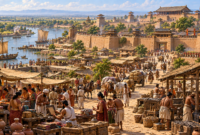
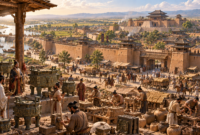
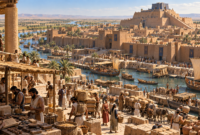
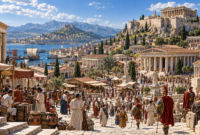
Hidden Frontiers uses AI-assisted tools as part of its content-production workflow, including research organization, drafting assistance, and visual development. The factual content of this article is based on the reliable sources cited below, and disputed or uncertain information is identified where appropriate. Some visuals accompanying this article are AI-generated historical reconstructions created for illustrative purposes.