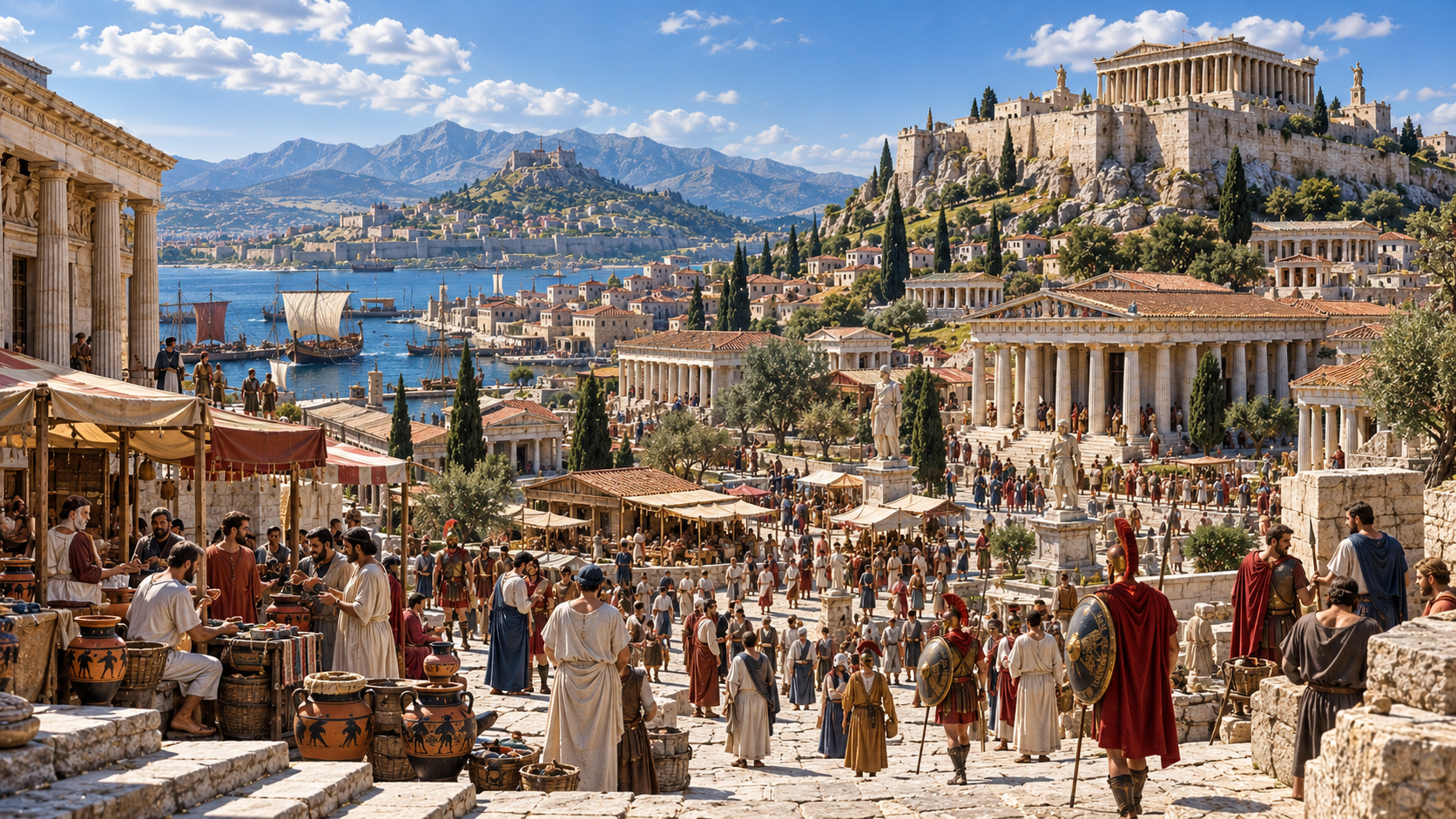
Ancient Greece was not a single country or a continuous empire, but a changing network of Greek-speaking communities spread across mainland Greece, the Aegean islands, the western coast of Anatolia, and colonies around the Mediterranean and Black Sea. From the Bronze Age societies of the Minoans and Mycenaeans to the city-states of the Archaic and Classical periods and the far-reaching Hellenistic kingdoms, Greek civilization developed through migration, trade, warfare, political experimentation, religious traditions, and cultural exchange. The world later called Ancient Greece produced influential forms of philosophy, political thought, literature, art, architecture, mathematics, science, theater, and historical writing, but those achievements emerged from societies that were also marked by slavery, warfare, political exclusion, and intense rivalry among communities.
AI & Editorial Note
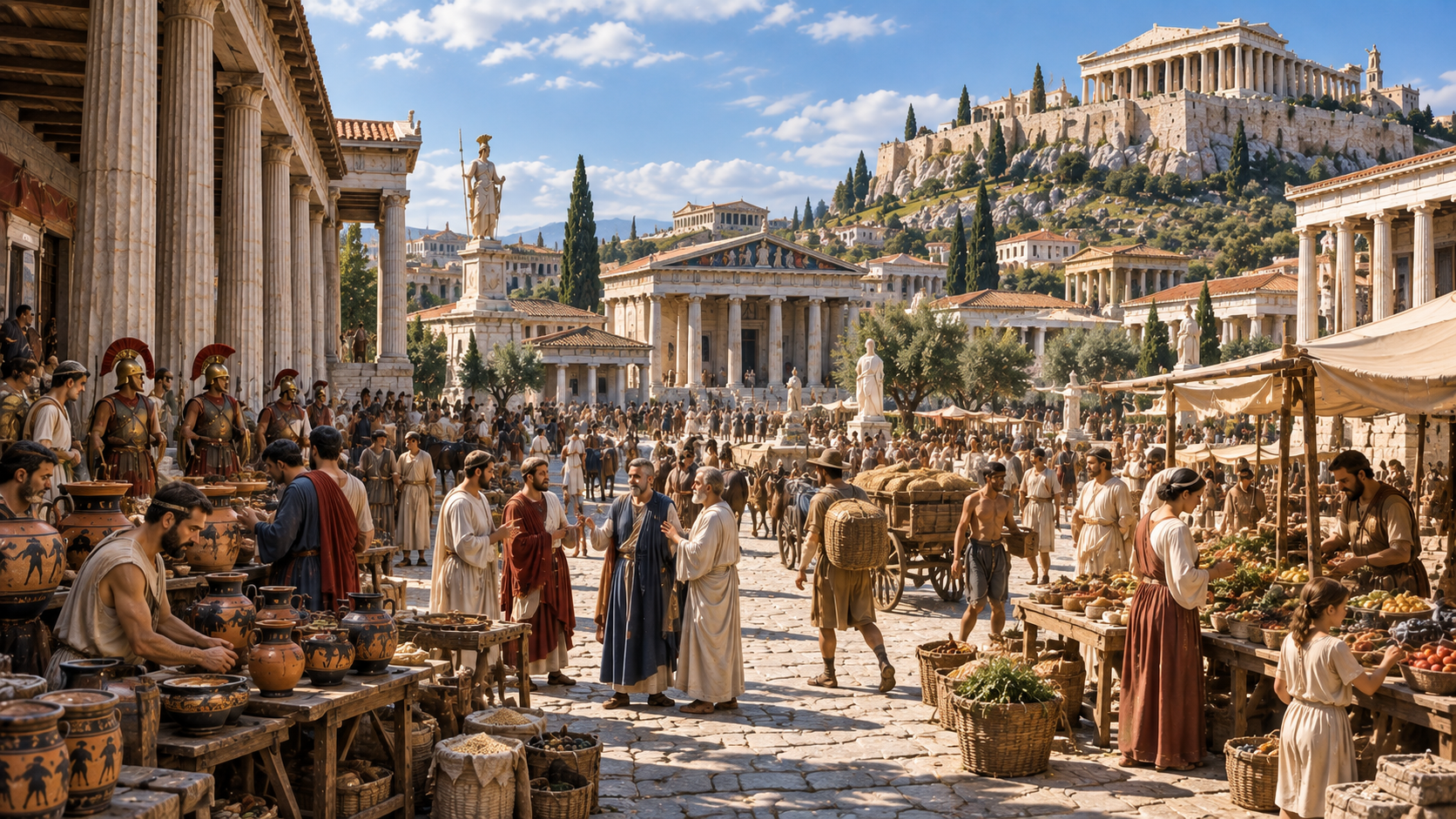
Hidden Frontiers uses AI-assisted tools as part of its content-production workflow, including research organization, drafting assistance, and visual development. The factual content of this article is strictly grounded in verified, cited sources, and disputed or uncertain information is identified where appropriate. Visuals accompanying this article are AI-generated historical reconstructions created for illustrative purposes.
What Was Ancient Greece?
The expression “Ancient Greece” describes a broad historical and cultural world rather than a single political state. Greek communities shared forms of language, religious practice, artistic traditions, festivals, myths, and institutions, yet individual poleis, or city-states, could have very different political systems, social structures, military traditions, and local identities. Geography encouraged this diversity because mountains divided many mainland regions while the Aegean and Mediterranean seas connected communities through travel, colonization, trade, and warfare.
The Greek world also extended far beyond the territory of modern Greece. Greek-speaking settlements appeared along the coast of Anatolia, on islands throughout the Aegean, in southern Italy and Sicily, around the Black Sea, and in parts of North Africa and the western Mediterranean. These communities were not all politically united, and their relationships ranged from cooperation and commercial exchange to competition and open warfare. The result was a highly interconnected cultural sphere in which local identities remained important even when people participated in wider Greek religious festivals and cultural traditions.
The Bronze Age Foundations
The roots of Greek civilization reach deep into the Bronze Age Aegean. The Minoan civilization flourished on Crete from approximately 2000 to 1450 BCE and developed sophisticated palace-centered societies, maritime connections, distinctive art, and complex administrative systems. Archaeological evidence shows that Minoan communities participated in extensive exchanges with the Aegean, Egypt, the Levant, and other Mediterranean regions, making Crete an important center of Bronze Age interaction.
On mainland Greece, the Mycenaean civilization became prominent during the Late Bronze Age, flourishing roughly from the seventeenth or sixteenth century BCE into the twelfth century BCE. Mycenaean centers such as Mycenae, Tiryns, Pylos, and Thebes developed palace economies, monumental fortifications, specialized craft production, and long-distance trade connections. Their administrative records, written in Linear B, provide some of the earliest surviving written evidence for an early form of the Greek language.
The collapse of the Bronze Age palace systems around the end of the second millennium BCE transformed the Aegean world. Archaeologists continue to debate the combination of factors involved, and there is no single explanation that adequately accounts for every site and region. Population movement, warfare, disruption of trade networks, political instability, environmental pressures, and other factors may all have contributed to the changes that followed, while the evidence does not justify reducing the transformation to a single invasion or catastrophe.
The Greek Dark Age and the Rise of the Polis
The centuries after the collapse of the Mycenaean palace system are often called the Greek Dark Age, largely because surviving written evidence becomes much more limited. The period was not simply an age of cultural disappearance, however, because communities continued to farm, trade, make pottery, develop social institutions, and interact across the Aegean. By the later part of the first millennium BCE, new forms of political organization and cultural expression were emerging that would become characteristic of the Archaic Greek world.
One of the most important developments was the emergence of the polis, usually translated as city-state. A polis was not merely a city in the modern sense because its political community generally included the surrounding countryside, agricultural land, sanctuaries, and settlements. Athens, Sparta, Corinth, Thebes, Argos, and hundreds of smaller communities developed their own political institutions and identities, producing a Greek world defined as much by competition among poleis as by shared culture.
The Archaic period also witnessed Greek expansion overseas. From approximately the eighth century BCE onward, Greek settlers established communities around the Mediterranean and Black Sea, creating new commercial and cultural connections. This expansion did not produce one unified Greek empire, but it helped spread Greek language, religious practices, artistic forms, political institutions, and commercial networks while also bringing Greek communities into sustained contact with Phoenician, Egyptian, Anatolian, Italian, and other cultures.
Athens, Sparta, and the Greek City-States
Athens and Sparta became the most famous Greek city-states, but their prominence should not obscure the importance of other communities. Athens developed unusually broad institutions of citizen participation and became a major naval and commercial power, while Sparta organized its society around a distinctive military and communal system. Corinth was a major commercial center, Thebes became a formidable military power, and numerous smaller poleis shaped regional politics in their own right.
Athenian democracy developed gradually rather than appearing fully formed at one moment. Reforms associated with Solon, Cleisthenes, and later political developments helped transform Athenian government, eventually producing institutions in which male citizens could participate directly in political decision-making. This system was significant, but it was not universal democracy by modern standards because women, enslaved people, and resident foreigners did not possess the same political rights as male citizens.
Sparta followed a markedly different political and social model. Its system combined kingship, councils, magistrates, and an assembly while placing exceptional emphasis on military discipline and communal organization among its citizen class. Much of Sparta’s economic and social system depended on the labor of populations subjected to Spartan control, particularly the helots of Messenia and Laconia, meaning the famous Spartan military system cannot be understood separately from the unequal society that supported it.
Religion, Gods, and Greek Mythology
Religion was deeply integrated into public and private life in Ancient Greece. Greek communities honored many gods and divine beings, including Zeus, Hera, Athena, Apollo, Artemis, Poseidon, Aphrodite, Demeter, Dionysus, and others, while local communities often emphasized particular deities and cult practices. Religious life included sacrifices, festivals, processions, dedications, prayers, athletic competitions, and consultation of sanctuaries associated with particular gods.
Greek mythology formed a vast body of stories concerning gods, heroes, monsters, creation, warfare, family conflict, and relationships between mortals and divine powers. These stories were not simply a fixed religious textbook because they circulated through poetry, drama, visual art, ritual traditions, and local variations. Artists repeatedly adapted mythological subjects, while poets and dramatists could reinterpret familiar stories for new audiences and political circumstances.
Major sanctuaries also served functions extending beyond worship. Olympia and Delphi, for example, became major Panhellenic centers where communities from different parts of the Greek world gathered, dedicated objects, competed in festivals, and interacted socially and politically. Such institutions helped create a sense of shared Greek culture even though political unity remained limited.
Society and Everyday Life
Ancient Greek society was highly unequal and varied significantly from one polis to another. Male citizens generally occupied the central position in political life, while women, children, resident foreigners, laborers, and enslaved people had different legal and social positions depending on their community. Wealth, family background, citizenship, occupation, gender, and legal status all influenced an individual’s opportunities and obligations.
Most people lived through agriculture, animal husbandry, craft production, trade, fishing, and other forms of manual or commercial work. Grain, olives, grapes, wine, fish, legumes, fruits, and other agricultural products were important components of the ancient Mediterranean economy, although diets varied according to region, wealth, season, and availability. Urban residents encountered markets, workshops, sanctuaries, public buildings, fountains, and civic spaces, while rural populations lived much more closely connected to agricultural cycles.
Clothing was generally made from woven textiles such as wool and linen, with styles and quality varying according to period, region, gender, occupation, and wealth. Pottery was particularly important because it served practical functions while also carrying painted scenes, inscriptions, and decorative designs that provide historians with evidence about mythology, warfare, athletics, domestic activities, and social ideals. Archaeological objects therefore help reconstruct everyday life alongside the literary sources that traditionally dominated narratives of Greek history.
The Persian Wars
The Persian Wars transformed the political landscape of the Greek world. Persian rulers controlled a vast empire that included the Greek-speaking cities of western Anatolia, and conflicts between Persian authority and Greek communities contributed to the Ionian Revolt and later Persian invasions of mainland Greece. Major episodes included the Persian victory at Thermopylae, the Greek naval victory at Salamis in 480 BCE, and the Greek victory at Plataea in 479 BCE.
The wars did not create permanent political unity among the Greeks, but they produced a powerful historical memory of resistance against Persian imperial expansion. Athens emerged from the conflict with enormous naval influence and became the leading power of the Delian League, an alliance originally organized against Persia. Over time, the alliance increasingly functioned as an Athenian empire, with allied communities providing tribute or ships and Athens exercising increasingly direct control.
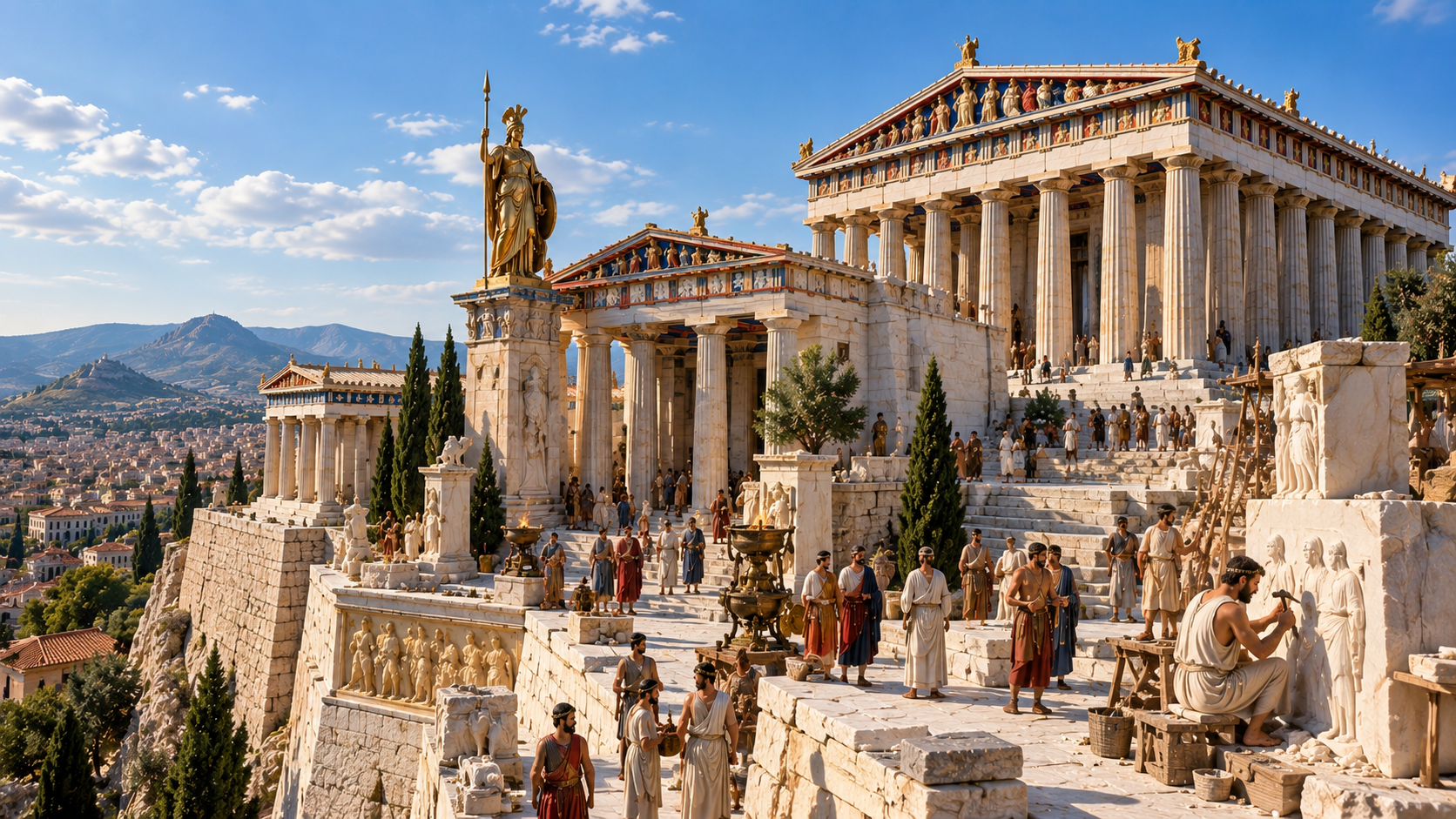
The rebuilding of Athens after the Persian destruction also produced some of the most famous monuments in Greek history. The Acropolis became the center of an ambitious building program during the fifth century BCE, including the Parthenon, the Propylaea, the Erechtheion, and the Temple of Athena Nike. UNESCO identifies the Acropolis as an exceptional surviving complex of Classical Greek architecture and emphasizes its importance for understanding the political, religious, artistic, and intellectual development of fifth-century Athens.
The Peloponnesian War
The growing power of Athens alarmed Sparta and other Greek states, contributing to a prolonged struggle between competing alliances. The Peloponnesian War is conventionally dated from 431 to 404 BCE, although an earlier conflict between Athens and Sparta and their allies had occurred during the fifth century. The later war drew in much of the Greek world and involved land campaigns, naval warfare, political revolutions, sieges, shifting alliances, and severe social disruption.
Athens suffered enormous losses during the conflict, including the effects of plague early in the war and the catastrophic failure of the Sicilian Expedition. Sparta eventually developed a naval force capable of challenging Athenian maritime power, with Persian financial support contributing to the Spartan war effort. The Athenian defeat in 404 BCE ended its empire and temporarily altered the balance of power among the Greek states.
The war also produced one of antiquity’s most important historical works. Thucydides, an Athenian participant and historian, attempted to construct a careful account of the conflict and explicitly emphasized the importance of evidence and inquiry. His History of the Peloponnesian War became an influential model for later historical writing, even though modern scholars continue to analyze its perspective, omissions, and interpretive choices.
Philosophy, Science, and Intellectual Life
Ancient Greek intellectual culture developed through a wide range of traditions rather than a single philosophical school. Earlier thinkers in Ionia investigated nature and the underlying principles of the cosmos, while later philosophers including Socrates, Plato, and Aristotle developed extensive arguments about ethics, knowledge, politics, metaphysics, logic, and human society. Greek intellectual traditions were also influenced by contact with other Mediterranean and Near Eastern cultures, making the history of Greek thought one of exchange as well as innovation.
Socrates left no writings of his own, and much of what is known about him comes through later authors, particularly Plato and Xenophon, as well as comic representations. Plato established a philosophical tradition centered on dialogues addressing questions such as justice, knowledge, education, and political organization. Aristotle, a student of Plato, developed influential work across logic, biology, ethics, politics, physics, and other fields, leaving an intellectual legacy that remained important far beyond antiquity.
Greek mathematics and science likewise developed through many individuals and schools. Pythagorean traditions, Euclidean geometry, Hippocratic medicine, Archimedean mechanics, and Hellenistic astronomy demonstrate the breadth of ancient scientific inquiry, although modern concepts such as “science” should not simply be projected backward without considering the intellectual frameworks of antiquity. The Hellenistic world in particular became an important environment for scholarship, mathematics, engineering, medicine, astronomy, and geographical research.
Greek Art and Architecture
Greek art changed substantially over time. Archaic artists increasingly developed naturalistic representations of the human figure while adapting motifs and techniques encountered through contacts with Egypt, the Near East, Cyprus, and other regions. Greek artists transformed these influences into distinctive forms of sculpture, pottery, architecture, metalwork, and decorative art rather than simply copying foreign models.
Greek architecture became especially influential through the development of recognizable column orders and carefully proportioned monumental buildings. Doric, Ionic, and later Corinthian forms became associated with different architectural traditions, while temples were integrated into sanctuaries and civic landscapes. The Parthenon remains the most famous example, but ancient Greece contained countless temples, stoas, theaters, gymnasia, civic buildings, fortifications, and private houses.
Greek sculpture also evolved from the more rigid forms of the Archaic period toward increasingly complex representations of movement, anatomy, emotion, and idealized human bodies. Some of the most famous Greek sculptures survive only through Roman copies, making it important to distinguish surviving Roman versions from the original Greek works they reproduced. The later Hellenistic period expanded artistic possibilities further, producing more dramatic compositions and a greater range of human experiences and physical states.
Warfare and Military Culture
Warfare was a persistent part of Greek political life because independent poleis competed over territory, resources, alliances, prestige, and political influence. The hoplite infantryman became an important military figure in the Archaic and Classical periods, typically fighting with a large shield, spear, sword, helmet, and body protection that varied according to period and wealth. Greek warfare also depended heavily on naval power, especially for states such as Athens whose political and economic systems were closely connected to maritime networks.
The traditional image of the Greek phalanx is useful but incomplete. Armies differed in organization, equipment, tactics, and social composition, while cavalry, light infantry, archers, naval forces, engineers, mercenaries, and allied contingents could all play important roles. The military history of Greece was therefore more varied than the image of two identical lines of heavily armed hoplites meeting on an open battlefield.
Military competition also shaped political institutions. Citizenship and military service were closely connected in many poleis, while the expansion of naval warfare at Athens increased the political importance of poorer citizens who served as rowers. Warfare could therefore influence not only borders and alliances but also the distribution of political power within a community.
The Rise of Macedon and Alexander the Great
The prolonged rivalry among the Greek city-states created conditions in which Macedon could expand its influence. Philip II of Macedon reorganized the Macedonian army and defeated a coalition of Greek states at Chaeronea in 338 BCE, establishing Macedonian dominance over much of mainland Greece. His assassination in 336 BCE brought his son Alexander to the throne, and Alexander inherited both the Macedonian military system and a political project directed toward the Persian Empire.
Alexander’s campaigns between 334 and 323 BCE transformed the political geography of the eastern Mediterranean and Near East. His armies defeated the Persian king Darius III, conquered Egypt and much of the Persian Empire, and advanced as far east as northwestern India. Alexander’s conquests did not simply “spread Greek civilization” into an otherwise passive world; they created new political and cultural environments in which Greek, Macedonian, Egyptian, Persian, Central Asian, and South Asian traditions interacted in complex ways.
Alexander died in Babylon in 323 BCE without leaving a stable succession system capable of preserving his empire as a unified state. His territories were subsequently divided among competing successor kingdoms, including the Ptolemaic kingdom in Egypt and the Seleucid kingdom across much of the Near East. The resulting Hellenistic world lasted for centuries and made Greek language and culture important across a vast geographical area while simultaneously transforming Greek culture through contact with other societies.
The Hellenistic World
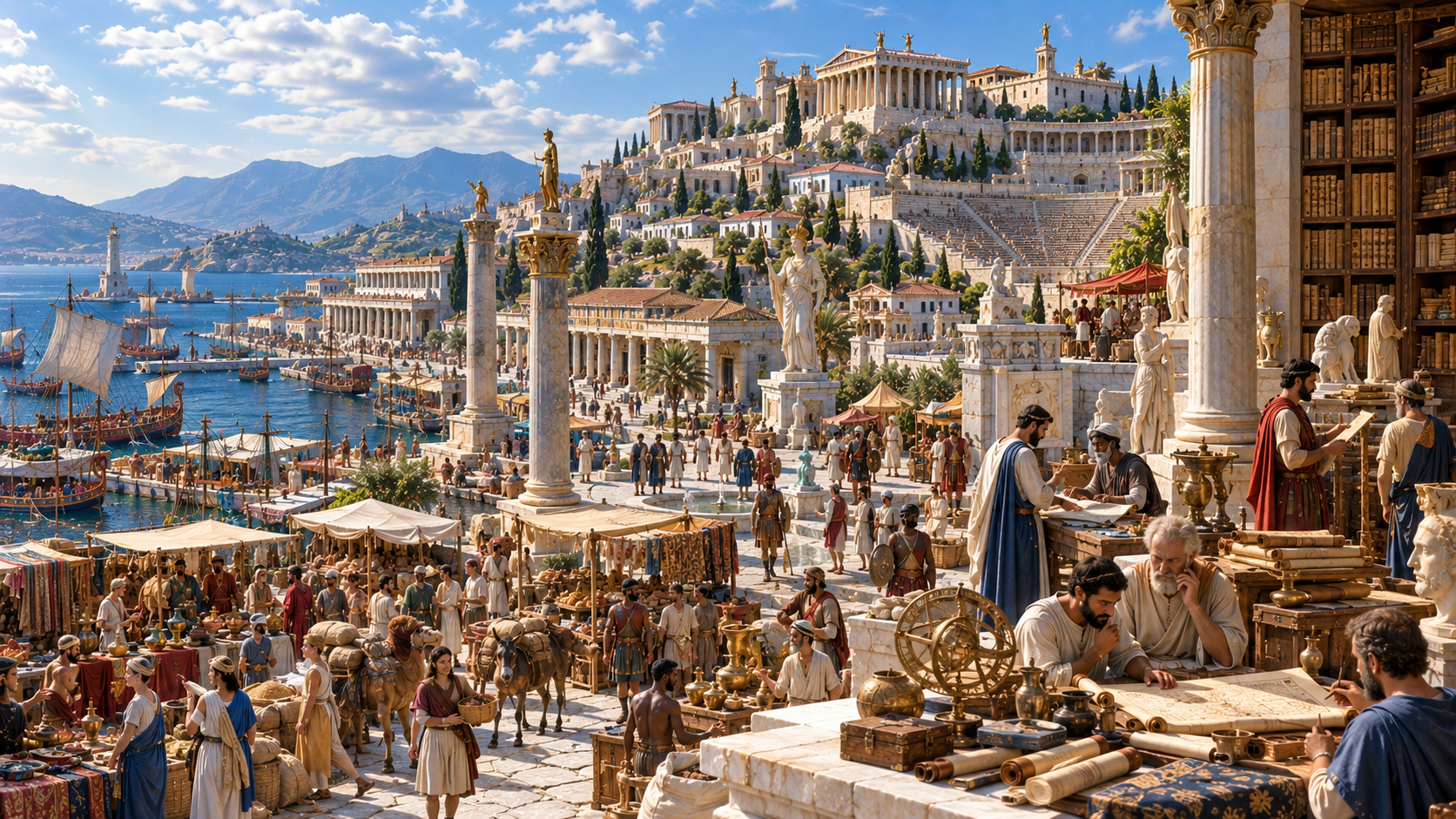
The Hellenistic period is conventionally dated from Alexander’s death in 323 BCE to the Roman conquest of the major Hellenistic kingdoms, with 31 BCE often used as a conventional endpoint because of the Battle of Actium. It was not simply a continuation of Classical Greece because political power shifted toward monarchies, cities became parts of larger kingdoms, and cultural interaction expanded across regions formerly separated by political and linguistic boundaries. Greek became an important language of administration, education, trade, and intellectual life in many parts of the eastern Mediterranean and Near East.
Hellenistic cities could become major centers of scholarship and artistic production. Alexandria in Egypt became famous for institutions and intellectual communities associated with mathematics, astronomy, literature, medicine, and textual scholarship, while Pergamon developed into another major center of learning and royal patronage. UNESCO describes Pergamon as the capital of the Attalid dynasty and a major Hellenistic center containing monumental temples, theaters, a gymnasium, an altar, and a library.
Hellenistic art also became more diverse and expressive. Sculptors experimented with movement, age, emotion, physical strain, theatrical composition, and representations of people outside the narrow idealized forms associated with earlier Classical sculpture. At the same time, older Classical traditions remained influential, and later Roman artists collected, copied, and adapted Greek and Hellenistic works on a vast scale.
The Olympic Games and Shared Greek Identity
Athletic festivals were among the institutions that connected otherwise independent Greek communities. Olympia hosted the ancient Olympic Games, with the first securely recorded Olympic festival traditionally dated to 776 BCE, although athletic competition at Olympia clearly had roots extending earlier than that date. The festival combined religious observance, athletic competition, social interaction, artistic activity, political meetings, and commercial exchange.
Olympia was dedicated to Zeus, while other Panhellenic sanctuaries such as Delphi, Isthmia, and Nemea hosted major festivals associated with particular gods. These gatherings helped reinforce a broader sense of Greek cultural identity without eliminating the powerful local identities of individual poleis. The shared institutions of religion, language, myth, and athletic competition were therefore important complements to the political fragmentation of the Greek world.
The Legacy of Ancient Greece
The influence of Ancient Greece was transmitted through many later societies rather than traveling directly from Classical Athens to the modern world. Roman elites adopted and transformed Greek philosophy, literature, education, architecture, sculpture, and artistic traditions, while Greek remained an important language of intellectual life across the eastern Roman Empire. Later Byzantine, Islamic, medieval European, Renaissance, and modern scholars also preserved, translated, debated, and transformed Greek texts and ideas.
Political thought is one of the most frequently discussed legacies. The experience of the Greek polis encouraged sustained debate about citizenship, justice, constitutions, political participation, and the purposes of government, particularly in the writings associated with Plato and Aristotle. Modern democratic institutions are not direct replicas of Athenian democracy, but ancient Greek political thought remains an important part of the intellectual history behind later debates over political organization.
Greek artistic and architectural traditions also became extraordinarily influential. Classical proportions, columns, temples, sculpture, theatrical architecture, and philosophical ideas about beauty were repeatedly revived and reinterpreted by later cultures. The Acropolis itself became a global reference point for Classical architecture, while Greek literature, mythology, drama, philosophy, and scientific writing continue to shape education and popular culture.
Why Ancient Greece Still Matters
Ancient Greece matters not because it represented a perfect civilization, but because it offers an unusually rich record of how different communities experimented with political institutions, religious traditions, artistic forms, intellectual arguments, military systems, and economic networks. Its achievements existed alongside slavery, gender inequality, warfare, imperial domination, and political exclusion, making the Greek world historically important precisely because it contained contradictions rather than because it conformed to a modern ideal. The surviving evidence allows historians to study both the extraordinary achievements and the limitations of ancient societies.
The most useful way to understand Ancient Greece is therefore as a changing network rather than a single civilization frozen in its Classical peak. Bronze Age palace societies gave way to new communities, city-states developed competing political systems, Athens and Sparta rose and declined, Macedon transformed the balance of power, and Hellenistic kingdoms carried Greek language and cultural practices across a much wider world. The history is a story of continuity and transformation, shaped by both internal development and sustained interaction with neighboring peoples.
Conclusion
Ancient Greece was a diverse and evolving world whose history stretched from Bronze Age Aegean societies to the Hellenistic kingdoms that followed Alexander the Great. Its city-states never formed one permanent political nation, yet Greek communities shared enough language, religious practice, artistic traditions, myths, festivals, and intellectual culture to create a recognizable wider Greek world. The conflicts between Athens and Sparta, the Persian Wars, the rise of Macedon, and the Hellenistic expansion all transformed that world while preserving important cultural connections.
Its legacy is equally complex. Greek philosophy and political thought influenced later intellectual traditions, Greek art and architecture became models repeatedly adapted by later societies, and Hellenistic cultural exchange helped connect the eastern Mediterranean and Near East through new political and commercial networks. Understanding Ancient Greece therefore means looking beyond familiar images of marble temples and heroic warriors to the farmers, craftspeople, merchants, women, enslaved people, soldiers, sailors, philosophers, rulers, and communities whose combined experiences created one of antiquity’s most influential cultural worlds.
Quick Historical Timeline
| Period | Approximate Date | Major Development |
|---|---|---|
| Neolithic Greece | c. 6000–2900 BCE | Agriculture and permanent settlements expand |
| Minoan civilization | c. 2000–1450 BCE | Palace-centered Bronze Age society flourishes on Crete |
| Mycenaean civilization | c. 1700–1100 BCE | Palace societies dominate much of mainland Greece |
| Post-palatial period | c. 1100–800 BCE | Mycenaean palace system collapses and new communities develop |
| Archaic period | c. 800–480 BCE | Polis institutions, colonization, new art and political systems emerge |
| Classical period | c. 480–323 BCE | Persian Wars, Athenian democracy, Peloponnesian War and Classical culture |
| Macedonian ascendancy | 338–323 BCE | Philip II and Alexander reshape Greek political power |
| Hellenistic period | 323–31 BCE | Greek culture expands through successor kingdoms and international exchange |
| Roman dominance | from 2nd–1st centuries BCE | Greek territories increasingly incorporated into Roman political structures |
When did Ancient Greece exist?
Ancient Greek history covers a very long period, and there is no single universally agreed beginning and ending date for “Ancient Greece.” A broad historical framework can extend from the Bronze Age Aegean civilizations of the second millennium BCE through the Hellenistic period and the incorporation of Greek territories into Roman political systems. The dates used for individual periods are therefore more useful than treating Ancient Greece as a civilization with one fixed start and end point.
Was Ancient Greece one country?
No, Ancient Greece was not a unified country in the modern sense. It consisted of numerous independent or semi-independent communities, especially the city-states known as poleis, which often competed with one another while sharing aspects of language, religion, culture, and identity. Larger political structures emerged at different times, particularly under Macedonian and Hellenistic rulers, but these should not be confused with a permanent Greek nation-state.
What was the most important Greek city-state?
There is no historically objective single answer because different city-states became important for different reasons and at different periods. Athens became especially influential for democracy, philosophy, drama, architecture, naval power, and the arts, while Sparta was renowned for its distinctive military and social organization and other states such as Corinth and Thebes played major economic or military roles. Ancient Greece is better understood by comparing these different communities than by assigning one city an overall historical ranking.
What was the difference between Athens and Sparta?
Athens developed institutions of direct citizen participation and became a major naval, commercial, intellectual, and cultural power, while Sparta developed a highly distinctive society centered on military organization and the control of a dependent agricultural population. Their political systems, education, economic structures, and military priorities were therefore substantially different. The rivalry between them became particularly important during the fifth century BCE and culminated in the Peloponnesian War.
What did ancient Greeks believe?
Ancient Greek religious traditions were polytheistic and included major gods such as Zeus, Hera, Athena, Apollo, Artemis, Poseidon, Demeter, Aphrodite, and Dionysus. Religious practice involved sacrifices, festivals, prayers, sanctuaries, processions, athletic competitions, and offerings, with local communities often emphasizing particular gods and cult traditions. Greek mythology formed an important body of stories about gods and heroes, but mythology and lived religious practice were not exactly the same thing.
Why was Ancient Greece important to philosophy and science?
Greek thinkers developed influential approaches to questions concerning nature, knowledge, ethics, politics, mathematics, medicine, and the structure of the universe. Figures such as Socrates, Plato, Aristotle, Euclid, Archimedes, and Hippocratic writers became important reference points for later intellectual traditions, although their ideas emerged from broader Mediterranean networks of knowledge and exchange. Their work was subsequently preserved, criticized, translated, and transformed by Roman, Byzantine, Islamic, medieval European, and modern intellectual traditions.
Who was Alexander the Great?
Alexander III of Macedon, commonly called Alexander the Great, was the Macedonian king who conquered the Persian Empire and established an enormous realm stretching from Greece and Egypt deep into Asia. His campaigns lasted from 334 BCE until his death in 323 BCE and created the political conditions for the Hellenistic period that followed. His conquests encouraged extensive interaction among Greek, Macedonian, Egyptian, Persian, Central Asian, and South Asian peoples, rather than simply replacing one culture with another.
What is the legacy of Ancient Greece?
The legacy of Ancient Greece includes major traditions in philosophy, political thought, literature, drama, art, architecture, mathematics, science, and historical writing. That legacy was transmitted through later societies, especially Rome and the Byzantine world, and through medieval and early modern traditions that preserved, translated, adapted, or challenged Greek ideas. Its importance is best understood as a long process of cultural transmission and transformation rather than as a simple direct inheritance from Classical Greece to the modern world.
SOURCES & REFERENCES
UNESCO World Heritage Centre — Acropolis, Athens
Authoritative institutional source for the Acropolis, Classical Athens, its monuments, religious significance, historical context, and architectural chronology. UNESCO World Heritage Centre — Acropolis, Athens
British Museum — Greece: Athens
Museum source covering fifth-century BCE Athens, the Acropolis, Athenian political and cultural power, and the Peloponnesian War. British Museum — Greece: Athens
The Metropolitan Museum of Art — Greek Art in the Archaic Period
Detailed museum research on Archaic Greek art, overseas connections, colonization, city-states, religious festivals, and artistic development. The Metropolitan Museum of Art — Greek Art in the Archaic Period
Stanford Encyclopedia of Philosophy — Ancient Political Philosophy
Academic reference for Greek political thought, the polis, Plato, Aristotle, justice, constitutions, and the development of ancient political philosophy. Stanford Encyclopedia of Philosophy — Ancient Political Philosophy
Perseus Digital Library, Tufts University — Thucydides, History of the Peloponnesian War
Digital primary-source resource for Thucydides’ account of the Peloponnesian War and ancient Greek historical writing. Perseus Digital Library — Thucydides, History of the Peloponnesian War
World History Encyclopedia — Ancient Greece
Secondary reference used for chronology, the development of Greek political communities, Persian Wars, Peloponnesian War, Macedonian expansion, and Hellenistic history. World History Encyclopedia — Ancient Greece
World History Encyclopedia — Mycenaean Civilization
Secondary archaeological and historical reference for Late Bronze Age Mycenaean society, Linear B, major centers, trade, architecture, and chronology. World History Encyclopedia — Mycenaean Civilization
The Metropolitan Museum of Art — Art of the Hellenistic Age and the Hellenistic Tradition
Museum research used for the Hellenistic period, its conventional chronology, artistic development, and later Roman engagement with Greek art. The Metropolitan Museum of Art — Art of the Hellenistic Age and the Hellenistic Tradition