


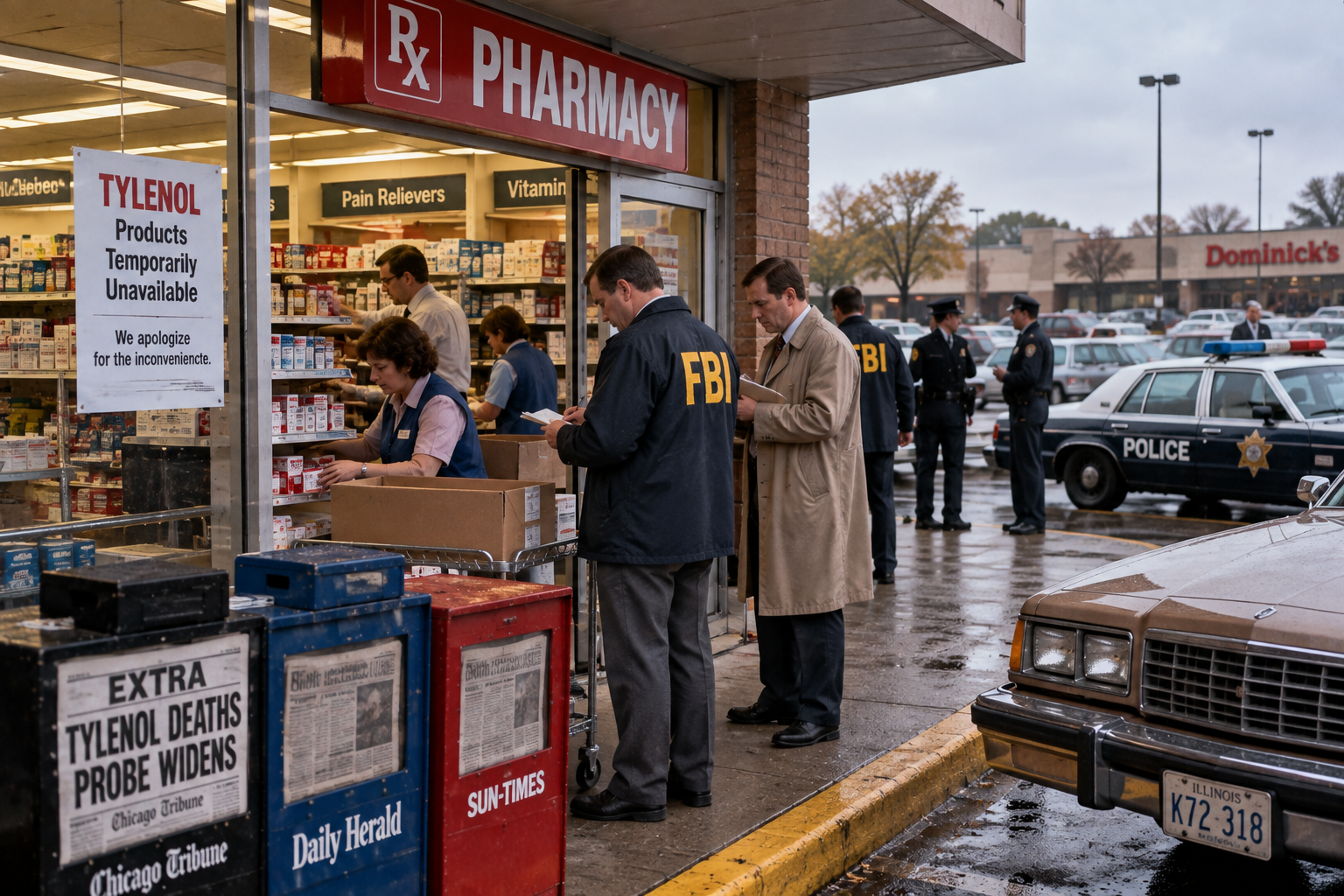
In late September 1982, a series of sudden deaths around Chicago initially appeared unrelated, occurring in different communities and involving people who had no known connection to one another. The common factor emerged only after investigators and medical authorities recognized that the victims had taken Extra-Strength Tylenol capsules that contained cyanide, transforming what first looked like isolated medical emergencies into a deliberate poisoning investigation. Seven people ultimately died, and the case became one of the largest product-tampering investigations in American law-enforcement history. FBI
AI & Editorial Note
Hidden Frontiers uses AI-assisted tools as part of its content-production workflow, including research organization, drafting assistance, and visual development. The factual content of this article is strictly grounded in verified, cited sources, and disputed or uncertain information is identified where appropriate. Visuals accompanying this article are AI-generated historical reconstructions created for illustrative purposes.
The Victims Behind the Tylenol Cyanide Murders
The first recognized victim was Mary Kellerman, a twelve-year-old girl from Elk Grove Village, Illinois. She became ill with what appeared to be an ordinary cold and took Extra-Strength Tylenol before suddenly collapsing, while another death involving the same product occurred soon afterward in Arlington Heights. The emerging pattern was especially disturbing because the victims were ordinary consumers who had no apparent reason to expect that a familiar over-the-counter medicine could contain a lethal contaminant. UPI
Adam Janus, a twenty-seven-year-old postal worker in Arlington Heights, was among the next victims. After his death, his brother Stanley Janus and Stanley’s wife, Theresa, were also poisoned after taking capsules from the same bottle at Adam’s home, turning an already frightening investigation into a tragedy involving three members of one family. The deaths of Mary Reiner, a twenty-seven-year-old mother from Winfield, Mary McFarland, a thirty-one-year-old woman from Elmhurst, and Paula Prince, a thirty-five-year-old flight attendant from Chicago, completed the group of seven victims associated with the original outbreak. UPI
The victims ranged from a twelve-year-old child to adults in their thirties, and their deaths occurred in homes, hospitals, and other ordinary settings rather than at a single crime scene. That dispersion initially made the deaths difficult to connect, because investigators were not dealing with one location, one witness group, or one conventional homicide scene. The eventual discovery that the victims had consumed cyanide-contaminated capsules created an entirely different investigative problem: someone had apparently interfered with a commercial product after it had entered the ordinary consumer supply chain. Amazon Web Services, Inc.
How Investigators Discovered the Common Link
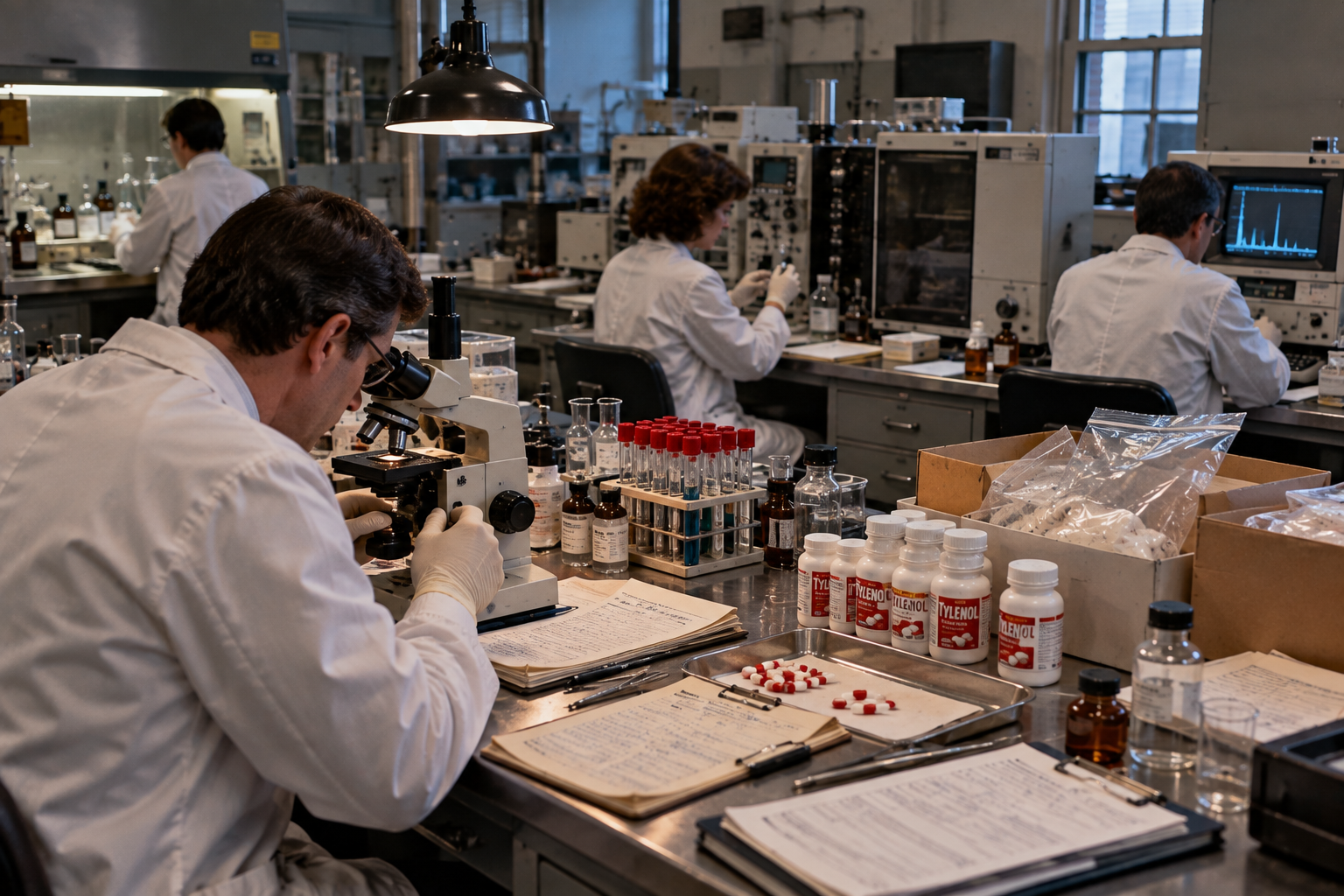
The breakthrough depended heavily on recognizing that the deaths were not conventional medical events. Cook County medical authorities determined that cyanide was responsible for the deaths, while investigators began examining the medication bottles associated with the victims rather than treating each death as an isolated incident. The FBI’s historical account states that seven Chicago-area residents ingested cyanide-laced Tylenol capsules between September twenty-ninth and thirtieth and died within hours. FBI
The evidence quickly indicated that the contamination was not a normal manufacturing problem. FDA historical records describe the incident as tampering that occurred after the product had entered retail channels, while later government documentation similarly describes the perpetrators as apparently having acquired capsules, contaminated them, replaced them in their packaging, and returned the products to the marketplace. This distinction was critical because it moved the investigation away from a manufacturing failure and toward deliberate criminal interference with a product intended for ordinary consumers. U.S. Food and Drug Administration
Investigators also had to determine whether the contaminated bottles came from a common source. The answer was complicated by the distribution of the victims and by the fact that additional contaminated capsules were discovered after the initial deaths, including bottles carrying different lot numbers. The Washington Post reported at the time that the bottle associated with Paula Prince carried a lot number different from the two lots already identified among earlier victims, reinforcing the concern that the contamination extended beyond one isolated manufacturing batch. The Washington Post
The Investigation Expands
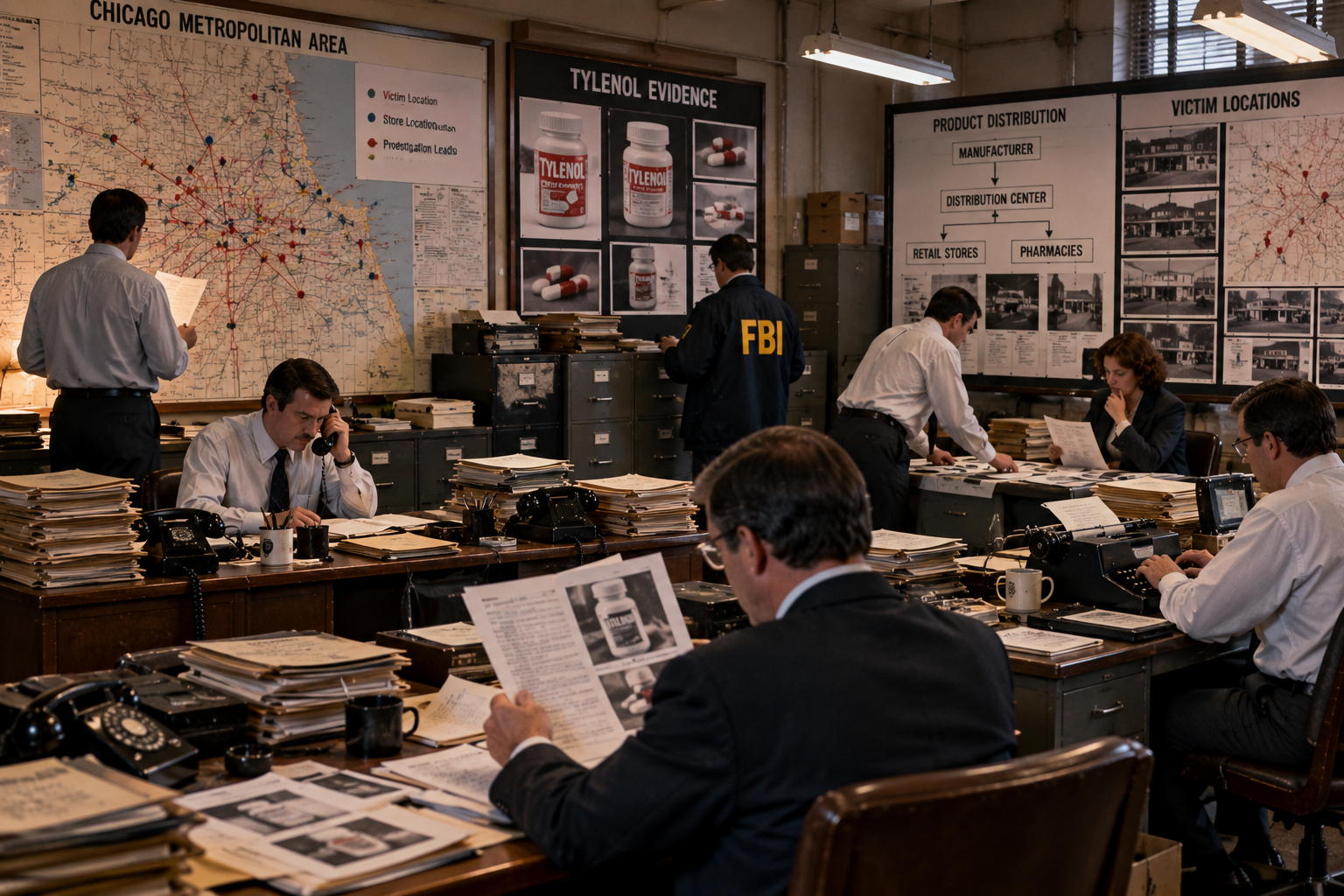
Once authorities understood that the deaths were connected to product tampering, the scale of the investigation changed dramatically. The FBI describes the resulting inquiry as the largest product-tampering investigation in the history of American law enforcement, involving federal agents and nearly one hundred twenty investigators from state and local agencies. Investigators had to reconstruct where the bottles had been sold, determine how the capsules had been contaminated, identify additional potentially dangerous products, and establish who could have accessed the medication before it reached the victims. FBI
The investigation was complicated by the absence of a conventional crime scene. In a typical homicide, investigators can begin with a particular location, physical traces, surveillance opportunities, witnesses, and a defined time window. Here, the crucial physical evidence was distributed across consumer products, retail locations, medical examinations, packaging, manufacturing and distribution records, and the victims’ movements. The investigation therefore required cooperation between police departments, federal investigators, medical examiners, the FDA, the manufacturer, and other agencies rather than depending on one local homicide unit. Amazon Web Services, Inc.
The public-health consequences were immediate. Johnson & Johnson and its McNeil subsidiary withdrew Tylenol capsules from the market, and contemporary reporting described a recall involving roughly thirty-one million bottles, with the company later introducing new packaging designed to make unauthorized access more visible. The FDA subsequently established tamper-resistant packaging requirements for many over-the-counter products, creating a regulatory response that extended far beyond Tylenol itself. The Washington Post
James Lewis and the Extortion Letter
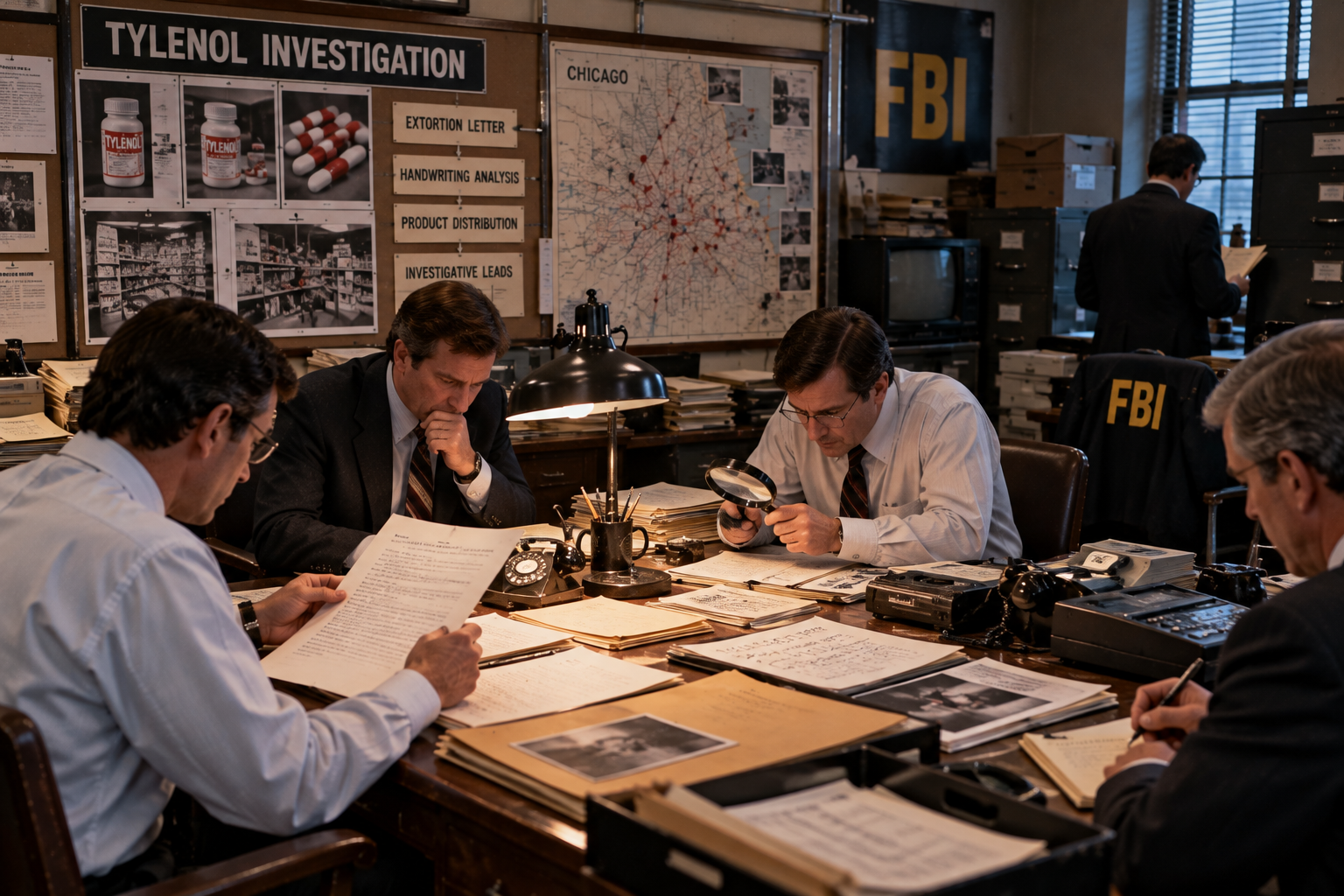
The investigation took a major turn when an extortion letter was sent to Johnson & Johnson demanding $1 million and threatening further killings. The letter became one of the most important pieces of evidence in the investigation because it demonstrated that someone was attempting to exploit the poisoning crisis for money while presenting the threat as connected to the continuing danger. Investigators eventually traced the letter to James Lewis, a New York man who became the most prominent named suspect associated with the case. UPI
Lewis was arrested in December 1982 and later convicted of extortion, receiving a twenty-year federal sentence according to the FBI’s historical account. His conviction, however, concerned the extortion scheme rather than the deaths themselves, and the FBI explicitly states that no one could be charged with the murders because investigators lacked sufficient evidence. Lewis repeatedly denied responsibility for the poisonings, including in correspondence sent to the Chicago Tribune. FBI
The distinction between the extortion conviction and the murder investigation is essential. A conviction for demanding money from Johnson & Johnson does not establish that Lewis poisoned the capsules, and authorities never obtained a murder conviction against him. The historical record instead shows an unusual situation in which a man connected directly to a threatening letter became a major focus of the homicide investigation but was never charged with the seven deaths. The Christian Science Monitor
Lewis’s connection to the case generated continuing suspicion because investigators examined his movements, background, correspondence, and knowledge of how the poisonings could have been carried out. Yet suspicion is not equivalent to proof, and the FBI’s own historical summary states that no one was charged with the murders. Lewis died in Massachusetts in July 2023 without having been convicted of any of the Tylenol killings, leaving the central question unresolved. FBI
What the Evidence Shows
The strongest established evidence concerns the nature of the poisonings themselves. The victims died after ingesting Extra-Strength Tylenol capsules containing cyanide, and medical and investigative authorities established that the contamination was deliberate rather than a normal pharmaceutical manufacturing problem. Government records from the period also show that federal investigators quickly became involved after the deaths were connected, while the FDA worked with state and local authorities to identify contaminated products and remove them from circulation. Amazon Web Services, Inc.
The physical and distribution evidence pointed investigators toward tampering after manufacture. The contaminated capsules were not simply defective products emerging from a single factory production line; instead, authorities concluded that someone had interfered with individual capsules and returned them to consumer packaging. That finding explains why the investigation was so difficult, because the offender did not need access to a pharmaceutical manufacturing facility to create a lethal product. U.S. Food and Drug Administration
The extortion letter created another category of evidence, but its meaning remains more limited than it can sometimes appear in popular accounts. The letter established that Lewis was responsible for an extortion attempt directed at Johnson & Johnson, and his correspondence placed him directly within the broader crisis surrounding the poisonings. It did not, however, establish in court that Lewis had handled the contaminated capsules or caused any of the seven deaths. FBI
The Unresolved Question of the Killer
The most important unresolved issue is the identity of the person or people who actually contaminated the capsules. Investigators considered multiple possibilities over the years, but the case never produced evidence sufficient to support a murder charge or conviction. The FBI continues to describe the original investigation as one in which no one could be charged with the murders because of insufficient evidence, while the University of Illinois Chicago’s historical review describes the case as still open and unsolved. FBI
James Lewis remains central to the public memory of the investigation because his extortion letter appeared so soon after the deaths and because he became a major investigative target. However, the legal record is narrower than the popular mythology surrounding him: he was convicted of extortion, not murder. Treating him as the confirmed Tylenol killer would therefore go beyond what the evidence and legal record establish. FBI
The continuing uncertainty also reflects the difficulty of proving a crime committed through an anonymous consumer product. There was no confirmed eyewitness who saw the perpetrator contaminate the capsules, no established chain of custody leading from a suspect to every poisoned bottle, and no murder conviction that resolved the identity question. The investigation could establish what happened to the victims with considerable confidence while failing to establish who caused it. Amazon Web Services, Inc.
How the Tylenol Cyanide Murders Changed Public Safety
The consequences of the poisonings extended far beyond the seven deaths. Before the crisis, consumers generally had fewer visible barriers indicating whether a medicine bottle had been opened or altered after leaving the manufacturer, and the Tylenol case demonstrated how vulnerable an ordinary packaged product could be to deliberate interference. The FDA issued tamper-resistant packaging requirements in November 1982, and Congress passed the Federal Anti-Tampering Act in 1983. U.S. Food and Drug Administration
Johnson & Johnson also changed its packaging strategy dramatically. Contemporary reporting described a new triple-sealed package using multiple barriers intended to provide visible evidence of interference, while the company withdrew and replaced enormous quantities of product during the crisis. The response helped establish the modern expectation that medicines and many other consumer products should provide some visible indication when their packaging has been opened or compromised. The Washington Post
The legacy of the case is therefore both criminal and regulatory. The murders remain unsolved, but the investigation helped change the relationship between manufacturers, regulators, law enforcement, and consumers when a product becomes the instrument of a crime. Modern tamper-evident packaging cannot undo what happened to the seven victims, but the regulatory changes that followed were directly shaped by the public-safety crisis created by their deaths. U.S. Food and Drug Administration
Remembering the Seven Victims
The scale of the investigation and the mystery surrounding the killer can sometimes overshadow the people who died. Mary Kellerman was twelve years old, while Adam, Stanley and Theresa Janus represented one family whose lives were suddenly altered by the same contaminated bottle. Mary Reiner, Mary McFarland and Paula Prince were also killed after taking medication they had every reason to believe was an ordinary consumer product. UPI
The Janus family’s experience illustrates the particular cruelty of the contamination. Adam died after taking capsules from his bottle, and Stanley and Theresa later took capsules from that same bottle without knowing what had caused Adam’s death. Three people from one family consequently became victims of the same act of tampering, leaving relatives to confront not only individual deaths but the sudden loss of multiple members of their family. CBS News
More than four decades later, the case remains defined by an uncomfortable contrast between certainty and uncertainty. There is substantial evidence about the cause of death, the contaminated product, the public-health response, and the subsequent legal consequences, yet the identity of the person responsible for the poisonings remains unresolved. Remembering the case accurately means preserving that distinction rather than allowing the mystery surrounding the offender to eclipse the lives of the people who were killed. School of Public Health
Conclusion
The Tylenol Cyanide Murders began as a series of apparently unrelated deaths and became a national crisis once investigators discovered that the victims had consumed cyanide-contaminated capsules. Seven people died, including a twelve-year-old child and three members of the Janus family, while investigators from local, state and federal agencies attempted to reconstruct how a familiar consumer product had been transformed into a lethal weapon. The FBI describes the resulting investigation as the largest product-tampering investigation in the history of American law enforcement at the time. FBI
James Lewis became the most recognizable suspect because of the $1 million extortion letter he sent to Johnson & Johnson, but his conviction was for extortion rather than murder. No person was ever charged or convicted for the seven deaths, and the FBI’s historical account explicitly records that investigators lacked sufficient evidence to charge anyone with the murders. Lewis died in 2023, meaning that one of the most prominent figures in the investigation is no longer available to investigators, while the central identity question remains unanswered. FBI
The case’s legacy can be measured in more than an unsolved file. The deaths prompted a nationwide recall, accelerated the development of tamper-resistant packaging, and contributed directly to federal legislation criminalizing product tampering. Yet the most important historical fact remains the simplest one: seven people died after taking medication they believed was safe, and decades of investigation have never produced a legally established answer to who poisoned them. U.S. Food and Drug Administration
FAQ
Who were the victims of the Tylenol Cyanide Murders? The seven victims were Mary Kellerman, Adam Janus, Stanley Janus, Theresa Janus, Mary Reiner, Mary McFarland and Paula Prince. They lived in the Chicago metropolitan area and died after ingesting Extra-Strength Tylenol capsules contaminated with cyanide. Their ages ranged from twelve to thirty-five, and the deaths included three members of the Janus family who unknowingly consumed capsules from the same bottle. UPI
Who was the Tylenol killer? The person responsible for contaminating the capsules has never been established through a murder conviction. James Lewis became the best-known suspect because of his $1 million extortion letter and his subsequent conviction for extortion, but he was never charged with the seven murders. The FBI’s historical account states that no one could be charged with the murders because investigators lacked sufficient evidence. FBI
Was James Lewis convicted of the Tylenol murders? No. Lewis was convicted of attempting to extort $1 million from Johnson & Johnson after the poisonings, and the FBI records that he was sentenced to twenty years in prison. His conviction did not establish that he contaminated the Tylenol capsules or caused any of the seven deaths. Lewis consistently denied responsibility for the murders, and he died in 2023 without being convicted of them. FBI
How did investigators discover that Tylenol was poisoned? Investigators and medical authorities noticed a pattern among deaths that initially appeared unrelated and determined that cyanide was responsible. Examination of the victims and the Tylenol bottles associated with them revealed the common link, prompting authorities to investigate deliberate product tampering. Federal records from the period show that the FBI was formally brought into the investigation while the FDA and state authorities worked to identify and remove contaminated products. Amazon Web Services, Inc.
How many people died in the Tylenol Cyanide Murders? Seven people died in the original Chicago-area poisoning incident. The FBI records that seven residents ingested cyanide-laced Tylenol capsules and died within hours, while contemporary reporting identified the seventh victim as Paula Prince. Other later product-tampering incidents occurred around the country, but those should not automatically be counted as part of the original seven-victim Chicago case. FBI
How did the Tylenol murders change medicine packaging? The poisonings prompted the FDA to issue tamper-resistant packaging requirements for many over-the-counter products in late 1982. Johnson & Johnson also introduced a package using multiple seals designed to make unauthorized access more visible, while Congress passed the Federal Anti-Tampering Act in 1983. These changes helped establish tamper-evident packaging as a standard consumer-safety measure. U.S. Food and Drug Administration
Is the Tylenol Cyanide Murders case still unsolved? Yes. No person has been convicted of the seven murders, and the FBI states that investigators were unable to charge anyone with the deaths because of insufficient evidence. The University of Illinois Chicago likewise describes the case as open and unsolved, despite the extensive investigation and the identification of James Lewis as a major suspect in the historical record. FBI
SOURCES & REFERENCES
- FBI — Chicago Field Office History — Official FBI historical account of the seven deaths, the federal investigation, James Lewis’s extortion conviction, and the unresolved murder case.
- FDA — Milestones in U.S. Food and Drug Law — Official FDA history documenting the 1982 tamper-resistant packaging response and the 1983 federal anti-tampering legislation.
- FDA — Tamper-Resistant Packaging Requirements — FDA regulatory history and requirements established following the poisonings.
- National Archives / Reagan Presidential Library — FBI Memorandum on the Tylenol Poisonings — Contemporary federal record documenting the seven deaths, cyanide findings and FBI involvement.
- University of Illinois Chicago — People, Politics and Poison: The Tylenol Murders Revisited — University-level historical review covering the victims, investigation, recall and continuing unsolved status.
- The Washington Post — Poisoned-Tylenol Toll Rises as Seventh Victim Is Found — Contemporary reporting documenting the seventh victim, contaminated capsules and the initial recall.

