
The Forgotten Kingdom Swallowed by History
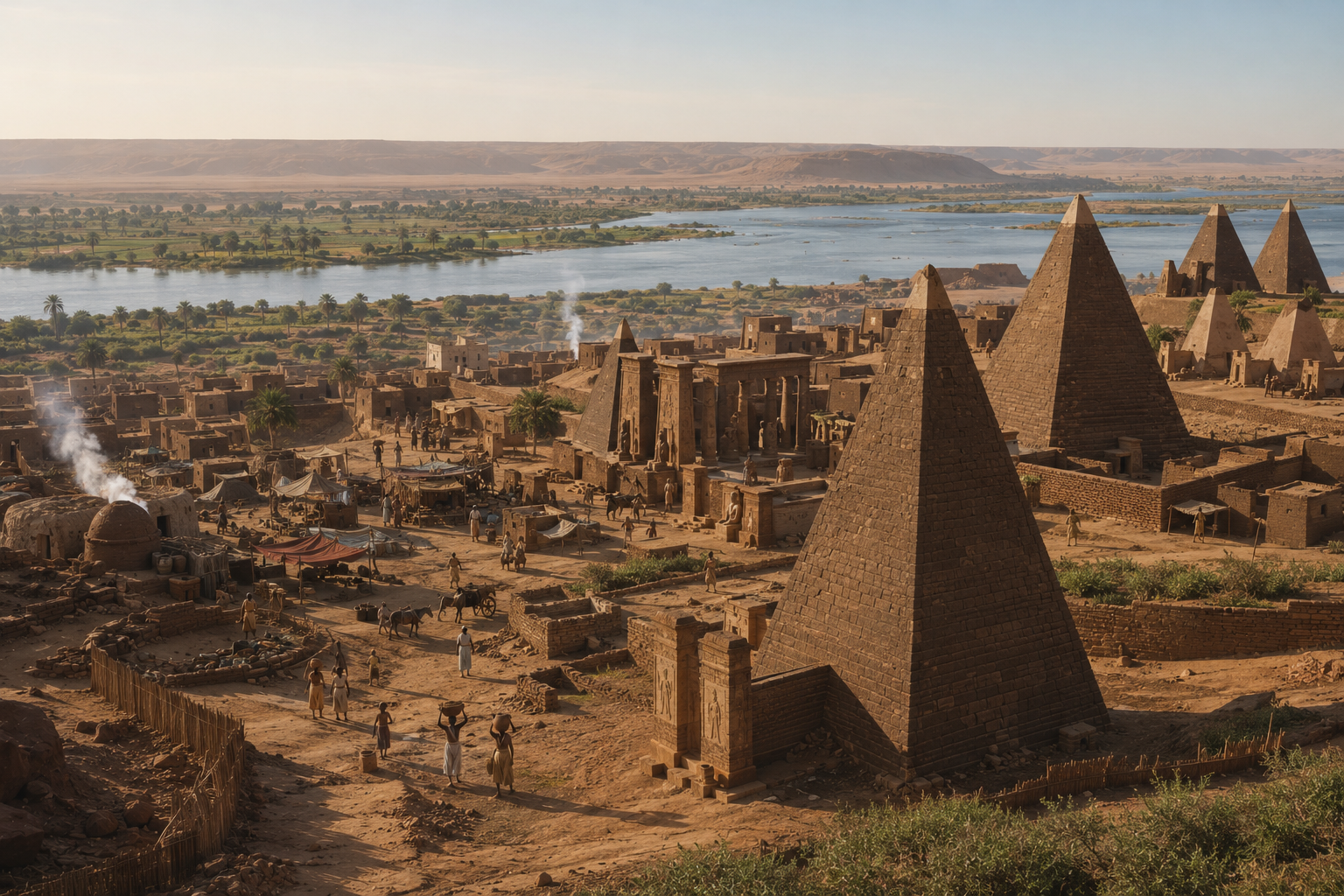
In the desert north of modern Khartoum, dozens of sharply angled pyramids rise from the sands around the ancient city of Meroë. They are smaller and steeper than the pyramids of Egypt, but they belonged to rulers of a kingdom that once controlled a large stretch of the Nile Valley and, for almost a century, governed Egypt itself. That Kingdom of Kush is now recognized by archaeologists as one of the major powers of the ancient world, yet its story remains far less familiar to most readers than that of its northern neighbor. (unesco.org)
The Kushite story is not simply the story of a civilization that disappeared. It is the story of a civilization that changed capitals, languages, religious traditions, political priorities, and relationships with Egypt and the Mediterranean world over more than a millennium. Archaeologists identify an early Kushite center at Kerma, a later Napatan kingdom based around Gebel Barkal, and a Meroitic phase centered farther south at Meroë, meaning that “Kush” describes a long-lived political and cultural tradition rather than one static state. (isac.uchicago.edu)
What survives is substantial. Temples, palaces, pyramids, settlements, inscriptions, pottery, metalworking installations, water reservoirs, royal burials, imported objects, and artworks reveal a society that was deeply connected to the wider ancient world while maintaining distinctive Nubian traditions. Some of its written language can be read phonetically, but much of the Meroitic language remains poorly understood, leaving historians with a civilization whose monuments are eloquent but whose own written voice is still only partly accessible. (academic.oup.com)
Kush Began Long Before the Pyramids of Meroë
The roots of Kush extend deep into the history of Nubia, the Nile region south of Egypt. One of the earliest major states in this region was centered at Kerma near the Third Cataract, where archaeologists have identified a substantial urban settlement with monumental mud-brick architecture, palaces, temples, workshops, and large royal burial mounds. The University of Chicago’s Institute for the Study of Ancient Cultures identifies Kerma as the most powerful Nubian state of the early second millennium BCE and notes that Egyptian texts referred to the southern region as Kush. (isac.uchicago.edu)
Kerma’s rulers eventually came into direct conflict with Egypt as their political and military influence expanded northward. Around the seventeenth century BCE, the Kerma kingdom controlled substantial portions of Nubia and reached beyond Egyptian frontier fortifications, becoming a major power at precisely the time Egypt itself was divided by internal and foreign political forces. The rise of Egypt’s New Kingdom eventually reversed that balance, and Egyptian rulers incorporated much of Nubia into their empire, but the earlier history demonstrates that powerful states existed south of Egypt long before later Kushite kings conquered the Egyptian throne. (isac.uchicago.edu)
Egyptian control of Nubia lasted for centuries and profoundly affected the region. New Kingdom pharaohs constructed temples, fortresses, administrative centers, and religious monuments along the Nile, while Nubian resources, including gold and other valuable products, moved north into the Egyptian economy. At the same time, cultural exchange moved in both directions, producing communities in which Egyptian and Nubian traditions existed alongside one another rather than creating a simple border between two entirely separate civilizations. (isac.uchicago.edu)
When Egyptian political authority weakened after the end of the New Kingdom, a new Kushite kingdom emerged around Napata near the Fourth Cataract. By the eighth century BCE, Kush had developed into a powerful state capable of intervening in Egyptian politics, and its rulers eventually took control of Egypt. The later history of Kush cannot therefore be understood simply as an isolated southern kingdom; it became one of the principal political forces in the Nile Valley. (isac.uchicago.edu)
The Kushite Pharaohs Ruled Egypt
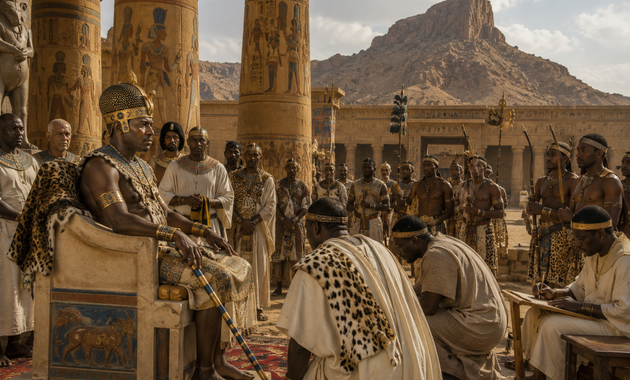
The most famous chapter in Kushite history began with Kashta and the rulers who followed him. The University of Chicago dates the Nubian Twenty-fifth Dynasty of Egypt to roughly 747–656 BCE, beginning with Kashta and continuing through kings including Piye and Taharqa. These rulers presented themselves as legitimate pharaohs and used Egyptian religious and political traditions while also emphasizing their Nubian identity through distinctive regalia and artistic conventions. (isac.uchicago.edu)
Piye was the ruler who carried Kushite power decisively into Egypt. His campaign was recorded on the famous Victory Stela, a lengthy Egyptian inscription that describes his military successes and presents him as a king favored by Amun, the deity whose cult was especially important at the Kushite sacred center of Gebel Barkal. Piye’s achievement created an empire stretching along the Nile from Kush into Egypt and placed a Nubian royal dynasty on the Egyptian throne. (isac.uchicago.edu)
The Kushite pharaohs did not attempt to erase Egyptian traditions. Instead, they deliberately adopted and revived them, restoring temples, reproducing older religious imagery, and presenting themselves within an Egyptian pharaonic tradition that reached back centuries. At the same time, their monuments and portraits contain unmistakably Kushite features, including royal crowns and regalia that distinguished them from earlier Egyptian rulers. The result was neither simple imitation nor complete separation, but a political culture created through the interaction of Nubian and Egyptian traditions. (metmuseum.org)
Taharqa, who ruled Egypt and Kush in the late seventh century BCE, became one of the most prominent of these kings. His reign produced major building projects, and representations of him show the distinctive synthesis of Egyptian conventions and Kushite royal symbolism that characterized the dynasty. The Met’s collection includes a representation of a Kushite king whose double uraei on the royal headdress expressed a specifically Nubian element within a traditionally Egyptian form of kingship. (metmuseum.org)
The Kushite dynasty’s control of Egypt did not last indefinitely. The expanding Neo-Assyrian Empire placed increasing pressure on Egypt, and after military defeats the Kushite rulers withdrew southward. By 656 BCE, Kushite rule over Egypt had ended, but the kingdom itself survived in Nubia, where its political and religious institutions continued for centuries. The retreat from Egypt was therefore not the end of Kush, but a major transformation of its place within the Nile Valley. (isac.uchicago.edu)
Napata Became the Spiritual Heart of Kush
After losing Egypt, Kush remained strongly tied to Napata and the sacred landscape around Gebel Barkal. The mountain and its temples became central to royal ideology, while nearby cemeteries at El-Kurru and Nuri preserve evidence of Kushite kings and queens. UNESCO describes the sites of the Napatan region as a connected archaeological landscape containing tombs, pyramids, temples, palaces, living complexes, and burial monuments associated with the Napatan and later Meroitic cultures. (unesco.org)
Gebel Barkal was particularly important because of its association with Amun. The religious relationship between Kush and Egypt was therefore not erased after the Kushites withdrew from the Egyptian throne; instead, Nubian rulers continued to use religious traditions connected to the Nile Valley while placing them within their own political landscape. This helps explain why Kushite kings could regard themselves as heirs to ancient Egyptian kingship while simultaneously ruling from a Nubian homeland with its own traditions. (isac.uchicago.edu)
The Napatan period also reveals how strongly royal burial mattered to Kushite political identity. Kings were buried beneath pyramids, and the form became an enduring symbol of royal authority, although Kushite pyramids differed considerably from the monumental pyramids of Egypt’s Old Kingdom. Their steep proportions, chapel entrances, and placement within extensive cemeteries created a distinctive Nubian funerary tradition that would become even more visible after the royal cemetery moved south. (unesco.org)
The shift away from Egypt was not simply a retreat from a conquered territory. Kush was developing its own political center, economic base, and cultural identity, and the move eventually led to the most distinctive phase of the kingdom. By the third century BCE, the royal burial ground had moved to Meroë, farther south along the Nile, marking what archaeologists generally describe as the beginning of the Meroitic period. (uni-muenster.de)
Meroë Became the Center of a Different Kush
Around 270 BCE, Meroë became the principal royal center of Kush, and the kingdom entered a phase that lasted for roughly six centuries. The city stood between the Fifth and Sixth Cataracts of the Nile, in a landscape where agriculture, pastoralism, trade, industry, and long-distance political connections could be integrated into a single state. Archaeological investigations have uncovered palaces, temples, residential areas, industrial facilities, royal cemeteries, and large water reservoirs. (isac.uchicago.edu)
Meroë’s position helped shape the character of the later kingdom. The city was farther from Egypt, and Kushite culture became increasingly distinctive, although Egyptian influence never disappeared entirely. Local gods, particularly the lion-headed deity Apedemak, became more prominent, while Egyptian gods such as Amun continued to be worshipped. Art and royal imagery increasingly emphasized specifically Meroitic forms, creating a cultural landscape that was connected to Egypt without simply reproducing it. (isac.uchicago.edu)
The famous pyramids of Meroë belong to this later period. There are many more pyramidal royal monuments in Nubia than in Egypt, although individual Nubian pyramids are generally much smaller than the Great Pyramid and other monumental tombs of Egypt. Their narrow angles, small funerary chapels, and desert setting create an architectural tradition instantly recognizable as Kushite, and UNESCO regards the pyramids of Meroë as among the outstanding features of the archaeological landscape. (isac.uchicago.edu)
The city itself was more than a royal cemetery. Excavations reveal a functioning urban center with religious buildings, elite residences, industrial areas, and evidence of manufacturing, while enormous reservoirs known today as hafirs collected water outside the immediate Nile corridor. UNESCO notes that these reservoirs are particularly valuable to historians because they can provide evidence about climate, hydrology, and the ability of ancient communities to sustain large settlements in what is now an arid environment. (unesco.org)
Kush Was an African Trade Power
One of the greatest misconceptions about Kush is that it existed on the edge of the ancient world. Its location actually placed it along a major corridor connecting central and sub-Saharan Africa with Egypt, the Mediterranean, and the Red Sea. UNESCO describes the Meroe archaeological sites as evidence of prolonged exchanges between sub-Saharan Africa and the Mediterranean and Middle Eastern worlds, while imported and locally produced materials demonstrate that Kush was engaged in networks extending far beyond its immediate territory. (unesco.org)
Gold was certainly important to the economies of the Nile Valley, but Kush’s commercial significance extended well beyond one commodity. Archaeological evidence and ancient written sources point to exchanges involving livestock, agricultural products, precious materials, ivory, exotic animals, ceramics, metals, and other goods moving through interconnected riverine and desert routes. Nubia’s geography made it a bridge between ecological zones rather than a peripheral dead end. (isac.uchicago.edu)
The kingdom’s economic strength also depended on its ability to manage water outside the permanent Nile channel. The hafirs around Meroë could collect seasonal rainfall and runoff, helping sustain communities and livestock in a region where modern observers might assume permanent settlement would have been impossible. UNESCO identifies these reservoirs as evidence of sophisticated water management and as important sources for understanding the environmental conditions of the ancient Meroitic period. (unesco.org)
This helps explain how Kush could support monumental construction in an environment that looks harsh today. The ancient landscape was not identical to the modern one, and ancient Kushites developed systems suited to the rainfall, river cycles, grazing patterns, and agricultural possibilities of their time. The archaeological record therefore challenges the image of Meroë as a miraculous city that somehow appeared in empty desert; it was a planned settlement within a managed landscape. (unesco.org)
Meroë Was Also a Center of Iron Production
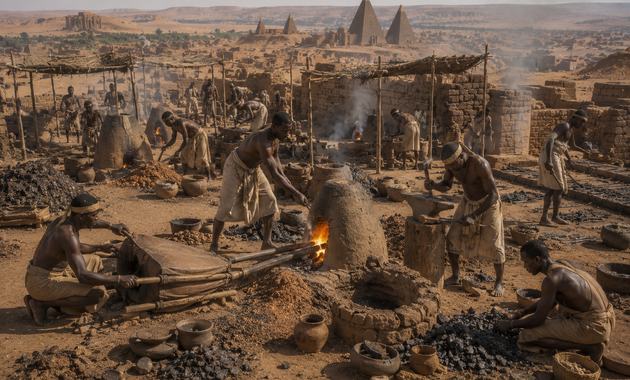
Another reason Meroë became associated with wealth and power is the large-scale production of iron. Archaeological work at the royal city and nearby Hamadab has established a long tradition of iron production at Meroë, potentially extending from as early as the seventh century BCE into the sixth century CE. Scholars have excavated furnaces, slag, production debris, and other remains showing that metallurgy was a significant component of the Meroitic economy. (cam.ac.uk)
For much of the twentieth century, Meroë was sometimes described too simply as an “iron city,” as though metallurgy alone explained its importance. The archaeological reality is more complicated. Ironworking was one part of a broader urban economy that included agriculture, livestock, crafts, trade, religion, administration, and royal institutions, and the quantity of metallurgical evidence demonstrates industrial capacity without proving every old claim about Meroë being the principal source of iron for half of Africa. (cam.ac.uk)
The industrial remains are nevertheless important because they complicate the image of Kushite civilization as merely agricultural or ceremonial. Meroë had specialized production and the infrastructure necessary to sustain it over long periods. Its workshops belonged to a state capable of organizing labor, acquiring raw materials, distributing finished goods, and supporting an urban population around a royal center. (unesco.org)
The evidence also matters for the history of Africa more broadly. Ancient African societies were not simply consumers of technologies developed elsewhere, and the Kushite archaeological record demonstrates substantial local technological traditions. The same civilization that built royal pyramids and temples also operated industrial centers, managed water, produced ceramics and maintained regional trade networks. (unesco.org)
Kush Developed Its Own Language and Writing
One of the greatest barriers to understanding Kush is linguistic. During the Meroitic period, the Kushites developed a writing system for their own language, using both a hieroglyphic form for monumental and religious contexts and a cursive form for more routine writing. The script was deciphered in 1911, but the language itself remains only partially understood because there are not enough bilingual inscriptions and its deeper linguistic relationships remain difficult to establish. (academic.oup.com)
That distinction is crucial. Saying that Meroitic writing is “undeciphered” can be misleading because scholars can identify many sounds and read portions of inscriptions, including names and recurring formulas. What remains difficult is the meaning of much of the vocabulary and grammar, meaning that historians can sometimes pronounce an inscription without being able to translate its full message confidently. (academic.oup.com)
A large body of Meroitic inscriptions survives on stone, pottery, funerary monuments, and other objects. These texts demonstrate that the Kushites were recording political and religious information in their own language rather than simply using Egyptian for every formal purpose, and the development of the alphabetic Meroitic script marks an important stage in the evolution of Kushite cultural identity. (mnamon.sns.it)
The problem for historians is that the written record is tantalizingly incomplete. A civilization may leave behind thousands of inscriptions, but if the language is only partly understood, those inscriptions cannot yet supply the same continuous narrative historians obtain from ancient Egypt, Greece, or Rome. Kush is therefore visible everywhere in archaeology while remaining frustratingly quiet in its own words. (academic.oup.com)
Queens and Women Held Unusual Political Importance
The political history of Kush also complicates assumptions based on neighboring ancient states. Kushite royal women could possess significant authority, and later Meroitic monuments preserve powerful images and inscriptions involving queens and royal women. One of the best-known examples is Queen Shanakdakhete, whose second-century BCE funerary chapel at Meroë contains a large relief depicting the queen enthroned with royal and divine imagery. The British Museum’s surviving relief preserves a monumental expression of female royal authority within Meroitic political culture. (britishmuseum.org)
Another famous ruler was Amanirenas, who lived during the first century BCE, when Kush came into direct conflict with Rome. A Meroitic inscription preserved by the British Museum names Amanirenas and King Akinidad, illustrating the survival of royal authority and Meroitic writing during this period of Roman-Kushite contact. (britishmuseum.org)
The Roman confrontation is significant because it shows that Kush remained politically active centuries after its kings had withdrawn from Egypt. Roman Egypt bordered Kushite territory, and the two powers competed and negotiated along the southern frontier, producing warfare, diplomacy, and shifting political relationships. Kush was therefore not an isolated remnant of an older empire; it was an active state interacting with one of the Mediterranean world’s most powerful imperial systems. (unesco.org)
These episodes also help explain why ancient Sudan cannot be reduced to an Egyptian appendix. Kushite rulers were not simply imitators of Egyptian kingship waiting for Rome to arrive; they maintained their own court traditions, religious institutions, political ambitions, artistic language, and regional networks. Their ability to negotiate with Rome demonstrates that Meroitic Kush belonged simultaneously to African, Nile Valley, and wider Afro-Mediterranean history. (unesco.org)
Why Did the Kingdom of Kush Decline?
The end of Kush was not a single dramatic event comparable to the eruption that buried Pompeii. The evidence instead points toward a complex weakening of the Meroitic state, and the exact sequence remains debated. Meroë had survived wars, changing trade routes, environmental pressures, and competition for centuries, but by the fourth century CE its political system was under severe strain and the city lost the central position it had once held. (isac.uchicago.edu)
One factor was the emergence of new political powers in the region. The University of Chicago notes that after the collapse of Meroë around the fourth century CE, the Noubadians and other regional powers became dominant in northern Nubia, while the broader Nile Valley entered a new political and religious landscape. The Kushite state did not simply vanish overnight; its territories were incorporated into a changing succession of Nubian societies. (isac.uchicago.edu)
Environmental change may also have mattered, particularly because Kush depended on a delicate balance among river agriculture, rainfall, grazing, and water storage. UNESCO emphasizes that the reservoirs and archaeological landscapes around Meroë offer important evidence for reconstructing the palaeoclimate and hydrology of the region, suggesting that environmental conditions are essential to understanding how the kingdom functioned. It would be too simplistic, however, to claim that drought alone destroyed Kush without stronger evidence connecting particular climatic changes to the political collapse. (unesco.org)
Trade routes may have shifted as well. Meroë benefited from its position within regional networks, but economic corridors change when political borders, desert routes, river conditions, and international demand change, and a state centered on long-distance exchange could be vulnerable to those transformations. The surviving evidence does not support one universally accepted “fall of Kush” theory, which is precisely why historians continue to study the archaeological record rather than relying on a single dramatic ending. (unesco.org)
Kush Did Not Vanish When Meroë Fell
The phrase “swallowed by history” becomes misleading if it suggests that Kush’s people disappeared. Political systems can collapse without populations disappearing, and later Nubian kingdoms emerged in the same broad Nile Valley landscape. The history of Christian Nubia, the Noubadian kingdoms, Makuria, Nobadia, and Alodia belongs to a later period, but these societies demonstrate that the end of Meroitic political authority was not the end of Nubian civilization. (isac.uchicago.edu)
What disappeared was a particular political order and its institutions. The capital at Meroë declined, royal burial traditions changed, the Meroitic writing system eventually ceased to be used, and new rulers reorganized the political landscape, but people continued to live along the Nile and preserve regional cultural traditions. Archaeologists therefore treat the end of Kush as a transition within Nubian history rather than the sudden disappearance of an entire population. (isac.uchicago.edu)
The modern rediscovery of Kush followed a different kind of disappearance: a disappearance from popular historical memory. European travelers and archaeologists encountered the ruins, but early scholarship often interpreted them primarily through Egyptian or classical frameworks, sometimes treating Nubian achievements as derivative. Recent archaeological research has increasingly challenged those assumptions by emphasizing local traditions, long-distance African connections, indigenous language, and the political agency of Kushite rulers. (gc.cuny.edu)
This shift matters because archaeological interpretation can itself determine whether a civilization appears visible or invisible in history. When monuments are described only as Egyptian “influences,” their local context can disappear from view, whereas examining trade, language, technology, religion, and political institutions reveals a more complex cultural system. Kush was not merely a bridge carrying Egyptian ideas into Africa; it was a major African power that participated in exchanges with Egypt, the Mediterranean, and neighboring African regions on its own terms. (unesco.org)
What the Ruins of Meroë Still Tell Us
The archaeological sites of Meroë are among the strongest physical arguments against the idea that Kush was a minor civilization. UNESCO identifies the site complex as containing pyramids, temples, palaces, industrial areas, domestic structures, production evidence, and hydraulic infrastructure covering more than a millennium of history. Together, these remains demonstrate the scale of Kushite political organization and the diversity of activities that took place within and around its capital. (unesco.org)
The temples also reveal how Kushite religion evolved. At Meroë, Apedemak, often represented as a lion-headed deity, became especially important, while older Egyptian gods continued to receive worship, producing a religious system that blended inherited Nile Valley traditions with distinctly Meroitic forms. The result was not cultural confusion but a selective synthesis in which Kushite rulers could use ancient religious symbols while giving them new local meanings. (isac.uchicago.edu)
The art tells a similar story. Kushite rulers appear wearing royal garments and crowns that resemble Egyptian forms but include recognizable Nubian elements, while reliefs and sculptures show local deities, royal women, animals, and ceremonial scenes. The British Museum’s Meroitic objects provide a physical record of a culture that borrowed, adapted, and transformed influences rather than simply reproducing them. (britishmuseum.org)
Even the damaged monuments are informative. Some pyramids were deliberately altered or badly damaged by nineteenth-century treasure hunters, while later conservation projects have preserved and reconstructed portions of the archaeological landscape. UNESCO records that the pyramid cemeteries suffered particularly serious damage during Giuseppe Ferlini’s treasure hunting in the 1830s, an episode that itself became part of the modern history of how Kush was rediscovered and understood. (unesco.org)
Kush in the Larger Story of Ancient Africa
The history of Kush belongs naturally beside Egypt, Carthage, Rome, and the civilizations of the Mediterranean, but it should not be described as merely an extension of those worlds. Its political centers were in Nubia, its economic networks reached deep into Africa, and its later rulers developed their own written language and religious iconography. The kingdom was connected to several regions at once, which is precisely what made its position along the Nile strategically important. (unesco.org)
The story also fits HiddenFrontiers’ broader interest in civilizations whose historical importance is obscured by the prominence of better-known neighbors. Readers familiar with why ancient Romans feared certain forests will recognize the importance of examining the ancient world through its own cultural concepts rather than projecting modern categories backward, while the history of El Dorado and the myths created around South American wealth offers a different example of how powerful outside narratives can distort the historical realities behind legendary places. Kush presents the reverse problem: there was a real kingdom, real cities, real rulers, and a vast archaeological record, yet the popular imagination often gives them less attention than legends that were never historical places at all.
The comparison with Pompeii is useful for another reason. Pompeii’s preservation after the eruption of Vesuvius allows archaeologists to reconstruct everyday Roman life through a city preserved by catastrophe, whereas Kush survives through a more fragmented archaeological record spread across centuries, landscapes, cemeteries, industrial installations, and temples. Both sites show the power of archaeology, but they preserve different kinds of historical information and therefore require different methods of reconstruction.
The larger lesson is that the absence of a familiar historical narrative does not mean a civilization lacked influence. Kush interacted with Egypt, confronted Assyria, negotiated and fought with Rome, developed long-distance trade, created an indigenous writing tradition, and constructed monumental cities and burial complexes. Its relative obscurity today is a problem of historical memory, not evidence that the civilization itself was marginal. (unesco.org)
The Mystery That Remains: Can We Read Kush in Its Own Words?
One of the most intriguing unresolved problems is the Meroitic language. Scholars can read the script’s signs and identify many names and recurring formulae, but much of the language remains difficult to translate because the surviving corpus lacks the kind of extensive bilingual texts that allowed scholars to unlock Egyptian through the Rosetta Stone. The result is unusual: archaeologists possess a large body of written material, yet the civilization’s own political and religious vocabulary remains only partly accessible. (academic.oup.com)
The lack of a complete decipherment limits historians’ ability to reconstruct everyday life, government institutions, theological ideas, and historical events directly from Kushite authors. Scholars therefore have to combine inscriptions with archaeology, Egyptian sources, Greek and Roman writers, comparative linguistics, art history, and material evidence. This approach can produce strong conclusions, but it also leaves gaps that future discoveries may eventually fill. (mnamon.sns.it)
That uncertainty makes the surviving monuments even more valuable. A pyramid can tell archaeologists about royal burial practices, a workshop can reveal production methods, a reservoir can illuminate water management, and an imported vessel can provide evidence of trade, even when the written explanation for those activities remains inaccessible. Kush therefore survives through a patchwork of evidence rather than one continuous royal history. (unesco.org)
The possibility of future discoveries is unusually strong because large parts of the archaeological record remain understudied, and UNESCO has emphasized both the research potential of the Meroë sites and the importance of conserving them. Archaeology is not simply confirming what historians already know; excavations and scientific analysis continue to change the picture of how Kush was organized, supplied, connected to other regions, and transformed over time. (unesco.org)
Why Was Kush Forgotten?
Part of the answer lies in the way ancient history has traditionally been taught. Egyptian history became a dominant framework for understanding the Nile Valley, while Greek and Roman writers became central sources for the history of the Mediterranean, leaving the societies between and beyond those cultural centers less visible in later historical narratives. Kush often appeared in those accounts through Egyptian or classical eyes rather than through its own surviving traditions. (gc.cuny.edu)
Another factor was the partial loss of the Meroitic language. Egypt left behind enormous bodies of readable hieroglyphic texts, while Greece and Rome left extensive literary traditions that remained accessible to later scholars. Kush left inscriptions too, but the difficulty of fully understanding Meroitic meant that its own written history could not be reconstructed with the same confidence. Archaeology consequently became far more important to the recovery of Kushite history than it was for civilizations whose texts could be read directly. (academic.oup.com)
There was also a modern history of unequal archaeological interpretation. Early explorers and treasure hunters sometimes viewed Nubian monuments primarily as objects to collect, compare with Egypt, or mine for valuables, and destructive expeditions damaged some of the pyramids at Meroë. UNESCO specifically identifies the treasure hunting of Ferlini in the 1830s as particularly damaging to the site. (unesco.org)
The modern archaeological picture is changing, but preservation remains crucial. In 2024, UNESCO publicly called for the protection of the Meroë World Heritage site after reports of military activity in the area during Sudan’s wider conflict, emphasizing that the archaeological remains should not be targeted or used for military purposes. That warning illustrates an uncomfortable continuity: Kush survived thousands of years, yet the physical remains are still vulnerable to decisions made by modern people. (unesco.org)
What the Kingdom of Kush Left Behind
Kush left behind more than pyramids. It left a record of political independence, military power, long-distance exchange, technological production, water management, religious change, monumental architecture, and cultural adaptation across more than a thousand years. From Kerma to Napata and then Meroë, the centers of power changed, but the civilization repeatedly demonstrated an ability to reorganize itself in response to changing relationships with Egypt, the Mediterranean, and neighboring African societies. (isac.uchicago.edu)
Its most famous monuments are the pyramids, but the industrial and hydraulic remains may be just as important for understanding how the kingdom worked. A royal tomb demonstrates power and ideology; a reservoir demonstrates environmental management; an ironworking installation demonstrates specialized labor; and a written inscription demonstrates administration and identity. Taken together, these pieces reveal a state far more complex than the romantic image of an ancient desert kingdom surrounded by mysterious ruins. (unesco.org)
The political story is equally significant. Kushite rulers did not merely survive alongside Egypt; they conquered and governed Egypt as the Twenty-fifth Dynasty, revived older Egyptian religious and artistic traditions, and then continued ruling independently from Nubia after their withdrawal. Later Meroitic kings and queens dealt with Rome and maintained a state that survived for centuries after the end of Kushite rule in Egypt. (isac.uchicago.edu)
The greatest irony is that the Kingdom of Kush was never truly lost. Its cities remained in the landscape, its pyramids continued to mark the graves of its rulers, and its temples and inscriptions waited for archaeologists to study them. What disappeared was largely the continuous historical narrative that would have allowed later generations to recognize Kush as one of Africa’s great ancient powers.
That is why calling Kush a kingdom “swallowed by history” is both useful and misleading. It captures how little space the civilization occupies in popular memory, but the archaeological record tells a different story: Kush was a major Nile Valley state whose influence reached Egypt, whose trade connected African and Mediterranean worlds, whose rulers built monumental cities, and whose own language still holds information that scholars have not fully recovered. (unesco.org)
The ruins at Meroë are therefore not the remains of a vanished curiosity at the edge of the ancient world. They are the surviving architecture of a civilization that once stood at its center, even if modern historical memory has been slower to recognize it. The more archaeologists uncover, and the more carefully they listen to the evidence that survives in stone, metal, water systems, graves, and inscriptions, the less Kush looks like a forgotten kingdom and the more it looks like what it was: a major African civilization whose story is still being recovered. (isac.uchicago.edu)
SOURCES & REFERENCES
UNESCO World Heritage Centre — “Archaeological Sites of the Island of Meroe.”
Used for the chronology of Kush, Meroë’s role as the kingdom’s heartland, architecture, water management, trade connections, ironworking, and cultural exchange. (unesco.org)
UNESCO World Heritage Centre — “Gebel Barkal and the Sites of the Napatan Region.”
Used for the Napatan period, Gebel Barkal, royal pyramids, temples, palaces, and the broader archaeological landscape of Kush. (unesco.org)
University of Chicago, Institute for the Study of Ancient Cultures — “Kushite Kingdom.”
Used for the Twenty-fifth Dynasty, Kashta, Piye, Kushite rule in Egypt, Taharqa, and the transition back to Nubia. (isac.uchicago.edu)
University of Chicago, Institute for the Study of Ancient Cultures — “Kerma Culture.”
Used for the early Kushite state at Kerma, its political expansion, urban structure, and conflict with Egypt. (isac.uchicago.edu)
University of Chicago, Institute for the Study of Ancient Cultures — “Meroe.”
Used for Meroë as the later capital, its palaces, temples, ironworking centers, water reservoirs, pyramids, religion, and Meroitic cultural development. (isac.uchicago.edu)
Claude Rilly — “Language and Writing in the Kingdom of Meroe,” The Oxford Handbook of Ancient Nubia, 2021.
Used for the Meroitic writing system, its decipherment, and the continuing difficulty of fully understanding the Meroitic language. (academic.oup.com)
Jane Humphris, Robert Bussert, Fareed Alshishani & Thomas Scheibner — “The ancient iron mines of Meroe.”
Used for archaeological evidence of long-term iron production at Meroë and Hamadab. (cam.ac.uk)
The British Museum — “Temple relief” from Queen Shanakdakhete’s funerary chapel.
Used for Meroitic royal art and the historical evidence concerning Queen Shanakdakhete. (britishmuseum.org)
The Metropolitan Museum of Art — “Head of a Kushite King.”
Used for Kushite royal imagery and the distinctive combination of Egyptian pharaonic conventions and Nubian regalia. (metmuseum.org)
UNESCO World Heritage Centre — “Sudan: UNESCO calls for the protection of the World Heritage Site of the Island of Meroe,” January 19, 2024.
Used for the modern preservation context and UNESCO’s warning concerning military activity near the archaeological site. (unesco.org)
FAQ
What was the Kingdom of Kush?
The Kingdom of Kush was a long-lived Nubian state centered in the Nile Valley south of Egypt. Its history included an early major center at Kerma, a Napatan phase centered near Gebel Barkal, and a later Meroitic phase centered at Meroë, with the broader Kushite tradition spanning well over a millennium. (isac.uchicago.edu)
Did Kush actually rule Egypt?
Yes. Kushite rulers established Egypt’s Twenty-fifth Dynasty and governed Egypt for roughly a century in the eighth and seventh centuries BCE. Kings including Piye and Taharqa presented themselves as Egyptian pharaohs while maintaining distinctive Kushite royal traditions and continued to rule from their Nubian homeland after the dynasty withdrew from Egypt. (isac.uchicago.edu)
Was Meroë the capital of Kush?
Meroë became the principal royal center of Kush around 270 BCE, replacing Napata as the main royal burial and political center. It remained the heart of the Meroitic kingdom for several centuries and developed into a substantial city with palaces, temples, industrial facilities, residential areas, and water-management systems. (isac.uchicago.edu)
Why does Meroë have so many pyramids?
The pyramids at Meroë were royal and elite tombs built according to a distinctive Kushite funerary tradition. They are generally much smaller and steeper than the famous Egyptian pyramids, and many were accompanied by chapels used for funerary rituals and offerings. (unesco.org)
Did Kush have its own language?
Yes. The later Kushite state used Meroitic, an indigenous language written in both hieroglyphic and cursive forms. The script was deciphered in the early twentieth century, but scholars still cannot fully understand the language because the surviving evidence lacks enough bilingual material and its deeper linguistic relationships remain difficult to establish. (academic.oup.com)
Was Kush a rich civilization?
Kush possessed substantial economic resources and participated in long-distance trade networks connecting the Nile Valley with broader African and Mediterranean regions. Archaeological evidence also demonstrates large-scale iron production, agricultural activity, livestock management, water storage, craft production, and monumental construction, indicating a complex economy rather than one based on a single source of wealth. (unesco.org)
Why did the Kingdom of Kush decline?
There is no universally accepted single cause. The decline of Meroë appears to have involved political changes, emerging regional powers, possible shifts in trade and economic networks, and environmental factors that affected the resources on which the kingdom depended, while the exact sequence remains an active area of archaeological research. (isac.uchicago.edu)
Did Kush completely disappear?
No. The Meroitic political system eventually collapsed, but the people of Nubia did not disappear, and later Nubian kingdoms developed in the region. The end of Kush should therefore be understood as a political and cultural transition rather than the sudden disappearance of an entire population. (isac.uchicago.edu)






2 comments