
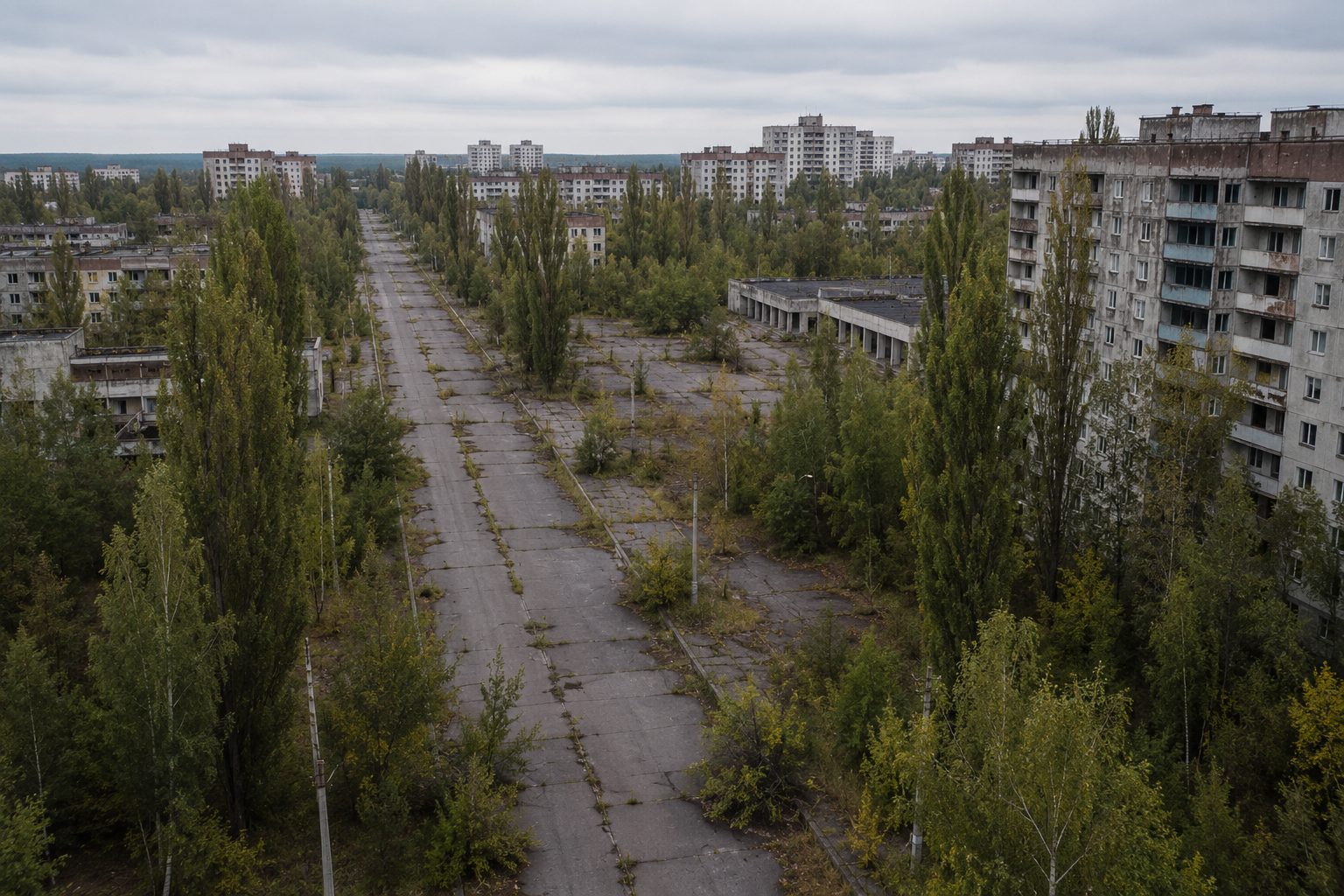
The Ghost Town That Nature Completely Reclaimed
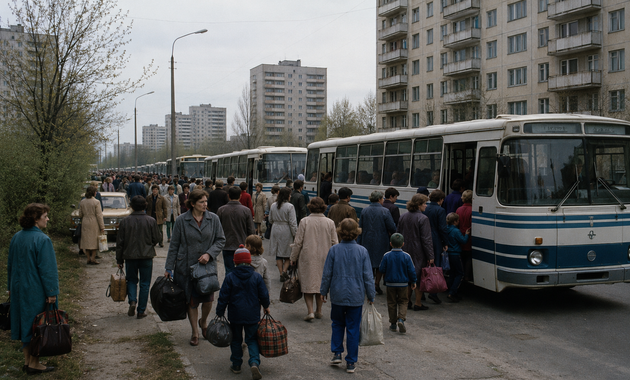
On April 27, 1986, Pripyat was still a functioning Soviet city, part of the Pripyat ghost town. Children played outside, families lived in apartment blocks, shops were open, and workers went about their ordinary routines. By the afternoon, however, the city was evacuated. More than a thousand buses were assembled from across the region, and residents were told to leave their homes temporarily. Many expected to return within a few days. They never did. The Pripyat ghost town that exists today began with an evacuation that was supposed to be temporary.
Pripyat had been built only sixteen years earlier, beginning in 1970 as a planned settlement for employees of the nearby Chernobyl Nuclear Power Plant and their families. It was a distinctly modern Soviet city for its time, with apartment districts, schools, cultural facilities, stores, sports grounds, public spaces and broad streets laid out around a young population. Its abandonment was therefore unusual even within the history of disaster zones: a functioning city was emptied almost at once, and the urban environment was then left without the daily maintenance that normally keeps a city alive.
The result is often described in photographs as nature taking back the city. Trees grow through neglected courtyards, grasses occupy cracks in pavement, shrubs spread around apartment blocks and roots push against sidewalks. Yet the process is more interesting than the cliche. Pripyat ghost town did not become a forest overnight, and the city has not literally disappeared beneath vegetation. It became an enormous experiment in what happens when an urban landscape is abruptly removed from ordinary human use but remains standing.
A City Built for the Nuclear Age
Pripyat was founded on February 4, 1970, and was granted city status in 1979. Its purpose was closely tied to the growth of the Chernobyl Nuclear Power Plant, whose workers and families formed much of the city’s population. By the time of the 1986 accident, Pripyat had become a substantial planned community rather than a temporary workers’ camp.
The city’s architecture reflected Soviet planning principles of the late twentieth century. Multi-story concrete apartment buildings were arranged around broad public spaces, schools and recreational facilities, with roads and pedestrian areas connecting residential districts. The city was designed to support a population that would grow alongside the nuclear plant, meaning its buildings and infrastructure were planned as part of a larger industrial system rather than as an organically developed historic town.
That distinction helps explain why Pripyat looks so different from older European ghost towns. There are no medieval walls, nineteenth-century stone streets or centuries-old wooden houses. Instead, there are standardized apartment blocks, concrete stairwells, playgrounds, sports facilities, utility infrastructure and wide Soviet avenues. When people disappeared, the physical city remained almost exactly where planners had put it.
Its youth makes what happened particularly striking. Pripyat had existed for only about sixteen years when the Chernobyl disaster occurred. Some buildings were still relatively new, and the city’s infrastructure belonged to a generation accustomed to modern housing and centralized utilities rather than the slow accumulation of structures seen in much older towns.
That is one reason photographs of Pripyat can feel strangely contemporary even decades later. The buildings may be badly weathered, but their basic forms belong to the relatively recent past. The city looks abandoned rather than ancient.
The Night Everything Changed
The Chernobyl disaster began during a reactor test at Unit 4 of the nuclear power plant during the early morning hours of April 26, 1986. The reactor was destroyed by explosions and fire, releasing large quantities of radioactive material into the environment. The accident affected enormous areas of Ukraine, Belarus and other parts of Europe, while the people living closest to the plant faced an immediate and unprecedented emergency.
For residents of Pripyat, the initial response was confusing. According to the International Atomic Energy Agency’s historical account, officials did not provide the population with clear radiation-related instructions on April 26, and normal life continued to a surprising degree during the first day even as radiation measurements increased and specialists argued that evacuation was necessary.
By April 27, that changed. The governmental commission ordered preparations for evacuation, and officials in Pripyat were instructed to organize the operation for 2 p.m. More than a thousand buses were brought in from Kyiv and other communities. Two special trains were also sent but were ultimately not used for the evacuation.
The evacuation was organized with extraordinary speed because the objective was to move a large civilian population out of an increasingly hazardous environment. Residents took only limited belongings. Many assumed that their absence would last for a short time, which helps explain why the city later appeared to contain so many ordinary objects: furniture, school materials, household items, children’s possessions and other evidence of routine life.
That expectation of return was important. Pripyat was not abandoned because residents slowly moved away after the economy collapsed. It was emptied because officials believed remaining there posed an unacceptable radiation risk. The city was then placed inside the exclusion zone established after the accident.
Why Nobody Came Back
The most important thing about Pripyat’s ecological transformation is not simply that people left. It is that ordinary urban maintenance stopped.
A functioning city constantly fights ecological processes.
In places like the Pripyat ghost town, authorities address issues by clearing streets, repairing gutters, and maintaining roofs.
They trim trees, service drainage, remove weeds, replace damaged windows, and repair small cracks before problems grow.
Parks are landscaped, vacant lots are managed, and water is directed away from buildings.
Remove that maintenance for a year, and the difference becomes visible. Remove it for decades, and vegetation begins to dominate the spaces between buildings.
In Pripyat, contamination prevented the city from simply returning to normal residential use. The broader Chernobyl Exclusion Zone was established to restrict human exposure to radioactive contamination, and elevated levels of radionuclides remain in parts of the zone. Studies continue to examine how radiation interacts with plants, animals, soils and ecological processes.
The absence of large-scale permanent human settlement had an enormous ecological consequence, however. Agricultural land stopped being cultivated, lawns stopped being routinely cut, roadside vegetation was left unmanaged, and urban surfaces were no longer regularly cleared. Research on vegetation in the exclusion zone has found that plant cover increased substantially over the decades following the accident, with abandonment and reduced human activity becoming major factors in the expansion of grasses, shrubs and trees.
The change therefore was not a simple story of radiation somehow making nature stronger. It was partly the opposite: an extraordinary reduction in human pressure created opportunities for plants and animals that had been constrained by intensive land use.
How the City Slowly Became Green
The first stage of ecological reclamation was not dramatic. Plants occupied disturbed soil, cracks in pavement and neglected patches around buildings. Seeds arrived through wind, water and animals, while existing vegetation expanded into places where humans had once controlled it.
Grass is particularly effective in abandoned urban environments because it requires relatively little space and can establish in disturbed ground. Once maintenance stops, grasses colonize roadsides, courtyards and open lots. Shrubs then develop in areas with sufficient soil, and young trees begin to compete for sunlight.
The process becomes more visible when tree seedlings reach several meters in height. Places that had once been dominated by concrete and carefully maintained lawns acquire an entirely different structure. A sidewalk becomes partially hidden beneath grass, a courtyard develops shrub cover, and tree branches begin to occupy space that was designed for people.
Research on the wider Chernobyl Exclusion Zone shows that the vegetation is now dominated by grasses, shrubs and trees, including Scots pine and silver birch. Remote-sensing studies have found that vegetation cover increased after the accident, while scientific analysis indicates that the benefits of land abandonment can outweigh some of the negative effects of radiation on plant communities in less contaminated areas.
This does not mean radiation has had no biological consequences. Studies show that species respond differently depending on contamination levels and other environmental stresses. Some plants and animals appear to tolerate the environment surprisingly well, while researchers continue to document physiological, genetic and ecological effects associated with chronic radiation exposure.
That complexity is important because the popular image of Pripyat often suggests that the nuclear accident somehow created a supercharged wilderness. The reality is more ordinary and more scientifically interesting: human pressure was dramatically reduced, natural succession proceeded, while radiation remained one of several environmental factors affecting organisms and landscapes.
Concrete Does Not Stop Trees Forever
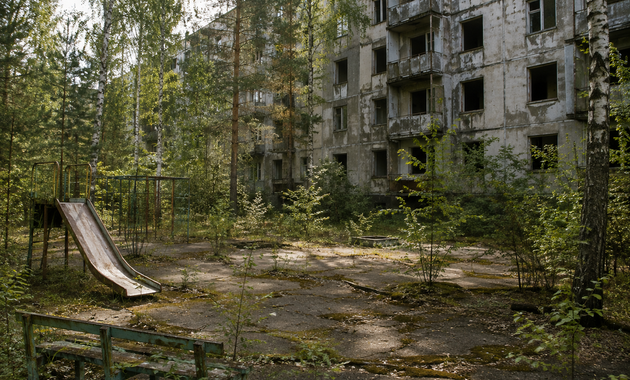
One of the most memorable sights in Pripyat is vegetation growing directly beside, between and sometimes inside Soviet buildings. This happens because abandoned structures are not sealed environments.
A cracked window allows moisture and seeds to enter. A roof leak damages interior materials. Freeze-thaw cycles enlarge cracks in concrete. Rain carries soil into depressions. Leaves accumulate and decompose, creating organic material where roots can establish. Once a plant becomes established, its roots can gradually alter the surrounding structure.
A building designed to remain functional for decades assumes that people will repair it. Without maintenance, water infiltration becomes especially destructive. Roofing materials deteriorate, window frames fail, balconies corrode and drainage systems stop working properly.
Vegetation then takes advantage of those weaknesses.
Trees are not literally pushing entire apartment buildings down by themselves, as some dramatic photographs might imply. Structural deterioration is normally a combination of weather, water, corrosion, freeze-thaw processes, material fatigue and vegetation. Roots can contribute to cracking and displacement, but the city’s decay is a complex interaction between biological growth and physical weathering.
The result can nevertheless look extraordinary. A young birch growing beside a concrete apartment block is relatively ordinary. A mature tree rising through a neglected courtyard beneath an eight-story Soviet building makes the passing of time visible.
Pripyat’s vegetation is therefore part of the architecture’s story. The buildings have not simply aged in isolation; they have become surfaces within a developing ecosystem.
The City Is Not Actually Buried Beneath a Forest
The phrase “nature completely reclaimed Pripyat” is effective because photographs can make individual streets appear almost swallowed by vegetation. But it is not literally accurate.
Large sections of the city remain recognizable as an urban landscape. Apartment blocks still dominate the skyline. Broad roads remain visible. Concrete structures, stairwells, sports halls and other buildings still occupy large areas. Some streets have become heavily vegetated, while others remain comparatively open.
The contrast is one of the most interesting parts of the landscape. A single scene can contain a concrete apartment facade, a cracked road, tall grass, young trees and mature woodland all at once. Pripyat is not a forest that happens to contain some buildings. It is an abandoned city in which different ecological stages coexist with surviving urban infrastructure.
This distinction also matters because “reclaimed” can imply that nature has erased human history. In Pripyat, the opposite is true. The surviving buildings make the history unusually visible. The vegetation provides a timeline of abandonment rather than eliminating the evidence of the city.
A tree growing beside a playground does not erase the playground. It changes how the playground is perceived. A road covered with grass still reveals its original geometry. An apartment block surrounded by trees still announces the planning decisions of the Soviet city.
The landscape is therefore a negotiation between two systems: one designed by people and another developing without them.
Wildlife Returned to a Human-Free Landscape
The transformation extends beyond plants. The wider exclusion zone has become important for wildlife research because large areas that were once heavily managed by humans became comparatively free of agriculture, traffic, construction and ordinary settlement.
Species such as wild boar, deer, moose and other mammals occupy parts of the zone, while wolves have become one of its most recognizable inhabitants. Researchers have also examined insects, birds, small mammals, plants, fungi and microbial communities to understand how organisms respond to a landscape affected simultaneously by radiation and dramatically reduced human activity.
It would be misleading to call the exclusion zone a perfect wildlife sanctuary. Radiation remains a major environmental stressor, contamination is unevenly distributed, and different species experience different effects. Scientific research has produced mixed and sometimes conflicting findings depending on species, location, dose and methodology.
What makes the region unusual is precisely that contradiction. It is simultaneously a contaminated environment and a landscape with very little conventional human pressure. Ecologists can therefore study how wildlife responds when one major ecological force—human land use—is abruptly reduced while another—chronic radiation exposure—remains.
Pripyat itself represents only a small urban part of this much larger ecological story. The famous photographs of apartment blocks and overgrown roads are visually striking, but the broader scientific significance lies in the thousands of square kilometers of forests, agricultural lands, wetlands and rivers affected by the abandonment.
The Red Forest Shows the Limits of the Nature-Returned Narrative
One of the most important places for understanding Chernobyl’s ecological consequences is the Red Forest, an area near the reactor that experienced particularly intense radioactive contamination. Large numbers of pine trees died after the accident, turning the landscape into one of the clearest examples of severe radiation damage to vegetation.
That history complicates the simple idea that nature immediately flourished after humans left.
Radiation affected organisms differently depending on exposure and location. In some highly contaminated areas, biological damage was severe. In other places, the reduction of human activity allowed ecological recovery and increased vegetation cover. The exclusion zone therefore contains a patchwork rather than a single ecological response.
This is why serious scientific accounts avoid describing Chernobyl as either a dead wasteland or a miraculous wildlife paradise. Both images are incomplete. The environment contains areas where radiation continues to produce measurable biological effects and areas where abandonment has allowed vegetation and wildlife to expand.
Pripyat sits inside that complicated landscape. Its green appearance is real, but greenery should never be interpreted automatically as evidence that the environment is harmless.
The Buildings Are Changing Faster Than the Trees
A tree can live for decades without anyone managing it. A Soviet apartment block cannot.
Concrete structures are designed around assumptions about maintenance. Water needs to drain correctly. Roofs need repair. Windows need replacement. Metal components need protection against corrosion. Electrical systems need servicing. Heating and plumbing need continual maintenance.
Pripyat has none of the ordinary human system required to keep a city functioning.
As years pass, structural failures accumulate. Roofs deteriorate, windows break, floors become unstable and parts of buildings collapse. The apparent “frozen in time” quality therefore has a built-in contradiction: the city is not actually frozen. It is changing constantly.
Nature’s reclamation is part of that change, but so are decay, weather and gravity.
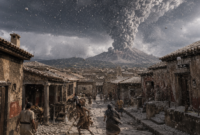
The comparison with archaeological cities is revealing. Pompeii was preserved in extraordinary detail because a catastrophic eruption rapidly buried large portions of the city. Pripyat experienced almost the reverse process. It was evacuated quickly, but its buildings remained exposed to decades of weather and biological growth. One city was preserved by sudden burial; the other is being transformed by slow exposure.
That difference explains why photographs of Pripyat change over time. A road photographed twenty years ago may now be more heavily covered by vegetation. A building that once appeared relatively intact may have suffered additional structural damage. Nature has not preserved the city; it has become one of the mechanisms changing it.
The Ghost Town Is Still a Controlled Zone
Despite its reputation as an abandoned destination, Pripyat is not simply an ordinary ghost town open for unrestricted exploration. It lies within the Chernobyl Exclusion Zone, where access is controlled and subject to official authorization and radiation-safety requirements. The Chernobyl Nuclear Power Plant’s current visitor information states that entry requires an approved request and program, while visits can be denied because of weather, fire risk, emergency conditions or ongoing technical and scientific work.
The distinction matters. Photographs often present the city as an open-air museum in which anyone can wander wherever they choose. The real environment is more complicated. Radioactive contamination remains uneven, some structures are unsafe, and the broader zone continues to be monitored.
The region is also not separated from the modern world. In 2026, scientists at Ukraine’s National Academy of Sciences assessed wildfires that occurred in contaminated areas of the exclusion zone after debris from Russian unmanned aerial vehicles fell in the region. Their analysis documented radioactive contamination in the burned areas and modeled the movement of radioactive aerosols.
That recent event is a useful reminder that the Chernobyl landscape is not a sealed historical capsule. Weather, fire, war, scientific monitoring, radioactive transport and ecological change continue to affect it.
Pripyat is abandoned, but it is not outside history.
Why the City Feels Frozen in Time
The strongest emotional effect of Pripyat comes from the mismatch between its age and its appearance.
A building constructed in the 1970s does not look as though it should contain decades of abandonment. A school gymnasium, apartment kitchen or public square belongs to living memory. People who were children when Pripyat was evacuated are still alive, and many former residents still have memories of the city as an ordinary place rather than a mysterious ruin.
That recentness distinguishes Pripyat from ancient ruins. The city did not disappear because centuries passed. It stopped functioning because a single technological disaster made normal habitation impossible.
The ordinary nature of the objects left behind reinforces the effect. A playground is unsettling not because it was designed as a monument to disaster, but because it was designed for children. A residential apartment block is powerful because it was intended to be someone’s home.
The vegetation makes this contrast more visible. Grass does not know that a road was once maintained. Trees do not recognize an apartment courtyard as public space. Plants simply occupy available ground.
That indifference gives Pripyat much of its visual power. Human beings built the city to organize daily life; once the people were gone, the same environment became available to ecological processes that had previously been controlled.
Pripyat and the Paradox of Rewilding
There is a larger historical question hidden inside the Pripyat ghost town: what happens when humans suddenly disappear from a landscape?
The answer is not simply “nature returns.” It depends on climate, soils, existing vegetation, pollution, infrastructure, wildlife populations and the intensity of previous land use. Some environments become forests; others become grassland or shrubland. Buildings collapse at different rates. Roads may remain visible for generations while smaller paths disappear within years.
Pripyat provides an unusually vivid example because the human absence was abrupt and unusually complete. The city did not gradually decline economically. It was removed from ordinary human use almost overnight.
That makes it valuable to ecologists and historians alike. It shows how much maintenance modern cities require and how quickly ecological succession can become visible when that maintenance disappears.
It also challenges the assumption that modern urban environments are permanent. Concrete looks durable, but durability is relative. A building that seems solid while occupied depends on thousands of invisible acts of maintenance. Once those stop, weather and vegetation begin working at a different timescale.
The same theme appears in other HiddenFrontiers stories. Coober Pedy shows how human beings can deliberately adapt architecture to an extreme environment, while Kyshtym and the Soviet villages displaced by contamination reveal another side of the Soviet nuclear landscape, where communities could disappear from ordinary life through evacuation and secrecy. In Pripyat, the difference is that the abandoned architecture itself remained visible.
What Pripyat Looks Like Today
Pripyat today is neither a thriving city nor a simple ruin. It is an abandoned urban landscape undergoing continuous physical and ecological change.
The apartment blocks remain among its most prominent structures. Streets and open spaces are increasingly divided by vegetation, and some buildings have suffered significant deterioration. Trees and shrubs have expanded throughout parts of the city, while exposed concrete, steel, glass and asphalt continue to weather.
Some places look surprisingly green. Others remain dominated by concrete and open space. This variation is important because photographs of the most heavily overgrown locations can create the impression that the entire city has disappeared beneath a forest.
It has not.
The more accurate description is that vegetation has become an integral part of the city’s physical structure. The city and the returning ecosystem now overlap.
That overlap is visible at almost every scale: grass through cracks in sidewalks, shrubs around apartment entrances, trees between buildings, roots affecting pavement and branches reaching toward windows. The boundary between “urban” and “natural” becomes progressively harder to see.
But the buildings still tell the story.
The concrete apartment blocks, roads and public facilities reveal the city that planners constructed. The vegetation reveals what happened after the people left. Together, they create a landscape that records both human ambition and the limits of human control.
What the Abandoned City Really Teaches Us
The most enduring image of Pripyat is a city swallowed by nature, but the reality is more revealing than the metaphor. Nature did not suddenly attack the city, and radiation did not simply create a miraculous wildlife paradise. Instead, an urban environment lost its human population and therefore lost the constant maintenance that had kept vegetation, water and structural decay under control.
Over nearly four decades, grasses spread, shrubs expanded and trees grew. Wildlife occupied the wider exclusion zone. Buildings weathered. Roads deteriorated. Roofs failed. The landscape became increasingly green without ever becoming completely natural.
The word “ghost town” is appropriate because Pripyat is uninhabited, but it can also be misleading. A ghost town suggests a place whose story is finished. Pripyat’s story is still unfolding.
Scientists continue to monitor radiation and ecological change. Ukraine continues to manage access to the exclusion zone. Researchers study how organisms respond to chronic contamination, while fires and other disturbances continue to reshape the landscape. Even in 2026, the area remains a living scientific and environmental system rather than a static memorial.
That is why Pripyat remains so compelling. The city appears frozen because the moment of evacuation is still visible in its architecture, but everything around those buildings continues to move through time. Trees grow. Concrete cracks. Water moves through damaged drainage systems. Soil accumulates. Species shift. Buildings weaken.
Pripyat was designed to be a modern city for the future. Its unexpected legacy is that it became one of the clearest places on Earth to see what happens when the future suddenly stops for people but continues for the landscape.
SOURCES & REFERENCES
International Atomic Energy Agency — The International Chernobyl Project: Technical Report.
Used for the Pripyat evacuation chronology, emergency preparations, buses, initial public information and evacuation arrangements.
International Atomic Energy Agency — “Twenty Years After the Chernobyl Accident.”
Used for the broader environmental and human consequences of the 1986 disaster and the long-term effects of evacuation and resettlement.
Institute for Safety Problems of Nuclear Power Plants, National Academy of Sciences of Ukraine — 2026 assessment of wildfires in the Chernobyl Exclusion Zone.
Used for the current environmental situation in 2026, including contaminated wildfire areas and ongoing scientific monitoring.
State Specialized Enterprise Chernobyl Nuclear Power Plant — Visit ChNPP / Exclusion Zone access information.
Used to verify that access to the exclusion zone remains controlled and subject to authorization, safety requirements and possible restrictions.
Frontiers in Plant Science — “Plants in the Light of Ionizing Radiation: What Have We Learned From Chernobyl, Fukushima, and Other ‘Hot’ Places?”
Used for evidence concerning vegetation recovery, land abandonment, radiation effects and the ecological complexity of the Chernobyl Exclusion Zone.
Frontiers in Environmental Science — “Time-series SAR scattering coefficients over woodland: trend analysis and explainable modeling.”
Used for the environmental setting of the exclusion zone and its contemporary monitoring with remote sensing.
Frontiers in Environmental Science — “Transcriptional Upregulation of DNA Damage Response Genes in Bank Voles…”
Used for the continuing presence of long-lived radionuclides and the scientific study of organisms living within the exclusion zone.
State Nuclear Regulatory Committee of Ukraine — radiation-ecological monitoring report.
Used for the ongoing monitoring of radionuclide redistribution and contamination within the exclusion zone.
FAQ
Why was Pripyat abandoned?
Pripyat was evacuated because radioactive contamination from the April 1986 Chernobyl nuclear accident made continued residence unsafe. The evacuation was organized on April 27, 1986, approximately 36 hours after the accident began. More than a thousand buses were brought in for the operation.
How long has Pripyat been abandoned?
Pripyat has been uninhabited since its evacuation on April 27, 1986. By 2026, the city had been without normal permanent civilian life for roughly forty years.
How did nature reclaim Pripyat?
Once residents left, routine maintenance stopped. Grass, shrubs and trees colonized open ground, cracks and neglected spaces, while weather, water and freeze-thaw cycles damaged buildings. Research across the wider exclusion zone shows that vegetation cover increased after abandonment, although radiation continues to affect some species and locations.
Is Pripyat completely covered by forest?
No. Some parts of the city are heavily overgrown, but large areas remain recognizable as an urban environment, including roads, apartment blocks and open concrete spaces. “Completely reclaimed” is therefore a vivid description rather than a literal scientific statement.
Are there animals in Pripyat and the Chernobyl Exclusion Zone?
Yes. Wildlife occupies large portions of the exclusion zone. Researchers have documented species including deer, moose, wild boar, wolves and smaller mammals. However, the ecological effects of radiation are complex and differ among species and locations.
Is Pripyat still radioactive?
Yes. Radioactive contamination remains unevenly distributed throughout the Chernobyl Exclusion Zone, and long-lived radionuclides remain present in parts of the environment. The zone continues to be monitored, including for radionuclide movement and ecological effects.
Can people visit Pripyat?
Pripyat lies inside a controlled exclusion zone. Current Chernobyl Nuclear Power Plant information states that visits require an approved written request and program and can be refused under certain conditions, including emergencies, fire danger, unfavorable weather or ongoing work.
Is Pripyat a natural wilderness now?
Not really. It is better described as an abandoned urban landscape undergoing ecological succession. Vegetation and wildlife have expanded because normal human activity largely disappeared, but the city remains dominated by human-built structures, radioactive contamination, damaged infrastructure and ongoing management.



3 comments