


The D.B. Cooper Hijacking: What the Evidence Really Tells Us
On November 24, 1971, a man calling himself Dan Cooper bought a one-way ticket from Portland, Oregon, to Seattle, Washington, using cash. He boarded Northwest Orient Airlines Flight 305 carrying a black attaché case and a paper bag, took a seat toward the rear of the Boeing 727, and appeared to be an ordinary business traveler. Within minutes of takeoff, he handed a flight attendant a note stating that he had a bomb and wanted her to sit beside him. The D.B. Cooper hijacking had begun.
Cooper demanded $200,000 in twenty-dollar bills and four parachutes. He displayed what appeared to be a bomb inside his briefcase, and the airline and authorities complied with his demands after the aircraft reached Seattle. The 36 passengers were released, while Cooper remained aboard with members of the crew as the Boeing 727 took off again. Sometime after 8 p.m., while the plane was flying between Seattle and Reno, he opened the aircraft’s rear staircase, jumped into the darkness with the ransom money and disappeared.
The remarkable part of the story is not simply that he escaped. It is that investigators never established with certainty who he was, where he landed, or whether he survived the jump, despite one of the longest investigations in FBI history. The Bureau eventually considered more than 800 suspects, examined physical evidence from the aircraft, recovered a portion of the ransom money nearly nine years later, and eventually redirected its investigative resources in 2016.
Who Was the Man Calling Himself Dan Cooper?
Very little about the hijacker’s identity was certain from the beginning. He purchased his ticket under the name Dan Cooper, and the FBI’s historical account describes him as a man who appeared to be in his mid-40s, wearing a business suit, white shirt and black tie. Witnesses also recalled the dark briefcase and the bomb-like device he displayed to the flight attendant.
The name “D.B. Cooper” was not actually the name he used when he bought the ticket. According to the FBI, the “D.B.” identity was apparently created by the press, although investigators did question a man with those initials who was not the hijacker. The distinction matters because “D.B. Cooper” has become so firmly attached to the case that many readers assume it was the criminal’s confirmed name rather than a journalistic label.
The FBI later developed an artist’s rendering based on witness descriptions and circulated information about the unknown hijacker. Those descriptions provided investigators with a general physical profile, but they were insufficient to establish an identity, particularly because the encounter was brief and the witnesses had experienced an extremely unusual event under stressful circumstances. The fact that hundreds of people were investigated without a conclusive identification illustrates how little direct identifying information Cooper left behind.
The Hijacking of Flight 305
Flight 305 was a short scheduled trip from Portland to Seattle, but Cooper transformed it into a hostage situation shortly after departure. He showed the flight attendant what appeared to be a bomb and presented demands that included money and four parachutes, apparently intending to use the parachutes as part of his escape plan. The FBI’s surviving historical record confirms that the device was displayed as a bomb, but the available evidence does not establish with absolute certainty whether it was a functioning explosive or a convincing imitation.
After the aircraft landed in Seattle, authorities arranged for the requested money and parachutes to be delivered. Cooper allowed the passengers to leave, substantially reducing the number of people at risk, but required several crew members to remain aboard and ordered the pilots to continue toward Mexico City. The flight instead proceeded under Cooper’s instructions at a lower altitude and slower speed than a normal commercial flight, conditions that were significant to the later escape.
Some aspects of the hijacking suggest that Cooper understood at least the basic mechanics of his plan. He requested multiple parachutes, recognized the usefulness of the Boeing 727’s rear stair configuration, and waited until the aircraft was airborne again before making his escape. Yet the available evidence does not demonstrate that he was an accomplished parachutist, military veteran, or aviation professional, despite the large number of theories that later attempted to construct such a background for him.
The FBI ultimately considered the possibility that Cooper did not survive. The Bureau has pointed to the dangerous conditions of the jump, the fact that the parachute he used could not be steered, his clothing and footwear, and the nighttime wooded terrain into which he apparently descended. Those factors do not prove that he died, but they provide a substantial basis for treating death during or after the escape as a serious possibility rather than assuming that the hijacker necessarily walked away.
The Money and the Jump
The ransom consisted of $200,000 in twenty-dollar bills, all individually recorded by serial number. That decision created one of the most important pieces of physical evidence in the case because investigators could potentially identify any of the stolen money if it resurfaced. For years, however, none of the ransom appeared in a way that provided a decisive lead.
That changed in 1980 when an eight-year-old boy named Brian Ingram found a deteriorating package containing $5,800 along the Columbia River in Washington state. The FBI confirmed that the serial numbers matched bills from the ransom paid to Cooper in 1971. The discovery was significant because it provided concrete proof that at least part of the ransom had reached the area where it was found, but it did not establish whether Cooper himself had deposited the money there or whether it had been transported by natural processes after his disappearance.
The money discovery produced an important contradiction. If Cooper had successfully escaped with all of the ransom and deliberately concealed some of it, the Columbia River find could have reflected an attempt to hide part of the money. If he died during the escape, the bills could have been carried or deposited by other processes. Without evidence showing how the package reached the river, the money narrows the mystery but does not solve it.
The limited recovery is also noteworthy. Only $5,800 of the $200,000 ransom has been publicly confirmed as recovered in this discovery, leaving the overwhelming majority of the ransom unaccounted for. The FBI has specifically asked anyone who discovers physical evidence related to the ransom money or parachutes to contact a Bureau field office, showing that the missing physical evidence remains relevant even after the end of active investigative work.
The Aircraft Became a Crime Scene

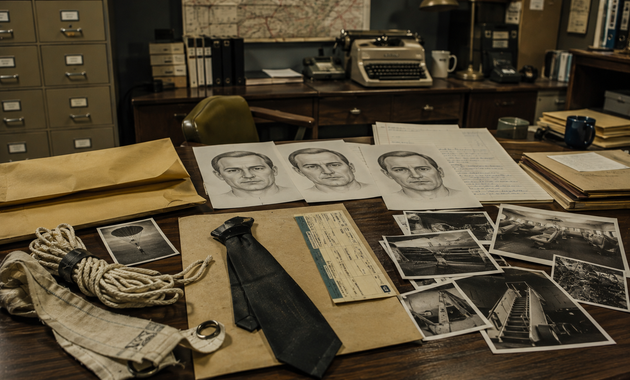
Once the aircraft was secured, investigators had an unusual advantage: the hijacker had spent hours aboard a relatively confined space. FBI agents could examine the seats, cabin, parachute equipment and other items he had touched, creating an opportunity for forensic evidence that did not depend on eyewitness memory alone. The case file preserved photographs, the initial suspect sketch and detailed investigative experiments conducted by the FBI and the U.S. Air Force.
Among the best-known surviving objects is Cooper’s black clip-on J.C. Penney tie. According to the FBI, Cooper removed the tie before jumping, and it later became a source of DNA material. That discovery appeared potentially important because modern forensic technology offered investigators a tool unavailable in 1971, but the resulting DNA evidence has not produced a universally accepted identification of the hijacker.
The tie therefore illustrates both the promise and limits of forensic evidence. Recovering biological material from an object associated with an unknown suspect can be extremely valuable, but DNA is only as useful as the quality and interpretation of the sample and the reference profiles available for comparison. In Cooper’s case, the tie did not yield the definitive identification investigators needed to close the historical question.
The National Archives still holds the U.S. Attorney’s case file for the 1971 skyjacking. The archive describes the collection as containing photographs, the original suspect sketch and experiments conducted by the FBI and Air Force to determine how the hijacking was carried out, making the surviving federal record itself an important part of the case’s legacy.
The FBI Investigation Became Enormous
The FBI opened its investigation while the hijacking was still underway. Agents created the case designation NORJAK, short for Northwest Hijacking, and pursued leads across the country, interviewed witnesses and searched for evidence that might reveal where Cooper landed or who he really was. According to the Bureau’s historical account, investigators had considered more than 800 suspects by the fifth anniversary of the hijacking and had narrowed that list dramatically, although none became legally established as Cooper.
The sheer number of suspects demonstrates how difficult the case became. Investigators were not simply looking for one obvious fugitive whose fingerprints or DNA could be compared with an existing database; they were trying to identify an unknown man who had used an alias, left no confirmed record of his real identity, disappeared immediately after the crime and may have died without anyone knowing his connection to the hijacking. Every promising lead therefore had to be tested against physical evidence and witness descriptions.
The FBI eventually investigated people who appeared to fit portions of the profile, including men with military, aviation, parachuting or criminal backgrounds. One of the most famous was Richard Floyd McCoy, who hijacked another aircraft and escaped by parachute less than five months after Cooper’s disappearance. Because McCoy possessed relevant skills and had committed a remarkably similar crime, he became an attractive suspect for researchers and the public.
But the FBI ruled McCoy out. The Bureau cited differences between McCoy and the nearly identical physical descriptions provided by two flight attendants, along with other reasons that investigators considered sufficient to exclude him from the case. McCoy therefore remains a popular private theory, but describing him as the identified D.B. Cooper would contradict the official investigative record.
The Suspect Theories Became Their Own Mystery
The Cooper case has generated an enormous catalogue of proposed identities. Former soldiers, pilots, criminals, parachutists and ordinary men whose biographies seemed to contain suspicious coincidences have all been proposed at various times, but the recurring problem is that resemblance to a witness description is not identification. A plausible biography can create a compelling story without providing the physical evidence needed to establish that the person bought the ticket, hijacked the aircraft or made the jump.
Richard McCoy remains one of the clearest examples of this problem because his later crime genuinely resembled the Cooper hijacking. He had experience with parachutes, successfully escaped from an airplane using a similar method and therefore possessed characteristics that could make him attractive to investigators examining a hypothetical Cooper profile. Yet the FBI’s exclusion of McCoy means any claim that the two men were the same person must overcome official evidence that investigators considered him inconsistent with the witnesses’ descriptions and other case facts.
Other theories have focused on suspected military connections, aviation knowledge or alleged confessions. Some have gained renewed attention years later when family members or researchers came forward, but the FBI has repeatedly emphasized the absence of definitive proof. Its 2016 statement noted that tips produced plausible theories and descriptions of possible individuals, but none had generated the evidence necessary to prove culpability beyond a reasonable doubt.
That standard is important because the Cooper case encourages a different kind of reasoning from ordinary criminal investigations. When the offender is unknown, almost any biographical coincidence can look meaningful, especially after decades of speculation. The strongest evidence remains evidence directly connected to the hijacking itself: the ticket, witness descriptions, aircraft evidence, ransom serial numbers, parachutes, physical traces and the geographic circumstances surrounding the jump.
Did Cooper Survive?

One of the central unresolved questions is what happened after Cooper disappeared from the aircraft. The FBI has suggested that he probably did not survive, emphasizing the night jump, difficult terrain, unsuitable footwear and clothing, and the characteristics of the parachute. The recovery of $5,800 in ransom money along the Columbia River also provided indirect support for the possibility that some of the money remained close to the suspected drop region rather than being spent by a successful fugitive.
There is still no body, confirmed grave, verified later identity or uncontested forensic discovery proving that he died. That absence is precisely why survival theories remain attractive to amateur investigators, who argue that the lack of a recovered body leaves open the possibility that Cooper landed successfully and disappeared into ordinary life. The problem is that absence of a body is not evidence of survival, particularly in a heavily wooded region and in a case where the precise landing point has never been established.
The parachute evidence also complicates the question. Cooper requested four parachutes and ultimately left the aircraft with two, including equipment that investigators later examined, while the escape required him to operate in darkness and potentially rough weather. The FBI’s historical account suggests that the parachute he used could not be steered, making a controlled landing considerably more difficult than some popular portrayals imply.
For that reason, the evidence supports two broad possibilities without proving either one: Cooper died during the jump or shortly afterward, or he survived sufficiently well to escape the immediate search area. What cannot responsibly be claimed is that a specific suspect is Cooper merely because that person’s later life contains unexplained money, travel or disappearance. The historical record does not provide the missing bridge between those coincidences and the 1971 crime.
What the Tie DNA Did — and Did Not — Prove
The tie recovered from the aircraft remains one of the most intriguing physical objects in the case because it was unquestionably associated with the hijacker and later yielded DNA material. The FBI has described the tie as a source of a DNA sample and has used modern forensic technology in attempts to narrow the suspect field. Yet the public record does not contain a DNA result identifying a particular person as Cooper.
That distinction is essential. A forensic sample may allow investigators to exclude a suspect without allowing them to identify the unknown source, particularly when the available sample is limited or potentially mixed. The FBI has explicitly said that DNA testing helped rule out at least one suspect during later investigative work, but the Bureau never announced a DNA-based identification of Cooper.
The case therefore illustrates a broader problem with modern technology applied to old crimes. New tools can revisit evidence that investigators could not analyze in 1971, but technology cannot manufacture evidence that never existed or restore a complete biological profile when the original material is limited. The tie is valuable because it narrows possibilities, but it has not transformed the case into a solved identification.
Why the FBI Stopped Actively Investigating
On July 8, 2016, after approximately 45 years of investigation, the FBI redirected resources assigned to the Cooper case toward other priorities. The Bureau said that it had reviewed credible leads, coordinated searches among field offices, interviewed identified witnesses and applied numerous investigative techniques over the years, but no lead had produced the evidence necessary to definitively identify the hijacker.
The decision was not a declaration that the historical question had been answered. The FBI specifically stated that evidence obtained during the investigation would be preserved at FBI headquarters for historical purposes and asked that any future physical evidence specifically related to the parachutes or ransom money be reported to the Bureau. The case therefore moved from active investigation into a largely archival status rather than being erased from official history.
This distinction is sometimes lost when the case is described as having been “closed.” The FBI stopped dedicating active investigative resources to NORJAK, but that does not mean investigators proved that Cooper died, proved his identity, or established where he landed. The unresolved status of the hijacker remains intact, and the National Archives continues to preserve the federal records documenting the investigation.
The archival dimension has become increasingly important. The National Archives holds the U.S. Attorney’s case file, while the FBI Vault contains hundreds of released investigative-file installments covering the search for Cooper from November 1971 into 1992. These records give researchers access to the actual investigative history rather than requiring them to rely solely on later books and television programs.
The Case Became a Cultural Legend
Cooper’s disappearance created a strange contradiction in American crime history. The hijacking was a serious federal crime involving threats against passengers and crew, yet the unknown offender gradually became a folk figure whose image was shaped by movies, books, television programs, festivals and amateur investigations. The mystery of his identity often overshadowed the fact that the event began as a violent threat against people aboard a commercial aircraft.
That transformation is worth examining because it changes how the case is remembered. Cooper’s apparent calmness and the absence of a known victim killed during the hijacking have sometimes produced an image of a clever antihero, but the essential facts remain those of an armed or purportedly armed criminal seizure of an aircraft. The passengers and crew were placed under threat, and the bomb claim forced the airline and authorities to respond as though the danger were real.
The comparison with other disappearances is useful. HiddenFrontiers’ coverage of the Mary Celeste and its missing crew examines an unexplained disappearance aboard a vessel where the absence of witnesses created competing explanations, while the Franklin Expedition illustrates how an expedition can become a historical mystery when environmental conditions destroy or conceal evidence. Cooper’s case differs because investigators know precisely when the disappearance began: the mystery starts at a known point in the sky. It is the identity, landing place and fate that remain uncertain.
A more direct true-crime comparison is the Zodiac Killer case, another investigation in which extensive evidence and years of police work failed to establish the offender’s identity conclusively. The difference is that the Zodiac case involves multiple victims, while the Cooper case centers on a single unidentified offender whose apparent escape became the defining fact of the investigation.
What the Evidence Establishes
The strongest evidence establishes a remarkably clear sequence. A man calling himself Dan Cooper boarded Northwest Orient Flight 305 in Portland on November 24, 1971, claimed to possess a bomb, demanded $200,000 and four parachutes, accepted the ransom in Seattle, released the passengers, remained aboard with crew members, and later jumped from the aircraft somewhere between Seattle and Reno. The aircraft landed safely, but Cooper was never seen again.
The investigation also established that the offender left behind physical evidence. The black J.C. Penney tie became a source of DNA material, the aircraft was examined extensively, and federal investigators preserved photographs, sketches and experiments related to the hijacking. Most importantly, $5,800 from the ransom was recovered in 1980 and matched the recorded serial numbers of the stolen bills.
What the evidence does not establish is equally important. No body has been conclusively identified as Cooper, no suspect has been legally established as the hijacker, and no forensic result has publicly produced an uncontested identity. The recovered ransom money does not prove how Cooper died or whether he personally deposited the bills, while the tie DNA has never produced the definitive identification that investigators would need.
The official record therefore supports a narrower conclusion than many popular accounts suggest. D.B. Cooper was not “found,” nor has the FBI identified one of the famous suspects as the offender; instead, the investigation narrowed a vast field of possibilities while leaving the central identity question unanswered. The case remains a genuine unsolved crime, even though the circumstances surrounding the hijacking are among the best-documented parts of the story.
What Remains Unresolved
The first unresolved question is Cooper’s real identity. “Dan Cooper” may have been an alias, and the FBI has explained that “D.B.” was a media-created name rather than the name used on the ticket, leaving investigators without a confirmed legal identity for the person who committed the hijacking.
The second is his fate. If he died during the escape, his remains have never been conclusively located, and if he survived, no later identity has been demonstrated beyond the evidence required to prove the connection. The ransom recovery provides an important clue but is insufficient to determine the outcome on its own.
The third is the precise landing location. Investigators know the approximate portion of the flight route during which the jump occurred, but uncertainty about wind, aircraft movement, the parachute, the exact timing of the jump and the conditions on the ground creates a broad potential search area. Without a confirmed landing site, even physical evidence discovered in the Pacific Northwest can be difficult to connect conclusively to Cooper.
The fourth concerns Cooper’s preparation. He demonstrated enough knowledge to request parachutes, use the aircraft’s rear staircase and negotiate a workable ransom exchange, but the evidence does not prove that he was a professional parachutist or military specialist. Investigators have repeatedly examined theories built around such backgrounds, yet a theory about skills is not the same thing as evidence establishing who possessed those skills in 1971.
Why the D.B. Cooper Mystery Still Matters
The D.B. Cooper hijacking remains important not because the offender successfully transformed himself into a glamorous legend, but because it exposes the limits of criminal investigation when an offender disappears without leaving an identifying chain of evidence. The case produced witnesses, physical evidence, financial records, forensic material and thousands of investigative leads, yet none was sufficient to bridge the gap between an anonymous criminal and a named person.
It also occupies an important place in the history of American aviation security. The hijacking occurred in an era before the extensive airport security procedures that became familiar after the 1970s, and Cooper exploited an aircraft and operating environment that made a rear-stair escape possible. Whatever his ultimate fate, the case became part of the historical record of the vulnerabilities that defined commercial aviation during that period.
For HiddenFrontiers, the strongest lesson is the difference between a compelling theory and a verified conclusion. A suspect can resemble the composite, possess parachuting experience or have unexplained money without being Cooper, while a piece of recovered evidence can dramatically narrow a case without solving it. The Cooper investigation is most revealing when the evidence is allowed to remain incomplete rather than being forced into a satisfying story.
More than half a century after the jump, the essential mystery remains remarkably narrow: a man bought a ticket under the name Dan Cooper, stole $200,000, parachuted from Flight 305 somewhere over the Pacific Northwest, and was never definitively identified. The FBI stopped actively investigating in 2016, but preserved the evidence and left the door open for genuinely new physical evidence, meaning the case is neither solved nor entirely beyond the possibility of discovery.
The enduring fascination comes from that gap between what is known and what cannot yet be proved. The Cooper story has accumulated myths, favorite suspects and elaborate theories, but the surviving record is considerably more restrained: an unidentified hijacker, a confirmed ransom payment, a dangerous nighttime parachute jump, $5,800 recovered years later, physical evidence preserved in federal archives, and an investigation that ultimately ran out of evidence before it ran out of questions. That is enough to make the case historically remarkable without turning an unsolved crime into a legend that the evidence cannot support.
FAQ
Who was D.B. Cooper?
The man known publicly as D.B. Cooper boarded Northwest Orient Flight 305 on November 24, 1971, using the name Dan Cooper on his ticket. He hijacked the aircraft, demanded $200,000 and four parachutes, released the passengers in Seattle, and later jumped from the plane with the ransom money. His real identity has never been established.
Was D.B. Cooper his real name?
Probably not, but the evidence does not establish his real identity. The ticket was purchased under the name Dan Cooper, while the FBI says “D.B. Cooper” was apparently a name created by the press. The Bureau also investigated a man with the initials D.B., but that individual was not the hijacker.
Did D.B. Cooper survive the parachute jump?
No one knows. The FBI has suggested that Cooper probably did not survive because he jumped at night into wooded terrain with a parachute that could not be steered and equipment that was poorly suited to a difficult landing. The recovery of $5,800 in ransom money also raised questions about what happened after the jump, but it did not prove Cooper’s death.
How much of the ransom money was recovered?
In 1980, Brian Ingram found a deteriorating package containing $5,800 along the Columbia River in Washington. Investigators confirmed that the serial numbers matched money from Cooper’s $200,000 ransom. The remaining ransom has never been publicly recovered and conclusively connected to Cooper’s disappearance.
Was Richard McCoy D.B. Cooper?
The FBI ruled Richard Floyd McCoy out as Cooper. McCoy had committed a remarkably similar aircraft hijacking and parachute escape less than five months after the Cooper crime, which made him a popular suspect, but investigators said his physical characteristics did not match the descriptions provided by the flight attendants and cited other reasons for excluding him.
Did DNA identify D.B. Cooper?
No. The FBI recovered Cooper’s black J.C. Penney tie, which later provided DNA material, and modern testing helped rule out at least one suspect. But no publicly established DNA result has identified the hijacker conclusively.
Is the D.B. Cooper case still being investigated?
The FBI stopped actively investigating the case in July 2016 after 45 years of work. The Bureau preserved the evidence for historical purposes and stated that specific physical evidence related to the parachutes or ransom money should still be reported, so the case remains an unsolved historical crime rather than a case with an identified offender.
Why is the case called the D.B. Cooper hijacking?
The hijacker purchased his ticket under the name Dan Cooper. The FBI states that “D.B.” appears to have been introduced by the press, and the incorrect name subsequently became so widely used that it became permanently associated with the case.
SOURCES & REFERENCES
Federal Bureau of Investigation — “D.B. Cooper Hijacking.”
Primary official case history covering the hijacking, ransom, parachute escape, suspect investigation, recovered money, tie DNA and the possibility that Cooper did not survive.
Open FBI case history
Federal Bureau of Investigation — “Update on Investigation of 1971 Hijacking by D.B. Cooper,” July 12, 2016.
Official announcement ending active FBI investigative resources after 45 years and explaining the preservation of evidence and requirements for future physical leads.
Open FBI 2016 update
Federal Bureau of Investigation Vault — D.B. Cooper investigative files.
Primary archive containing released NORJAK investigative files from the FBI’s search between 1971 and 1992.
Open FBI Vault
National Archives — “D.B. Cooper. U.S. Attorney’s Case File for the skyjacking case involving the alias ‘D.B. Cooper,’ dated 1971.”
Federal archival description of the case file, including photographs, the initial sketch and FBI/Air Force experiments concerning the hijacking.
Open National Archives record
Federal Bureau of Investigation — “D.B. Cooper Plane Ticket.”
Official artifact page documenting the ticket purchased under the name Dan Cooper and the basic chronology of the hijacking.
Open FBI artifact record
Federal Bureau of Investigation — “Can You Identify This Hijacker?” FBI Law Enforcement Bulletin, December 1972.
Contemporary FBI material documenting the early description and investigation of the unknown hijacker.
Federal Bureau of Investigation — “Recovered Money from DB Cooper Case.”
Official FBI record identifying the $5,800 discovered by Brian Ingram in 1980 as ransom money through matching serial numbers.
Federal Bureau of Investigation — “DB Cooper’s Black Tie.”
Official FBI record describing the black J.C. Penney tie left aboard the aircraft and its later use as a source of DNA material.

