On the night of June 9, 1912, the Moore family of Villisca, Iowa, attended a Children’s Day program at their local Presbyterian church before returning home with two young sisters who had been invited to spend the night. By the following morning, all eight people inside the house were dead, and the small southwestern Iowa community had become the center of one of the most extensive and controversial murder investigations in the state’s history. More than a century later, the Villisca axe murders remain unsolved, with no convicted killer and no surviving explanation that has been established as fact. Iowa Legislature
AI & Editorial Note
Hidden Frontiers uses AI-assisted tools as part of its content-production workflow, including research organization, drafting assistance, and visual development. The factual content of this article is strictly grounded in verified, cited sources, and disputed or uncertain information is identified where appropriate. Visuals accompanying this article are AI-generated historical reconstructions created for illustrative purposes.
The Moore Family and Their Guests
Josiah B. “Joe” Moore was a prominent Villisca businessman, and he lived with his wife, Sarah, and their four children in a modest house at what is now 508 East Second Street. Their children were Herman Montgomery Moore, age eleven; Mary Katherine Moore, age ten; Arthur Boyd Moore, age seven; and Paul Vernon Moore, age five. On the night of the murders, two neighboring sisters, Lena Stillinger, twelve, and Ina Stillinger, eight, were also staying at the house, bringing the total number of people inside to eight. Iowa Cold Cases
The evening had begun as an ordinary community occasion rather than an event that suggested danger. Sarah Moore had helped organize the Children’s Day program at the Presbyterian church, and the Moore children and the Stillinger sisters participated in the evening’s activities. After the service and social gathering ended, the group walked the few blocks back to the Moore home, where the family and their guests settled in for the night. Contemporary and later historical accounts agree that the murders occurred after the household had gone to bed. Iowa Cold Cases
Villisca in 1912 was a small railroad community in southwestern Iowa, and the scale of the crime was difficult for residents to comprehend. The victims were not strangers gathered in a public place but members of one family and two children who had been invited into the home for an ordinary sleepover. The fact that six of the eight victims were children became one of the defining elements of the case and contributed to the intense public reaction that followed. Iowa Legislature
What Happened Inside the Villisca Home

Sometime after midnight, an unknown person or persons entered the Moore residence and attacked everyone inside. Historical sources identify an axe belonging to Josiah Moore as the murder weapon, and all eight victims were found in their beds with fatal head injuries. The exact sequence of the killings has never been established with certainty, and although later accounts have attempted to reconstruct the attack room by room, those reconstructions should not be treated as a definitive account of what happened. Iowa Cold Cases
The crime scene contained details that immediately became subjects of investigation and speculation. The axe was found inside the home, and investigators documented objects and conditions that appeared unusual, including food left in the kitchen and coverings placed over mirrors and glass. Because the investigation took place before modern forensic standards existed, later interpretations of these details have often depended on early reports and retrospective accounts rather than a complete modern crime-scene record. Iowa Cold Cases
The most important fact about the physical scene is also one of the most limiting: the house was not preserved under anything resembling today’s forensic protocols. Investigators and other people entered the property, information spread rapidly through the community, and newspapers began publishing accounts almost immediately. This made it difficult for later researchers to determine which physical details were original evidence, which observations were contaminated by handling, and which claims were added or exaggerated as the story spread. University of Iowa Libraries
The Discovery of the Murders
The murders were discovered on the morning of June 10, 1912 after concern developed about the unusually quiet Moore household. Neighbor Mary Peckham became suspicious that something was wrong and contacted Josiah Moore’s brother, Ross, who went to the house. Ross entered cautiously and soon realized that something terrible had happened, after which local authorities were summoned. Iowa Cold Cases
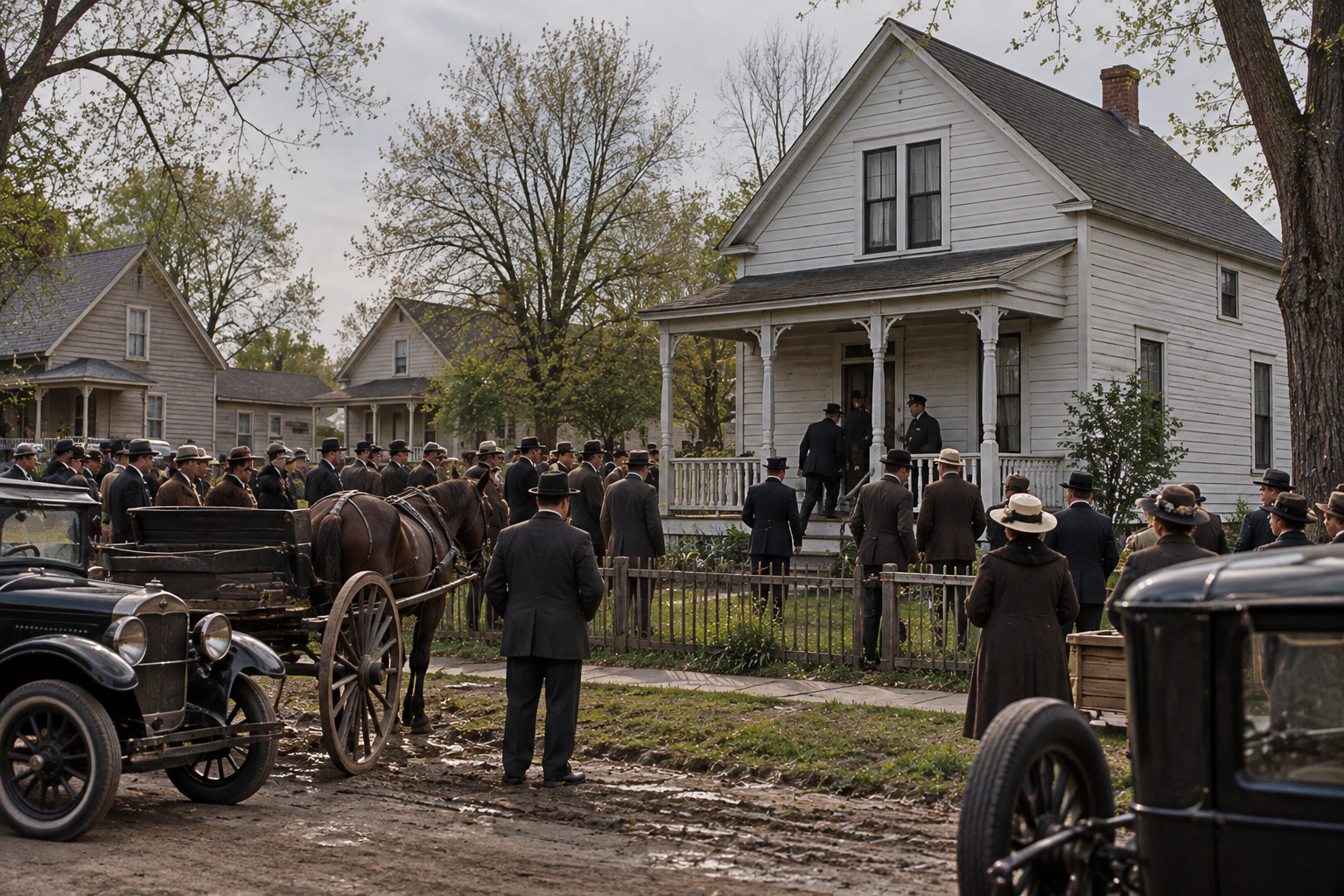
Marshal Henry “Hank” Horton arrived and entered the residence, discovering victims in the bedrooms. The scene was then exposed to a community that had little experience with a crime of this magnitude, and the investigation quickly attracted enormous attention. Contemporary newspaper coverage preserved the shock of the discovery, while later historical accounts have emphasized that the early hours were also marked by confusion, rumor, and a rapidly growing crowd around the house. Iowa Cold Cases
The funeral became another indication of how deeply the murders had affected Villisca and the surrounding region. The eight victims were buried after funeral services held on June 12, and thousands attended, with National Guardsmen used to control the crowds according to the historical record compiled by Iowa Cold Cases. The public response demonstrated that the murders had already moved beyond a local tragedy and become a statewide and national news story. Iowa Cold Cases
The First Investigation
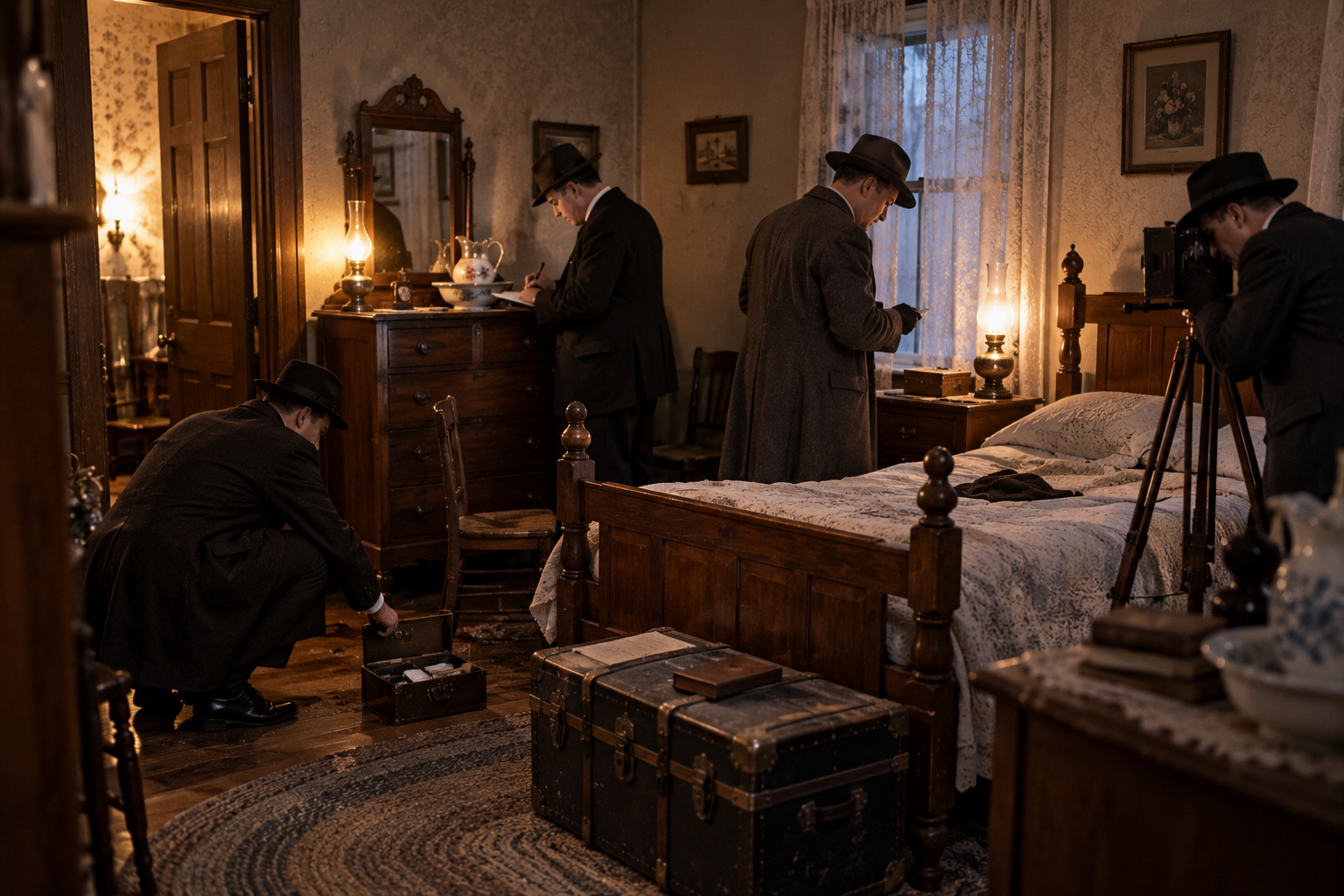
The initial investigation focused on finding whoever had entered the Moore home and escaped before the murders were discovered. Searchers used bloodhounds and pursued possible trails, while authorities questioned people in and around Villisca and investigated reports of suspicious strangers. Contemporary newspaper coverage shows how quickly the search became a national story, but those reports also demonstrate why early press accounts must be handled carefully because they sometimes contained rumors or premature claims about suspects. Wikimedia Commons
The investigation expanded well beyond Villisca as authorities considered whether the killings might have been committed by a transient offender. The town’s railroad connections made traveling suspects an obvious investigative possibility, and historical sources document searches and inquiries involving people passing through the region. Yet the absence of a reliable identification or decisive physical evidence meant that the investigation repeatedly moved from one possibility to another without establishing a clear chain connecting a particular person to the murders. University of Iowa Libraries
The case also became entangled with local rivalries and political tensions. Josiah Moore had previously worked for businessman and Iowa state senator Frank F. Jones before establishing a competing business, and private detective J. N. Wilkerson later developed a public theory that Jones had arranged the murders. The theory attracted substantial attention, but the National Register documentation for the Moore house records that Wilkerson’s campaign did not result in a grand-jury indictment of Jones, making it important to distinguish the accusation from an established finding of guilt. NPGallery
Frank Jones and William Mansfield
Frank Jones became one of the most controversial names connected with the case because of his business relationship with Josiah Moore and the allegations advanced by Wilkerson. Wilkerson claimed that Jones had a motive to eliminate Moore and that William “Blackie” Mansfield was the person hired to carry out the killings. The theory became sufficiently prominent that Mansfield was arrested, but a Montgomery County grand jury declined to indict him in 1916, and the allegation never resulted in a conviction. University of Iowa Libraries
The Jones-Mansfield theory illustrates the danger of treating investigative suspicion as proof. There were documented personal and business connections between some of the people involved, and Wilkerson actively promoted his interpretation of those relationships, but a motive does not establish that a crime occurred according to that motive. The available historical record therefore supports describing Jones and Mansfield as subjects of a major investigative theory rather than declaring either man responsible for the Villisca murders. NPGallery
Wilkerson’s own conduct also became part of the historical controversy surrounding the investigation. The National Register documentation says that he organized public meetings, promoted his case against Jones, helped arrange an unauthorized search of Jones’s office, and became involved in political material connecting Jones with the murders. These details do not establish whether Wilkerson’s theory was true or false, but they demonstrate why his allegations cannot simply be treated as neutral investigative conclusions. NPGallery
Reverend George Kelly
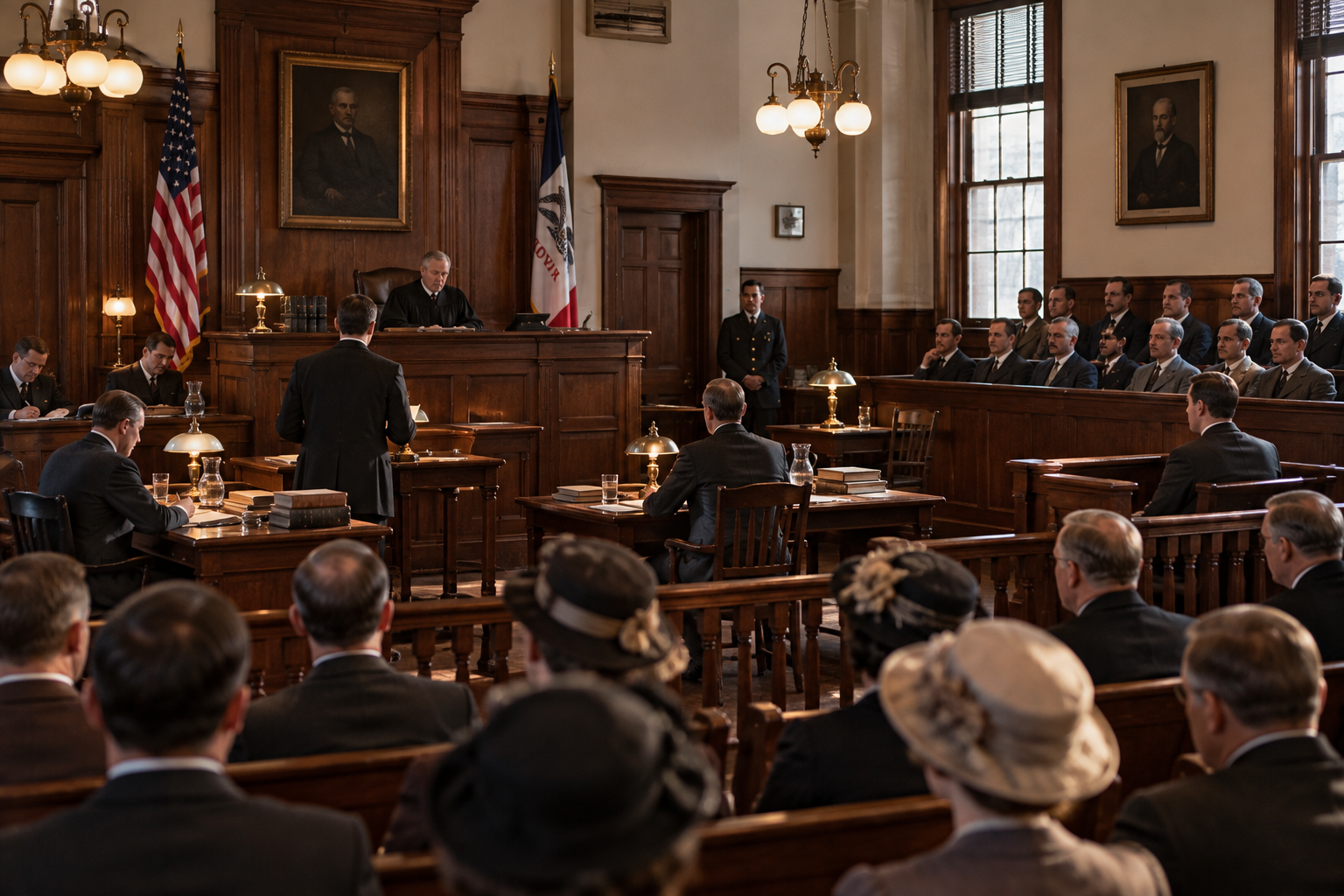
The suspect whose case actually reached trial was Reverend Lyn George Jacklin Kelly, a traveling minister who had been in Villisca around the time of the murders. According to Iowa Cold Cases, Kelly left Villisca on a westbound train early on the morning after the killings and later became a subject of suspicion after authorities received letters associated with him. His behavior and statements attracted investigators’ attention, and he eventually became the only person prosecuted in connection with the Villisca murders. Iowa Cold Cases
A grand jury indicted Kelly for the murder of Lena Stillinger in 1917. During that year’s investigation, Kelly signed a confession to the murder, but he later recanted it and challenged the circumstances surrounding the confession. The prosecution therefore had to present its case against Kelly in court rather than relying on the confession as an uncontested admission of guilt. Iowa Cold Cases
Kelly’s first trial ended with a divided jury rather than a conviction. Iowa Cold Cases records that the jury deadlocked eleven to one in favor of acquittal, after which a second trial was held and Kelly was acquitted in November 1917. Because the second trial ended in an acquittal, Kelly cannot properly be described as the convicted killer of Lena Stillinger or the other victims. Iowa Cold Cases
The Kelly case remains central to the Villisca mystery precisely because it produced a courtroom proceeding without a definitive resolution. His presence in Villisca, his later statements, his confession and recantation, and the conflicting interpretation of the evidence have allowed the theory to survive for generations. But the legal record ended with acquittal, and no subsequent conviction has replaced that outcome with an established identification of the killer. Iowa Cold Cases
What the Evidence Can Actually Establish
The surviving evidence establishes that eight people were murdered inside the Moore residence and that an axe was used in the killings. It also establishes that investigators conducted extensive searches, questioned numerous people, pursued several theories, and eventually brought Kelly to trial. What the surviving evidence does not establish is a reliable identity for the person who entered the home and killed the eight occupants. Iowa Legislature
The limitations of the original crime scene are particularly important when evaluating modern claims about the case. Investigators in 1912 did not have contemporary DNA testing, digital databases, modern crime-scene preservation practices, or today’s systematic chain-of-custody procedures. The early movement of people through the house and the rapid spread of information created conditions in which later claims about fingerprints, footprints, blood evidence, or other physical clues require careful examination against the surviving primary record. University of Iowa Libraries
The absence of modern forensic certainty has allowed theories to multiply rather than disappear. Some researchers have argued for a local conspiracy, while others have proposed a traveling offender or connected the murders with other axe killings in the Midwest. A review essay published in the Annals of Iowa notes that the case has generated extensive later literature and competing interpretations, while also emphasizing the limitations of some published accounts and the continuing uncertainty over the killer’s identity. University of Iowa Libraries
Theories About the Killer
One recurring theory is that the murders were committed by a transient offender who entered the home and left Villisca before the bodies were discovered. The theory gained some support from the broader context of early twentieth-century railroad travel and the existence of other unsolved or similar axe killings in the Midwest. However, similarity between crimes is not sufficient to prove that one person committed them all, and the historical record does not establish a single serial offender as the Villisca killer. Iowa Cold Cases
Another theory centers on Frank Jones and the possibility of a hired killer. That theory has an identifiable historical origin in Wilkerson’s investigation and public campaign, rather than simply appearing as a modern internet theory. Nevertheless, Jones was not indicted for the Villisca murders, Mansfield was not convicted, and the documentary record does not provide a legally established chain from Jones to the murders. NPGallery
George Kelly remains another major theory because he was the only person actually tried for one of the killings. His presence, statements, confession and subsequent acquittal have made him an enduring focus for researchers, but an acquittal cannot be converted into a conviction through later speculation. The responsible historical approach is therefore to present Kelly as a prosecuted suspect whose case ended without a guilty verdict rather than as the established murderer. Iowa Cold Cases
Other names have appeared in books, newspaper accounts, historical research and later theories, but the number of suspects should not be mistaken for the strength of the evidence against them. The University of Iowa’s Annals of Iowa review demonstrates how the case has accumulated interpretations over generations, while the National Park Service documentation shows how one particularly influential investigator attempted to construct a case against Frank Jones without securing an indictment. The continuing mystery is therefore not a shortage of theories but the absence of evidence strong enough to establish one theory as fact. University of Iowa Libraries
The Moore House and the Legacy of the Case
The house itself survived the murders and eventually became a historic property associated with one of Iowa’s most notorious crimes. The National Park Service lists the Josiah B. and Sara Moore House at 508 East Second Street in Villisca on the National Register of Historic Places, with the property recognized for its historical significance and its connection to the events of 1912. The listing was made in 1997, reflecting the site’s importance as part of Iowa’s social and criminal history. NPGallery
The preservation of the house has also helped keep the story visible long after the original investigation ended. The property has been restored and interpreted as a historic site, while later tourism and paranormal culture have added another layer to its public identity. Those later traditions should be separated from the documented murder investigation because claims about hauntings or supernatural activity are not evidence establishing who killed the Moore family and the Stillinger sisters. Villisca Axe Murder House
The historical record is therefore more complicated than the popular image of a mysterious house frozen in time. The real story involves a family, two visiting children, a shocked community, a massive investigation, political and personal disputes, multiple suspects, one prosecution and a trial that ended without conviction. The house is important because it preserves the physical setting of the tragedy, but the unresolved identity of the killer remains a question of historical evidence rather than paranormal explanation. NPGallery
Why the Villisca Axe Murders Remain Unsolved
More than a century after the murders, the central questions remain unanswered. Investigators never established who entered the Moore home, why all eight victims were targeted, whether the killer acted alone, or what happened immediately before and after the attacks. The investigation produced suspects and court proceedings, but it never produced a conviction capable of closing the case. Iowa Legislature
The age of the case makes a definitive resolution especially difficult. Evidence was collected and handled according to investigative practices of 1912 rather than modern forensic standards, and the crime scene was exposed to numerous people before investigators could preserve it in the way contemporary investigators would expect. The passage of more than a century also means that witnesses, investigators and people with direct knowledge are long gone, leaving historians dependent on surviving records and contemporaneous reporting. University of Iowa Libraries
The Villisca axe murders therefore remain a case in which the historical facts are considerably stronger than the explanations built around them. The eight victims can be identified, the date and location are established, the broad circumstances of the murders are documented, and the investigation can be traced through records and later historical analysis. What remains unresolved is the identity and motive of the person or persons responsible, and no later theory has replaced that uncertainty with a proven conclusion. Iowa Legislature
Conclusion
The Villisca axe murders began as a tragedy inside one Iowa household and became a national crime story almost immediately. Josiah and Sarah Moore, their four children, and Lena and Ina Stillinger were killed during a single night in June 1912, and the investigation that followed consumed years of official and private attention. Yet despite suspects, grand-jury proceedings, accusations and the prosecution of Reverend George Kelly, no person was convicted of the murders. Iowa Legislature
The case’s enduring mystery is not evidence that every theory is equally plausible, nor does the passage of time make every historical claim credible. Instead, it shows what happens when a major crime is investigated under the technological and procedural limitations of an earlier era and then becomes surrounded by decades of competing narratives. The most responsible account is one that preserves the distinction between what investigators documented, what courts decided, and what later researchers have proposed. University of Iowa Libraries
The Villisca axe murders remain unsolved because the surviving record does not establish the killer beyond a reasonable doubt. George Kelly was acquitted, Frank Jones was never convicted, William Mansfield was never convicted, and no later suspect has been established through a definitive legal finding. More than a century later, the names of the eight victims remain the most certain part of the story, while the identity of the person who killed them remains an unanswered historical question. Iowa Cold Cases
FAQ
Who were the victims of the Villisca axe murders? The victims were Josiah B. “Joe” Moore, his wife Sarah Moore, their four children Herman, Mary Katherine, Arthur Boyd and Paul, and two sisters who were spending the night with the family, Lena and Ina Stillinger. The children ranged in age from five to twelve, making six of the eight victims children. All eight were killed inside the Moore residence in Villisca, Iowa, during the night of June 9 and early morning of June 10, 1912. Iowa Cold Cases
What happened in Villisca in 1912? On the evening of June 9, 1912, the Moore family attended a Children’s Day service at the local Presbyterian church, accompanied by Lena and Ina Stillinger. After returning home, the household went to sleep, and sometime after midnight an unknown person or persons entered the house and killed all eight occupants with an axe. Their deaths were discovered the next morning after a neighbor became concerned about the unusual silence at the Moore residence. Iowa Cold Cases
Who discovered the Villisca murders? Neighbor Mary Peckham became concerned about the quiet house and contacted Josiah Moore’s brother, Ross Moore. Ross went to the residence and discovered that something was seriously wrong before local authorities were summoned. Marshal Henry “Hank” Horton then entered the home and confirmed that people had been killed throughout the house. Iowa Cold Cases
Was Reverend George Kelly the Villisca killer? Kelly was a major suspect and the only person who was actually tried for one of the Villisca murders, but he was never convicted. A grand jury indicted him for the murder of Lena Stillinger, and although he signed a confession in 1917, he later recanted it; his first trial ended with a hung jury and his second trial ended in acquittal. Because there was no conviction, the historical record does not establish Kelly as the murderer. Iowa Cold Cases
Was Frank Jones responsible for the Villisca axe murders? Frank F. Jones became the subject of a major theory promoted by private detective J. N. Wilkerson, who alleged that Jones had arranged the killings because of a dispute involving Josiah Moore. William Mansfield was also implicated in Wilkerson’s theory as the alleged hired killer, but the theory never produced a conviction, and the National Park Service record notes that Wilkerson’s investigation did not result in a grand-jury indictment of Jones. The accusation therefore remains a historical theory rather than an established finding of responsibility. NPGallery
Why are the Villisca axe murders still unsolved? The investigation took place more than a century ago, before modern DNA analysis, digital records and contemporary crime-scene preservation standards were available. The scene was also exposed to extensive activity and public attention, making the later interpretation of physical evidence difficult. Investigators pursued numerous suspects and theories, but none produced a conviction establishing who committed all eight murders. University of Iowa Libraries
Is the Villisca Axe Murder House still standing? Yes. The Josiah B. and Sara Moore House at 508 East Second Street in Villisca survives and was listed on the National Register of Historic Places in 1997. The National Park Service identifies the property as historically significant, while later private restoration and tourism have turned the house into a site associated with the history of the murders. NPGallery
Are the Villisca axe murders solved today? No. Iowa historical sources continue to list the case among the state’s unsolved murders, and no individual has ever been convicted of killing the eight victims. The surviving evidence establishes the murders and much of the subsequent investigation, but it does not establish the identity of the perpetrator with the certainty required for a definitive historical or legal conclusion. Iowa Cold Cases
SOURCES & REFERENCES
- Iowa Legislature — Pieces of Iowa’s Past: “1912 Axe Murders in Villisca Remain Unsolved” — Official Iowa legislative historical publication summarizing the murders, victims, investigation and George Kelly’s trials. Iowa Legislature
- Iowa Cold Cases — The Villisca Axe Murders — Detailed historical case summary covering the victims, discovery, investigation and Kelly proceedings. Iowa Cold Cases
- National Park Service — Josiah B. and Sara Moore House, National Register — Official National Register record for the Moore house. NPGallery
- National Park Service — National Register documentation for the Moore House — Historical documentation discussing the investigation, Wilkerson, Frank Jones, William Mansfield and George Kelly. NPGallery
- University of Iowa — Annals of Iowa: “The Villisca Axe Murders” — Scholarly historical review examining the case’s later literature and competing interpretations. University of Iowa Libraries
- Library of Congress — The Day Book, June 14, 1912 — Contemporaneous newspaper source documenting national reporting about the murders.