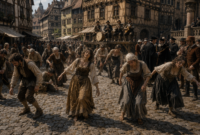
In 1348, London was already struggling to cope with a scale of death that overwhelmed its ordinary burial arrangements. New cemeteries were established at East and West Smithfield, and thousands of people were eventually buried there during the first wave of the epidemic. Centuries later, DNA recovered from East Smithfield skeletons helped establish that the bacterium responsible was Yersinia pestis, confirming a connection between archaeology and the historical accounts of the plague.
AI & Editorial Note
This article was produced with AI-assisted tools as part of the editorial workflow. Its factual claims are based on the reliable sources cited here; disputed or uncertain interpretations are identified as such, and accompanying visuals may be AI-generated historical reconstructions created for illustrative purposes.
The Black Death history taught in schools often becomes a compressed story: plague reached Europe, millions died, and medieval society changed. That outline is accurate, but it leaves out the mechanisms that made the catastrophe so consequential. The plague arrived in a society already connected by trade, shaped by recent famine, governed by overlapping religious and political institutions, and increasingly dependent on dense networks of transport and commerce. When disease entered those networks, the consequences extended far beyond the immediate medical crisis.
The deeper history is also darker. Fear contributed to the persecution of Jewish communities, governments tried to control workers after labor shortages pushed wages upward, cities experimented with new forms of epidemic regulation, and families had to reorganize burial and inheritance practices on an extraordinary scale. At the same time, the disaster produced changes that benefited some survivors, including higher wages and improved access to land and resources in parts of Europe. The Black Death was therefore not a single historical experience but a chain of biological, economic, political, religious and social shocks.
The Black Death Was a Pandemic, Not a Single Local Plague

The Black Death was the first major wave of the second plague pandemic, which began in the fourteenth century and continued through later centuries. The causative organism was Yersinia pestis, a zoonotic bacterium maintained in animal populations and capable of infecting humans through several routes. Modern plague can appear as bubonic, septicemic or pneumonic disease, and untreated infection can be rapidly fatal.
The first wave in Europe began in 1347 and reached Britain in 1348. Medieval population data are incomplete, so no single death toll can be treated as exact. In England, however, a major reconstruction places the population decline from about 4.8 million in 1348 to about 2.6 million in 1351, a fall of approximately 46 percent. Oxford historians also emphasize that plague returned repeatedly after the first wave, with some 30 major epidemics eventually occurring in Europe before the long second-pandemic cycle ended in much of western Europe around the early eighteenth century.
That distinction matters. The Black Death was not followed by a clean recovery in which Europe simply returned to normal. Communities were repeatedly exposed to plague for generations. The social memory of the first catastrophe therefore existed alongside the practical experience of recurring disease.
Modern research has also complicated the old geographical story. It is no longer sufficient to describe the disease simply as a mysterious plague that somehow came “from the East.” Genetic, environmental and historical studies point toward plague reservoirs in central Eurasia and transmission through the Black Sea region, while recent research has explored how climatic shocks and changing grain-trade patterns may have influenced the timing and route by which plague reached Mediterranean ports. A 2025 study by Martin Bauch and Ulf Büntgen argues that climate-driven famine in the mid-1340s redirected maritime grain networks toward the Black Sea and may have helped create a pathway through which plague reached Europe. That is an important recent hypothesis, but it should be treated as an interpretation of a complex sequence rather than a final explanation accepted by all historians.
Europe Was Already Under Pressure
The Black Death did not strike a completely healthy and stable Europe.
During the early fourteenth century, parts of Europe experienced severe demographic pressure and repeated agricultural difficulties. The Great Famine of 1315–1317 and the wider crisis that followed affected food production, prices, mortality and population growth across northern Europe. Climate research links these food shortages to prolonged unfavorable weather conditions, including excessive rainfall that damaged harvests.
This does not mean famine “caused” the Black Death. The two events were different historical phenomena. But a population living through hunger and economic stress could be more vulnerable to another shock.
The connection becomes especially interesting when viewed through trade. Mediterranean cities had developed long-distance commercial systems linking Europe to the Black Sea, eastern Mediterranean and wider Eurasian markets. If climate disruption reduced local food production, merchants had stronger incentives to import grain. Those same networks could carry people, goods and pathogens. Bauch and Büntgen’s 2025 study proposes precisely such an interaction between famine relief, maritime trade and plague introduction.
The broader lesson is that pandemics rarely move through biology alone. Human economic systems determine where people travel, which goods move, how densely communities interact and how quickly a pathogen can cross geographical boundaries.
Trade Helped Turn Local Infection Into a Continental Catastrophe
By 1347, plague had entered Mediterranean trading networks. From ports, it could move inland along roads, rivers and commercial routes. Researchers studying the historical epidemiology of plague have emphasized the importance of shipping, merchant networks and movement between population centers in explaining the rapid geographic expansion of the disease.
This is one of the most important corrections to the image of isolated medieval villages. Fourteenth-century Europe was highly mobile by preindustrial standards. Merchants, sailors, soldiers, pilgrims, laborers and travelers moved between communities, while food, textiles and other goods crossed long distances.
A contagious disease entering those systems had access to something the pathogen itself could not create: human mobility.
That is why the Black Death should be understood partly as a history of connectivity. The same networks that generated wealth and helped provision cities also created opportunities for disease transmission.
This paradox would become more familiar many centuries later. Economic integration can make societies richer and more resilient in some circumstances while also allowing infectious diseases to move faster.
Medieval Medicine Was More Sophisticated Than the Stereotype
The popular image of medieval doctors is often a caricature: superstitious figures with no useful knowledge who could do nothing but bleed patients.
The reality is more complicated.
Physicians inherited large bodies of medical writing from Greek, Roman and Islamic traditions. They observed symptoms, classified diseases, debated environmental influences and used practical treatments. Medical education existed within universities, and elite physicians often possessed considerable theoretical knowledge.
The problem was that none of this gave them the microbial understanding or antibiotics that modern medicine uses against plague.
Physicians did not know that a bacterium called Yersinia pestis was moving through ecological systems. They worked with frameworks involving humors, environmental conditions and theories of corrupted air. Treatments could include bloodletting, herbal preparations, diet modification and other measures that had no ability to eliminate the underlying bacterial infection.
Modern plague is a useful comparison. The World Health Organization notes that plague is still a serious bacterial disease, but effective antibiotics can treat it when diagnosis occurs early. That single difference illustrates the enormous medical gap between the fourteenth century and the modern world.
The medieval failure was therefore not a failure to think. It was a failure of available knowledge and technology when confronted with an infectious organism that could not yet be seen or understood.
People Recognized Danger Without Understanding Germs
Another misleading idea is that medieval societies had no concept of infection because they lacked germ theory.
They did not understand bacteria, but they could observe that contact with infected places seemed dangerous.
Cities attempted to restrict movement, inspect travelers, control trade and isolate people thought likely to be carrying disease. These actions were based on practical experience and sometimes on incorrect explanations, but the behavioral response could still be effective.
The development of quarantine is especially revealing. In 1377, authorities in Ragusa, now Dubrovnik, established a 30-day separation period for visitors arriving from plague-affected areas. In later decades the period became associated with forty days, giving rise to the term quarantine from the Italian quaranta.
This did not represent modern epidemiology. Medieval officials did not know the incubation period of Yersinia pestis with modern accuracy, nor could they distinguish all transmission routes.
But quarantine shows that governments were learning from repeated epidemics. They were beginning to treat disease as an administrative problem involving movement, borders and collective risk.
The Black Death Produced a Public-Health Experiment

Once plague became recurrent, cities had an incentive to institutionalize their responses.
Ports became especially important. Mediterranean governments could separate ships and travelers from populations on shore, restrict trade with affected places and create designated facilities for isolation. Venice and other maritime powers developed quarantine systems and plague hospitals that became increasingly sophisticated over time.
These institutions were imperfect and could be coercive. They could also impose enormous economic costs by restricting trade and travel.
Yet they represented a major conceptual change.
Disease control was no longer simply a matter for the individual household. Municipal governments increasingly recognized that one family’s infection could become an entire city’s problem.
This is one of the Black Death’s less visible legacies. The modern public-health state did not emerge fully formed from the fourteenth century, but plague helped create a tradition of epidemic regulation that later governments inherited and expanded.
The Most Shameful Consequence Was Scapegoating
The disease was biological, but some of its worst consequences were social.
Jewish communities in parts of Europe were falsely accused of poisoning wells and deliberately spreading plague. These claims had no factual basis. They grew out of longstanding antisemitic traditions that became especially dangerous during a moment of mass fear.
In parts of the Holy Roman Empire, accusations were followed by expulsions, imprisonment and mass killing. At Colmar, the Jewish community was destroyed in 1349 amid the wave of plague-related persecution along the Rhine. The Metropolitan Museum of Art notes that panic and prejudice combined with accusations of well poisoning before the city’s Jews were burned to death.
This deserves careful language because the plague itself did not “cause” antisemitism.
Antisemitism already existed.
The epidemic supplied a crisis in which old prejudices could be activated by fear, political opportunism and economic interests. Property belonging to victims could be seized, debts could be erased, and local authorities sometimes found themselves participating in or tolerating persecution.
The Black Death therefore demonstrates an important principle of disaster history: social suffering does not always follow directly from the original hazard. Human beings can add new forms of suffering to a catastrophe through the decisions they make in response to it.
The Flagellants Offered Another Response to Fear
Not everyone looked for a human group to blame.
Across parts of Europe, some people responded through intensified religious devotion and penitential movements. Flagellants organized processions in which participants publicly scourged themselves as acts of repentance.
The movement grew out of a broader medieval tradition of penitence and did not represent the response of all Christians. Some church authorities criticized or attempted to suppress flagellant groups, particularly when their activities challenged established ecclesiastical authority.
The movement is historically important because it illustrates the psychological problem created by the plague. When people could not explain why some households were struck while others escaped, religious interpretation became one way to make sense of an apparently arbitrary disaster.
The same uncertainty could produce very different responses: prayer, isolation, migration, charity, extreme penitence or persecution.
There was no single “medieval reaction” to plague.
Mass Death Did Not Mean the Dead Were Treated as Worthless
The scale of mortality inevitably changed burial practices, but archaeology provides a more complicated picture than the phrase “mass graves” suggests.
At East Smithfield in London, one of the best-known Black Death cemeteries, researchers found evidence that thousands of victims were placed carefully in graves. A 2011 report on the site described bodies oriented according to Christian practice, with some individuals buried alongside small personal objects. The cemetery’s organization suggests an extraordinary emergency response that nevertheless retained elements of normal funerary dignity.
That evidence matters because it restores individuality to a population usually represented only as a statistic.
A person buried at East Smithfield was not simply “one of millions.” They had belonged to a household, worked somewhere, possessed belongings and occupied a place in a religious community.
The archaeological record cannot restore their individual voices, but it can show that surviving communities continued to treat many victims as people rather than anonymous biological waste.
It also created an unexpected scientific legacy.
The same cemetery that records medieval grief eventually became a source of genetic evidence about the organism responsible for the catastrophe.
Ancient DNA Changed the Black Death Story
For centuries, historians could infer plague from symptoms, chronicles and later medical knowledge. Ancient DNA provided something more direct.
Researchers working with East Smithfield remains reconstructed the genome of Yersinia pestis from people who died during the Black Death. The work confirmed that the bacterium responsible for modern plague was also responsible for the fourteenth-century pandemic.
This did not answer every question.
The medieval strain was not found to contain an obvious genetic feature that simply explained why the Black Death was so extraordinarily severe compared with modern outbreaks. That finding redirected attention toward other possible factors, including ecological conditions, patterns of transmission, host populations, human mobility and the biological context in which the pathogen spread.
Ancient DNA therefore solved one major question while creating others.
It confirmed the identity of the pathogen but did not reduce the historical catastrophe to a single biological explanation.
The pandemic remained a product of interaction between organism and environment.
The Black Death Transformed the Labor Market
The economic consequences were among the most important long-term changes.
When a large share of the population died, surviving laborers became relatively scarce. Land did not disappear at the same rate. That changed the economic relationship between land and labor.
In England, employers increasingly had to compete for workers. Wages rose, and labor became more mobile. The government responded with legislation intended to restrain those changes.
The National Archives describes the 1351 Statute of Labourers as a response to the restricted labor market following the plague. The law attempted to control wages, limit labor mobility and require able-bodied workers to accept employment under regulated conditions.
The significance is easy to miss.
Before the plague, large populations had provided landowners with abundant labor. After the plague, surviving workers could demand more.
The law itself is evidence that authorities recognized the shift.
The government was not simply trying to “help” workers. It was trying to restore a labor system in which employers had greater control.
The attempt was only partially successful. Research in economic history shows that workers became more mobile and that the enforcement of wage controls was difficult. In the long run, higher wages and changes in labor institutions became among the most significant consequences of the demographic shock.
The Survivors Could Become Richer
This sounds paradoxical, but it is one of the most important findings in the economic history of the Black Death.
A catastrophe that destroys half the population can increase resources available per survivor.
There was more land per surviving household, fewer workers competing for jobs and, in many parts of western Europe, greater bargaining power for laborers. Oxford historians note that survivors in England generally experienced higher wages and improved living standards in the aftermath of the demographic collapse, while the broader literature finds sustained changes in wages and income in some regions.
This did not mean everyone became wealthy.
Landowners could lose tenants. Merchants could lose customers. Entire villages could disappear. Families could inherit property under devastating circumstances.
But scarcity changes bargaining power.
For laborers, the Black Death could create opportunities that would have been impossible in a densely populated society with an abundant workforce.
This is one reason the economic aftermath cannot simply be labeled a depression.
The immediate shock was catastrophic. The distribution of resources among survivors could, however, improve.
The Black Death Challenged Feudal Labor Relations
The connection between plague and the decline of serfdom is real but complicated.
In western Europe, especially in regions where labor scarcity was pronounced, peasants and workers gained leverage over landlords. Some traditional labor obligations became harder to enforce.
Economic historians identify the eventual decline of serfdom in western Europe as one of the long-run effects associated with the Black Death, alongside higher wages and changes in economic geography. But this was not an automatic result of mortality, and eastern Europe followed a different trajectory in which forms of coerced labor later became more entrenched.
This regional contrast is essential.
A disease cannot mechanically produce the same political result everywhere.
Institutions mattered. So did land availability, government power, labor organization and the ability of elites to enforce contracts.
The Black Death altered the economic conditions under which those institutions operated, but it did not dictate the final outcome.
Women Experienced the Aftermath Differently
The labor shortage also affected women, although not in a uniform or automatically liberating way.
In some sectors, women’s labor became more valuable. Research on later medieval England indicates that labor-market changes could temporarily widen economic opportunities for women, including in textile production and other forms of work. Oxford historians note that economic opportunities for women widened in parts of England after the demographic shock.
But the underlying social order remained highly unequal.
Women’s access to property, guilds, wages and inheritance depended on local laws and customs. A labor shortage could create opportunities without eliminating structural restrictions.
This is another reason broad claims about “the Black Death freeing women” should be treated cautiously.
The pandemic changed economic conditions. It did not erase gender hierarchy.
Land Itself Began to Change

When millions of people disappeared, they did not simply leave empty houses.
Their farms changed.
Some fields were abandoned. Some arable land was converted to pasture. Forest returned to places where labor was no longer available to clear or cultivate it. Villages shrank, roads became less important, and patterns of settlement shifted.
Palaeoecological research has been particularly valuable because pollen records and other environmental indicators provide evidence of changing land use even in regions where written records are poor. A major 2022 study found strong evidence that the Black Death produced geographically uneven changes in land use across Europe, corresponding with differences in mortality and local economic structures.
The environmental consequences therefore varied.
A densely farmed region that lost much of its workforce could experience rapid reforestation or pasture expansion. A less severely affected region might see much smaller changes.
This makes the Black Death an environmental event as well as a demographic one.
Europe’s landscape after the pandemic was not identical to the landscape before it.
Governments Tried to Freeze the Old Economy
The Statute of Labourers illustrates an important political response: governments attempted to use law to prevent demographic change from producing too much social change.
In England, wage controls and restrictions on labor mobility were attempts to keep employers from having to compete freely for workers. The fact that such laws were enacted demonstrates that the political system was trying to protect the economic order even as its demographic foundations had changed.
But law could not create dead workers.
A regulation could set a maximum wage; it could not make a scarce laborer abundant.
That tension helps explain why medieval governments found the post-plague labor market so difficult to control. Surviving workers had something that governments could regulate only imperfectly: the ability to choose where and for whom they worked.
In the decades after the Black Death, this increased mobility became one of the forces reshaping rural society.
The plague did not create a modern labor market overnight, but it accelerated the movement away from some older arrangements.
The Church Was Both Essential and Vulnerable
The Church remained central throughout the crisis.
Priests were expected to hear confessions, administer rites and care for dying Christians. Yet clergy were also exposed to infection.
The result was an institutional contradiction. The very people expected to provide spiritual support were vulnerable to the same disease as everyone else.
The decline in religious authority sometimes associated with the Black Death should therefore not be interpreted as a sudden collapse of Christianity. Medieval Europe remained profoundly religious.
The change was subtler.
People could see that prayers and rituals did not make infection disappear. Institutions that had seemed permanent could suddenly be stripped of personnel. Communities could lose priests, monks and religious leaders alongside ordinary households.
Economic historians have identified a longer-term decline in the authority of religious institutions as one of the consequences associated with the Black Death, but this unfolded over time and differed considerably across regions.
The plague weakened confidence in some institutions without eliminating the religious worldview that sustained medieval society.
The Disease Was Not the Only Enemy
The history of the Black Death is often reduced to the bacterium because modern science makes the pathogen visible.
But the human record shows several interacting disasters.
There was disease.
There was fear.
There was economic disruption.
There was displacement.
There was hunger in some regions.
There was persecution.
There were labor conflicts.
There were institutional failures.
There were also acts of cooperation, care and adaptation.
A household could lose several members and still have to plant crops. A city could face empty streets while continuing to enforce laws. A merchant could lose customers while trying to preserve trade. A government could discover that its old wage regulations were suddenly ineffective.
The pandemic therefore exposed the flexibility and fragility of medieval society at the same time.
The Black Death Did Not Destroy Civilization
Another common misconception is that the Black Death brought medieval civilization to an end.
It did not.
Universities continued. Governments survived. Trade resumed. Cities rebuilt. Agricultural production reorganized. Artistic and literary activity continued.
What changed was the scale and direction of development.
The American Economic Association’s review of the economic literature identifies long-term effects including higher wages and income in some regions, the decline of serfdom in western Europe, changes in religious authority, stronger states and a gradual shift in Europe’s economic geography toward the northwest.
Those are structural changes rather than evidence of civilization disappearing.
The post-plague world was still recognizably medieval, but it was operating under different demographic and economic conditions.
The Black Death did not erase the old society.
It changed the balance within it.
The Pandemics That Followed Were Part of the Same Story
It is misleading to treat 1351 as the final chapter.
Plague returned repeatedly.
Oxford’s historical overview describes a sequence of later epidemics that continued into the early eighteenth century in much of Europe. Some outbreaks were smaller than the Black Death; others could still be devastating locally.
This recurring threat encouraged societies to preserve and expand the institutions developed during earlier crises.
Quarantine systems became more elaborate. Governments developed regulations for commerce and travel. Cities maintained isolation facilities. Families remembered previous outbreaks and modified behavior accordingly.
In that sense, the Black Death created a cultural memory of pandemic risk that lasted for centuries.
Europe learned to live with plague.
It did not learn to eliminate it.
The Black Death Also Changed European Art
The visibility of death entered the cultural landscape.
Later medieval art frequently emphasized mortality, decay and the temporary nature of earthly power. The danse macabre, or Dance of Death, became one of the most recognizable expressions of this fascination, depicting figures from different social levels confronted by death.
The idea that death ultimately defeats kings and laborers alike was older than the Black Death. Medieval Christianity had long emphasized mortality and judgment.
But the pandemic gave that idea extraordinary emotional force.
When aristocrats, merchants, priests, laborers and children all died in extraordinary numbers, the theological claim that death erased social distinctions became something people could observe directly.
The cultural response therefore belongs to a broader history of medieval mortality rather than a simple artistic reaction to one epidemic.
Modern Science Did Not Make the Mystery Disappear
Ancient DNA answered the question of which bacterium caused the Black Death, but modern research continues to debate how the pandemic became so geographically expansive and so deadly.
Researchers now have access to genomics, palaeoecology, climate reconstruction, demographic modeling and archaeological evidence that medieval chroniclers could never have imagined. Yet those tools sometimes produce more nuanced answers rather than simple certainty.
Mortality varied considerably between regions. The role of different transmission pathways remains an area of research. Climate may have influenced timing and trade. Human mobility shaped spread. Ecological conditions affected reservoirs and vectors.
The plague was therefore never just one thing.
It was an infectious organism interacting with a complicated human and environmental system.
That is why the Black Death remains a major subject of interdisciplinary research more than six centuries later.
What Schools Often Leave Out
The Black Death did kill an extraordinary proportion of Europe’s population. But the number alone cannot explain the historical significance of the event.
The real story includes a famine-stressed Europe in which commerce had linked distant regions more tightly than earlier generations might have imagined. It includes physicians who were capable observers but lacked microbiology. It includes municipal governments experimenting with quarantine before understanding bacteria. It includes religious movements, institutional strain and the repeated return of plague.
Most painfully, it includes the deliberate destruction of Jewish communities based on false accusations.
It includes a labor shortage powerful enough to worry governments, leading to laws designed to restrain workers.
It includes abandoned fields and changing landscapes.
It includes surviving families whose material circumstances could improve even as their communities were traumatized.
And it includes an archaeological record in which the dead became, centuries later, evidence that could answer questions their contemporaries could not.
The simplified story says the Black Death killed millions.
The fuller story explains what those deaths did to the people who remained.
The Black Death and the Making of a Different Europe
The pandemic’s deepest consequence was not that medieval Europe ended.
It was that the balance of power within Europe changed.
Labor became scarce. Land became relatively abundant in some regions. Governments tried to preserve old systems but struggled to enforce them. Survivors could demand more. Religious authority was questioned in places. Cities learned to regulate epidemic movement. The landscape itself changed because fewer people were available to work it.
These processes unfolded unevenly and sometimes contradicted one another.
A society can become richer per person while experiencing immense grief.
A government can become stronger while workers become harder to control.
A community can become more religious while religious institutions lose some authority.
A city can develop better public-health systems because its earlier failures were catastrophic.
Those contradictions are not anomalies.
They are what historical change looks like after a crisis of this scale.
The Darkest Lesson Is Not About Disease
Modern readers often approach the Black Death as a story about an extinct world.
But the most revealing parts of its history remain recognizable.
People confronted incomplete information. Officials had to make decisions before they understood the science. Economic systems behaved unpredictably. Fear influenced politics. Existing prejudice intensified under pressure. Some institutions adapted quickly, while others resisted change. New rules were created because old ones no longer worked.
The pathogen was extraordinary.
Human reactions were ordinary.
That is why the Black Death remains historically important.
It shows that the consequences of a catastrophe are never produced by the original hazard alone. Biology sets certain limits, but institutions and choices determine much of what follows.
The disease could cause death.
It could not, by itself, decide who would be blamed, which workers would gain bargaining power, whether a government would regulate movement, whether a community would care for its dead, or whether prejudice would become violence.
Those were human decisions.
A Pandemic That Still Has a Modern Echo
Plague has not disappeared from the world.
The World Health Organization still describes plague as an active zoonotic disease caused by Yersinia pestis, with modern cases continuing to occur. Antibiotics can be highly effective when treatment begins early, although untreated infection remains dangerous.
Modern medicine therefore changed the biological equation dramatically.
What it did not change is the social dimension of epidemic disease.
People still move through connected networks. Governments still have to balance public safety with commerce and individual freedom. Rumors can still spread faster than evidence. Minority groups can still become targets of conspiracy theories during crises.
The technology is different.
Some human behaviors are not.
Why the Black Death Still Matters
The Black Death deserves to be remembered as more than a medieval plague because it changed the conditions under which European society operated.
It altered population density, labor markets, land use, public-health practices, religious institutions and political authority. It helped weaken some systems of coerced labor in western Europe and gave surviving workers greater economic leverage in places where labor became scarce. It also showed how quickly an epidemic could expose institutional weaknesses that had remained invisible during ordinary times.
But perhaps its most important lesson lies outside economics or medicine.
The Black Death demonstrated that a society facing mass uncertainty can move in opposite directions at once. It can invent quarantine while inventing scapegoats. It can produce stronger government while encouraging resistance from workers. It can preserve dignity for the dead while committing atrocities against the living.
That is why the darkest history of the Black Death is not simply the story of how many people died.
It is the story of what fear revealed.
The plague was caused by a bacterium. The tragedy that followed was built from millions of individual experiences and countless collective decisions. Some responses created institutions that survived for centuries. Others left records of violence that should never be mistaken for inevitable consequences of disease.
The graves at East Smithfield tell us how many people a society could lose.
The laws, chronicles and surviving institutions tell us what happened afterward.
And the most enduring historical lesson is that when a catastrophe strips away certainty, the choices people make next can reshape society long after the original danger has passed.
SOURCES & REFERENCES
- World Health Organization — Plague.
Used for the identification of Yersinia pestis, transmission routes, clinical forms, modern mortality and the effectiveness of antibiotics. - University of Oxford, Faculty of History — “The Black Death and European Expansion.”
Used for mortality estimates in England and the recurrence of plague epidemics after the first wave. - Jedwab, Johnson & Koyama — “The Economic Impact of the Black Death,” Journal of Economic Literature.
Used for labor markets, wages, serfdom, religious authority, state development and long-term economic effects. - Nature — Ancient Yersinia pestis genome research.
Used for East Smithfield DNA evidence identifying the bacterium responsible for the medieval plague. - CDC, Emerging Infectious Diseases — Etymologia: “Quarantine.”
Used for the development of quarantine in Ragusa in 1377 and the history of the term. - The National Archives (UK) — “Plague.”
Used for the 1349 ordinance and 1351 Statute of Labourers and their relationship to labor shortages after the plague. - Metropolitan Museum of Art — Colmar Treasure / Jewish history during the Black Death.
Used for documented persecution of Colmar’s Jewish community in 1349 following false accusations of well poisoning. - Izdebski et al., Nature Ecology & Evolution — palaeoecological evidence of land-use change.
Used for environmental and regional consequences of the demographic shock. - Bauch & Büntgen, Communications Earth & Environment (2025).
Used as a recent, explicitly qualified hypothesis concerning climate, famine, grain trade and the arrival of plague in Mediterranean Europe. - Oxford History of the British Isles — social and economic change after the Black Death.
Used for the relationship between mortality, labor markets and changing opportunities after 1348.
FAQ
What was the Black Death?
The Black Death was the first major wave of the second plague pandemic, beginning in Europe in 1347 and spreading rapidly during the following years. It was caused by the bacterium Yersinia pestis.
How many people died in the Black Death?
There is no exact figure because medieval demographic records are incomplete and mortality varied greatly by region. In England, one major reconstruction estimates a population decline of about 46 percent between 1348 and 1351, while some parts of Europe may have experienced even higher mortality.
Did the Black Death really come from rats?
Rats and their fleas are part of the established ecology of plague, but the historical transmission of the Black Death was more complicated than the familiar “rat flea” diagram suggests. Yersinia pestis can infect humans through infected flea bites, direct contact with infected material and, in pneumonic disease, respiratory transmission.
Why were Jewish people blamed for the Black Death?
Jewish communities were falsely accused in parts of Europe of poisoning wells and spreading plague. These accusations grew from longstanding antisemitism and became particularly destructive during the epidemic, contributing to massacres, expulsions and destruction of communities.
Did the Black Death lead to higher wages?
In many parts of western Europe, the enormous loss of workers created labor shortages and increased workers’ bargaining power. English authorities responded with laws attempting to control wages and labor mobility, but those measures had limited long-term success.
Did the Black Death end feudalism?
Not immediately and not everywhere. The demographic shock weakened some forms of serfdom in western Europe, but regional political and economic conditions produced very different outcomes.
What did medieval people do to stop the plague?
They used a mixture of religious practices, medical treatments, isolation, movement restrictions and eventually formal quarantine systems. These methods were based on incomplete understanding, but some represented important early forms of public-health administration.
Is plague still around today?
Yes. Yersinia pestis remains present in animal reservoirs and causes modern human infections. Unlike in the Middle Ages, plague can usually be treated successfully with appropriate antibiotics when diagnosed early.