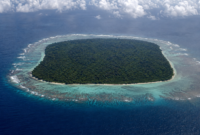
At the entrance to Albania’s Gulf of Vlora, a small island preserves the physical remains of decades of military preparation. Sazan Island military ruins include concrete bunkers, underground facilities, abandoned buildings and other defensive infrastructure left behind after the island spent much of the twentieth century as a restricted military zone. Today, Albania’s official tourism authority describes Sazan as open to visitors and notes the surviving Cold War tunnels, buildings and former military base.
The island is often portrayed as if every square meter were an abandoned fortress. That is an exaggeration. Sazan also has Mediterranean vegetation, beaches, rocky terrain and important surrounding marine habitat. What makes it extraordinary is the concentration of military infrastructure within such a small landscape—and the fact that this infrastructure represents several different political eras rather than one single military project.
Today, the island stands between two very different futures. One is the preservation of a remarkable Cold War landscape increasingly reclaimed by vegetation. The other is redevelopment. In 2026, the Albanian government said a development permit had been approved for a proposed tourism project, while emphasizing that this was not yet a construction permit and that a detailed environmental assessment was still required.
The ruins, therefore, are more than abandoned concrete. They are evidence of a political history that is still being negotiated.
Why Sazan Island Was So Strategic
Sazan lies at the entrance to the Gulf of Vlora in southwestern Albania. Its location places it close to the meeting of the Adriatic and Ionian seas and gives it a commanding position near one of Albania’s most strategically important coastal areas. Albania’s official tourism authority describes it as the country’s largest island.
That geography explains much of the island’s history. A power controlling Sazan could observe maritime approaches and help protect or threaten access to the Gulf of Vlora. The island’s strategic value was recognized long before the Cold War, and successive governments repeatedly adapted it for military purposes.
By the twentieth century, Sazan had become part of the complicated territorial and strategic politics of the Adriatic. American diplomatic records from the postwar period show that its status was discussed at length during the settlement of Italy’s peace treaty. The records note that Italy had occupied the island in 1914 and that its final transfer to Albania formed part of the postwar territorial settlement.
That history matters because the military landscape on Sazan was built in stages. The bunkers visible today were not the product of one government or one war.
The Italian Era Turned the Island Into a Fortress
Italy occupied Sazan in October 1914, during the upheaval of the First World War. The island subsequently became part of Italy’s strategic presence along the Albanian coast. The Treaty of London of 1915 provided for Italy to receive Valona and the island of Saseno as part of its wartime territorial arrangements.
The political status of Sazan remained contentious, but Italy continued to control the island for decades. By the interwar period, Italian authorities had strengthened its defenses with military buildings and barracks. National Geographic’s recent historical account describes these installations as important to Italy’s ability to control the Adriatic approaches.
This was not simply a matter of placing guns on a rocky island. A permanent military installation required roads, storage, accommodation and other supporting infrastructure. The beginnings of the built environment later inherited by Albania therefore predated the Communist period.
World War II added another layer. Italy continued to occupy Sazan, and after the Italian armistice in 1943, German forces also occupied the island for a period. The island had once again become part of a wider European war whose military geography extended deep into the Adriatic.
When the war ended, the political landscape changed again.
Albania Finally Took Sovereignty After World War II
The settlement following World War II confirmed Sazan as part of Albania. A U.S. diplomatic record from the Paris Peace Conference states that the draft peace treaty with Italy required Italy to recognize Sazan as part of Albanian territory and renounce its claims to the island. Earlier diplomatic records also document the decision that Saseno should go to Albania.
For Albania, control of Sazan had obvious military value. The country was emerging from war, but it was also entering the sharply polarized political world that would become the Cold War.
The island’s importance increased as Albania aligned itself with the Soviet Union.
The Soviet Union Helped Build a Naval Stronghold

Albania joined the Warsaw Pact in 1955, placing it within the Soviet-led military alliance in Europe. The Albanian Armed Forces Museum records that Soviet support from 1956 onward included military equipment and assistance, while the Vlora naval base became a major Communist-bloc facility in the Mediterranean. The museum’s account says twelve submarines and numerous other vessels were associated with the base complex.
Declassified CIA material provides a more detailed contemporary window into the military infrastructure. A 1961 report described Soviet construction on Sazan and identified underground submarine pens as part of the island’s naval system. It reported twelve completed underground pens and plans for additional pens, as well as fuel infrastructure and other defensive facilities.
Another CIA record from 1951 reported that Soviet military specialists had helped convert Sazan into a submarine base. Because these reports were intelligence documents produced during the Cold War, their details should be treated as historical intelligence reporting rather than automatically as an exact inventory of every structure on the island. Their value lies in demonstrating how Western intelligence understood the strategic importance of Sazan and the Soviet military presence there.
The submarine connection became one of the defining aspects of Sazan’s Cold War reputation.
But the Soviet-Albanian relationship did not last.
The Alliance With Moscow Collapsed
Albania’s relationship with the Soviet Union deteriorated sharply at the beginning of the 1960s. Political and ideological differences between Enver Hoxha and Nikita Khrushchev became increasingly serious, and Albania moved away from Moscow.
The break had direct military consequences. Soviet personnel and influence were pushed out, while Albania took increasing control of its own defense system. Later, Albania would also withdraw from the Warsaw Pact in 1968, further deepening its isolation. The Albanian Armed Forces Museum identifies the 1968 withdrawal and subsequent isolation as major factors behind the country’s increasingly extensive program of fortification.
Sazan therefore went through a remarkable transformation. It had first been important because a foreign power controlled it. It then became part of a Soviet-associated naval network. After the alliance broke down, it became even more deeply embedded in Albania’s own defensive doctrine.
The result was the landscape of concrete and tunnels that attracts visitors today.
Enver Hoxha’s Albania Turned Defense Into a National Obsession
Under Enver Hoxha, the fear of invasion became a central part of Albania’s military and political culture. The country was increasingly isolated from its former allies, yet the government continued to prepare for attacks from a wide range of potential enemies.
The Albanian Armed Forces Museum describes the process as “bunkerization,” a national fortification program initiated politically in the early 1970s and implemented intensively from 1975 through the middle of the 1980s. By 1983, according to the museum, 173,371 bunkers had been constructed from a planned total of 221,143.
Academic research on Albania’s bunkers emphasizes just how large this architectural legacy became. A 2020 study by Denada Veizaj, Gjergji Islami and Andrea Maliqari describes nearly 200,000 bunkers constructed under Hoxha and notes that many remain part of Albania’s landscape.
Sazan became an especially concentrated expression of this defensive mentality.
The island’s military infrastructure was not limited to a handful of small concrete pillboxes. Its ruins included hardened positions, tunnels, military buildings and infrastructure associated with a long-term military settlement. National Geographic describes a large network of abandoned tunnels, barracks and other military structures remaining on the island.
This is what distinguishes Sazan from an ordinary abandoned fort. It was an entire military environment.
The Ruins Once Supported a Permanent Military Community
Sazan was not only a place where weapons were stored.
The military system required people to live there for extended periods, and the island developed the infrastructure of a functioning community. Contemporary descriptions of Sazan’s abandoned settlement include residential buildings and other facilities associated with the military population. National Geographic notes that homes, schools and medical facilities existed alongside the military installations.
That detail changes the way the ruins should be read.
An abandoned apartment block on Sazan does not necessarily represent a failed civilian settlement. It can be understood as part of a military community that existed because the state needed personnel permanently stationed on a strategically important island.
The same is true of roads and utility infrastructure. What might appear to modern visitors as random concrete structures once belonged to an organized system in which housing, logistics, defense and communications were interconnected.
In that sense, Sazan preserves not just military hardware but the architecture of military life.
The Underground World Is One of Sazan’s Most Important Remains
The tunnels are among the most visually striking elements of the island.
Some were associated with the island’s naval and defensive functions, while Soviet-era intelligence reports specifically described underground submarine pens. The CIA’s 1961 report even described the construction of multiple underground pens on Sazan.
It is tempting to assume that every tunnel visible today belongs to the same system, or that every underground chamber had a dramatic strategic purpose. The surviving evidence does not justify that level of certainty.
Military complexes evolve. Structures are modified, repurposed and connected over time. Some underground spaces may reflect Soviet-era construction; others may belong to later Albanian defensive planning or supporting infrastructure.
That distinction is important because Sazan’s reputation has generated stories that go well beyond what the documentary record establishes. A responsible history should separate confirmed military infrastructure from later speculation about secret weapons or hidden activities.
The existence of the tunnels is documented. Their individual functions require more careful evidence.
Sazan Stayed Closed While Albania Changed

For ordinary Albanians, Sazan was largely a place seen from a distance rather than visited freely.
Its restricted status continued well into the post-Communist period. The island’s military identity was so strong that opening it to tourism became a notable political and administrative change.
In April 2017, Albania’s Ministry of Defense announced an agreement allowing tourists to visit Sazan during the summer season. The arrangement applied to specified areas of the island and placed particular emphasis on security because the property remained under the responsibility of the Ministry of Defense.
The transformation was unusual. A site once defined by restricted access was now becoming valuable because outsiders wanted to see precisely what had once been hidden from them.
The former military zone became a historical attraction.
Nature Is Reclaiming the Military Base

Today, one of the strongest visual contrasts on Sazan is between concrete and vegetation.
The official Albanian tourism authority describes the island as having wild Mediterranean vegetation and beaches alongside the remains of its military base and Cold War infrastructure.
Photographs show buildings with missing windows, cracked concrete and vegetation growing around old structures. Over time, roads and empty compounds become less sharply defined as shrubs spread across disturbed ground.
This process does not mean the military past has disappeared. It makes the past more visible in a different way.
The contrast between nature and abandoned architecture has also become part of the island’s modern identity. Sazan is now valued partly because visitors can see both a protected coastal environment and an unusually extensive military landscape in the same place.
The surrounding marine environment is particularly important. The Karaburun-Sazan National Marine Park includes the waters around the island and the Karaburun Peninsula, creating a protected marine landscape in which natural values coexist with Sazan’s military heritage.
There is, however, a useful distinction to make about protection. Albania’s environmental agency stated in 2026 that the terrestrial part of Sazan Island is not itself a protected area, while the surrounding marine area is part of the Karaburun-Sazan Marine National Park. The agency also identifies two natural monuments on the island.
That makes Sazan’s land-use future more complicated than simply “preserve the national park.”
Abandoned Does Not Mean Safe
Sazan’s ruins are relatively recent compared with classical archaeological sites, and some remnants can still carry hazards from their military function.
In July 2020, Albania’s Ministry of Defense reported an operation to clear combat ammunition from the island. The operation included the destruction of unexploded ordnance and artillery shells in several calibers, and the ministry stated that monitoring of the island’s security situation would continue.
This is a crucial part of the story because abandoned military sites are different from ordinary ruins. A building can be architecturally empty while its surroundings still contain remnants of military activity.
Visitors therefore should not interpret Sazan’s open status as meaning that every bunker, tunnel or abandoned structure is safe to enter.
The military legacy remains more than historical decoration.
The Island’s Strategic Role Never Really Disappeared
There is a temptation to describe Sazan as a place that became irrelevant after the Cold War. Its history suggests otherwise.
The island was repeatedly valuable precisely because of where it sits. The governments that controlled it changed, their alliances changed, and the technology of warfare changed, but the geographic reason for paying attention to Sazan remained.
That is why Italian military construction was followed by wartime occupation, Soviet-supported naval development and extensive Albanian fortification.
The strategic landscape survived the political systems built upon it.
What changed after 1991 was the purpose.
The island gradually ceased to function as the heavily restricted military outpost that had defined it for decades. Instead, its old infrastructure became an inheritance: expensive to maintain, difficult to remove and increasingly attractive as a historical curiosity.
The concrete remained even after the political rationale for building it disappeared.
Sazan’s Future Became Another National Debate
The story did not end when the military base declined.
In 2026, Sazan became the subject of an important new debate over tourism development. On June 15, the Albanian government stated that the island remains state property and that negotiations over a proposed tourism development were still open. The government also clarified that a development permit approved by the National Territorial Council in March 2026 was not a construction permit. Before construction could be authorized, detailed architectural documentation and environmental procedures would still be required.
The environmental review is particularly significant. According to the government, Albania’s environmental authorities determined in May 2026 that the proposal required an in-depth Environmental Impact Assessment, including analysis of biodiversity, habitats, ecosystems, landscape integrity and long-term environmental sustainability.
The controversy illustrates a larger problem facing historic military landscapes.
Preservation does not necessarily mean leaving everything untouched. Some structures may be stabilized, interpreted or reused. Tourism can create money and public attention that may help protect a site. But intensive development can also fundamentally change the landscape that made the site historically distinctive.
Sazan therefore faces a question that many abandoned military places eventually encounter: what happens when ruins become valuable?
The Island Is a Physical Record of Albania’s Cold War
Sazan’s greatest historical importance is not any individual bunker.
It is the accumulated story.
The Italian defenses represent an era when Fascist Italy sought strategic influence across the Adriatic. The wartime occupation records the island’s place in World War II. Soviet-era naval infrastructure reflects Albania’s short-lived integration into Moscow’s military system. The later bunkers and hardened structures reveal the much more isolated defense doctrine of Hoxha’s Albania.
Each layer was built for a different political reality.
Yet the structures overlap physically. A road may have served different military authorities. An old building may have been modified rather than destroyed and replaced. A tunnel system may contain evidence of several periods of construction.
That makes Sazan a particularly useful historical landscape because its chronology is visible in concrete.
The story also connects to the broader legacy of Communist Albania. Across the country, bunkers remain among the most recognizable physical symbols of Hoxha’s regime. Researchers studying Albanian bunker architecture have emphasized that these objects are not simply military relics; they have become part of debates over memory, identity and the meaning of the country’s Communist past.
Sazan concentrates that national legacy into one island.
Why Sazan Still Feels Like a Secret Place
The island no longer has the same legal and military isolation it once did, yet the atmosphere of secrecy is difficult to escape.
The buildings are empty. The tunnels disappear into the rock. Concrete defensive positions sit among Mediterranean vegetation. From certain parts of the island, the surrounding sea makes the settlement feel physically separated from the mainland even though Vlora is nearby.
That atmosphere can encourage legends, but the documented history is already remarkable enough.
Sazan does not need an invented secret laboratory or an unverified conspiracy to be historically unusual. The available evidence already shows that the island was repeatedly considered strategically important, used for military purposes by several governments and incorporated into one of Europe’s most unusual Cold War defensive systems.
Its mystery lies less in not knowing what happened there than in seeing how much history remains physically present.
The Ruins May Not Look the Same Forever
For decades, Sazan’s abandoned buildings could deteriorate largely outside public view. That period may now be ending.
Tourism has increased awareness of the island. Environmental protection gives greater importance to its natural surroundings. Government-backed development proposals could eventually alter parts of the landscape. At the same time, the military heritage remains vulnerable to weathering, unauthorized access and the difficulty of preserving large quantities of aging concrete infrastructure.
The choice is not simply between development and abandonment.
There is a third possibility: recognizing the island itself as heritage.
That could mean documenting the existing military landscape before significant changes occur, identifying structures according to their historical period and function, and preserving representative areas rather than treating every ruin as disposable or every building as equally important.
Such an approach would also help prevent Sazan from being reduced to a generic “abandoned island” attraction.
Its real story is much more specific.
Sazan Is Not an Ancient Ruin—and That Is What Makes It So Powerful
The strange thing about Sazan is how recent its ruins are.
The people who designed the bunkers, lived in the apartments and operated the military facilities were not separated from the present by thousands of years. The Communist system that shaped much of the landscape ended in the early 1990s. Many of the buildings are therefore reminders of a political world that existed within living memory.
That changes how the ruins should be interpreted.
They are not simply picturesque remnants. They represent decisions about national security, isolation, ideology, resources and fear. They show how governments can transform landscapes when military preparedness becomes a dominant political priority.
And they demonstrate another historical truth: military landscapes can outlive the conflicts and political systems that created them.
Sazan remains because concrete is slow to disappear.
Its meaning, however, continues to change.
Once a strategic island, then a restricted military base, later an abandoned landscape and now a tourism destination under consideration for further development, Sazan has passed through several identities without losing the traces of the previous ones.
That is why the island matters beyond its ruins. Its bunkers and tunnels are fragments of Albania’s twentieth-century history, preserved not in a museum case but across an actual landscape. The strongest reason to remember Sazan is not that it was once secret. It is that the island makes visible what a vanished political system looked like when it built itself in concrete.
SOURCES & REFERENCES
- Albanian National Tourism Agency — Sazan Island. Official information on Sazan’s location, former military status, remaining Cold War infrastructure, tunnels, buildings and tourism access.
- Albanian Armed Forces Museum — Bunkerization. Institutional history of Albania’s bunkerization program and its scale under Enver Hoxha.
- Albanian Armed Forces Museum — Cold War. Background on Albania’s Warsaw Pact membership, Soviet military assistance, the Vlora naval base and the country’s 1968 withdrawal from the alliance.
- U.S. Central Intelligence Agency — Soviet Activity in the Albanian Armed Forces, 1961. Declassified intelligence documenting Soviet-supported military infrastructure and underground submarine facilities on Sazan.
- U.S. Central Intelligence Agency — Soviet Domination of Albania, 1951. Contemporary intelligence reporting identifying Sazan as a Soviet-associated submarine base.
- U.S. Department of State, Office of the Historian — Paris Peace Conference and Saseno. Diplomatic records concerning Italy’s occupation of Sazan and its postwar transfer to Albania.
- Albanian Ministry of Defense — Sazan Island Opens for Tourists. Official 2017 announcement establishing regulated summer tourist access to the former military property.
- Albanian Ministry of Defense — Sazan Island Ammunition Clearance. Government report documenting unexploded-ordnance and artillery-shell clearance operations on the island.
- Albanian National Tourism Agency — Karaburun-Sazan National Marine Park. Official information on the protected marine environment surrounding Sazan and the Karaburun Peninsula.
- Council of Ministers of Albania — Facts and Information Regarding Sazan Island and Zvërnec, June 15, 2026. Current government information on state ownership, development proceedings and environmental assessment requirements.
FAQ
Where is Sazan Island?
Sazan Island is located off southwestern Albania at the entrance to the Gulf of Vlora. It is Albania’s largest island and occupies a strategic position near the meeting of the Adriatic and Ionian seas.
Why does Sazan Island have so many military ruins?
Sazan’s strategic location caused several governments to fortify and use it for military purposes. Italian forces developed defenses during the twentieth century, the island became part of the Soviet-Albanian naval system after World War II, and Albania later expanded its defenses under Enver Hoxha’s bunkerization program.
Was Sazan Island a Soviet submarine base?
Yes. Declassified CIA records from the Cold War describe Soviet-supported naval facilities and underground submarine pens on Sazan. The reports provide contemporary evidence of the island’s role within the Soviet-Albanian naval system.
Did Enver Hoxha build the bunkers on Sazan?
Hoxha’s government was responsible for Albania’s large-scale bunkerization program, which intensified from the 1970s into the 1980s. Sazan formed part of this wider defensive system, although its military infrastructure also predates the Communist period.
Can tourists visit Sazan Island?
Sazan was opened to regulated tourist visits after decades as a restricted military area. Albania’s Ministry of Defense formally announced seasonal tourist access in 2017, and the national tourism authority currently describes the island as open to visitors.
Are Sazan Island’s tunnels and bunkers safe?
Not necessarily. Albania has carried out ammunition-clearance operations on the island, including the removal and destruction of unexploded ordnance and artillery shells. Visitors should therefore treat abandoned military structures as potentially hazardous and follow current access restrictions.
Is Sazan Island protected?
The surrounding marine waters are part of the Karaburun-Sazan National Marine Park. Albania’s environmental authorities clarified in 2026 that the terrestrial part of Sazan is not itself a protected area, although two natural monuments exist on the island.
What will happen to Sazan Island?
As of June 2026, Albania’s government stated that Sazan remains state property and that a proposed tourism development was still undergoing legal, technical and environmental procedures. A development permit had been approved, but the government specifically stated that this was not a construction permit and that an in-depth environmental assessment was required