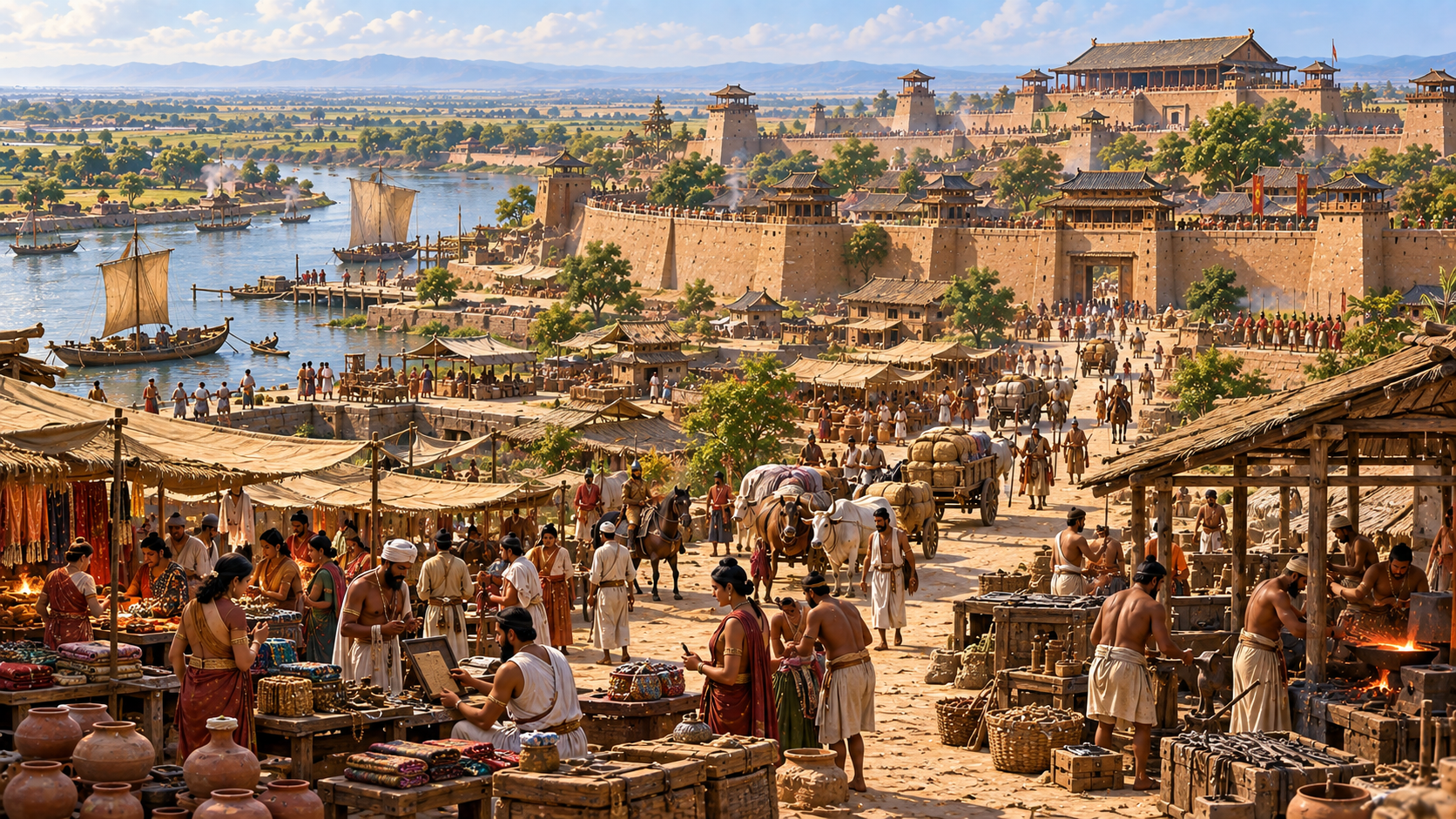
Ancient India was never a single civilization progressing unchanged from its earliest settlements to the great empires of the first millennium CE. Across the Indian subcontinent, communities developed within dramatically different environments, from the Indus basin and northwestern plains to the Ganges valley, the Deccan plateau, coastal regions, and southern India. The history of Ancient India encompasses the sophisticated cities of the Harappan world, the development of Vedic traditions, the growth of kingdoms and republics, the emergence of Buddhism and Jainism, the Mauryan experiment in imperial rule, and the cultural achievements associated with the Gupta period. Archaeology, inscriptions, coins, monuments, and literary traditions together reveal a complex history shaped by migration, trade, political competition, religious debate, technological innovation, and sustained contact with societies beyond the subcontinent.
AI & Editorial Note
Hidden Frontiers uses AI-assisted tools as part of its content-production workflow, including research organization, drafting assistance, and visual development. The factual content of this article is strictly grounded in verified, cited sources, and disputed or uncertain information is identified where appropriate. Visuals accompanying this article are AI-generated historical reconstructions created for illustrative purposes.
Geography and the Foundations of Ancient India
Geography profoundly influenced the development of early societies across South Asia. The Indus and its tributaries supported settlements in the northwest, while the Ganges and Yamuna river systems later became central to political and agricultural expansion farther east. The Himalayas, Thar Desert, Deccan plateau, coastal plains, river valleys, monsoon systems, and mountain passes created distinctive environments while also providing corridors through which people, goods, technologies, and ideas moved.
Agricultural communities existed in different parts of the subcontinent long before the appearance of large cities. Farmers cultivated crops, kept domesticated animals, manufactured pottery, and established permanent settlements that gradually became connected through regional networks. These developments did not occur everywhere at the same pace, making the history of early India a mosaic of local transformations rather than a single sequence radiating from one center.
The northwest became the setting for South Asia’s earliest extensive urban civilization. By the third millennium BCE, communities associated with what scholars call the Indus, Harappan, or Indus Valley Civilization had created an urban network covering a vast area. Its settlements demonstrate sophisticated approaches to construction, water management, craft production, measurement, and long-distance exchange.
The Indus Valley Civilization
The mature phase of the Indus civilization flourished broadly during the third and early second millennia BCE, although its origins lay in earlier regional cultures and many settlements continued after its major urban centers changed or declined. Harappa and Mohenjo-daro became the best-known cities after archaeological investigation revealed planned streets, substantial brick architecture, drainage systems, wells, workshops, and distinctive artifacts. Discoveries at numerous additional sites have demonstrated that the civilization extended well beyond the Indus valley itself.
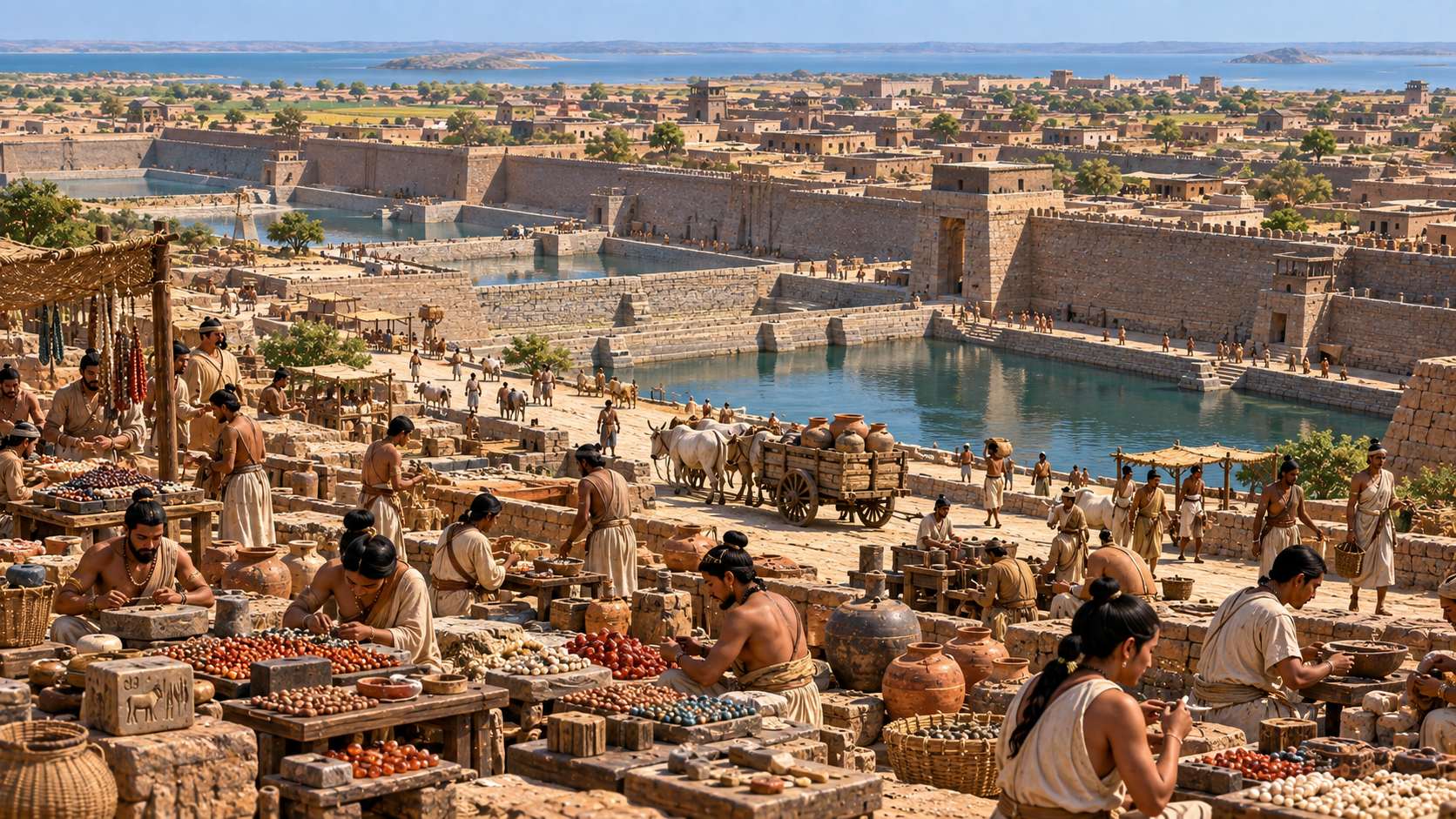
Dholavira, located in present-day Gujarat, offers especially striking evidence of Harappan urban planning. The settlement contained fortifications, differentiated urban sectors, ceremonial spaces, reservoirs, workshops, and an elaborate system designed to capture and manage scarce water. Archaeological discoveries there also include evidence of bead production, copper, shell, stone, terracotta, gold, ivory, and semiprecious materials, illustrating the technical sophistication and extensive economic networks of Harappan communities.
Harappan cities were not identical. Their inhabitants adapted shared traditions of construction, craft production, weights, seals, and material culture to different regional environments, producing considerable variation within the broader civilization. This diversity is important because the Indus world was not necessarily a centralized empire comparable to later states, and no securely identified Harappan king list or royal dynasty survives.
Harappan Cities and Everyday Life
Urban planning is among the most visible achievements of Harappan civilization. Many settlements contained carefully arranged streets, baked or mud-brick buildings, drainage facilities, wells, workshops, and areas apparently used for specialized activities. At Mohenjo-daro, the famous structure traditionally called the Great Bath indicates sophisticated hydraulic engineering, although its precise ritual or social function cannot be established with certainty.
Craft production was equally impressive. Harappan artisans manufactured beads, ceramics, shell ornaments, metal objects, stone tools, jewelry, figurines, standardized weights, and finely carved seals. Some workshops required highly specialized knowledge, while similarities in measurements and artifact styles across distant settlements suggest substantial communication and shared conventions.
The economy combined agriculture with pastoralism, craft production, regional exchange, and long-distance commerce. Archaeological evidence demonstrates connections between Harappan communities and regions including Mesopotamia and the Oman Peninsula. Indus-style seals discovered in western Asia, together with imported materials and archaeological evidence within South Asia, show that the Harappan world participated in wider networks linking the subcontinent to the Persian Gulf and Mesopotamia.
The Mystery of the Indus Script
One of the most important unresolved questions about Ancient India concerns the signs found on Harappan seals, tablets, pottery, and other objects. Hundreds of distinct signs have been identified, often arranged in extremely short sequences. Scholars generally refer to this system as the Indus script, but no decipherment has achieved broad scholarly acceptance.
The difficulty arises partly because surviving inscriptions are exceptionally brief and no securely identified bilingual inscription comparable to the Rosetta Stone has been discovered. Without knowing the underlying language, even determining exactly how the system encoded information remains challenging. Claims that the script has been conclusively translated should therefore be treated cautiously unless supported by a major scholarly consensus.
This uncertainty places important limits on what historians can say about Harappan politics and beliefs. Archaeologists can reconstruct aspects of urban organization, technology, trade, diet, crafts, and settlement patterns from material remains, but the names of rulers, institutions, deities, and political offices remain largely unknown. Interpretations of famous objects such as the so-called “Pashupati” seal should likewise be presented as hypotheses rather than direct proof of later religious practices.
The Transformation of the Harappan World
The great Harappan urban centers underwent major changes after approximately 1900 BCE. Large cities declined in importance, patterns of settlement shifted, long-distance trade networks changed, and some standardized features associated with the mature urban civilization became less common. The transformation occurred over time and varied between regions, making the older image of a civilization suddenly destroyed by a single catastrophe increasingly inadequate.
Environmental changes probably contributed to these developments, including changes in river systems and climatic conditions, but no single explanation accounts for the transformation across the entire Harappan zone. Economic reorganization and changing settlement patterns were also significant. Populations did not simply disappear; communities continued in different forms, and post-urban cultures developed across regions formerly integrated into the Harappan system.
Older narratives sometimes attributed the civilization’s collapse to a destructive “Aryan invasion.” Modern research treats that simple invasion-and-destruction scenario as unsupported by the archaeological evidence. Questions concerning Indo-Aryan migration, language, population movement, and interaction remain important, but they should not be conflated with an unsupported claim that invading armies suddenly destroyed the Harappan cities.
The Vedic Period in Ancient India
The Vedic period takes its name from the Vedas, a body of religious compositions preserved in Vedic Sanskrit through a highly developed oral tradition. The Rigveda is the oldest of these collections and reflects a world different from the mature Harappan cities. Early Vedic communities were especially associated with northwestern parts of the subcontinent, while later Vedic society increasingly extended eastward toward the western and central Ganges plains.
Indo-Aryan languages belong to the Indo-Iranian branch of the Indo-European language family. Historical linguistics, archaeology, and modern genetic research have contributed to scholarly discussions of how Indo-Aryan-speaking populations became established in South Asia, with migration and interaction forming a more useful framework than older racialized theories. The cultural transformations involved were complex and unfolded over generations rather than representing the replacement of every existing population.
Vedic literature provides information about ritual, cattle, warfare, kinship, political leadership, social distinctions, religious specialists, and relationships with supernatural powers. Gods including Indra, Agni, Varuna, and Soma occupied important places within Vedic religious traditions, while elaborate sacrificial rituals became increasingly significant. These traditions changed substantially over centuries and should not simply be equated in every detail with later Hinduism.
Society and Religious Change
Later Vedic society became increasingly settled and politically organized in parts of northern India. Agriculture expanded, iron technology became more widespread, territorial kingdoms emerged, and social categories grew increasingly elaborate. Textual traditions describe the four varnas of Brahmins, Kshatriyas, Vaishyas, and Shudras, although actual social organization was more complicated than this idealized framework suggests.
Religious and philosophical thought also developed in new directions. The Upanishadic traditions explored questions concerning existence, consciousness, ritual, rebirth, karma, and liberation, contributing ideas that became deeply influential in subsequent Indian philosophy. These developments emerged within a larger intellectual environment in which ritual specialists, ascetics, teachers, and competing movements debated the nature of human life and spiritual freedom.
It is therefore misleading to search for one moment when “Hinduism” suddenly began. Traditions now grouped under that term developed over long periods from Vedic religion, local practices, philosophical speculation, devotional traditions, ritual systems, and interactions among many communities. Ancient Indian religion was dynamic and internally diverse, not a single unchanged system.
Kingdoms, Cities, and the Mahajanapadas
By the middle of the first millennium BCE, northern India experienced renewed urban growth and increasingly powerful territorial states. Buddhist and Jain traditions refer to a number of major political entities conventionally known as the Mahajanapadas. These included kingdoms and other political formations, demonstrating that the subcontinent did not follow one uniform model of government.
Cities became important centers of trade, craft production, administration, and intellectual activity. Coinage appeared in forms such as punch-marked silver coins, while merchants and caravan networks connected settlements across northern India and beyond. Expanding agriculture and commercial exchange supported political states capable of controlling larger territories and collecting resources more systematically.
Among these states, Magadha emerged as an especially important power in the eastern Ganges basin. Its strategic location, agricultural resources, political leadership, and access to trade and transportation helped it expand at the expense of competitors. Magadha eventually became the core from which the Mauryan Empire would develop.
Buddhism and Jainism
The middle of the first millennium BCE was an era of intense religious and philosophical debate. Siddhartha Gautama, the historical Buddha, lived in northern South Asia and became the central figure of Buddhism, although precise details of his chronology remain debated. Buddhist teachings emphasized the problem of suffering, its causes, the possibility of liberation, and a path of ethical conduct, mental discipline, and insight.
Jain traditions identify Vardhamana Mahavira as the twenty-fourth Tirthankara and an important historical teacher of roughly the same broad era. Jain teachings developed a particularly rigorous commitment to nonviolence, alongside principles concerning karma, renunciation, self-discipline, and liberation. Both Buddhism and Jainism became influential alternatives within the diverse religious environment of early historic India.
Neither movement developed in isolation from the society around it. Monastic communities depended partly on support from rulers, merchants, craftspeople, and householders, while trade routes helped religious communities and ideas travel between regions. Over subsequent centuries, Buddhism in particular expanded far beyond India, profoundly influencing Sri Lanka, Central Asia, Southeast Asia, China, Korea, Japan, Tibet, and other regions.
Alexander and Northwestern India
Alexander of Macedon entered northwestern parts of the Indian subcontinent during his campaigns in the late fourth century BCE. His forces crossed the Indus and fought the ruler commonly known in Greek sources as Porus at the Battle of the Hydaspes. Alexander’s troops eventually refused to continue farther east, and he turned back before reaching the major political centers of the Ganges basin.
Alexander’s campaign did not amount to a conquest of India as a whole. His presence was geographically limited and brief, while major Indian states remained beyond his control. Nevertheless, the campaign intensified contacts between the northwestern subcontinent and the Hellenistic world and became part of a larger period of political change that preceded the rise of the Mauryan Empire.
The subsequent history of the northwest included sustained interaction among South Asian, Iranian, Central Asian, and Hellenistic traditions. These connections became especially visible in later Indo-Greek and Kushan political and artistic cultures. Ancient India was therefore connected to wider Eurasian networks rather than isolated behind geographic barriers.
The Mauryan Empire
Chandragupta Maurya established Mauryan power around the end of the fourth century BCE, building an empire centered on Magadha. Mauryan authority eventually extended across a very large portion of the subcontinent, although the degree of direct imperial control varied from one region to another. Pataliputra served as the political heart of a state whose scale was unprecedented in early South Asian history.
The Mauryan Empire relied on taxation, officials, military power, regional administration, communication routes, and relationships with local authorities. The precise structure of Mauryan government remains debated because historians must combine inscriptions, archaeology, later literary sources, and foreign accounts written from different perspectives. Descriptions of an extremely centralized bureaucracy should therefore be used cautiously rather than assuming every administrative detail applied uniformly across the empire.
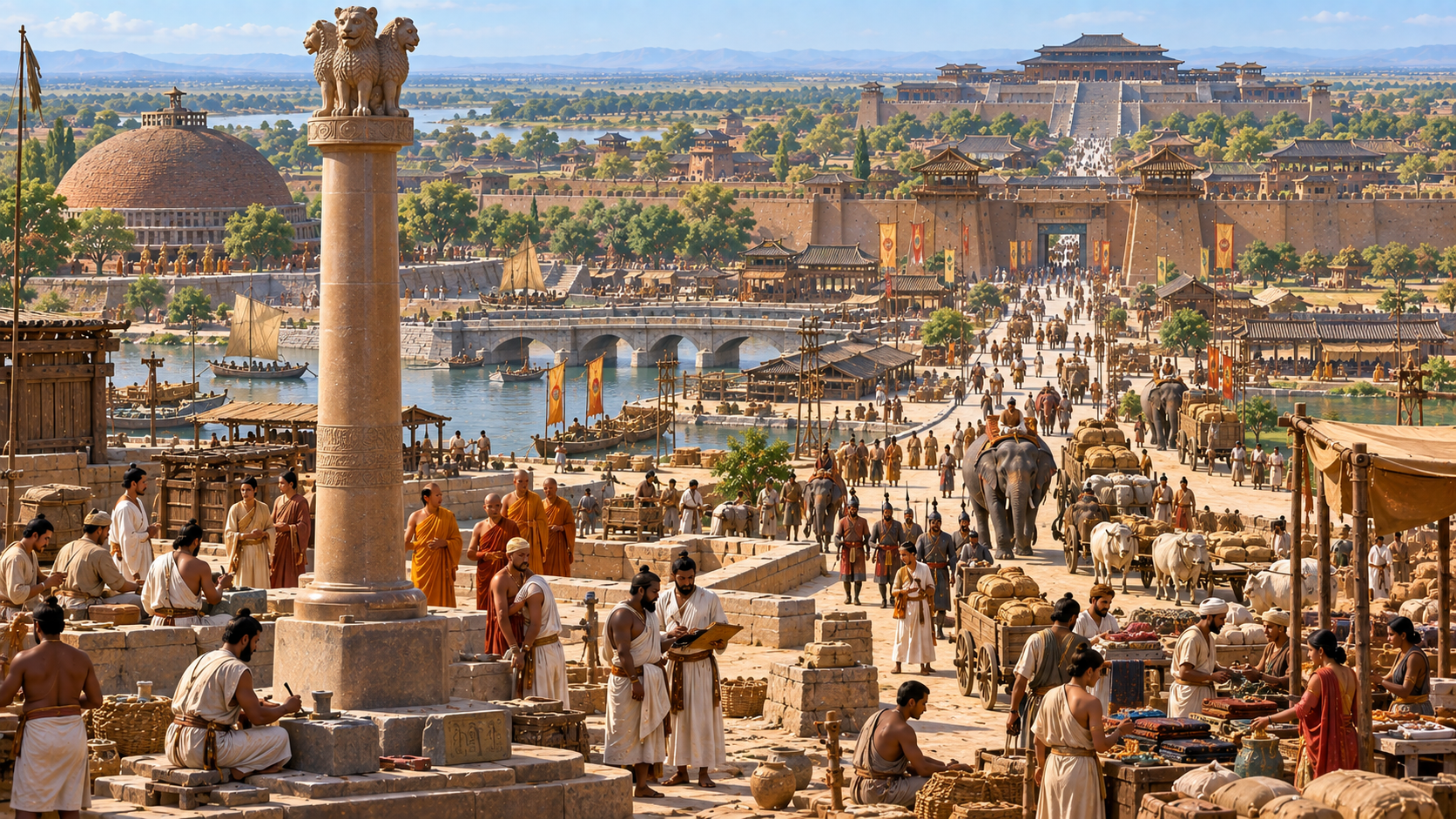
Chandragupta was followed by Bindusara and then Ashoka, whose reign transformed the historical record available for Mauryan India. Ashoka had inscriptions placed on rocks and pillars across different regions of his empire. These edicts provide direct evidence for royal policies, ethical concerns, administration, religious patronage, and the emperor’s attempt to communicate with diverse populations.
Ashoka, Kalinga, and Dhamma
Ashoka is among the best-documented rulers of Ancient India because his inscriptions survive across a wide geographic area. His Major Rock Edict concerning Kalinga describes suffering associated with the conquest and expresses remorse over death, deportation, and human misery. The inscription presents the emperor as increasingly committed to conquest through dhamma rather than military expansion.
Ashoka’s dhamma should not simply be translated as an attempt to impose Buddhism on every subject. His inscriptions advocate principles including respect for parents and teachers, generosity, restraint, humane treatment, concern for different religious communities, and limits on certain forms of animal killing. Ashoka personally supported Buddhism, but his public moral program addressed a religiously diverse imperial population.
Monuments and inscriptions associated with his reign also became important to the later history of Buddhism. Sanchi developed as a major Buddhist center with origins associated with the Mauryan period, although many of its surviving structures were enlarged or constructed in subsequent centuries. Ashoka’s legacy became particularly powerful because later Buddhist traditions remembered him as an exemplary royal patron, even as historical reconstruction depends primarily on inscriptions and archaeology rather than legend alone.
Trade and the Post-Mauryan World
The Mauryan Empire fragmented during the second century BCE, but political fragmentation did not end economic or cultural development. Regional dynasties and kingdoms competed across the subcontinent, while northwestern India became deeply connected with Central Asian and Hellenistic political worlds. Indo-Greek, Shaka, Parthian, and Kushan rulers all became part of the complex political history of northern South Asia.
Trade expanded through both overland and maritime networks. Indian merchants exchanged textiles, spices, precious stones, ivory, metal goods, and other commodities with regions around the Indian Ocean and beyond, while foreign coins, ceramics, artistic influences, and written accounts reveal contacts extending toward the Mediterranean, Central Asia, Arabia, and Southeast Asia. Ports on India’s western and eastern coasts connected inland production centers to maritime commerce.
The Kushan Empire became particularly important in northern India and Central Asia during the early centuries CE. Kushan rulers controlled territories positioned along major commercial routes and patronized multiple religious traditions. Artistic centers such as Gandhara and Mathura developed distinctive approaches to Buddhist imagery, demonstrating how regional traditions could absorb and transform influences moving across political and cultural boundaries.
The Gupta Period
The Gupta dynasty rose to prominence in northern India during the fourth century CE. Rulers including Chandragupta I, Samudragupta, and Chandragupta II expanded Gupta political influence through conquest, diplomacy, alliances, and relationships with subordinate rulers. The empire never encompassed the entire Indian subcontinent, and its authority differed considerably across regions.
The Gupta period is often described as a “golden age,” particularly because of achievements in literature, mathematics, astronomy, art, sculpture, and religious culture. That label can be useful for identifying important intellectual and artistic developments, but it can also oversimplify social realities and obscure equally significant achievements in regions outside Gupta political control. Historians increasingly treat the period as one of major cultural creativity without assuming universal prosperity.
Sanskrit gained extraordinary prestige in courtly, literary, religious, and intellectual settings. Gupta-era sculpture developed influential representations of Buddhist and Brahmanical subjects, while Hindu temple architecture became increasingly visible in surviving archaeological evidence. Gold coinage, inscriptions, sculpture, and monuments provide important evidence for royal ideology and elite culture.
Mathematics, Astronomy, and Learning
Ancient Indian scholars made influential contributions to mathematics and astronomy, although many developments occurred gradually and continued beyond the chronological boundaries of the Gupta Empire. The place-value decimal tradition and increasingly sophisticated uses of zero emerged within Indian mathematical culture over time. These ideas eventually traveled through scholarly networks and became fundamental to mathematics across much of the world.
Aryabhata, born in the late fifth century CE, wrote an influential mathematical and astronomical work known as the Aryabhatiya. He developed methods relating to arithmetic, algebra, trigonometry, astronomical calculations, and planetary motion. His work illustrates the sophistication of scientific scholarship in early India while also reminding readers that ancient knowledge developed through cumulative traditions rather than isolated flashes of invention.
Medicine likewise possessed substantial textual traditions. Works associated with Ayurveda discuss diagnosis, diet, pharmacology, surgery, bodily processes, and approaches to health, although the dates and textual histories of important compilations are complex. Ancient Indian learning encompassed grammar, logic, philosophy, linguistics, mathematics, astronomy, medicine, politics, and religious scholarship.
Society and Everyday Life in Ancient India
Most inhabitants of Ancient India lived outside monumental palaces and religious centers. Agricultural communities formed the economic foundation of kingdoms and empires, cultivating grains and other crops while raising livestock and participating in regional markets. Rural life varied considerably according to environment, landholding arrangements, political demands, caste and occupational structures, and access to water.
Cities supported merchants, administrators, religious communities, metalworkers, potters, textile producers, jewelers, builders, entertainers, and many other occupations. Guild-like organizations appear in inscriptions and literary evidence from early historic India, suggesting that some craftspeople and merchants organized collectively and could become significant patrons of religious institutions. Donations recorded at Buddhist monuments demonstrate that patronage was not limited to kings.
Women occupied different positions depending on social status, region, family, occupation, and historical period, making sweeping statements about a single female experience misleading. Literary prescriptions do not always describe everyday behavior, while inscriptions and archaeological evidence occasionally reveal women acting as donors, patrons, householders, and members of economically active families. Ancient Indian society was hierarchical, but it was also sufficiently varied that normative texts cannot be treated as straightforward descriptions of every community.
Ancient Indian Art and Architecture
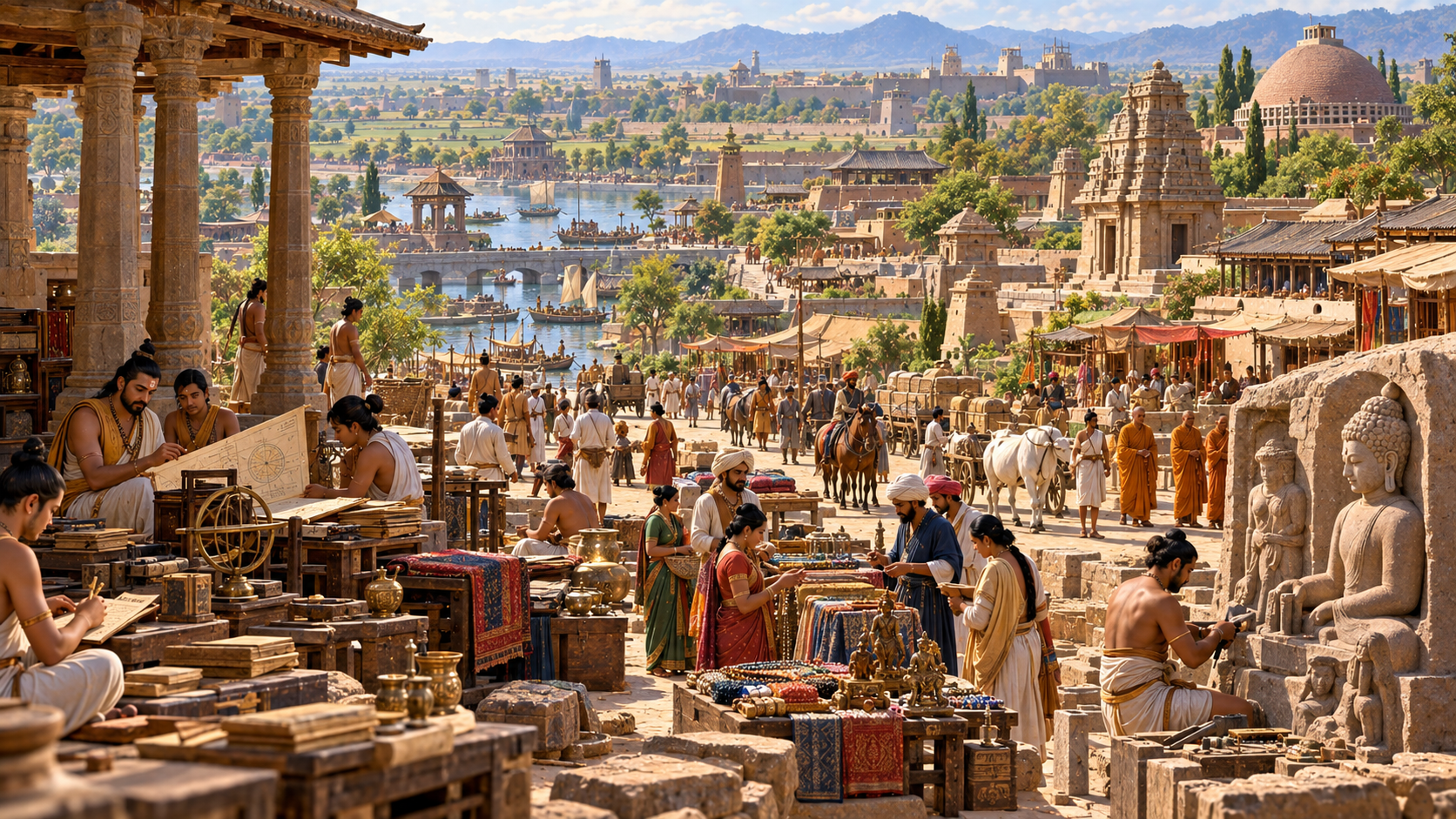
The surviving art of Ancient India is inseparable from religious, political, and social history. Mauryan stone pillars, stupas, railings, gateways, cave complexes, sculptures, coins, and later temples reveal changing ideas about kingship, sacred space, devotion, and representation. Materials ranging from polished stone and terracotta to bronze and precious metals demonstrate sophisticated craft traditions.
Buddhist architecture became particularly influential. The stupa developed as a focus for relics, devotion, circumambulation, patronage, and artistic storytelling, while monasteries provided spaces for religious communities. At Sanchi, architectural additions accumulated across centuries, preserving evidence for the changing forms of Buddhist art and patronage.
Brahmanical and Jain artistic traditions also expanded, particularly during the early centuries CE. Images of Vishnu, Shiva, goddesses, Jain Tirthankaras, the Buddha, bodhisattvas, and numerous other sacred figures developed increasingly recognizable iconographies. These artistic traditions would profoundly influence later architecture and visual culture across South and Southeast Asia.
The Legacy of Ancient India
The historical importance of Ancient India extends far beyond individual dynasties. Religious and philosophical traditions originating or developing in South Asia—including Buddhism, Jainism, and the many traditions eventually grouped under Hinduism—shaped societies across enormous geographic areas. Sanskrit literature, philosophical systems, political ideas, artistic conventions, mathematical knowledge, and scientific traditions continued to be studied and transformed long after ancient empires disappeared.
Commercial and cultural exchange also connected the subcontinent to a wider world. Merchants, monks, diplomats, artisans, and travelers carried goods and ideas through Central Asia, the Indian Ocean, and Southeast Asia. Indian religious imagery, scripts, languages, political concepts, and literary traditions were adapted by other societies rather than simply copied unchanged.
Perhaps the clearest lesson of Ancient India is that continuity did not require political unity. Harappan cities, Vedic communities, Ganges kingdoms, Mauryan administrators, Buddhist monasteries, Kushan trading centers, southern polities, and Gupta courts belonged to different historical worlds, yet their interactions contributed to later South Asian civilization. Ancient Indian history is therefore best understood not as the story of one timeless culture, but as the cumulative history of diverse peoples continually reshaping institutions, beliefs, technologies, languages, and connections across the subcontinent.
Conclusion
Ancient India developed through several profound transformations, beginning with early agricultural communities and the urban sophistication of the Harappan civilization before moving through Vedic society, expanding states, new religious movements, imperial experiments, and increasingly interconnected regional cultures. The Mauryan Empire created an unprecedented political framework across much of the subcontinent, while Ashoka’s inscriptions provide an exceptional direct voice from ancient Indian kingship. Later centuries brought Indo-Greek and Central Asian connections, Kushan power, flourishing trade, and the cultural achievements associated with Gupta-era India.
Yet archaeology repeatedly cautions against reducing this history to a neat succession of dynasties. The undeciphered Indus script leaves major questions unanswered, literary traditions often preserve several chronological layers, and the boundaries between political authority, cultural influence, and religious identity changed constantly. What emerges from the evidence is a civilization of remarkable diversity whose cities, philosophies, religious traditions, artistic achievements, commercial networks, and intellectual discoveries became part of a historical legacy extending far beyond the borders of the Indian subcontinent.
FAQ
When did Ancient India begin?
There is no universally agreed single starting date for Ancient India because complex societies developed gradually across different parts of South Asia. Agricultural settlements existed long before the great Harappan cities, while the mature phase of the Indus civilization became one of the world’s major Bronze Age urban traditions during the third millennium BCE. For a broad historical guide, early farming communities and the rise of Harappan civilization provide a more meaningful beginning than assigning Ancient India one exact foundation date.
What was the Indus Valley Civilization?
The Indus Valley Civilization, also called the Harappan civilization, was an extensive Bronze Age civilization centered in northwestern South Asia but distributed across a much larger territory than the Indus valley alone. Its communities built planned settlements, managed water and drainage, practiced specialized crafts, used standardized weights and seals, and maintained long-distance trade connections. Major sites include Harappa, Mohenjo-daro, Dholavira, and numerous smaller settlements spread across areas now divided among India, Pakistan, and neighboring regions.
Has the Indus script been deciphered?
No decipherment of the Indus script has achieved broad scholarly acceptance. The inscriptions are generally very short, the underlying language remains uncertain, and researchers lack a securely identified bilingual inscription that could provide a key to the signs. Proposed decipherments should therefore not be presented as established translations, and the undeciphered script remains one of the most significant unresolved problems in the archaeology of ancient South Asia.
Did Aryans destroy the Indus Valley Civilization?
The older theory that invading Aryans suddenly destroyed the major Harappan cities is not supported as a simple explanation for the civilization’s urban transformation. Harappan decline and regional reorganization unfolded over time and involved changing settlement patterns, economic networks, environmental conditions, and river systems. Indo-Aryan migration and cultural interaction remain important subjects of research, but they should be distinguished from the outdated image of one invading army abruptly destroying the entire Indus civilization.
Who was Ashoka?
Ashoka was a Mauryan emperor who ruled much of the Indian subcontinent during the third century BCE and is known particularly through inscriptions placed on rocks and pillars. His edicts discuss administration, moral conduct, religious communities, animal welfare, and his remorse concerning the suffering associated with the conquest of Kalinga. Although Ashoka personally supported Buddhism, his public policy of dhamma was broader than simply requiring his subjects to adopt Buddhist beliefs.
What religions developed in Ancient India?
Ancient India was the setting for the development of several major religious and philosophical traditions. Vedic religious traditions contributed to the long and complex formation of what is now broadly called Hinduism, while Buddhism and Jainism emerged within the intellectually diverse environment of the first millennium BCE. These traditions changed substantially over time, interacted with local beliefs and competing philosophies, and eventually influenced societies far beyond the Indian subcontinent.
Why is the Gupta period important?
The Gupta period is associated with major developments in Sanskrit literature, mathematics, astronomy, sculpture, religious culture, coinage, and temple architecture. It has frequently been called a golden age, although modern historians use that description cautiously because it can exaggerate uniform prosperity and overlook important developments outside Gupta territory. Its lasting importance lies in the influential intellectual, artistic, religious, and political traditions that flourished during and around the Gupta era.
What did Ancient India contribute to world civilization?
Ancient and early historic South Asia produced influential traditions in mathematics, astronomy, medicine, philosophy, linguistics, literature, religion, architecture, metallurgy, and visual art. Buddhism spread from South Asia across much of Asia, while Indian mathematical traditions played a major role in the development and transmission of the decimal place-value system and the mathematical use of zero. Trade and cultural networks also carried Indian scripts, religious concepts, artistic forms, literature, and scientific knowledge into Central, Southeast, and other parts of Asia.
SOURCES & REFERENCES
UNESCO World Heritage Centre — Dholavira: a Harappan City — UNESCO documents Dholavira’s occupation, fortifications, sophisticated water-management system, workshops, social differentiation, and trade with Mesopotamia and Oman. UNESCO World Heritage Centre
UNESCO World Heritage Centre — Archaeological Ruins at Moenjodaro — UNESCO’s World Heritage documentation for one of the principal urban archaeological sites of the Indus civilization.
UNESCO World Heritage Centre — Buddhist Monuments at Sanchi — UNESCO documents Sanchi’s stupas, pillars, temples, and monasteries and its long importance as a Buddhist center. UNESCO World Heritage Centre
University of Chicago Press — Edicts of Asoka — Academic edition covering Ashoka’s rock and pillar edicts, Kalinga, dhamma, administration, religious tolerance, Buddhism, and public policy. University of Chicago Press
Columbia University Press — Mauryan India — Scholarly history of Mauryan India based on epigraphic, textual, archaeological, and numismatic evidence. Columbia University Press
University of Chicago Library — The World of South Asian Scripts — University resource on Brahmi, Ashokan inscriptions, and the historical development of South Asian writing systems. University of Chicago Library
Penn Museum — The Indus Civilization and Dilmun — Museum research discussing Indus inscriptions, archaeological evidence, and ancient commercial connections between South Asia and Mesopotamia. Penn Museum
The Metropolitan Museum of Art — Gupta Period Gold Coin of Chandragupta II — Museum documentation of Gupta-period coinage associated with Chandragupta II. The Metropolitan Museum of Art
The Metropolitan Museum of Art — Gupta Period Buddha — Museum documentation of fifth-century Gupta-period Buddhist sculpture and material culture.