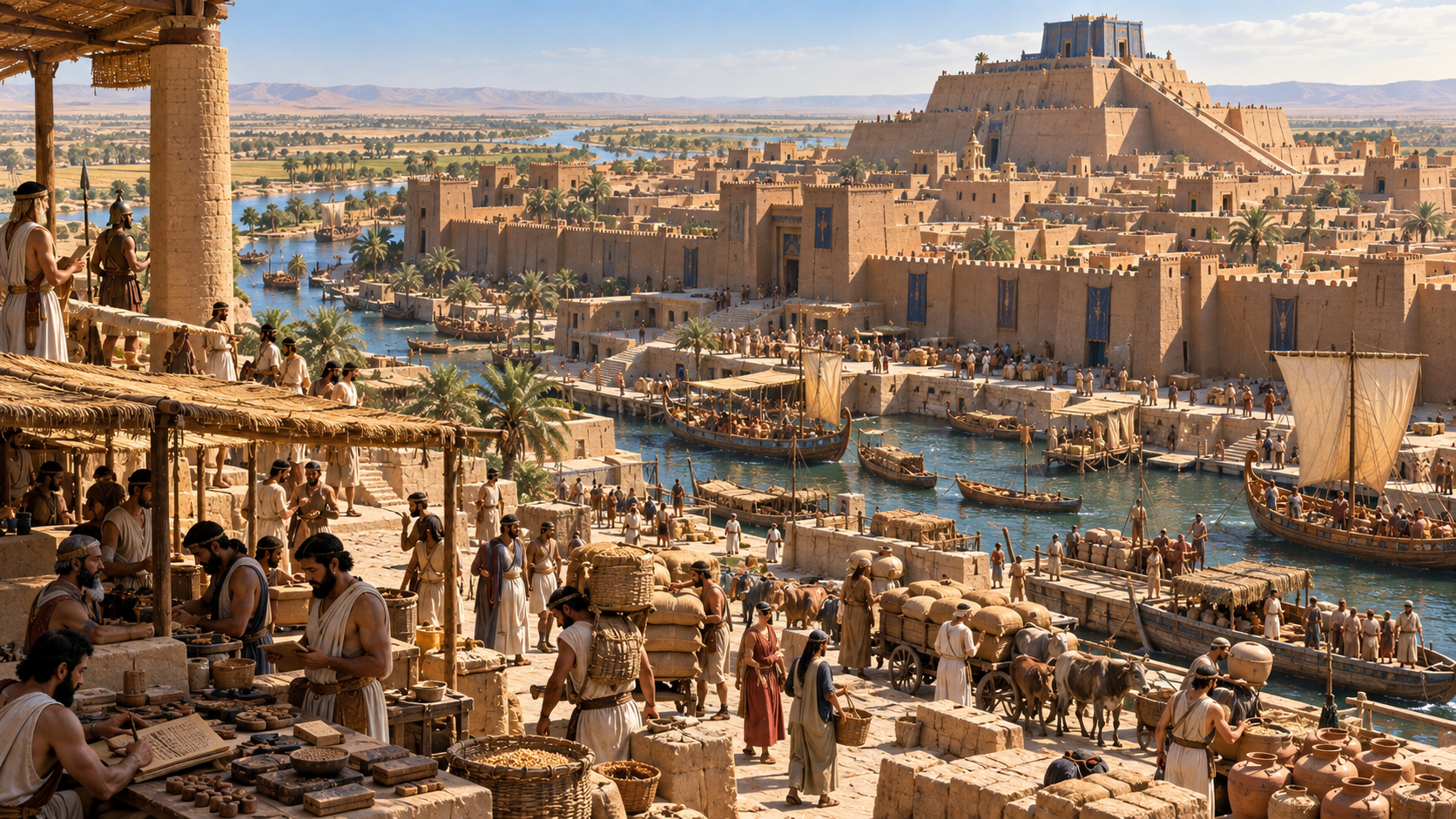
Ancient Mesopotamia was one of the most important regions in the development of early urban civilization, stretching across the fertile lands associated with the Tigris and Euphrates rivers in what is now primarily Iraq, with parts of northeastern Syria and southeastern Turkey also falling within the broader historical region. Rather than being a single kingdom or people, Mesopotamia was a changing landscape of cities, states, languages, cultures, and empires that developed over thousands of years. Sumerians, Akkadians, Babylonians, Assyrians, and many other communities built cities, developed writing, organized complex economies, constructed monumental temples, established legal traditions, and created literary and scholarly traditions whose surviving records still shape our understanding of the ancient world. British Museum
AI & Editorial Note
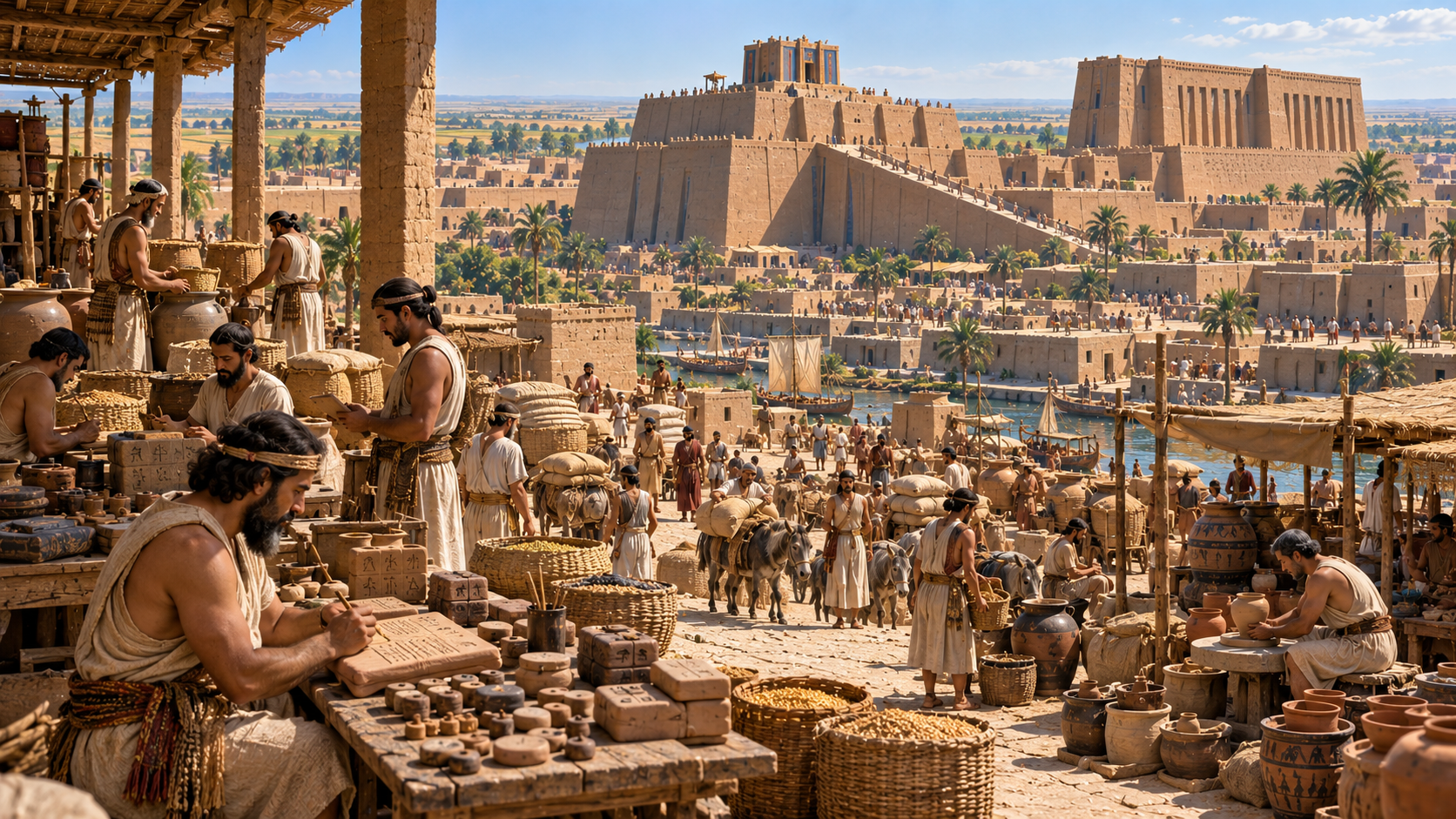
Hidden Frontiers uses AI-assisted tools as part of its content-production workflow, including research organization, drafting assistance, and visual development. The factual content of this article is strictly grounded in verified, cited sources, and disputed or uncertain information is identified where appropriate. Visuals accompanying this article are AI-generated historical reconstructions created for illustrative purposes.
What Was Ancient Mesopotamia?
The name Mesopotamia comes from a Greek expression meaning “land between the rivers,” referring to the Tigris and Euphrates. The region was not defined by a single political boundary because its extent changed according to period and context, and ancient peoples themselves used different names for particular lands, cities, and kingdoms. In modern historical writing, Mesopotamia generally refers to a broad zone centered on the river systems of present-day Iraq and extending into neighboring parts of Syria and Turkey. British Museum
Geography was fundamental to the region’s history, but the familiar idea that the rivers simply created an effortless agricultural paradise is misleading. Southern Mesopotamia received relatively limited rainfall and depended heavily on organized water management, while flooding could be destructive as well as beneficial. Communities developed canals, fields, storage systems, and administrative institutions that allowed agricultural production to support increasingly large populations, helping some settlements grow into towns and cities. British Museum
Mesopotamia also occupied an important position between several different ecological and cultural zones. Raw materials that were scarce in the southern alluvial plain, including high-quality stone, timber, and certain metals, had to be obtained through exchange or long-distance networks. Archaeological evidence and written records consequently reveal connections extending toward Anatolia, the Levant, Iran, the Gulf, and other regions, showing that Mesopotamian civilization developed through interaction as well as local innovation. The Metropolitan Museum of Art
The Agricultural Foundations of Civilization
Permanent agricultural settlement developed in Mesopotamia thousands of years before the great cities of Sumer appeared. By the sixth millennium BCE, communities in parts of the region were cultivating crops and keeping domesticated animals, while southern Mesopotamia presented distinctive challenges because reliable agriculture required deliberate management of water. Over generations, farming communities developed increasingly sophisticated ways of organizing land, labor, crops, storage, and irrigation. British Museum
Agriculture created more than food surpluses. It encouraged systems for storing grain, allocating labor, managing fields, supporting specialists, and coordinating construction, all of which contributed to increasingly complex societies. Temples and later palaces became major institutional centers in many Mesopotamian cities, while administrators and scribes recorded quantities of grain, livestock, land, labor, and other resources. These systems did not appear everywhere at the same time or operate identically, but they became central features of early Mesopotamian urban society. The Metropolitan Museum of Art
The environment could also impose severe constraints. Irrigation could increase agricultural productivity, but maintaining canals and drainage systems required substantial labor, while changes in water availability and soil conditions could affect settlement patterns and agricultural output. Modern research into ancient irrigation emphasizes that Mesopotamian agriculture was a dynamic system shaped by environmental conditions, human management, and long-term changes rather than a simple story of technological triumph. UChicago ISAC
Uruk and the Rise of the First Cities
The development of large urban settlements accelerated dramatically during the fourth millennium BCE. Uruk, in southern Mesopotamia, became one of the most important centers of this transformation, and the archaeological tradition associated with Uruk is found across a surprisingly broad area. British Museum collections place Uruk material culture approximately between 4000 and 3000 BCE and note that it spread across parts of Mesopotamia, southeastern Anatolia, and Iran. British Museum
Uruk’s importance lies not simply in its size but in the emergence of institutions capable of organizing large populations and complex economic activity. Monumental buildings, specialized crafts, administrative practices, seals, standardized containers, and early writing all appear within the broader transformation associated with Late Uruk society. The city therefore provides an important window into the processes by which settlements became urban centers with increasingly specialized economic and political structures. The Metropolitan Museum of Art
The expression “first civilization” can be useful as a shorthand, but it should not imply that one city suddenly invented civilization from nothing. Urbanization was a long process involving earlier villages, agricultural communities, craft traditions, exchange networks, institutional experimentation, and changing social relationships. What makes southern Mesopotamia especially important is the unusually early appearance of large cities combined with writing, monumental architecture, administrative institutions, and complex political organization.
The Invention and Development of Cuneiform
Writing is one of Ancient Mesopotamia’s most famous achievements, but its earliest purpose appears to have been practical rather than literary. Some of the earliest known tablets from southern Mesopotamia, dating to around the late fourth millennium BCE, record economic information such as commodities, quantities, and distributions. Early signs were largely pictographic and numerical, and the writing system gradually developed into the wedge-shaped script now known as cuneiform. The Metropolitan Museum of Art
The development of cuneiform transformed the possibilities of administration and communication. Scribes could record transactions, property, labor, taxation, offerings, royal activities, legal matters, literature, mathematics, astronomy, medicine, and religious traditions. The script was adapted to write more than one language, most importantly Sumerian and Akkadian, demonstrating that cuneiform was a writing system whose use extended well beyond the people who first developed it. British Museum
Clay was particularly important because it was widely available in the alluvial landscapes of southern Mesopotamia. A scribe could shape a lump of wet clay and press a reed stylus into its surface, leaving distinctive wedge-shaped marks that hardened when the tablet dried or was accidentally or deliberately baked. Thousands of surviving tablets provide historians with an unusually detailed record of ancient economic, political, legal, literary, and scholarly activity, although the surviving evidence is uneven and heavily influenced by what ancient institutions chose to record and what archaeological conditions preserved. British Museum
Sumer and the City-State World
Sumer emerged as a major cultural and political tradition in southern Mesopotamia during the third millennium BCE. Rather than forming a single unified kingdom for most of its early history, Sumer was characterized by competing city-states such as Uruk, Ur, Lagash, Nippur, Kish, and others. These cities had their own rulers, patron deities, temples, territories, and political interests, and warfare between neighboring states was a recurring feature of the period. The Metropolitan Museum of Art
Religion and political authority were closely connected to the structure of the city-state. Temples were understood as the houses of gods and served not merely as places of ritual but also as important institutional centers, while rulers presented themselves as responsible for maintaining divine favor, order, irrigation works, temples, and the prosperity of their communities. Archaeological evidence from early dynastic cities demonstrates the enormous importance of religious institutions, although historians must be careful not to assume that every part of everyday life was directly controlled by temples or palaces. The Metropolitan Museum of Art
Sumerian culture also produced some of the world’s earliest surviving literary traditions. Hymns, myths, royal inscriptions, laments, administrative documents, legal texts, and stories were written in Sumerian cuneiform, and later scribes preserved or translated many Sumerian compositions. Sumerian eventually ceased to be a spoken language, but it remained important as a learned and literary language for centuries, much as certain classical languages were preserved by later scholarly traditions. The Metropolitan Museum of Art
The Akkadian Empire
The political landscape changed dramatically during the rise of the Akkadian dynasty in the twenty-fourth century BCE. Sargon of Akkad, traditionally dated to the reign beginning around 2334 BCE in many modern chronologies, established a powerful state that brought much of Mesopotamia under one ruler and extended its influence beyond the traditional southern Mesopotamian heartland. The capital city of Akkad, or Agade, has not yet been securely located, which is an important reminder that major parts of Mesopotamian history remain archaeologically incomplete. The Metropolitan Museum of Art
The Akkadian period introduced a new political scale. Instead of independent city-states competing primarily within southern Mesopotamia, an imperial government attempted to control a much larger territory containing different communities and languages. Akkadian, a Semitic language, was written using the established cuneiform system, creating a long-lasting interaction between Sumerian literary traditions and Akkadian political and administrative culture. The Metropolitan Museum of Art
Sargon’s successors continued and expanded the dynasty, with Naram-Sin becoming particularly prominent. The Akkadian Empire eventually weakened and collapsed, but its political model had an enduring influence on later Mesopotamian rulers. Later kings repeatedly drew upon the memory of earlier imperial figures, demonstrating that political legitimacy in Mesopotamia could depend not only on military power but also on the ability to present a ruler as the heir to an established historical tradition. The Metropolitan Museum of Art
Ur and the Reunification of Southern Mesopotamia
After the decline of the Akkadian state and a period of political fragmentation, the Third Dynasty of Ur created another powerful centralized kingdom in southern Mesopotamia around the end of the third millennium BCE. Ur-Nammu and his successors established an administrative system that left extensive written records and undertook major building projects. The surviving evidence illustrates how rulers combined political authority, religious patronage, taxation, labor organization, and monumental construction. British Museum
Ur became particularly famous for its monumental ziggurat. These massive stepped platforms were associated with major temples, although their exact religious significance remains uncertain, and modern interpretations should not treat them as simple “temple pyramids” with one universally established function. The ziggurat at Ur was built and expanded within a long tradition of monumental religious architecture, and later Mesopotamian societies continued constructing similar structures for centuries. The Metropolitan Museum of Art
The Ur III state also demonstrates the extraordinary scale of Mesopotamian administration. Thousands of surviving tablets record deliveries, labor, agricultural production, livestock, taxation, and institutional activity, giving historians unusually detailed evidence for an early bureaucratic economy. Yet those records largely represent the concerns of institutions, meaning that ordinary people’s lives must be reconstructed by combining administrative texts with archaeology, settlement evidence, material culture, and other forms of evidence.
Babylon and Hammurabi
By the early second millennium BCE, political power had shifted among several competing states, including Isin, Larsa, Assyria, and Babylon. Babylon was initially only one of several regional powers, but its position changed dramatically under Hammurabi, who ruled approximately from 1792 to 1750 BCE according to the chronology used by major museum references. During his reign, Babylon expanded from a relatively modest kingdom into the dominant power over much of southern and central Mesopotamia. The Metropolitan Museum of Art
Hammurabi is particularly famous because of the monumental legal inscription traditionally called the Code of Hammurabi. The Louvre emphasizes that the text should not be understood as a modern legal code in the strict sense; it is better described as a collection of legal judgments or jurisprudence organized around subjects such as property, family, trade, and labor. Its importance lies not simply in the individual penalties recorded but in what the monument reveals about royal ideology, justice, social hierarchy, property, and the responsibilities claimed by an ancient ruler. Le Louvre
The Babylonian kingdom did not remain permanently dominant after Hammurabi. Political power shifted again as new dynasties and foreign powers entered Mesopotamian affairs, and Babylon itself experienced periods of conquest, destruction, restoration, and renewed importance. Nevertheless, the city became one of the most enduring political and cultural centers in the ancient Near East, with later rulers repeatedly investing in its temples, walls, streets, and monumental architecture.
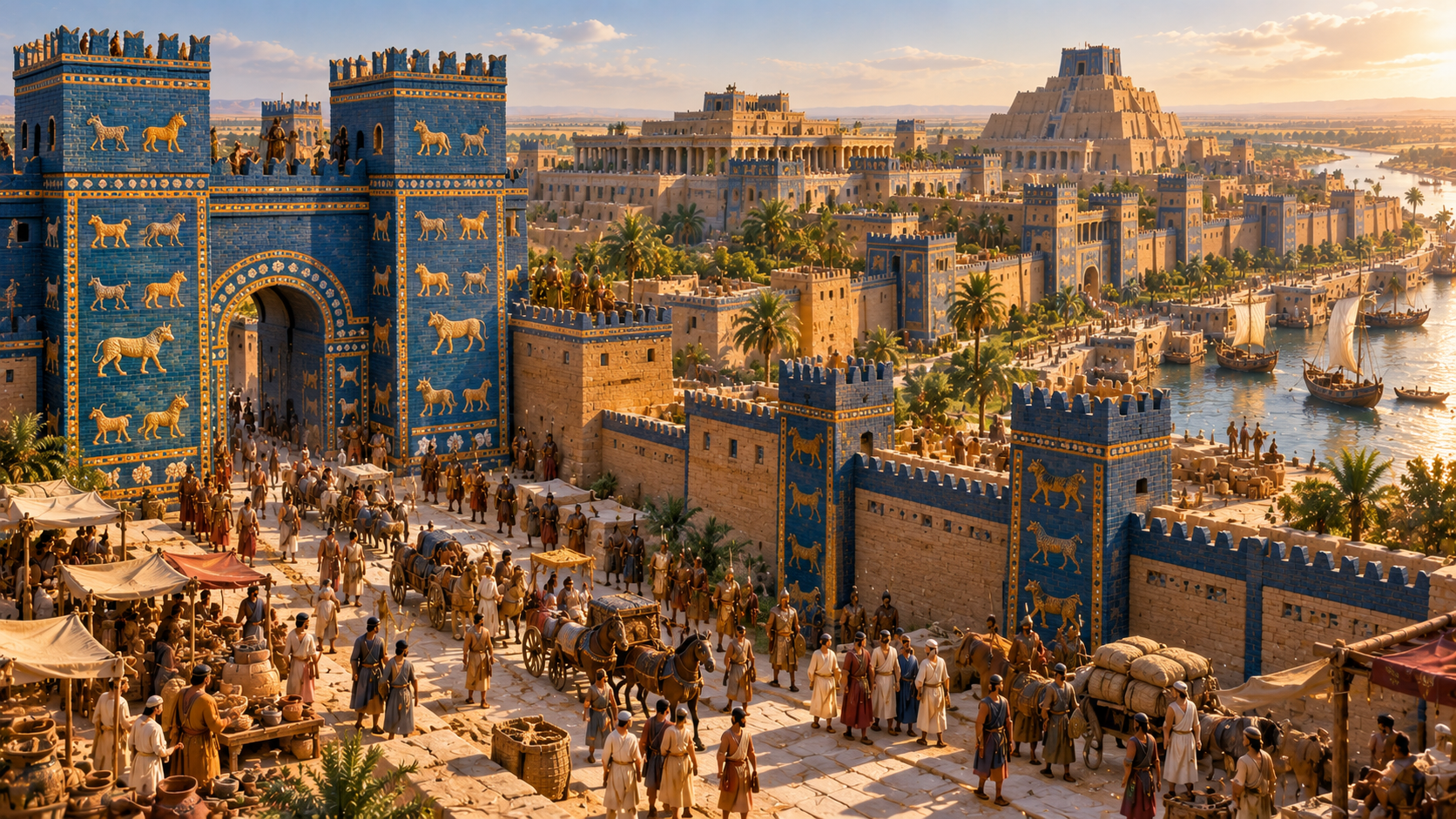
Assyria and the Rise of an Imperial Power
Assyria developed in northern Mesopotamia around the city of Ashur and eventually became one of the most formidable imperial powers of the ancient Near East. Its early economic development was closely connected to long-distance trade, while later rulers expanded Assyrian political control through military campaigns, provincial administration, tribute, deportation, and diplomatic relationships. The Assyrian state changed significantly over time, so it is more accurate to view Assyrian imperialism as a developing political system than as a fixed model that existed unchanged for centuries. Iranica Online
The Neo-Assyrian Empire reached extraordinary territorial scale during the first millennium BCE. Kings such as Tiglath-pileser III, Sargon II, Sennacherib, Esarhaddon, and Ashurbanipal expanded or consolidated imperial authority across Mesopotamia and large parts of the Levant and surrounding regions. Royal inscriptions and palace reliefs deliberately emphasized military victories, tribute, royal power, and the punishment of enemies, providing important evidence while also requiring careful interpretation because these sources were designed to project the authority of the Assyrian king. Iranica Online
Assyrian capitals became monumental centers of administration and royal display. Sargon II established Dur-Sharrukin, while his successor Sennacherib moved the capital to Nineveh and initiated an enormous building program. Nineveh became famous for its palaces, temples, gardens, monumental sculpture, and scholarly collections, demonstrating that the Assyrian state relied on intellectual and administrative institutions as well as military force. The Metropolitan Museum of Art
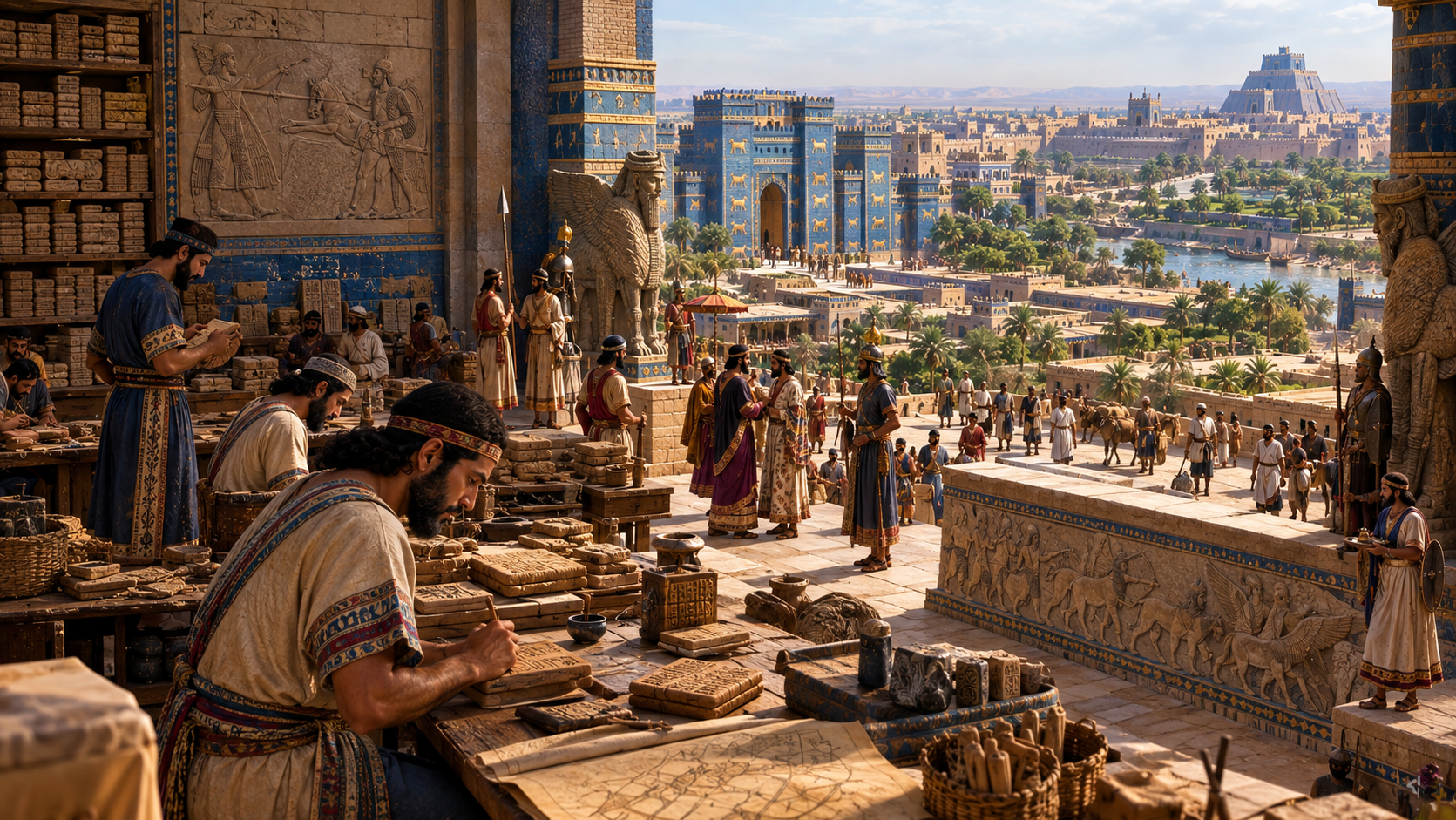
The Library of Ashurbanipal
One of the most important surviving collections of Mesopotamian writing comes from Nineveh and is associated with King Ashurbanipal. More than thirty thousand clay tablets and fragments were discovered in the ruins of the city, containing literary, scientific, administrative, religious, and royal texts. The collection provides an extraordinary view of Mesopotamian scholarship during the seventh century BCE and preserves copies of much older works that might otherwise have disappeared. British Museum
The famous Epic of Gilgamesh is among the literary traditions preserved through copies found in the broader cuneiform tradition, including material associated with Nineveh. The story centers on Gilgamesh, king of Uruk, and his relationship with Enkidu, eventually turning toward themes of mortality, friendship, loss, kingship, and the human desire for immortality. Although Gilgamesh may have been based on a historical ruler, the surviving epic is a literary composition assembled and reshaped over centuries, so the story should not be treated as a straightforward biography. British Museum
Ashurbanipal’s collection also illustrates the unusual continuity of Mesopotamian scholarly traditions. Scribes copied older Sumerian and Akkadian works, compiled lexical lists, preserved omens, studied celestial phenomena, recorded medical knowledge, and transmitted religious literature. The library therefore demonstrates that Mesopotamian civilization was not simply a sequence of unrelated empires but a long intellectual tradition in which later scholars actively preserved and reinterpreted the knowledge of earlier periods. British Museum
Babylon in the Neo-Babylonian Age
The Assyrian Empire eventually collapsed at the end of the seventh century BCE, and Babylon once again became the center of a major Mesopotamian kingdom. The Neo-Babylonian Empire, associated particularly with rulers such as Nabopolassar and Nebuchadnezzar II, controlled a substantial portion of the region before being conquered by Cyrus the Great of Persia in 539 BCE. UNESCO identifies Babylon’s period as the capital of the Neo-Babylonian Empire from 626 to 539 BCE as one of the city’s most significant historical phases. UNESCO World Heritage Centre
Nebuchadnezzar II undertook major construction projects at Babylon, transforming the city into a monumental royal and religious center. Its walls, gates, temples, palaces, processional ways, and glazed brick decoration became symbols of royal power, while the city also maintained a strong intellectual and religious tradition. Archaeological evidence demonstrates the extraordinary scale of the urban environment, although popular images of Babylon sometimes combine archaeological evidence with later legends and interpretations. UNESCO World Heritage Centre
The Hanging Gardens of Babylon are a good example of why historical claims must be separated from later tradition. Ancient and later sources associate Babylon with spectacular gardens, but the exact existence, location, and appearance of the famous “Hanging Gardens” remain debated. Modern scholarship therefore treats the gardens cautiously rather than presenting the traditional Seven Wonders narrative as an archaeological certainty.
Religion and the Mesopotamian Gods
Religion was deeply woven into Mesopotamian political, economic, artistic, and social life. Major deities included Anu, Enlil, Enki or Ea, Inanna or Ishtar, Utu or Shamash, Nanna or Sin, and Marduk, although the importance and identity of individual gods changed across time and place. Cities commonly maintained strong relationships with particular patron deities, and temples were understood as divine residences rather than simply buildings where congregations gathered. The Metropolitan Museum of Art
Mesopotamian religious practice involved offerings, prayers, festivals, rituals, divination, temple administration, royal ceremonies, and care for divine images. Gods were often represented in humanlike terms within myths and literary texts, possessing personalities, desires, rivalries, and powers that could affect the fortunes of individuals and communities. There was no single standardized Mesopotamian theology that remained unchanged for three thousand years, so religious beliefs and practices must be understood within particular historical and regional contexts. The Metropolitan Museum of Art
Temples were also major institutions with economic significance. They could own land, employ workers, receive agricultural goods, organize craft production, and participate in redistribution, although the relationship between temples, palaces, households, and private property varied considerably across different periods. Archaeological evidence from early cities shows that religious institutions were powerful, but Mesopotamian society cannot be reduced to a simple temple-controlled economy. The Metropolitan Museum of Art
Daily Life in Ancient Mesopotamia
Most Mesopotamians were not kings, priests, or scribes. They were farmers, herders, craftspeople, merchants, laborers, soldiers, boatmen, builders, servants, and members of households whose lives were shaped by agriculture, family relationships, local institutions, and the demands of the state or temple. Written records make it possible to glimpse contracts, wages, marriage arrangements, loans, property transactions, food distributions, and disputes, although the surviving evidence is much richer for some social groups than for others.
Food production depended heavily on grain agriculture, with barley particularly important in southern Mesopotamia. Dates, legumes, vegetables, fruits, dairy products, fish, and livestock also contributed to diets, depending on region, season, wealth, and access to resources. Brewing beer was common enough to appear repeatedly in administrative and literary records, and surviving tablets include some of the earliest documentary evidence connected with the management of beer and grain. British Museum
Housing varied according to city, period, wealth, and environment. Mudbrick was one of the dominant building materials because suitable stone and timber were comparatively scarce in the southern alluvial plain, while baked bricks and bitumen were used in situations where greater durability was required. Palaces and temples could be monumental, but ordinary homes formed the dense urban fabric in which most people actually lived and worked.
Law, Government, and Social Order
Mesopotamian political systems changed considerably over time. Early city-states were governed by local rulers whose authority was closely connected to religious institutions, while later kingdoms and empires developed more extensive bureaucracies, provincial administrations, military structures, taxation systems, and diplomatic networks. Kings regularly described themselves as responsible for justice, temple restoration, protection of the land, and the prosperity of their subjects, although royal inscriptions naturally present the ruler’s preferred image of government rather than an objective description of political reality.
Law was expressed through royal pronouncements, court procedures, contracts, precedents, customary practices, and written collections of legal decisions. The Code of Hammurabi is the best-known example, but it was part of a much broader Mesopotamian tradition of recording legal and administrative practice. Its surviving provisions reveal a society characterized by social hierarchy, differentiated legal status, property rights, family regulation, labor relationships, and penalties that could vary according to the status of the people involved. Le Louvre
Women could own or manage property, participate in economic transactions, appear in legal documents, and hold various occupations, but their rights and social roles differed substantially according to period, class, marital status, and local custom. Enslavement also existed across Mesopotamian societies, with enslaved people performing agricultural, domestic, institutional, and other forms of labor. The evidence therefore points to complex social hierarchies rather than a simple division between a powerful king and an undifferentiated population.
Trade and the Wider Ancient World
Mesopotamia’s agricultural wealth did not eliminate the need for foreign resources. Southern Mesopotamia lacked many materials required for construction, metallurgy, and luxury production, encouraging extensive trade with neighboring regions. Texts and archaeological discoveries show connections with Anatolia, Syria, Iran, the Gulf, the Levant, and regions farther afield. The Metropolitan Museum of Art
Merchants, diplomatic missions, military expeditions, and royal networks carried goods and ideas across these regions. Copper from Oman, for example, was associated with long-distance exchange networks reaching Mesopotamia during the third millennium BCE, while Mesopotamian objects and writing traditions also traveled beyond the Tigris-Euphrates heartland. These networks demonstrate that early Mesopotamian civilization was deeply connected to its neighbors rather than isolated behind the boundaries of a river valley. UNESCO World Heritage Centre
Cultural exchange was equally significant. Mesopotamian writing systems, artistic motifs, administrative practices, religious concepts, and literary traditions influenced neighboring regions, while Mesopotamian societies themselves adopted and adapted ideas from the cultures with which they interacted. The history of the region is therefore better understood as a network of exchanges than as a sequence of isolated civilizations.
Mathematics, Astronomy, and Scholarship
Mesopotamian scholars developed sophisticated systems of calculation and record keeping. Administrative needs encouraged numerical notation and metrological systems, while mathematical texts demonstrate the ability to solve practical and theoretical problems involving quantities, areas, volumes, and other calculations. Later Babylonian scholars also developed extensive traditions of astronomical observation and mathematical astronomy, building upon knowledge accumulated over many generations.
Astronomy was closely connected with religion, calendrical needs, agriculture, royal concerns, and scholarly traditions. Scribes observed celestial phenomena and recorded patterns that could later be interpreted through systems of omens or used for more systematic calculations. Babylonian mathematical and astronomical traditions survived long enough to influence later scientific cultures, making Mesopotamia an important part of the ancient history of quantitative scholarship.
The preservation of knowledge was itself a major achievement. Scribes copied earlier compositions, produced lexical lists, maintained technical traditions, and taught specialized writing skills within scholarly communities. The survival of these texts allows modern researchers to study Mesopotamian society at a level of detail that is exceptional for the ancient world, while also reminding us that literacy was concentrated among a relatively small portion of the population.
The Fall of the Great Mesopotamian Empires
Mesopotamian political power repeatedly rose and fell because the region was exposed to internal struggles, military competition, changing trade patterns, environmental pressures, and powerful neighboring states. The collapse of the Akkadian Empire, the decline of the Ur III state, the fall of Babylonian dynasties, and the eventual destruction of the Neo-Assyrian Empire all demonstrate that political centralization was difficult to sustain indefinitely. No single factor explains every collapse, and modern historians increasingly avoid simple narratives in which one invasion or climate event is treated as the sole cause.
The Neo-Assyrian Empire fell rapidly at the end of the seventh century BCE. Nineveh was captured and destroyed in 612 BCE by a coalition including Babylonians and Medes, while the remaining Assyrian territories were defeated over the following years. The political landscape then shifted toward the Neo-Babylonian Empire before Babylon itself fell to Cyrus the Great in 539 BCE. British Museum
The conquest of Babylon did not mean the end of Mesopotamian culture. Under Persian rule, Babylon and other Mesopotamian cities remained important centers, and local traditions continued even as Aramaic became increasingly dominant in everyday communication. Akkadian and Sumerian survived longer as written languages within scholarly and religious traditions, demonstrating that cultural continuity could persist long after political control had passed to another empire. Iranica Online
What Happened to Mesopotamia After the Great Empires?
Mesopotamian history continued long after the traditional kingdoms of Sumer, Babylon, and Assyria disappeared. Persian, Hellenistic, Parthian, and Sasanian powers successively controlled or influenced the region, while cities such as Babylon and others continued to function in changing political and economic environments. The ancient cuneiform tradition itself persisted remarkably late, although by the second century CE it was close to extinction as alphabetic scripts became dominant. The Metropolitan Museum of Art
This later history matters because “Ancient Mesopotamia” is sometimes presented as though the region vanished when Alexander the Great or the Persian Empire arrived. In reality, populations, cities, religious institutions, languages, agricultural systems, and intellectual traditions continued to evolve under new rulers. Mesopotamia was repeatedly incorporated into larger empires while maintaining distinctive local traditions.
The Legacy of Ancient Mesopotamia
The legacy of Ancient Mesopotamia extends far beyond the famous claim that it produced “the first civilization.” Its cities provide evidence for some of the earliest large-scale urban institutions, its tablets preserve some of the world’s earliest extensive written records, and its legal, administrative, mathematical, literary, religious, and astronomical traditions influenced neighboring cultures and later generations. The survival of cuneiform texts means that historians can examine ancient economic transactions and royal propaganda alongside literature, mythology, scholarly texts, and personal documents. The Metropolitan Museum of Art
The region also demonstrates that civilization was not a single invention that happened at one moment. Urban societies developed through long processes involving agriculture, water management, specialization, trade, political organization, religious institutions, technological adaptation, and cultural exchange. Mesopotamia is especially valuable to historians because those processes can be traced across several thousand years, revealing both continuity and repeated transformation.
Perhaps the most important lesson is that the civilizations of Mesopotamia were dynamic rather than static. Sumerian cities gave way to Akkadian imperial rule, Ur briefly reunited the south, Babylon became a major political center, Assyria built an enormous empire, and Babylon rose again under its Neo-Babylonian rulers. Each political order inherited institutions and knowledge from its predecessors while reshaping them for new circumstances.
Conclusion
Ancient Mesopotamia was a vast and changing historical world in which some of humanity’s earliest cities, writing systems, bureaucratic institutions, monumental religious buildings, legal traditions, literary works, and scholarly practices developed. Its history cannot be reduced to Sumer, Babylon, or Assyria alone because these societies existed within a much longer sequence of settlement, political competition, cultural exchange, and institutional change. From the urban transformation of Uruk to the libraries of Nineveh and the monumental rebuilding of Babylon, Mesopotamian history reveals how complex societies could emerge, expand, collapse, and reinvent themselves.
The surviving record is extraordinary but incomplete. Clay tablets preserve administrative accounts, legal documents, literature, mathematics, royal inscriptions, and religious traditions, while archaeological remains reveal cities, temples, palaces, workshops, homes, roads, canals, and burial sites. Together, these sources show a civilization whose influence was built not only through kings and armies but through generations of farmers, craftspeople, merchants, scribes, priests, administrators, and ordinary families whose lives created the foundations of one of the ancient world’s most enduring cultural traditions.
Quick Historical Timeline
| Period | Approximate Date | Major Development |
|---|---|---|
| Early agricultural settlement | c. sixth millennium BCE onward | Farming communities and increasingly permanent settlements expand |
| Ubaid period | c. sixth–fifth millennium BCE | Complex village societies develop in southern Mesopotamia |
| Uruk period | c. fourth millennium BCE | Large cities, monumental institutions, specialized production, and early writing emerge |
| Early Dynastic period | c. 2900–2350 BCE | Sumerian city-states dominate southern Mesopotamia |
| Akkadian period | c. 2350–2150 BCE | Sargon and his successors establish a large territorial empire |
| Ur III period | c. twenty-first century BCE | Ur becomes the center of a highly organized southern Mesopotamian state |
| Old Babylonian period | c. nineteenth–sixteenth centuries BCE | Babylon rises under Hammurabi and becomes a major regional power |
| Middle and Neo-Assyrian periods | second–first millennia BCE | Assyria develops into a major northern Mesopotamian kingdom and empire |
| Neo-Babylonian period | 626–539 BCE | Babylon becomes the center of a powerful empire under rulers including Nebuchadnezzar II |
| Persian period and later antiquity | from 539 BCE onward | Mesopotamian cities continue under Persian and later Hellenistic, Parthian, and Sasanian rule |
FAQ
What was Ancient Mesopotamia?
Ancient Mesopotamia was a broad historical region associated primarily with the Tigris and Euphrates river systems in present-day Iraq and neighboring parts of Syria and Turkey. It was home to many different peoples, languages, kingdoms, and city-states rather than one continuous civilization with a single government. Its importance comes from the unusually early development of large cities, writing, complex administration, monumental architecture, and long-lasting scholarly traditions.
Where was Ancient Mesopotamia located?
Mesopotamia was centered on the lands between and around the Tigris and Euphrates rivers. Its historical extent varied, but the core region corresponds largely to modern Iraq, with parts of northeastern Syria and southeastern Turkey also included in broader definitions. Southern Mesopotamia was especially important for the development of Sumerian urban civilization, while northern Mesopotamia became the heartland of Assyria and other major states.
Who were the Sumerians?
The Sumerians were the people associated with the earliest known urban civilization in southern Mesopotamia and with the Sumerian language. Their major city-states included Uruk, Ur, Lagash, Kish, and Nippur, and they produced extensive cuneiform records, religious literature, administrative documents, and monumental architecture. Sumerian culture continued to influence later Mesopotamian societies even after Akkadian became the dominant spoken language in much of the region.
Who invented cuneiform writing?
Cuneiform developed in southern Mesopotamia during the late fourth millennium BCE, with the earliest known writing associated especially with the urban environment of Uruk. Its first uses appear strongly connected to administrative accounting, including records of commodities and quantities, rather than beginning as a literary script. Over subsequent centuries, cuneiform developed into a flexible writing system used for Sumerian, Akkadian, Babylonian, Assyrian, and other languages and for subjects ranging from commerce to literature and astronomy.
What was the Code of Hammurabi?
The Code of Hammurabi is a famous Babylonian monument containing a collection of legal judgments associated with King Hammurabi, who ruled Babylon in the eighteenth century BCE. The Louvre notes that it should not be understood as a modern legal code but as a large collection of jurisprudence dealing with subjects such as family, property, trade, and labor. Its historical value lies in what it reveals about Babylonian law, social hierarchy, royal ideology, and ideas about justice.
What were ziggurats used for?
Ziggurats were enormous stepped platforms associated with important religious complexes in Mesopotamian cities. Their precise religious meaning is not completely known, although they were closely associated with temples and divine cults, and scholars have proposed different interpretations of their symbolic and practical functions. The famous ziggurat at Ur was part of a major religious complex associated with the moon god Nanna and was one of many such structures built in Mesopotamia.
What did people in Ancient Mesopotamia believe?
Mesopotamian religion was polytheistic and involved large pantheons of gods whose importance varied according to city, period, and political circumstances. Major deities included Enlil, Enki or Ea, Inanna or Ishtar, Shamash, Sin, and Marduk, while individual cities often maintained especially important relationships with particular patron gods. Religious life involved temples, offerings, rituals, festivals, prayers, divination, and the maintenance of divine images, with religion closely connected to political and economic institutions.
Why is Ancient Mesopotamia important?
Ancient Mesopotamia is important because it provides some of the earliest extensive evidence for cities, writing, centralized administration, monumental architecture, complex economies, legal traditions, literature, mathematics, and systematic scholarship. Its influence spread through long-distance trade, diplomacy, warfare, migration, and cultural exchange across the ancient Near East. Studying Mesopotamia also helps explain that civilization emerged through long and interconnected processes rather than through one isolated invention.
SOURCES & REFERENCES
British Museum — Mesopotamia
Institutional overview of Mesopotamia, its geography, early settlements, agriculture, writing, Sumerians, Akkadians, and Babylonians. British Museum — Mesopotamia
British Museum — Mesopotamia 1500–539 BC
Museum reference covering Babylonia, Assyria, the Assyrian Empire, Ashurbanipal, and the transition to Persian rule. British Museum — Mesopotamia 1500–539 BC
The Metropolitan Museum of Art — Art of the First Cities
Extensive institutional research on the emergence of Mesopotamian cities, writing, temples, palaces, economy, and third-millennium civilization. The Metropolitan Museum of Art — Art of the First Cities
The Metropolitan Museum of Art — The Akkadian Period
Museum research on Sargon of Akkad, the Akkadian Empire, its chronology, territorial expansion, and cultural context. The Metropolitan Museum of Art — The Akkadian Period
The Metropolitan Museum of Art — The Isin-Larsa and Old Babylonian Periods
Institutional reference for the political landscape surrounding Hammurabi and the rise of Babylon. The Metropolitan Museum of Art — The Isin-Larsa and Old Babylonian Periods
The Louvre — The Code of Hammurabi
Museum documentation explaining the famous Babylonian legal monument and its historical context. The Louvre — The Code of Hammurabi
UNESCO World Heritage Centre — Babylon
Authoritative archaeological and heritage reference for Babylon, its Neo-Babylonian period, architecture, urbanism, and cultural significance. UNESCO World Heritage Centre — Babylon
Encyclopaedia Iranica — The Kingdom of Assyria and Its Relations with Iran
Academic reference for Assyrian geography, chronology, political development, trade, and imperial expansion. Encyclopaedia Iranica — Assyria
British Museum — Reading the Library of Ashurbanipal
Research project documenting the more than thirty thousand cuneiform tablets and fragments associated with Ashurbanipal’s library at Nineveh. British Museum — What Was Ashurbanipal’s Library?