
The Chilling Legend of the Headless Horseman and Its Origins
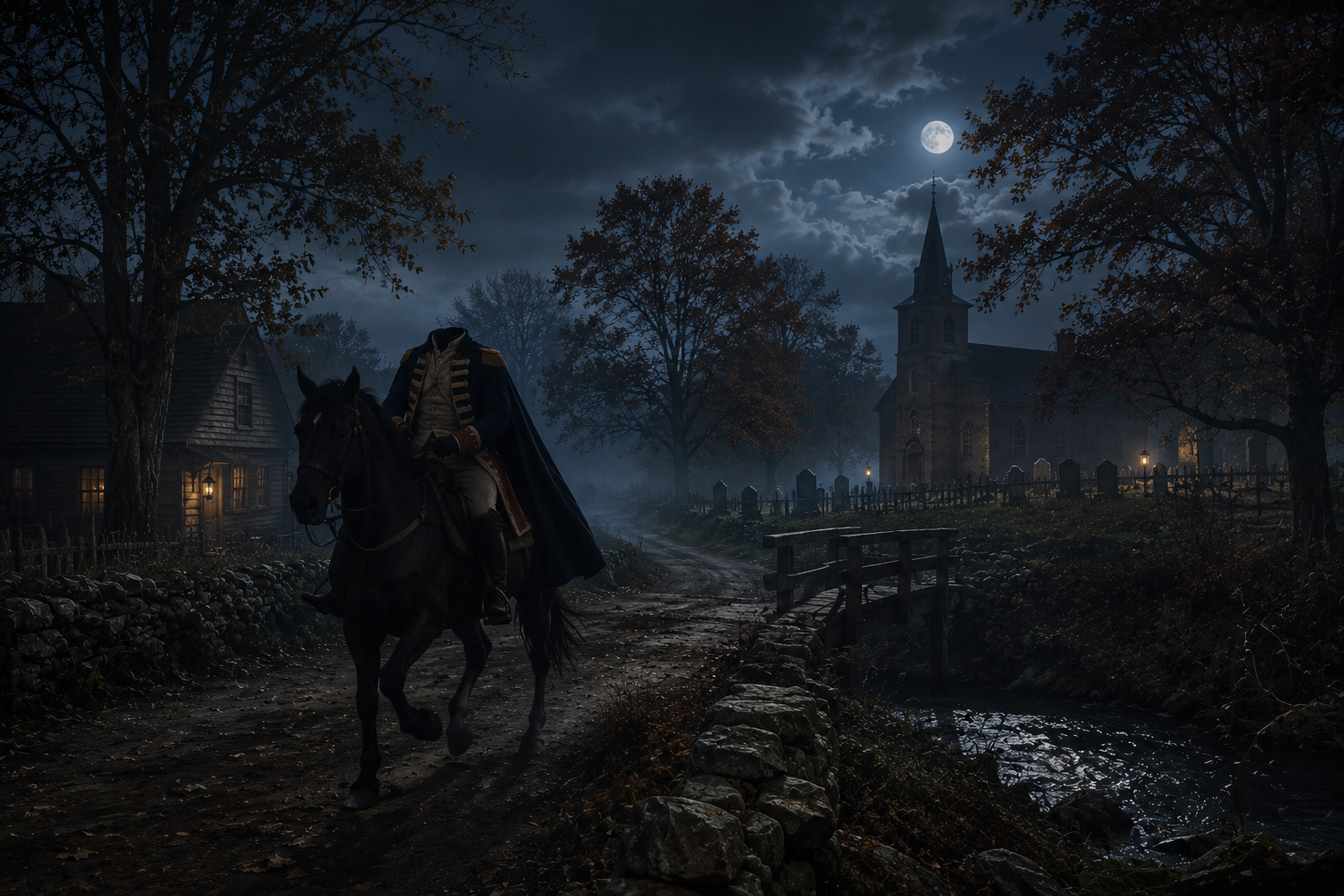
In Washington Irving’s The Legend of Sleepy Hollow, first published in 1820, a quiet valley in New York is haunted by an apparition riding through the darkness on horseback without a head. According to the story’s narrator, some local residents believe the specter is the ghost of a Hessian trooper whose head was carried away by a cannonball during the Revolutionary War, and who now rides between the battlefield and the churchyard where his body was supposedly buried. Irving presented the story as local folklore, but the Headless Horseman origins are more complicated: the character emerged from a blend of Revolutionary War memory, Hudson Valley tradition, European supernatural motifs, and Irving’s own invention.
That distinction matters because the Horseman is often treated today as though he were a centuries-old American ghost whose story was passed down unchanged. He was not. The familiar American figure was created by an early nineteenth-century writer who deliberately blurred the boundary between history, local rumor and fiction, giving his narrator a tone that makes almost everything sound as though it had been collected from supposedly reliable village storytellers. The result was so convincing that later generations began treating Irving’s invented folklore as if Irving had merely written down an older legend.
The real story is therefore less about proving that one headless soldier actually haunted Sleepy Hollow than about understanding how legends are manufactured from fragments of genuine history. A real war had taken place in the Hudson Valley, Hessian troops really had served the British side, local communities really did preserve stories about ghosts and battlefield deaths, and Irving really knew the landscape around Tarrytown. What transformed those ingredients into the Horseman was literature.
Washington Irving Created the Famous American Horseman
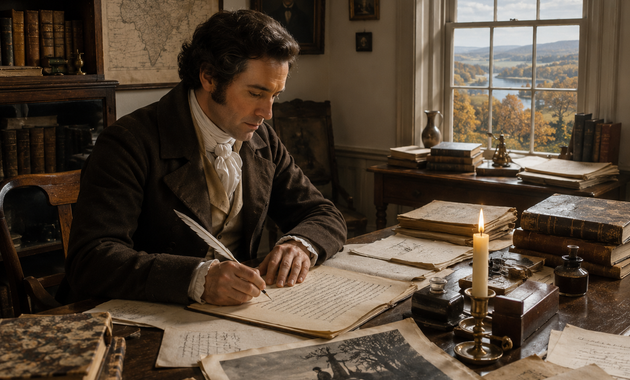
Washington Irving was born in New York in 1783, only a few years after the Revolutionary War, and grew up in a society that still lived close to the conflict’s memories. As a young man, he spent time in the Hudson Valley and became familiar with the Dutch-American communities, landscapes and stories that would later appear in his fiction. The Washington Irving Society records that during his youth he encountered local ghost stories and visited places that would become recognizable features of The Legend of Sleepy Hollow, including the Old Dutch Church and the surrounding burial grounds.
Irving later traveled extensively in Europe, and his literary development was strongly influenced by European Romantic and Gothic traditions. His major collection, The Sketch Book of Geoffrey Crayon, Gent., appeared in installments in 1819 and 1820 and included both Rip Van Winkle and The Legend of Sleepy Hollow. The Library of Congress identifies the 1820 story as one of the earliest works by an American author to achieve major international popularity.
Irving’s achievement was not simply inventing a ghost. He invented a narrator who appears to be reporting an established local tradition, allowing the reader to wonder whether the supernatural events actually occurred. The story repeatedly gives supernatural claims a documentary flavor, mentioning supposed historians, old storytellers and local traditions while also placing hints of rational explanations underneath them. Literary scholars have emphasized that this ambiguity is central to the story rather than an accident of later adaptation.
This technique made the Horseman unusually durable. The reader is never given the kind of clear supernatural confirmation that would settle the question, but neither is the ghost completely dismissed. By preserving uncertainty, Irving made the legend feel as though it existed independently of the story, allowing fictional folklore to escape the boundaries of the original book and become part of the identity of the Hudson Valley itself.
Sleepy Hollow Was a Real Place, but Irving Changed Its Identity
The landscape Irving described was not invented from nothing. The story is set in and around Tarry Town, the Old Dutch Church, the Pocantico River and the Hudson Valley countryside, all of which were real places. Irving used recognizable geography and real local history as anchors, then transformed those places through the conventions of Gothic storytelling.
The place-name itself has an interesting history. Irving’s Sleepy Hollow was a fictionalized valley associated with Tarry Town, while the modern village now known as Sleepy Hollow was historically called North Tarrytown. The village changed its official name after a referendum held on December 10, 1996, with the change formally filed with New York State days later. In other words, one of the most famous fictional names in American literature eventually became the official name of the community that had inspired it.
That transformation illustrates the extraordinary cultural power of Irving’s story. The name was not simply preserved as a literary reference; it became part of the local civic identity. Modern Sleepy Hollow openly builds its heritage around Washington Irving, his story and the places associated with the legend.
The geography also matters because the real landscape helps explain the atmosphere of the story. Irving described a secluded valley of wooded roads, old farms, water, churchyards and hills, creating a setting that felt removed from the rapidly changing American world around it. He used the apparent stillness of the valley to make superstition seem plausible, while contrasting it with the forces of modernization and migration beginning to reshape early nineteenth-century America.
The Hessian Soldier Was Part History, Part Legend
The most famous historical element in the Horseman’s story is the Hessian soldier. In Irving’s version, the specter is said to be a Hessian trooper who lost his head to a cannonball during an unnamed battle of the Revolutionary War. The story claims that his body was buried in the churchyard and that his ghost returned night after night in search of his missing head.
Hessian troops were real. Britain hired military auxiliaries from several German states during the American Revolutionary War, and soldiers from Hesse-Kassel formed an important part of the British forces. Their presence in the Hudson Valley made a Hessian ghost a particularly effective literary choice for Irving because local readers understood immediately that such soldiers had actually fought nearby.
There is also a genuine historical record of a Hessian artilleryman losing his head to American cannon fire during the Battle of White Plains in 1776. General William Heath’s memoirs contain a contemporary account describing an American cannon shot taking the head off a Hessian artilleryman. That fact gives the Horseman’s backstory an intriguing historical foundation, but it does not prove that this particular soldier became the ghost described by Irving.
This distinction is essential. There is evidence for a headless Hessian casualty, but there is no established historical evidence that the dead soldier was buried at the Old Dutch Church and subsequently became the source of an actual supernatural apparition. Irving took a real wartime detail and inserted it into a much older literary pattern: the dangerous rider appearing after dark. The historical event supplies credibility; the ghost supplies the fiction.
Did a Real Headless Ghost Exist Before Irving?
This is where the question of the Horseman’s origins becomes more complicated. Headless riders appear in European folklore well before Irving, including traditions involving supernatural riders in German-speaking regions and the Irish figure known as the Dullahan. Similar stories also appear elsewhere in European folklore, sometimes involving a rider carrying his severed head, sometimes a rider without one, and sometimes a supernatural horseman associated with death or punishment.
It would be too simple, however, to say that Irving copied the Dullahan and converted it into the American Horseman. The surviving evidence does not establish a single source that can be labeled “the original inspiration.” The Smithsonian has specifically cautioned that the ancestry of Irving’s Horseman is difficult to trace, noting that Sir Walter Scott and broader European literary traditions also deserve consideration when examining the character’s development.
That uncertainty is historically useful rather than frustrating. Folklore rarely moves in a straight line from one story to another. Writers absorb images, motifs, moods and narrative structures from multiple sources, sometimes consciously and sometimes indirectly, then place them in new settings. Irving was particularly well suited to this process because he was interested in both European literary traditions and the emerging folklore of the United States.
The result was a distinctly American supernatural figure. The Horseman looked European enough to belong to the world of Gothic ghosts, yet his identity was tied to a specific American war and a recognizable Hudson Valley landscape. That combination gave him a sense of local authenticity while also connecting the story to a much older tradition of supernatural riders.
Irving’s Headless Horseman Was More Than a Ghost Story
One reason The Legend of Sleepy Hollow has survived for more than two centuries is that the Horseman is not simply a monster who appears for no reason. The story uses the supernatural figure to expose the fears and weaknesses of other characters, especially Ichabod Crane, a superstitious schoolmaster whose imagination is easily influenced by stories of ghosts, witches and mysterious events. Scholars have noted that Irving repeatedly undermines Ichabod’s confidence by placing him in a world where apparently supernatural events may have ordinary explanations.
Ichabod’s encounter with the Horseman is therefore deliberately ambiguous. He sees a mounted figure without a head, believes he is being pursued by a supernatural being, and eventually encounters the thrown object that appears to be the Horseman’s missing head. Yet the closing details strongly suggest another possibility: the rider may have been Brom Bones, Ichabod’s romantic rival, who had a motive for frightening him. The broken pumpkin found near Ichabod’s discarded hat is Irving’s most famous clue that the haunting may have been an elaborate human prank.
The story never completely resolves that ambiguity. The villagers assume Ichabod has been carried away by the Horseman, while Brom’s reaction to the mention of the pumpkin hints that he knows more than he admits. Irving consequently gives the reader two interpretations at once: Sleepy Hollow may really be haunted, or a combination of superstition, rivalry and a carefully staged scare may have created the entire experience.
That uncertainty is a defining part of the character’s appeal. The Horseman is frightening precisely because he occupies the space between evidence and belief. If Irving had presented an unquestionably supernatural ghost, the story would have become a straightforward ghost tale; if he had revealed Brom immediately, the mystery would have disappeared. Instead, the reader remains caught between the two possibilities.
Ichabod Crane Was Fiction, but His World Felt Real
Ichabod Crane is sometimes treated as though he were a historical schoolteacher whose disappearance gave rise to the legend. He was not. He is a fictional character created by Irving, although some of his features may have been drawn from real people and local circumstances familiar to the author.
The same technique appears throughout the story. Irving uses recognizable local surnames, farms, churches, roads and traditions, then places fictional characters inside them. Katrina Van Tassel and Brom Bones belong to the fictional world of the story, but the Dutch-American social environment surrounding them was based on a real Hudson Valley culture that Irving knew personally.
This mixture of reality and invention is one reason the story became so deeply embedded in local history. Readers can visit the Old Dutch Church, see the surrounding landscape and identify real roads and settlements mentioned or alluded to by Irving, even though the particular chase involving Ichabod and the Horseman never happened as described in the story.
That is also why attempts to identify a literal historical Ichabod or a single “real” Headless Horseman tend to miss the point. The character was built from multiple ingredients rather than copied directly from one documented individual. The historical record provides the raw material, but Irving’s literary construction created the figure that survives today.
The Old Dutch Church Became Part of the Legend
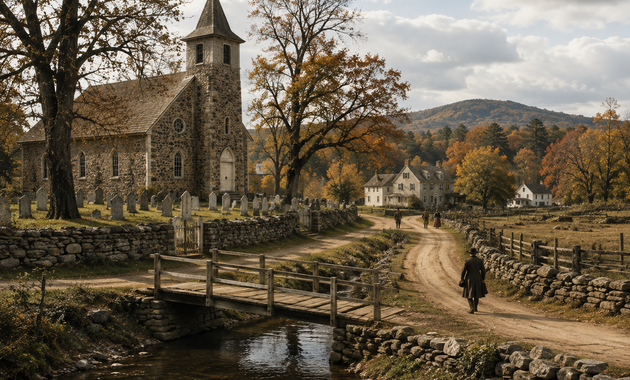
The Old Dutch Church and its churchyard are among the most important physical locations associated with the story. Irving placed the final chase in the area around the church and bridge, turning an existing religious and historical landscape into the setting for the Horseman’s most famous appearance. The church itself is a real colonial-era landmark and remains central to Sleepy Hollow’s historical identity.
The bridge presents an even clearer example of how fiction and geography became intertwined. The bridge that appears in modern popular culture is not simply the exact bridge Irving described. According to the historical record compiled by Sleepy Hollow authorities and local historians, the original crossing over the Pocantico River disappeared long ago, and several later bridges occupied different positions along the route.
The famous covered bridge seen in some modern film versions is also misleading. There is no evidence in Irving’s story or the historical record that the bridge had a roof like the dramatic covered bridges commonly shown in films. Those cinematic versions helped create a visual shorthand for Sleepy Hollow that is now more familiar to many people than the historical landscape Irving actually knew.
The Library of Congress preserves photographs from the early twentieth century identified as the “Headless Horseman Bridge,” showing how deeply the literary association had become embedded in the local landscape by that point. The photograph dates to roughly 1910–1920, long after Irving’s story but still early enough to document the physical preservation of the legend as a place-based tradition.
Why Hessians Became Such Powerful Ghosts in American Memory
The Horseman also reflects how Americans remembered the Revolutionary War. Hessian soldiers had fought on the British side, and their presence became part of American wartime memory. By turning a Hessian into a ghost, Irving transformed an enemy soldier from a historical figure into a supernatural reminder of a conflict that was still relatively recent when he wrote the story.
That choice gave the ghost a symbolic power that a generic phantom would not have possessed. The Horseman was not just something frightening in the woods; he was associated with a war that had reshaped the country and with a landscape where the physical evidence of that war remained present in burial grounds, roads and local memories.
At the same time, Irving did not write a solemn historical account of the Revolution. He mixed history with comedy, superstition, courtship and social satire. The terrifying Horseman appears in a story that is also deeply humorous, particularly in its treatment of Ichabod’s appetite, vanity and credulity. The mixture of fear and comedy helped prevent the character from becoming a purely tragic war ghost.
That blend eventually became central to American folklore. The Horseman could be frightening enough for ghost stories and Halloween traditions while remaining familiar enough to appear in children’s books, illustrations, theater, cartoons and popular entertainment. The character became flexible because Irving had created him with ambiguity at his core.
The Pumpkin Changed the Horseman Forever
Modern images of the Headless Horseman are inseparable from a pumpkin, yet the pumpkin’s role is a literary one rather than an ancient piece of folklore. In Irving’s story, the pursuer throws the object at Ichabod as the schoolmaster crosses the bridge, and the next morning Ichabod’s hat is found with a shattered pumpkin nearby. The implication that the object was being used as a substitute head became one of the most memorable comic details in the story.
Over time, artists and later adaptations transformed this detail into the glowing jack-o’-lantern head that dominates modern Halloween imagery. Irving himself did not create the exact visual convention that is now common in popular culture. His original story involves a pumpkin thrown during a nighttime chase, leaving the reader to infer that Brom Bones may have been responsible.
That distinction matters because the modern Headless Horseman is actually a composite of several historical layers. The Hessian ghost comes from Irving’s story, the headless rider belongs to a broader European supernatural tradition, the Revolutionary War supplies a genuine historical setting, and the pumpkin belongs to the comic mechanics of Irving’s fictional climax. Modern Halloween culture then combined all of those elements into one instantly recognizable image.
The resulting character is therefore younger than many people assume. There were headless supernatural figures in European folklore long before the United States existed, but the specific American Horseman of Sleepy Hollow was created in the early nineteenth century. His modern appearance is the product of more than two centuries of reinterpretation.
From Literary Story to American Folklore
The Library of Congress describes The Legend of Sleepy Hollow as one of the earliest works by an American author to become popular beyond the United States, and its supernatural imagery has survived through generations of editions and adaptations. The story became important not only as literature but also as a source of American folklore, providing later audiences with characters and locations that felt rooted in a real regional landscape.
Illustrators played an especially important role. The Metropolitan Museum of Art documents nineteenth-century illustrated editions and portfolios devoted to Irving’s story, including the influential illustrations produced by Felix Octavius Carr Darley in the 1840s and 1850s. These images helped establish visual interpretations of Ichabod, the Horseman and the Hudson Valley that later artists could reproduce and modify.
Film and television eventually accelerated the process. Different adaptations emphasized different aspects of the story, sometimes making the Horseman a terrifying supernatural villain and sometimes restoring more of Irving’s ambiguity. Modern productions often use dark forests, fog, covered bridges and dramatic weaponry to create a visual language that is much more Gothic than the original story.
That process is not evidence of historical distortion in itself; folklore naturally changes as it moves between generations. What matters is recognizing the difference between the original literary text and the later tradition. The Horseman that Americans recognize today is not simply Irving’s 1820 character preserved unchanged. He is the cumulative result of literature, illustration, local tourism, theater, film, Halloween culture and repeated retelling.
The Legend Became a Place
One of the strangest aspects of the Horseman’s history is that a fictional landscape gradually became a real-world heritage landscape. The modern village of Sleepy Hollow embraced the name officially in 1996 after previously being known as North Tarrytown, and local institutions now use Irving’s characters and settings as part of the community’s historical identity.
Washington Irving’s former home, Sunnyside, is preserved as a historic site, while the Old Dutch Church, cemetery and surrounding landscape remain central to the local story. The Metropolitan Museum notes that Sunnyside was Irving’s home from 1835 and later became a National Historic Landmark, while Historic Hudson Valley continues to present Irving’s legend at the site.
The physical places are real even when the events associated with them are fictional. Visitors can stand beside the church, walk through the cemetery and see landscapes related to the story, but they are experiencing the geography that inspired Irving rather than visiting a crime scene where a supernatural horseman actually appeared.
That distinction is increasingly important in historical tourism. Legends become more powerful when they have physical landmarks, because the visitor can associate a story with a road, church, bridge or graveyard. The result can make fiction feel almost documentary, especially when local traditions preserve the narrative across generations.
Sleepy Hollow is an unusually clear example of that process because the community ultimately adopted the fictional name itself. The story did not merely survive in the place; the place incorporated the story into its official identity.
Was the Headless Horseman Based on a Real Person?
There is no securely documented individual who can be identified as the real Headless Horseman. The best-known historical candidate is the unnamed Hessian artilleryman reportedly decapitated by cannon fire during the Battle of White Plains, but the surviving evidence does not establish that this soldier became the source of the local ghost story or that Irving based his character exclusively on him.
Later writers and researchers have proposed specific names for the soldier, but those identifications remain contested and should not be presented as established fact. Even if a particular Hessian casualty could be identified, proving that he was the person behind the legend would require a separate chain of evidence showing a connection between his death, local folklore and Irving’s later story.
The stronger historical conclusion is that Irving deliberately made the Horseman anonymous. In the story he is not given a personal name, detailed biography or documented military history. He exists as a figure of collective memory, which makes him more effective as folklore because readers can project their own fears and historical associations onto him.
That anonymity also connects the Horseman to the broader tradition of supernatural riders. A named historical individual would make the story more like a ghost biography; an unnamed rider becomes something closer to a symbol. Irving’s fictional Horseman therefore works simultaneously as a Revolutionary War memory, a local ghost and a literary embodiment of uncertainty.
The European Origins Are Real, but Not Simple
The deeper Headless Horseman origins reach beyond America. European folklore contains numerous supernatural riders, wild hunts, revenants and headless figures, and the idea of a mounted apparition associated with death is considerably older than Irving. The Irish Dullahan is perhaps the most famous comparison, but German-speaking traditions and other northern European legends also contain supernatural horsemen.
Yet similarities do not automatically prove direct borrowing. Folkloric motifs can emerge independently, travel through books and oral traditions, or be reshaped by writers who encounter them through multiple sources. The evidence for Irving’s exact reading history is not strong enough to establish a single European tale as the direct blueprint for his Horseman.
What can be said confidently is that Irving was working within a literary environment saturated with European supernatural traditions. His European travels, interest in Romantic literature and fascination with folklore gave him access to a much wider imaginative vocabulary than the local Hudson Valley alone could provide.
This explains why the American Horseman feels both local and ancient. His specific identity as a Hessian belongs to the Revolutionary War and the Hudson Valley, while his basic form belongs to a much older family of supernatural riders. Irving fused those layers into a character that Americans could recognize as their own.
The Horseman and the American Fear of the Past
The story’s historical setting matters because it was written only a few decades after the Revolutionary War. Memories of the conflict were still visible in the landscape and in family histories, while the new United States was undergoing rapid migration, economic change and territorial expansion. Irving turned that unstable relationship with the past into a supernatural story about a landscape that seemed unable to let its history die.
Literary scholars have interpreted the Horseman as a figure representing the persistence of the past, and that reading fits the structure of the story. The ghost belongs to a war that supposedly ended decades earlier, yet he continues to ride through a community that has moved on. He is literally a historical memory that refuses to stay buried.
That theme helps explain why the story remains effective even for readers who do not believe in ghosts. The real fear is not necessarily that an undead soldier will appear on a road. It is that the past can continue to shape the present through stories, landscapes, family traditions and unresolved memories.
In that sense, the Horseman is simultaneously a ghost and a historical metaphor. He rides through an American community that is becoming modern, but he carries an older European military identity and a Revolutionary War memory with him. Irving’s achievement was to make those layers appear in the form of a single unforgettable character.
Why the Legend Survived for More Than Two Centuries
The Horseman survives because the story offers several things at once. It is a ghost story, a comedy, a romance, a historical tale, a satire of superstition and a portrait of a changing American community. Each generation can emphasize a different part of it without destroying the basic structure.
The character is also visually simple. A rider without a head can be recognized instantly, and the addition of a black horse, darkness, a bridge or a pumpkin creates an image that requires very little explanation. That visual simplicity helped the Horseman move from literature into illustration, stage performance, film and eventually mass-market Halloween culture. The Metropolitan Museum’s record of illustrated editions demonstrates how early artists were already helping to fix the Horseman’s visual identity for later audiences.
Local tourism gave the legend another life. Once physical places became associated with Irving’s fictional events, the story could be experienced geographically rather than merely read. The Old Dutch Church, cemetery, bridge locations and Sunnyside transformed the Horseman from a literary character into a regional cultural symbol.
The story’s uncertainty also makes it unusually adaptable. Readers can believe the ghost was real, accept Brom Bones as the probable culprit, or remain undecided, and the story works under all three interpretations. That ambiguity means modern retellings can shift toward horror without contradicting Irving completely, because the original tale had already left room for supernatural belief.
What the Headless Horseman Really Is
The Headless Horseman is not one historical figure waiting to be identified. He is a layered creation whose ancestry includes genuine Revolutionary War history, regional folklore, European supernatural motifs and Washington Irving’s literary imagination. The unnamed Hessian casualty at White Plains may have provided a particularly effective historical detail, but there is no evidence that the ghost of that specific soldier literally became the legend.
Irving’s genius was to make the boundary between history and folklore deliberately difficult to see. He placed a supernatural rider inside a real landscape, surrounded him with real historical references, gave him a plausible wartime identity and then allowed the narrator to imply that old villagers had been telling the story long before the reader arrived. The fiction therefore disguises itself as inherited memory.
That technique has consequences far beyond Sleepy Hollow. Readers often assume that old legends must have originated from a single mysterious event, but folklore usually develops through layers of retelling, adaptation and cultural memory. The Headless Horseman provides an unusually well-documented example because historians can still read the original literary creation and compare it with the older historical and folkloric elements Irving transformed.
The same distinction is useful elsewhere on HiddenFrontiers. The Roanoke Colony mystery began with a real colonial settlement and an unresolved disappearance, but later generations added layers of legend to the evidence. The story of El Dorado shows another process in which real societies and encounters were transformed into an increasingly elaborate legend. And the history of ancient Roman forests demonstrates how landscapes can accumulate supernatural meanings as stories are passed between generations.
The Headless Horseman belongs to this larger history of how humans turn uncertain places and memories into narratives. What makes him special is that we can see the transformation unusually clearly because the literary moment that created the modern American version is preserved. The ghost feels ancient, but the version most Americans know is only a little more than two centuries old.
The Real Mystery Is How a Fiction Became Folklore
The most enduring mystery surrounding the Headless Horseman is therefore not whether an undead Hessian actually rode through Sleepy Hollow. No historical investigation has established such an event, and the evidence instead shows that Irving crafted the famous character in a story published in 1820. The more interesting historical question is how an invented specter became so deeply embedded in a real community that the community eventually changed its official name to match Irving’s fictional landscape.
The answer lies in the remarkable power of place-based storytelling. Irving did not invent an imaginary kingdom or distant fantasy world; he transformed recognizable roads, churches, farms, local families and Revolutionary War memories into literature. Because the physical landscape survived, later generations could continue walking through places that seemed to confirm the story.
That process blurred the line between history and folklore. The Hessian soldier may have a real historical counterpart, the battlefield certainly existed, the church is real, the Hudson Valley is real, and the old bridge had real successors, but the supernatural Horseman belongs to the imaginative world created by Irving. The modern legend survives because all of these different forms of reality became intertwined.
Perhaps that is why the Horseman still feels more unsettling than many newer fictional monsters. He is not separated from history; he is made from it. He rides through a real American landscape carrying a fictional headless identity assembled from war, memory, folklore and literature, reminding readers that sometimes the stories that feel oldest are not ancient at all. They are carefully constructed narratives that have simply survived long enough to become traditions.
SOURCES & REFERENCES
Library of Congress — The Legend of Sleepy Hollow, Washington Irving.
Primary literary source for Irving’s 1820 story, including the Hessian Horseman, Ichabod Crane, the Old Dutch Church, the chase and the ambiguous pumpkin ending.
Library of Congress — “Books That Shaped America: Washington Irving, The Legend of Sleepy Hollow.”
Used for publication history, the story’s 1820 appearance in The Sketch Book, and its early international popularity.
Smithsonian Magazine — “What ‘The Legend of Sleepy Hollow’ Tells Us About Contagion, Fear and Epidemics.”
Used for Washington Irving’s early connection to Tarrytown, local ghost-story traditions, and the caution that the Horseman’s literary ancestry cannot be reduced to a single source.
Washington Irving Society — “‘Sleepy Hollow’: Unearthing the Legend.”
Used for Irving’s exposure to Dutch-American stories and local landmarks, and the relationship between Revolutionary War history and the literary Horseman.
University of New Brunswick, Loyalist Collection — “The Legends and Reality of Sleepy Hollow, Part 1: Headless Hessians.”
Used for historical context concerning Hessian troops, Irving’s use of Revolutionary War memory, and the broader folklore of supernatural riders.
Oxford Academic — “By Supernatural Means”: Environment and Ambiguity in Irving’s “The Legend of Sleepy Hollow.”
Used for the literary interpretation of the story’s deliberate uncertainty between supernatural and rational explanations.
Oxford Academic — “Pride and Gluttony in Washington Irving’s ‘The Legend of Sleepy Hollow.’”
Used for the narrative structure, Ichabod Crane, Brom Bones and the ambiguity surrounding the Horseman’s final appearance.
New York State Department of State — “Village Name Change.”
Used to verify the 1996 referendum and official change from North Tarrytown to the Village of Sleepy Hollow.
Village of Sleepy Hollow, New York — “History of the Village.”
Used for the development of the real Hudson Valley community and its later relationship with Irving’s fictional Sleepy Hollow.
Library of Congress — Headless Horseman Bridge photograph.
Used to establish the existence of early twentieth-century photographic documentation of the bridge associated with Irving’s legend.
FAQ
Who created the Headless Horseman?
The famous American version of the Headless Horseman was created by Washington Irving in The Legend of Sleepy Hollow, first published in 1820 as part of The Sketch Book of Geoffrey Crayon, Gent. Irving placed the figure in a real Hudson Valley setting and gave him the identity of a Hessian soldier said to have lost his head during the Revolutionary War.
Was the Headless Horseman based on a real Hessian soldier?
Possibly in part, but the evidence does not establish a single real person as the Horseman’s identity. A Hessian artilleryman really was reportedly decapitated by American cannon fire during the Battle of White Plains, providing a striking historical parallel, but there is no proof that this individual became the ghost of Sleepy Hollow or that Irving based the entire character on him.
Did the Headless Horseman exist before Washington Irving?
Headless riders and supernatural horsemen appear in European folklore long before Irving, including German traditions and the Irish Dullahan. However, the specific American figure known as the Headless Horseman of Sleepy Hollow is Irving’s literary creation, and historians cannot establish a single European story as his direct source.
Was Ichabod Crane a real person?
Ichabod Crane is a fictional character. Irving placed him in a real Hudson Valley environment and surrounded him with historical places and local traditions, which helped the story feel like a genuine piece of regional folklore.
Did the real Sleepy Hollow exist when Irving wrote the story?
The Hudson Valley landscape and the communities around Tarrytown certainly existed, but the modern village officially called Sleepy Hollow was previously known as North Tarrytown. The village adopted the name Sleepy Hollow after a referendum in December 1996, more than 175 years after Irving’s story first appeared.
Was the Headless Horseman Bridge real?
A real bridge crossed the Pocantico River and was associated with the route described by Irving, but the original bridge no longer survives. Several later bridges occupied different locations, and there is no historical evidence that Irving’s bridge was the covered bridge often shown in modern movies.
Why does the Headless Horseman carry a pumpkin?
The pumpkin comes from Irving’s original story rather than an ancient Horseman tradition. During Ichabod’s flight, the Horseman throws what appears to be his missing head, and the discovery of a shattered pumpkin near Ichabod’s hat the following morning helps suggest that Brom Bones may have staged the encounter.
Is the Headless Horseman a real American ghost story?
It is an American literary legend rather than a documented supernatural event. Irving deliberately presented the story as local folklore and left the reader uncertain about whether Ichabod encountered an actual specter or was frightened by a human prank, which is one of the reasons the tale has remained so durable.



2 comments