The Strange Tradition of Sleeping Beside the Dead in Madagascar
In the central highlands of Madagascar, death does not end a family’s relationship with the deceased. During Famadihana Madagascar, relatives may open a family tomb and bring ancestral remains into the daylight. They wrap them in fresh cloth and celebrate together before returning them to the tomb. The ceremony can include music, dancing, feasting, speeches, prayer and large family gatherings. It is sometimes translated as the “turning of the bones,” a phrase that sounds macabre to outsiders. Nevertheless, it does not capture what the ritual means to the people who practice it (persée.fr).
The popular phrase “sleeping beside the dead” is therefore misleading. Famadihana is not literally a tradition in which families spend the night beside corpses as an everyday custom. It is a ceremonial form of secondary burial in which ancestral remains are periodically exhumed and respectfully rewrapped or transferred, depending on the community and circumstances. The ceremony is associated particularly with Merina and Betsileo communities in the central highlands, although funerary customs vary across Madagascar’s many cultural groups. (persée.fr)
To understand why a family would deliberately reopen a tomb, it is necessary to understand a Malagasy idea that is difficult to translate into a single English word: the continuing importance of ancestors, or razana. In many Malagasy traditions, the dead remain deeply connected to the living through family, memory, land and social obligations. The tomb is therefore not merely a place where a body has been deposited. It can be the physical center of a lineage. Scholars working on Malagasy burial traditions have repeatedly emphasized the connections between ancestors, kinship, land and tombs. (cambridge.org)
That is why Famadihana is better understood as a ceremony of relationship than a ceremony of death.
What Is Famadihana Madagascar?
The Malagasy word famadihana is commonly translated as “turning,” and in anthropological literature the expression “turning of the bones” is widely used. The ceremony involves ancestral remains being removed from a tomb, wrapped in new cloth and returned to their resting place after a period of communal celebration. A Malagasy-language dictionary also defines the term in connection with honoring the dead and asking for blessings from ancestors, while noting different forms of the practice, including moving remains from temporary graves and periodically re-wrapping those already in ancestral tombs. (motmalgache.org)
The exact ceremony is not identical from one family to another.
That matters because there is a tendency in popular writing to describe Famadihana as though every Malagasy community performs the same ceremony on the same timetable. The historical record does not support that simplification. Susan McGeorge’s study of Merina Famadihana describes it specifically as a form of secondary burial in which a deceased person may initially be buried and later transferred into a family tomb, accompanied by a larger ceremony. (persée.fr)
Other research likewise shows that the practice can be adapted when families move away from their ancestral region, build new tombs or face changing economic circumstances. A 2026 study in Africa described Malagasy migrant families in the Betsiboka valley negotiating their relationship to ancestral tombs and the practice of returning remains to the highlands. (cambridge.org)
So there is no single script that every family follows. Famadihana Madagascar highlights the continued importance of the dead as members of a family. Moreover, the dead remain integral to the living family’s ongoing relationship.
Why Are the Dead Returned to the Family?

Indeed, the tomb is at the center of the ritual.
Among Merina communities of the central highlands, family tombs can be elaborate structures tied closely to descent, property and ancestral identity. Anthropologist Maurice Bloch’s influential work on Malagasy kinship emphasized the importance of tombs as places where family relationships are materially and socially anchored. Later scholarship continues to examine how burial sites connect ancestry to land and belonging. (cambridge.org)
A family tomb can therefore represent far more than personal remembrance. It can embody lineage. It can identify the place from which a family comes. It can provide a physical connection between generations. And it can serve as a visible statement that the dead still belong to the family. This helps explain why the removal and re-wrapping of remains is not necessarily understood as disturbing the dead. Within the ritual framework, the ceremony can be a way of reaffirming that relationship.
The dead are handled carefully. They are wrapped in fresh cloth, they are presented to relatives, families gather around them, music and celebration can accompany the event. From outside, these actions can look contradictory. Why would grief be mixed with dancing? Why would people celebrate while holding human remains? The answer is that the ceremony is not organized around the same sharp boundary between mourning and celebration that many Western funerary traditions assume. Famadihana can be an occasion to remember someone who remains important to the family.
The Ancestors Are Not Treated as Forgotten
Many Malagasy traditions place unusual emphasis on the continuing presence of ancestors.
A U.S. Library of Congress country study describes traditional Malagasy religion as emphasizing strong links between the living and the dead and records the belief that ancestors remain deeply concerned with the lives of their descendants. It also describes Famadihana among Merina and Betsileo communities as a ceremony in which remains are removed from family tombs, rewrapped in new silk shrouds and returned after communal celebrations. (countrystudies.us)
This does not mean that every Malagasy person holds identical religious beliefs. Madagascar contains diverse ethnic communities and multiple religious traditions. Christianity has also become deeply established, particularly in the central highlands. Some Malagasy Christians incorporate aspects of ancestral practice into their religious lives, while others reject Famadihana or regard it as incompatible with their beliefs. (countrystudies.us)
The result is not a simple conflict between “traditional” people and “modern” people. Families make different choices, some continue the ceremony, some modify it, some stop participating, some combine traditional burial practices with Christian prayer, and some reject the ritual entirely. That diversity is important because Famadihana is often presented as though it represents all of Madagascar, it does not.
The Ceremony Is About More Than the Dead

Famadihana can also bring living relatives together.
This is one reason the ritual can become a major family event rather than a private funeral. Relatives who live far apart may return to their ancestral region. Families may spend substantial sums preparing for the ceremony. Food, clothing, music and hospitality can become part of a gathering that reinforces relationships between relatives who may not see one another regularly.
David Graeber’s anthropological work on Famadihana in Arivonimamo examined the ceremony not only as a ritual involving the dead but also as a way of organizing relations among the living. His work emphasizes the practical actions surrounding the ritual and the way families interact with their ancestors through material objects, movement and ceremony. (davidgraeber.org)
That perspective helps explain why communal celebration is so prominent. The ceremony brings together the dead and the living, but it also brings together relatives who may otherwise be separated by distance, marriage, work or migration. In that sense, the event can function like a family reunion with an unusually long historical memory. The people being honored are not merely remembered. They are placed back at the center of family identity.
What Actually Happens During Famadihana?
The details vary, but the central sequence is recognizable.
Families prepare for the event, often coordinating relatives and raising the money necessary for food, transportation, textiles, musicians and other expenses. On the appointed occasion, the family tomb is opened and ancestral remains are carefully removed.
The remains are wrapped in fresh cloth, often associated with lamba, the distinctive Malagasy textile tradition. Research on Malagasy material culture notes that silk and other high-quality cloths have long held special significance in ceremonies surrounding the dead, particularly among highland communities. (pmc.ncbi.nlm.nih.gov)
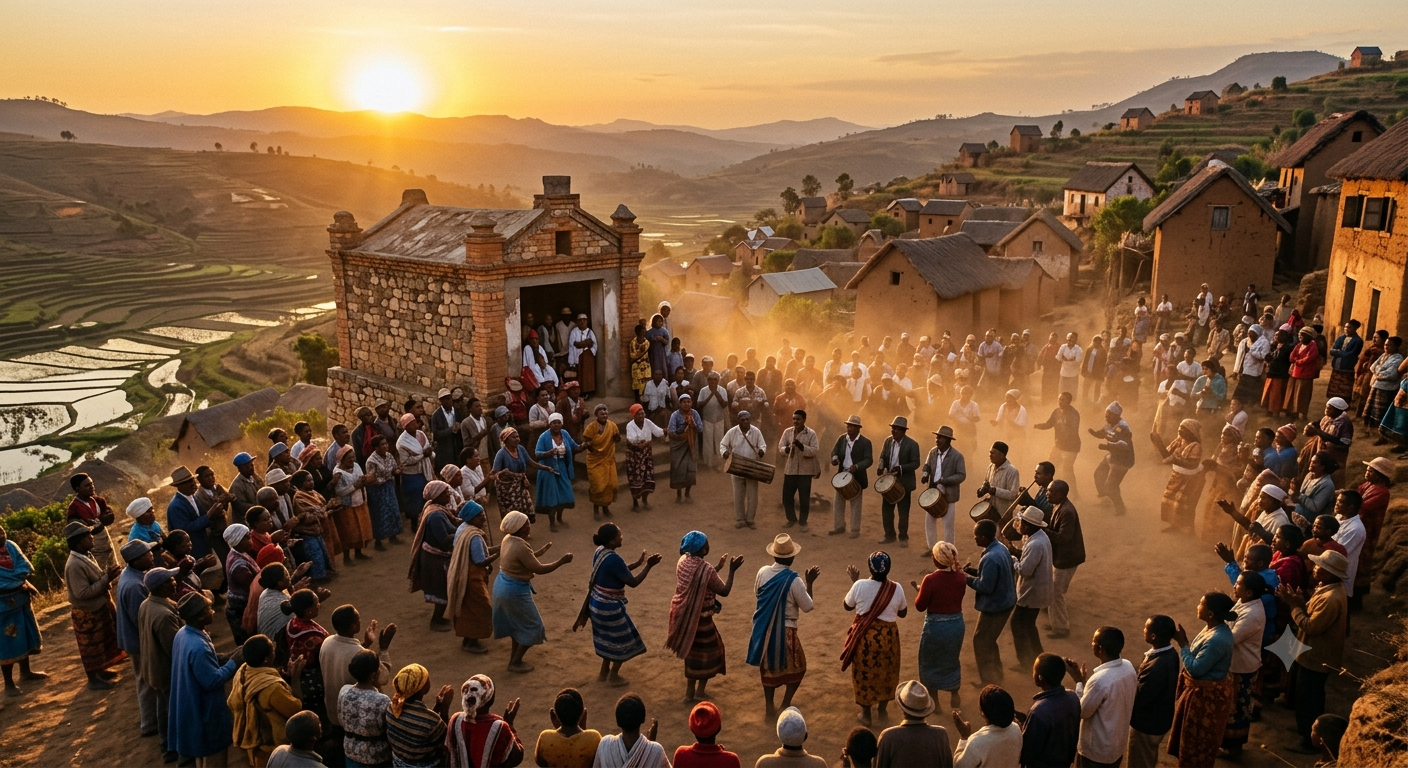
Relatives may carry the rewrapped remains around the tomb or through the surrounding area while musicians play. Families eat and drink together, and people may dance or speak about the deceased. The ceremony can be joyful, that does not mean the family is indifferent to death. Quite the opposite. The celebration is part of remembering the person as a member of the family rather than treating death as a complete severing of identity. After the celebrations, the remains are returned to the family tomb. The tomb closes again. The relationship continues.
The next Famadihana may not occur for several years, depending on family decisions and circumstances. Malagasy sources describe schedules in terms that can include intervals of five, seven or ten years, while anthropological literature stresses variation rather than a single national timetable. (motmalgache.org)
Why Does the Ritual Involve Rewrapping the Remains?
The fresh cloth is not merely decorative, It is part of the ceremony’s logic. The dead are not treated as objects being displayed for curiosity. They are carefully handled, wrapped and honored. The textile becomes a material expression of respect and renewal.
A study of Malagasy silk traditions notes that special cloths have long been associated with important people and funerary contexts, including the wrapping of deceased members of Merina and Betsileo communities. (pmc.ncbi.nlm.nih.gov)
The new wrapping also creates a physical sign of the ritual itself. The ancestor has been taken out of the tomb, the ancestor has been honored, the family has gathered, the remains are prepared again for the tomb, the sequence makes the passage of time visible. A person who died years earlier becomes physically present to a new generation of relatives, many of whom may know that person primarily through family stories. For children and younger relatives, the ritual can therefore function as an introduction to ancestors they never personally knew. The dead become part of living memory through objects and ceremony.
The Meaning of “Turning the Bones”
The English phrase “turning of the bones” sounds literal, but it does not adequately express the cultural significance of Famadihana. The name is associated with the idea of turning or re-wrapping the dead, but scholars have interpreted the broader ritual in different ways. Susan McGeorge approached Famadihana through the concept of secondary burial and the transition of the deceased from the community of the living into the ancestral realm. (persée.fr)
Other anthropologists have focused more heavily on kinship, social relationships, authority, obligation and the material role of tombs. David Graeber’s work is particularly useful because it asks not merely what the ritual symbolizes but what people actually do during it: how they handle the dead, how relatives interact with one another, and how objects, bodies and family relationships are reorganized through the ceremony. (davidgraeber.org)
There is no requirement that readers choose one interpretation. A ritual can perform several social functions simultaneously. It can honor ancestors, it can reaffirm kinship, it can connect a family with a particular landscape, it can introduce younger generations to their lineage, it can settle obligations between relatives, it can also provide a culturally accepted way of transforming mourning into communal celebration. Reducing it to one symbolic meaning would make the ritual seem simpler than it is.
A Ceremony With Roots in Older Burial Practices
The history of Famadihana is difficult to reduce to a single moment of origin.
Anthropologists have debated whether its modern form represents an older Malagasy practice, a transformation of earlier secondary-burial traditions, or a ritual shaped by broader Austronesian and Southeast Asian cultural connections. What can be said more safely is that secondary burial practices have a long history in Madagascar and that the present form of Famadihana developed over time rather than appearing suddenly as a fully formed modern custom. (persée.fr)
This historical uncertainty is worth preserving. Madagascar itself has an unusually complex human history. Genetic, archaeological and linguistic evidence points to Austronesian and African roots in the island’s population, although the exact chronology and pathways of early settlement remain subjects of scholarly debate. Recent archaeological research has also revised estimates of when humans reached the island, demonstrating just how complicated Madagascar’s deep history can be. (pmc.ncbi.nlm.nih.gov)
Famadihana belongs to that long cultural history. It should not be treated as a bizarre curiosity detached from Madagascar’s broader traditions of kinship, land, ancestry and death.
Famadihana and the Family Tomb
The architecture of Malagasy tombs helps explain why the ritual matters. In many Merina communities, ancestral tombs are substantial family structures and can become important markers of lineage. Tombs can also express relationships to ancestral land. Recent ethnographic research in the Betsiboka valley shows how the construction, location and use of family tombs can become part of larger arguments about identity, belonging and territorial connection. (cambridge.org)
The dead therefore occupy physical geography. A family does not simply remember its ancestors abstractly. It may know exactly where they are buried. The tomb identifies a lineage. Returning to that tomb can therefore be a way of returning to a place of origin. This becomes especially important when families migrate. An individual may live far from the central highlands, but the ancestral tomb can remain the place where family identity is anchored. Some families save money for years to transport remains back to an ancestral tomb rather than permanently burying them in the place where the person died.
The ritual is consequently tied to movement as much as to burial, people move, the dead move, the tomb remains the anchor.
When Families Move Away
Modern migration has complicated these traditions. Madagascar’s people are not geographically fixed, and families can live far from the places where earlier generations were buried. A recent Cambridge study describes Malagasy families in the Betsiboka valley negotiating precisely this tension. Some migrant families historically followed a custom of returning deceased relatives to ancestral tombs in the highlands, while others built new family tombs closer to their current homes. (cambridge.org)
That research reveals something easily missed in tourist descriptions of Famadihana. The ritual is not static, it responds to migration, money, land, identity and changing family structures. A community may preserve the ritual while changing where the dead are kept. Another family may stop the ritual altogether. A third may combine it with Christian practice. The ceremony is therefore best understood as a living cultural system rather than a relic of an unchanging ancient past.
Christianity Did Not Simply Erase the Tradition
Christian missionaries historically opposed many traditional Malagasy practices, including ceremonies connected with ancestors. But the relationship between Christianity and Famadihana is more complicated than a simple conflict between old and new religions.
A U.S. Library of Congress country study notes that some Malagasy Christians continue to incorporate traditional funerary practices, including Famadihana, into their religious lives. Pastors may attend ceremonies, and some families may have a deceased relative blessed in church before traditional rites continue. At the same time, other Christians regard ancestral practices as superstitious and choose not to participate. (countrystudies.us)
This mixture is typical of religious change. Old practices do not necessarily disappear because a new religion arrives, they can be rejected, they can be adapted, they can be reinterpreted, or they can continue alongside new beliefs. Famadihana has survived partly because its meaning is not limited to formal religious doctrine. Family identity and obligations can motivate participation even when relatives hold different theological beliefs. That makes the ceremony socially resilient.
The Financial Burden of Holding a Famadihana
There is another side to the ritual that romantic descriptions often overlook. Famadihana can be expensive. Families may have to pay for textiles, food, transportation, musicians and other arrangements. Extended relatives may travel long distances to attend. In rural areas, livestock can represent a major portion of household wealth, making the costs substantial.
A 2026 study in Humanities and Social Sciences Communications examined the economic role of Famadihana in rural Madagascar and found that households can prioritize ritual obligations over productive investment and food security, including by liquidating productive assets such as cattle. (nature.com)
That does not mean every family experiences the ritual as an economic burden. Some families regard the expense as an essential obligation. Others may postpone the ceremony until they can afford it. Still others may reduce the scale or abandon the practice. The economic dimension is important because it shows that ritual is not separate from practical life. A ceremony involving ancestors also involves money, work, transport, food and family negotiations. Tradition has a price.
The Public-Health Debate
Famadihana has occasionally entered public-health discussions because Madagascar remains one of the world’s major plague-endemic countries.
Yersinia pestis, the bacterium that causes plague, remains endemic in Madagascar, especially in the central highlands. The CDC’s long-term epidemiological analysis of human plague in Madagascar recorded thousands of suspected cases between 1998 and 2016, with confirmed and presumptive cases concentrated especially in highland regions. (cdc.gov)
Plague can also appear in pneumonic form, which can spread from person to person through respiratory droplets. CDC research on a 2011 outbreak in northern Madagascar documented the severe consequences of untreated pneumonic plague and emphasized the continuing epidemiological importance of the disease. (cdc.gov)
This creates an unusual point of tension with funerary practice. Public-health authorities have had to consider how the handling of remains from people who died of plague could contribute to transmission. Such concerns do not mean that ordinary Famadihana ceremonies are inherently dangerous, nor do they justify describing the tradition itself as a cause of plague. The risk depends on the disease status of the deceased and the specific circumstances.
That distinction is crucial. The health issue is about infectious disease and contaminated remains, not about the cultural meaning of the ceremony. A respectful account should not turn an ancient funerary tradition into a sensational explanation for an epidemic.
Why the Ceremony Can Look Like a Celebration
Visitors unfamiliar with Malagasy culture can be startled by the atmosphere of Famadihana. There may be music, people may dance, relatives may laugh, food and drink are shared, the dead are brought into public view, these scenes can seem incompatible with conventional Western expectations about grief, but the ceremony is not necessarily celebrating death. It is celebrating relationship. A Smithsonian photograph describing Famadihana emphasizes the bringing forth of ancestors, re-wrapping them in fresh cloth and carrying them around the tomb to live music, while framing the event as a celebration of kinship and respect. (smithsonianmag.com)
That interpretation helps explain why the dead are not hidden away throughout the ceremony. Their temporary return to the center of family life is the point. For a short period, ancestors are physically present. Relatives can touch them, carry them, wrap them, speak about them, then the remains return to the tomb, the ceremony closes. The dead remain part of the family, but the living continue with their lives.
Does Every Malagasy Family Practice Famadihana?
No.
This is one of the most important facts for understanding the tradition. Madagascar is culturally diverse, and Famadihana is especially associated with Merina and Betsileo communities of the central highlands. Other Malagasy groups have different funerary systems and relationships with ancestors. Even among communities that practice Famadihana, families may make different choices. Some continue the ceremony regularly, some participate only occasionally, some modify it because of migration, expense or religion, some have stopped. The practice therefore cannot accurately be described as “the Malagasy funeral ritual.” It is one important tradition within a much broader landscape of Malagasy funerary customs. That distinction prevents the ritual from being turned into an exotic symbol for an entire country.
What the Ritual Says About Memory
There is a deeper reason Famadihana has attracted so much attention from anthropologists. It challenges a common modern assumption that remembrance happens mainly through photographs, written records and stories. In Famadihana, memory can be physical. The ancestor is not represented by a photograph alone. The remains themselves are brought into the ceremony, the cloth is changed, the tomb is reopened, the family gathers, the act of handling the remains creates a connection between generations that is tactile as well as symbolic. That helps explain why the ritual can be emotionally powerful even for relatives born long after the deceased died. The ancestor becomes more than a historical name, the ancestor becomes someone the family physically encounters.
This is also why the ritual can reaffirm lineage. A person can learn where they belong by learning whose remains lie in the tomb and who else is responsible for caring for them. Death becomes part of genealogy. The tomb becomes part of identity. And the ceremony turns that connection into something the living can experience together.
What We Know
Famadihana is a funerary and ancestral practice associated especially with Merina and Betsileo communities in Madagascar’s central highlands. In its best-documented forms, families open ancestral tombs, remove remains, re-wrap them in fresh cloth and return them to the tomb after a period of communal ceremony. (persée.fr)
The ritual is often translated as the “turning of the bones,” and Malagasy reference material connects the practice with honoring ancestors and seeking their blessings. (motmalgache.org)
It can involve extended families, music, dancing, feasting and significant expenditure. Recent research shows that the ceremony remains socially important while also creating substantial economic obligations for some rural households. (nature.com)
Christianity has not produced a single uniform response. Some Malagasy Christians incorporate elements of traditional funerary practice, while others reject Famadihana. (countrystudies.us)
What Remains Uncertain
The precise origins of the modern Famadihana tradition are not fully settled. Scholars have debated how it developed from earlier Malagasy funerary practices and how secondary burial traditions relate to the island’s wider Austronesian and African cultural history. The ceremony also varies substantially across families and regions, making it difficult to describe one universal version.
The frequency of the ritual is not fixed nationally either. Some sources describe intervals of several years, while Malagasy linguistic and anthropological materials record different possible schedules depending on family custom and circumstance. (motmalgache.org)
It is also difficult to separate “religious belief” from social obligation in a simple way. A family may participate because of spiritual beliefs, respect for ancestors, kinship expectations, identity, emotional attachment or a combination of these motivations.
And because Madagascar’s cultures are diverse, no single explanation can be applied to every family that participates.
FAQ
What is Famadihana in Madagascar?
Famadihana is a funerary tradition associated particularly with Merina and Betsileo communities in Madagascar’s central highlands. It commonly involves exhuming ancestral remains, re-wrapping them in fresh cloth and returning them to a family tomb after a communal ceremony. (persée.fr)
Does Famadihana literally mean sleeping beside the dead?
No. “Sleeping beside the dead” is a sensational description rather than an accurate definition. Famadihana is generally understood as a secondary burial and ancestral-renewal ceremony involving the temporary removal, re-wrapping and return of ancestral remains.
Why do Malagasy families exhume their ancestors?
The practice is closely connected with relationships between living relatives and ancestors, family tombs, kinship and ancestral identity. The ceremony can reaffirm family connections and honor the deceased as continuing members of the lineage. (countrystudies.us)
How often does Famadihana happen?
There is no single national schedule. Malagasy sources describe ceremonies occurring after intervals of several years, with five-, seven- and ten-year periods among the possibilities recorded in linguistic and ethnographic sources. (motmalgache.org)
Do people really dance with the dead?
Some Famadihana ceremonies include relatives carrying rewrapped ancestral remains while music is played and people dance or celebrate around them. The meaning is one of remembrance, kinship and respect rather than entertainment involving corpses. (smithsonianmag.com)
Is Famadihana still practiced today?
Yes, although participation varies by family, religion, location and economic circumstances. Recent anthropological and economic research documents families continuing to adapt the practice to migration, new burial sites and modern financial realities. (cambridge.org)
Is Famadihana connected to plague?
Public-health concerns can arise when human remains are handled during an infectious-disease outbreak, and plague remains endemic in parts of Madagascar. That does not mean Famadihana itself causes plague. CDC research shows that plague transmission is associated with Yersinia pestis, infected rodents and fleas, and, for pneumonic plague, respiratory transmission between people. (cdc.gov)
Is Famadihana practiced throughout Madagascar?
No. Madagascar has many cultural groups with different funerary traditions. Famadihana is particularly associated with Merina and Betsileo communities of the central highlands and should not be presented as a universal Malagasy custom.
The Dead Remain Part of the Family
The most striking thing about Famadihana is not the sight of people carrying ancestral remains. It is the idea behind that act. In much of modern Western culture, death is often imagined as the final separation between an individual and everyday family life. The funeral closes a chapter, the grave becomes a permanent location, and remembrance happens through photographs, stories and anniversaries.
Famadihana works differently. The tomb can remain an active center of family identity. Ancestors remain connected to descendants. Their remains can be brought out again, wrapped in new cloth and surrounded by relatives who may never have met them while they were alive. The ceremony turns memory into something physical and communal. (cambridge.org)
That does not make the tradition static, universal or untouched by modern life. Families migrate. Religious beliefs change. Ceremonies can become expensive. Public-health realities matter. Some people choose to continue Famadihana, while others reject or modify it.
Yet the underlying question remains remarkably durable: what does a family owe to the people who came before it? For the communities that continue the tradition, the answer is not simply remembrance. It is continued relationship. That is why the ceremony is better understood as an encounter between generations than as a macabre spectacle. The dead are temporarily brought back into the social world of the living, honored, wrapped and celebrated before returning to the tomb. The bodies return to the earth.
The relationship does not.
SOURCES & REFERENCES
Susan McGeorge — “Imerina Famadihana as a secondary burial.” Archipelago, Vol. 7, 1974.
A foundational academic study examining Famadihana as a secondary burial and its relationship to Malagasy funerary practice.
https://www.persee.fr/doc/arch_0044-8613_1974_num_7_1_1155 (persée.fr)
David Graeber — “Dancing With Corpses Reconsidered: An Interpretation of Famadihana (In Arivonimamo, Madagascar).”
Anthropological analysis of the ceremony, family relationships and the practical actions surrounding ancestors.
https://davidgraeber.org/articles/dancing-with-corpses-reconsidered-an-interpretation-of-famadihana-in-arivonimamo-madagascar/ (davidgraeber.org)
Seth Palmer — “Mastering the fertile Betsiboka valley: ritual techniques of allochthonous dominance among a re-anchored lost people in Madagascar.” Africa, Cambridge University Press, 2026.
Used for contemporary evidence on family tombs, migration, ancestral identity and adaptations of Famadihana among Malagasy migrant communities.
https://www.cambridge.org/core/journals/africa/article/mastering-the-fertile-betsiboka-valley-ritual-techniques-of-allochthonous-dominance-among-a-reanchored-lost-people-in-madagascar/52A72DC8108F2DA139F4EF92B367DE34 (cambridge.org)
U.S. Library of Congress — Madagascar: Traditional Beliefs and Religion.
Used for the relationship between Malagasy ancestors, traditional religion, Famadihana and Christianity.
https://countrystudies.us/madagascar/17.htm (countrystudies.us)
Mot Malagasy — Malagasy Dictionary, “famadihana.”
Used to verify the Malagasy meaning of the term and documented forms and intervals associated with the practice.
https://motmalgache.org/bins/teny2/famadihana (motmalgache.org)
Smithsonian Magazine Photo Contest — “Famadihana.”
Used for a concise contemporary description of the ritual’s re-wrapping, music, movement and family significance.
https://photocontest.smithsonianmag.com/photocontest/detail/famadhina/ (smithsonianmag.com)
Voahangy Andrianaivoarimanana et al. — “Trends of Human Plague, Madagascar, 1998–2016.” Emerging Infectious Diseases, CDC, 2019.
Used for the current historical and epidemiological context of plague in Madagascar.
https://wwwnc.cdc.gov/eid/article/25/2/17-1974_article (cdc.gov)
Vincent Richard et al. — “Pneumonic Plague Outbreak, Northern Madagascar, 2011.” Emerging Infectious Diseases, CDC, 2015.
Used to explain the public-health significance of pneumonic plague and why funerary handling can become a concern during outbreaks.
https://wwwnc.cdc.gov/eid/article/21/1/13-1828_article (cdc.gov)
Zoniaina Ramahaimandimby & Sakiko Shiratori — “From ritual sacrifice to agricultural resilience: the unintended consequences of COVID-19 on rural livestock use in Madagascar.” Humanities and Social Sciences Communications, 2026.
Used for the contemporary economic significance and household costs associated with Famadihana.
https://www.nature.com/articles/s41599-026-07583-4 (nature.com)
FAQ
What is Famadihana in Madagascar?
Famadihana is a funerary and ancestral ritual associated particularly with Merina and Betsileo communities of the central highlands. It generally involves removing ancestral remains from a family tomb, re-wrapping them in fresh cloth and returning them after communal ceremonies. (persée.fr)
Does Famadihana mean sleeping beside the dead?
No. The phrase used in the article title is a popularized description, not the literal definition of Famadihana. The more accurate description is a secondary burial or ancestral re-wrapping ceremony.
Why do Malagasy families reopen ancestral tombs?
The practice is connected with ancestry, kinship, family identity and relationships between living relatives and ancestors. Family tombs can also serve as important markers of ancestral land and belonging. (cambridge.org)
Are the dead really carried and danced with?
Some ceremonies involve relatives carrying rewrapped ancestral remains while music plays and family members celebrate. The purpose is remembrance, respect and reaffirmation of family ties, not entertainment at the expense of the dead. (smithsonianmag.com)
How often does Famadihana happen?
There is no single universal schedule. Malagasy linguistic and ethnographic sources describe intervals that can include several years, with five-, seven- and ten-year patterns documented in some contexts. (motmalgache.org)
Is Famadihana practiced by all Malagasy people?
No. Madagascar has many ethnic and cultural communities with different funerary traditions. Famadihana is particularly associated with Merina and Betsileo populations in the central highlands.
Do Christians in Madagascar participate?
Some do, while others do not. Historical and contemporary accounts show that some Malagasy Christians combine church blessings with traditional funerary practices, while other Christians reject Famadihana as incompatible with their beliefs. (countrystudies.us)
Does Famadihana cost a lot?
It can. Families may spend substantial amounts on food, transport, ceremonial textiles, livestock and other arrangements. Recent economic research has documented cases in which ritual obligations compete with household investment and food security. (nature.com)